
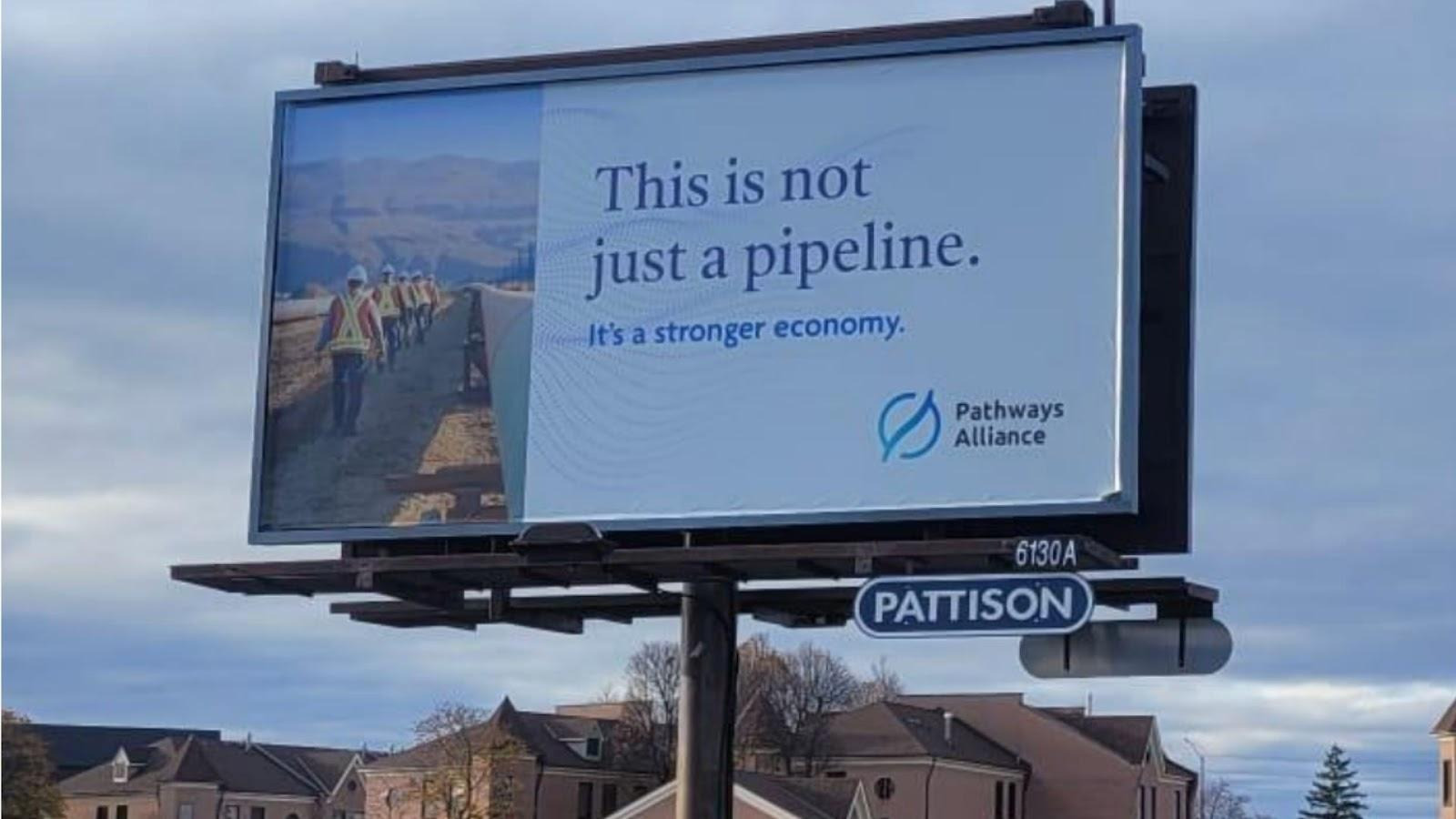
Mississauga resident urges City to rethink oil and gas ads after spotting ‘greenwashing’ billboard
“This is not just a pipeline. It’s a stronger economy.”
Mississauga resident Martin Tsvetanov was passing by Erindale Station Road in early December when he first spotted the billboard.
The advertisement, paid for by Pathways Alliance, a coalition of five of Canada’s largest oil sands producers (Canadian Natural Resources Limited, Cenovus Energy, ConocoPhillips Canada, Imperial, MEG Energy, and Suncor Energy), struck Tsvetanov as misleading.
Its message of reassurance was lost on him.
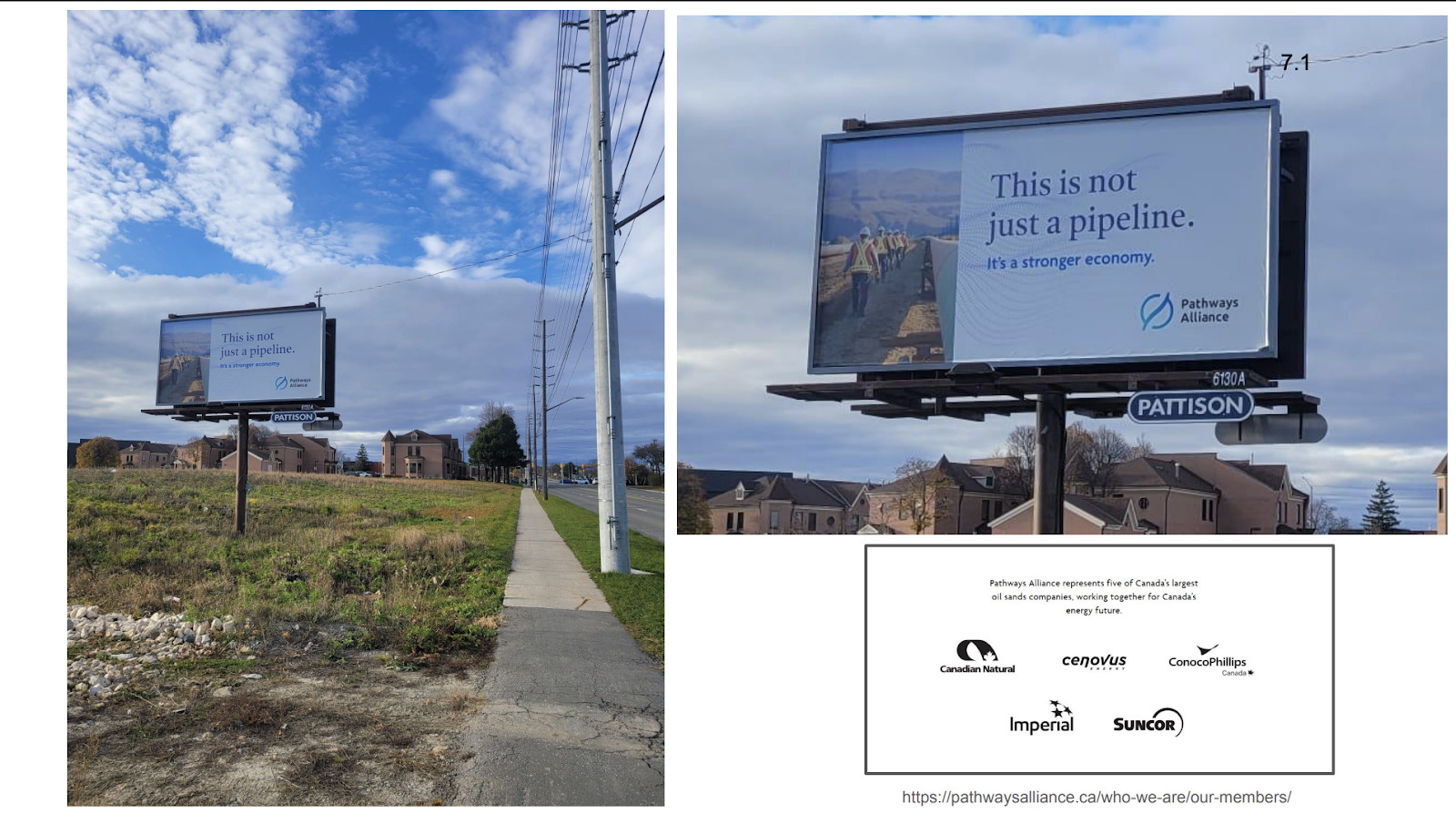
Mississauga resident Martin Tsvetanov was troubled when he saw the Pathways Alliance advertisement on Erindale Station Road between Central Parkway West and McBride Avenue.
An environmental advocate active in climate protests since his student days at The Woodlands School, he knew the ad glosses over the ecological costs of pipeline expansion while selling an economic narrative out of step with Mississauga’s own policies.
“The advertisement is a clear example of greenwashing,” Tsvetanov said at the City of Mississauga’s General Committee on January 7. He urged councillors to add fossil fuel advocacy campaigns to the City’s “list of banned advertisements”.
Although there is no explicit list, Mississauga’s Advertising and Sponsorship with the City policy governs which third-party advertising is permitted on City property and platforms.
Its criteria is clear: “The Advertising or Sponsorship does not conflict with the City’s core values, vision or strategic goals or does not adversely impact on the City’s identity.”
The policy specifies that advertising is prohibited if it “is in conflict with any applicable federal or provincial laws, regulations or standards, City by-laws or policies”.
Tsvetanov argued fossil fuel advertising fails on both counts, pointing to Mississauga’s Climate Change Action Plan, which commits the City to reducing greenhouse gas (GHG) emissions by 40 percent by 2030 and becoming a net-zero community by 2050. It was first approved in 2019, the same year that Tsvetanov booked Celebration Square to organize Mississauga’s edition of the global climate strike on September 28.
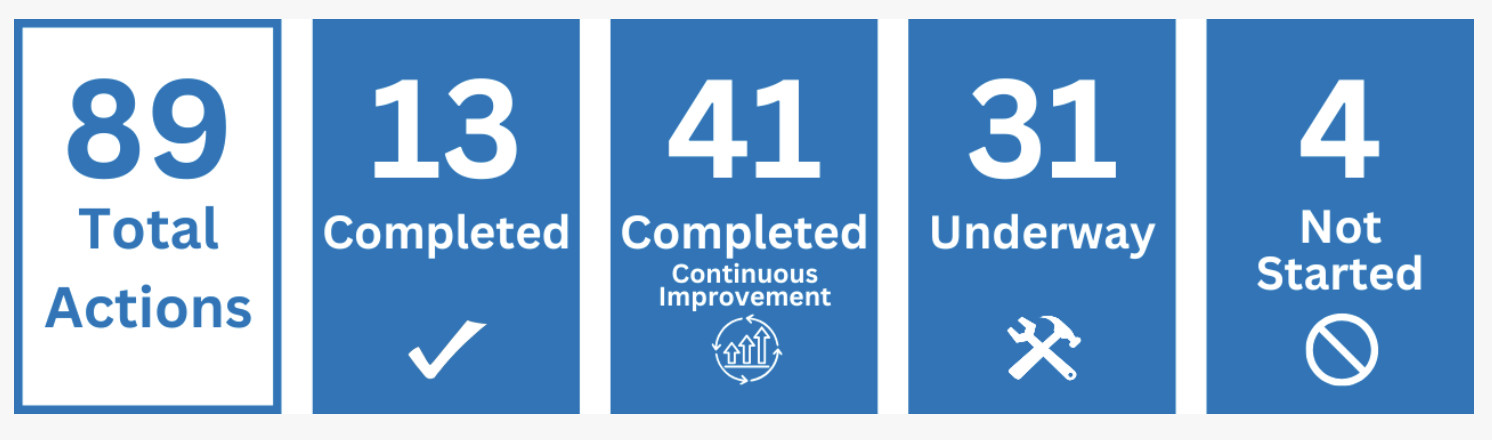
As of Winter 2024, 54 actions have been completed, including 41 continuous improvement actions, under Mississauga’s Climate Change Action Plan, with 31 actions underway.
(City of Mississauga)
In 2025, Mississauga advanced that plan to include new Green Development Standards (GDS) mandatory for new builds starting March last year, requiring renewable energy and sustainable roofs. The visionary document also included plans for hydrogen fuel cell buses, introducing flood prevention rebates, and continuing the City’s tree planting and energy efficiency initiatives designed to reduce fossil fuel use and emissions.
Provincial roadblocks to these initiatives are a separate issue. The Doug Ford administration not only dismantled green development standards through Bill 17, the Protecting Ontario by Building Faster and Smarter Act but also moved to limit provincial accountability on climate targets through its annual fall economic statement, which repealed parts of the 2018 Cap and Trade Cancellation Act, legislation that requires the government to prepare a climate plan and publicly report on progress.
In 2018, the PCs also struck down the Climate Change Mitigation and Low-carbon Economy Act, which involved provincial strategies aiming for 30 percent GHG reduction below 2005 levels by 2030, focusing on energy efficiency, sustainable transportation and protecting natural carbon sinks, efforts that relied on local municipalities and conservation authorities, whose powers have since been weakened dramatically over the last five years by the PC government; the latest move forces the consolidation of 36 CAs into seven regional bodies.
Federal climate targets remain in place.
In February 2025, Canada submitted its latest Nationally Determined Contribution (NDC) to the United Nations Framework Convention on Climate Change (UNFCCC), setting a new but modest target to reduce emissions by 45 to 50 percent below 2005 levels by 2035 while maintaining its goal of cutting emissions by 40 to 45 percent below 2005 levels by 2030.
The targets were set to decrease emissions arising from the oil and gas industry, Canada’s largest GHG-emitting sector, accounting for over 30 percent of total national emissions in 2022 and 2023.
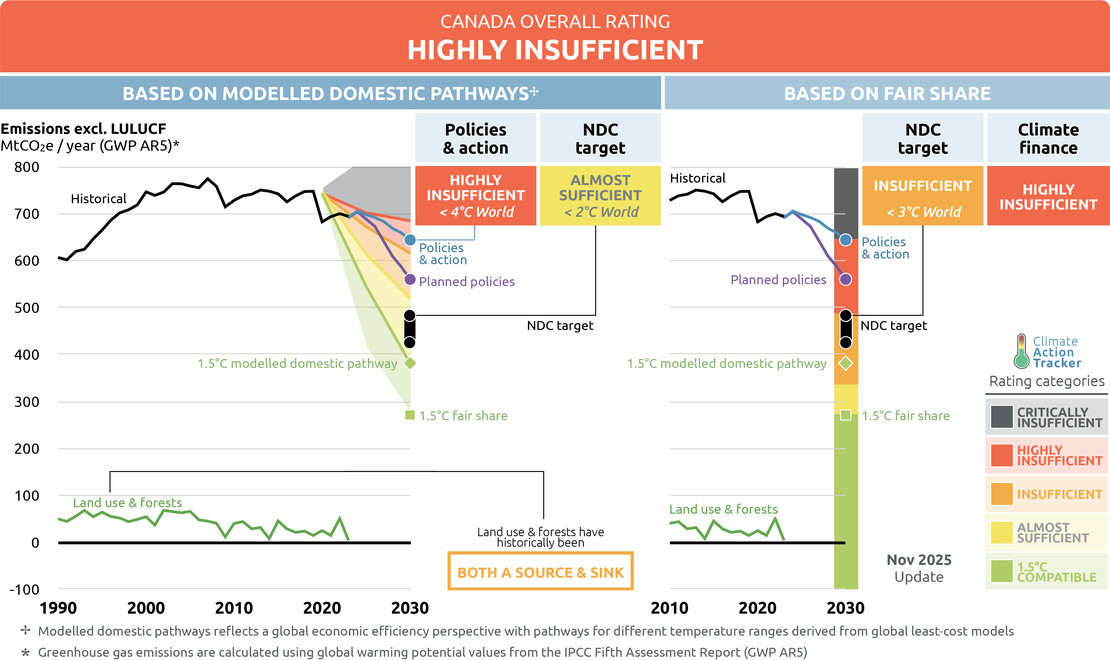
Canada has been rated as “Highly Insufficient” by Climate Action Tracker, as fragile progress on emissions is threatened by policy delays, rollbacks like the removal of the 2025 consumer carbon price tax and slow implementation of key measures such as methane regulations and emissions caps. Canada is far from meeting its 2030 and 2035 targets to avoid the 1.5-degree Celsius threshold amid intensifying climate impacts including its second worst wildfire season on record in 2025.
(Climate Action Tracker)
“Fossil fuel advertisements aim to increase the supply and therefore, the emissions of the oil and gas sector,” Tsvetanov said, noting that because the City’s advertising policy bars content that conflicts with higher levels of government policy, fossil fuel promotion is incompatible with Mississauga’s own rules.
He argued the matter falls within municipal authority, pointing to Mississauga’s Sign By-law, which states that “no person shall erect, display, alter or allow or cause the erection, display or alteration of any sign within the City on publicly or privately owned lands without obtaining a permit under this by-law”.
City staff acknowledged the policy arguments and council members appreciated Tsvetanov’s well-researched delegation, but highlighted that the current sign bylaw does not allow the City to regulate content on private signs located on private property.
“Based on our review, the Sign By-law currently allows us to review an application for a sign based on height, where it's located, setback, more planning-related issues,” City of Mississauga’s City Solicitor and Director of Legal Services Graham Walsh explained.
“We currently do not review content, particularly for a case like this, where it's a private sign on private lands. This is perhaps an approach council may consider.”
Walsh suggested that before taking any action, the municipality should first conduct “a full analysis benchmarking the legal issues” of how its role in assessing sign content would work.
Ward 6 Councillor Joe Horneck said he had “very mixed feelings” about the matter.
“It's a slippery slope to start saying yes and no to certain things,” Horneck noted.
“I worry that if you create a rule, someone will always find a way to massage the wording or images to get around that rule if it doesn't fit their need.”
Mayor Carolyn Parrish said she expects the City’s legal staff will focus on “free speech” and whether Mississauga’s bylaws conflict with current federal policies.
“It will also be the fact that the federal government is considering a pipeline, so I don't know if it goes against federal policy right now,” Parrish said, referring to the Ksi Lisims LNG pipeline in British Columbia, which was included in the second list of projects considered by the Liberal government’s Major Projects Office (MPO).
The advertisement in question is for an initiative, the Pathways Alliance plan, that is one of the MPO’s initial projects under review for potential fast-tracking.
Pathways Plus, a $16.5-billion Carbon Capture, Utilization, and Storage (CCUS) network long promoted by the Pathways Alliance, aims to build a 400-kilometre pipeline to transport captured carbon dioxide for underground storage in Alberta to curb oil sands emissions.
The proposal was added to the list despite widespread Indigenous and environmental concerns.
“To fast-track this project without a proper assessment, despite its failed track record and the serious environmental risks it poses, pipelines exploding and impacts on surrounding ecosystems, is extremely risky,” Environmental Defence’s oil and gas program manager Aly Hyder Ali cautioned.
On September 18, the Canadian Climate Institute’s Early Estimate of National Emissions (EENE) report revealed national greenhouse gas (GHG) emissions remained unchanged in 2024, holding at 694 megatonnes of carbon dioxide equivalent, the same level as 2023, a troubling reversal after years of modest declines.
Emissions from the oil and gas sector rose by 1.9 percent, driven by a 3.4 percent increase in oil sands production as Ottawa provided nearly $30 billion in direct subsidies and public financing to the fossil fuel industry.
In Prime Minister Mark Carney’s first budget, which narrowly passed on November 17, Ottawa scrapped oil and gas emissions caps and loosened anti-greenwashing regulations that had been enacted in June 2024, requiring environmental claims to be properly substantiated using internationally recognized methodologies.
The amendments added more focused anti‑greenwashing measures, giving the Competition Bureau stronger enforcement powers and allowing private parties to take legal action against misleading environmental claims.
Within months, the provisions faced constitutional challenges from industry groups, who argued the rules infringe on freedom of expression under section 2(b) of the Canadian Charter of Rights and Freedoms by placing a heavy burden on businesses to prove the accuracy of forward-looking statements.
Canada Climate Law Initiative’s Senior Policy Researcher Helen Tooze noted that courts have, in the past, made it clear that “truthful expression is not a shield for unsubstantiated commercial speech”.
“Free expression is not an absolute right,” Tooze said.
“There are circumstances where the rights of opposing parties must be considered, and a balance struck. The courts have found that the right of the consumer not to be deceived outweighs the right of the business to freely express deceptions.”
Mississauga’s legal staff is now expected to report back to the Committee by the end of the month with an analysis of the municipal government’s role, and legal issues regarding private signs on private land with a review of rules used by other jurisdictions.
Email: [email protected]
At a time when vital public information is needed by everyone, The Pointer has taken down our paywall on all stories to ensure every resident of Brampton, Mississauga and Niagara has access to the facts. For those who are able, we encourage you to consider a subscription. This will help us report on important public interest issues the community needs to know about now more than ever. You can register for a 30-day free trial HERE. Thereafter, The Pointer will charge $10 a month and you can cancel any time right on the website. Thank you
Submit a correction about this story

