
As road salt continues to wash into Peel’s waterways, CVC calls for an end to overapplication; liability a major issue
The white residue left behind shortly after a winter storm is an ordinary sight across Canada. It coats sidewalks, collects along the edges of parking lots and leaves thick deposits on roadways long after the snow has disappeared.
In Ontario, 1.5 million to 2 million tons of road salt gets applied each winter.
The sight of bare pavement after a major winter storm brings calm to drivers, especially on highways, which often see salting immediately after snow starts to fall. Safety considerations are paramount.
Local drivers and those who traverse sidewalks appreciate the use of salt to keep traffic moving and people safe.
But there are significant consequences to keeping people safe during the winter.
For the waterways along and beneath the surface across Peel, road salt is becoming an increasingly problematic threat to vital ecosystems and our water supply.
The salt spread by municipal crews and private contractors eventually finds its way into surrounding soil, stormwater systems, creeks and rivers, contributing to rising chloride concentrations that threaten freshwater ecosystems and potentially compromise drinking water sources.
Credit Valley Conservation (CVC), which has monitored water quality throughout the Credit River watershed for decades, is warning that the worsening problem needs a big policy change. The conservation authority is asking the provincial government to intervene to stop excessive salt application, particularly by private winter maintenance contractors that often over-apply to mitigate legal liability from slips, falls and accidents.
In a May 8 resolution, CVC's Board of Directors called on the PC government to introduce limited liability legislation for snow and ice management contractors, establish provincially recognized training and certification and develop standardized best management practices for salt application. It also asks the province to establish and fund an expert stakeholder advisory committee to direct municipalities and Queen’s Park on measures to protect freshwater ecosystems and drinking water from salt pollution.
The request is not for municipalities to abandon winter maintenance or leave roads and sidewalks untreated by salt. Rather, the CVC wants the province to create conditions in which contractors can apply the amount of salt necessary to maintain safety without feeling pressured to spread more than required to protect themselves against potential lawsuits.

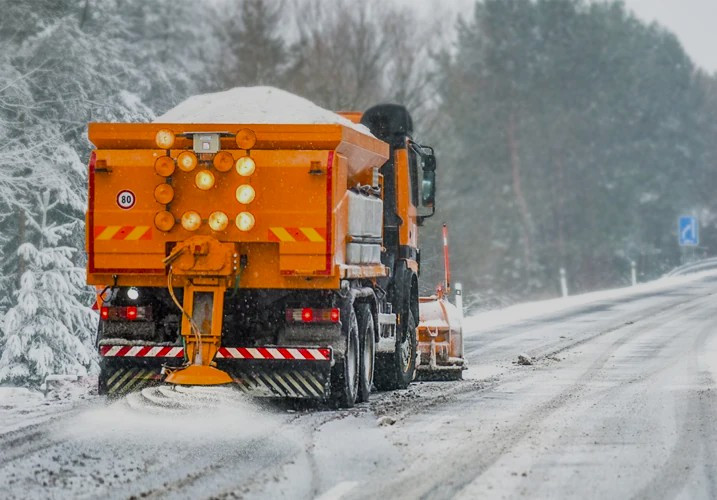
Significant amounts of road salt end up in local watersheds that are immediately harmed by the chemical pollution. (City of Mississauga)
Jennifer Doherty, CVC's senior manager of Water Quality and Stormwater Science, highlights monitoring of Peel’s watersheds for decades and the worsening impacts of road salt.
Having worked at the conservation authority for more than 20 years, Doherty has watched urban development, with its demands on winter maintenance, impact water quality. The problem, she explained, is particularly visible in heavily developed areas where extensive pavement allows winter runoff to move quickly into nearby waterways.
"What we're seeing in the industry is that a lot of salt application is happening by private contractors. And so there's local studies that show an urban monoxide up to more than a third, up to 38 percent of the salt that's applied can come from private contractors," she told The Pointer.
Those contractors, she said, are often operating under pressure to demonstrate that they have adequately treated the properties they maintain.
"I think we see this a lot when we go to private properties, such as a mall or a condo, we see there's almost like a second layer of salt that's applied. You see that all throughout the month where you're almost slipping on the salt layer versus the ice itself."
The irony is that an effort intended to prevent slips and falls can create another hazard while contributing to the environmental damage CVC is trying to address.
"And so the crux of this resolution we put forward is to advocate to the province to put forward a standard best practices and standard training that contractors can follow and have limited liability legislation in place so that if contractors follow this best practice, then they won't be exposed to the lawsuits that they're exposed to."
The concern is not limited to private contractors. Municipalities also face expectations to maintain accessible roads and sidewalks, often while balancing provincial maintenance requirements, public safety and environmental responsibilities.
The conservation authority believes changing the legal framework governing winter maintenance could help address one of the underlying reasons excessive salt continues to be applied.
Road salt has become deeply embedded in winter maintenance across Ontario. Its effectiveness, relatively low cost and accessibility have made it the preferred option for municipalities and private property owners attempting to manage snow and ice.
According to Joe Salemia, executive director of Landscape Ontario, the province accounts for a substantial portion of the road salt used nationally.
"[In] Ontario, we use 3 million [tons]. Across the country, we use about 5 million tons," Salemia said. Ontario uses about 60 percent of the total road salt across Canada but only has a little less than 40 percent of the population. Part of the reason Ontario uses so much is because of winter temperatures across much of the most populated parts of the province. Road salt is not very effective when temperatures drop below -10 degrees celsius, making it ideal across southern Ontario. In other parts of the province and the country that experience colder winters a range of different de-icing and road safety materials are used.
Landscape Ontario represents landscape contractors, nurseries and garden centres throughout the province, with more than 2,600 member companies representing approximately 30,000 employees. Many of those businesses also provide snow and ice management services during the winter months.
Salemia said the industry understands the importance of responsible salt application, but contractors are operating within a system where the consequences of inadequate winter maintenance can be dire.
Over the past four years, Landscape Ontario has been advocating for the provincial government to modernize its approach to liability, arguing that contractors should not automatically carry the burden when they have followed established procedures and fulfilled their contractual responsibilities.
"If there's a slip and fall claim, it's the contractor who's named first in that lawsuit," he said.
That fear is what influences how much salt is applied, even when contractors have access to the training and technology needed to determine the appropriate amount.
Salemia explained that professional contractors can assess pavement temperatures, air temperatures and precipitation forecasts to determine how much salt is required for particular conditions. Equipment can also be calibrated to distribute measured quantities across specific areas, allowing companies to track how much material is being applied. The fear of being held responsible for an accident can undermine the technology and the knowledge.
“I guarantee you, most of them are adding way more than they need because of that fear of liability."
For Salemia, reducing salt use without addressing the legal concerns facing contractors would create conflicting expectations.
"Now the contractor, if there's a salt reduction bill that's passed are now mandated to use less salt, however, it doesn't address the liability. So there's still a liability for slip and falls, but now they have to use less salt because they've been mandated to.
"The solution at the end of the day is only good if we're addressing the overuse of salt by combating it with addressing the liability framework together, they go hand in hand."
The same concern has been raised by municipalities and conservation authorities across Ontario. CVC's resolution follows similar calls from other jurisdictions, with Doherty identifying approximately 26 municipalities and three other conservation authorities that have pursued similar resolutions.
The issue has also been raised through the Ontario Salt Pollution Coalition, a network of environmental organizations, community advocates, politicians and grassroots groups working to persuade the province to take action.
Dani Lindamood, campaign and communications director at Water Watchers, is among those advocating for changes to how Ontario approaches winter salt use.
Water Watchers began as a small organization formed by six people responding to a local water resource concern in Wellington County. It has since grown into a network of more than 40,000 people, while the Ontario Salt Pollution Coalition has brought together groups concerned about the effects of salt on freshwater across the province.
Lindamood says the environmental consequences extend well beyond the immediate waterways receiving winter runoff.
"Salt finds its way into both groundwater and surface waters that supply our drinking water system."
She also pointed to the impact on public infrastructure, including drinking water systems, roads and bridges.
"The physical and economic impacts of salt pollution are far-reaching."
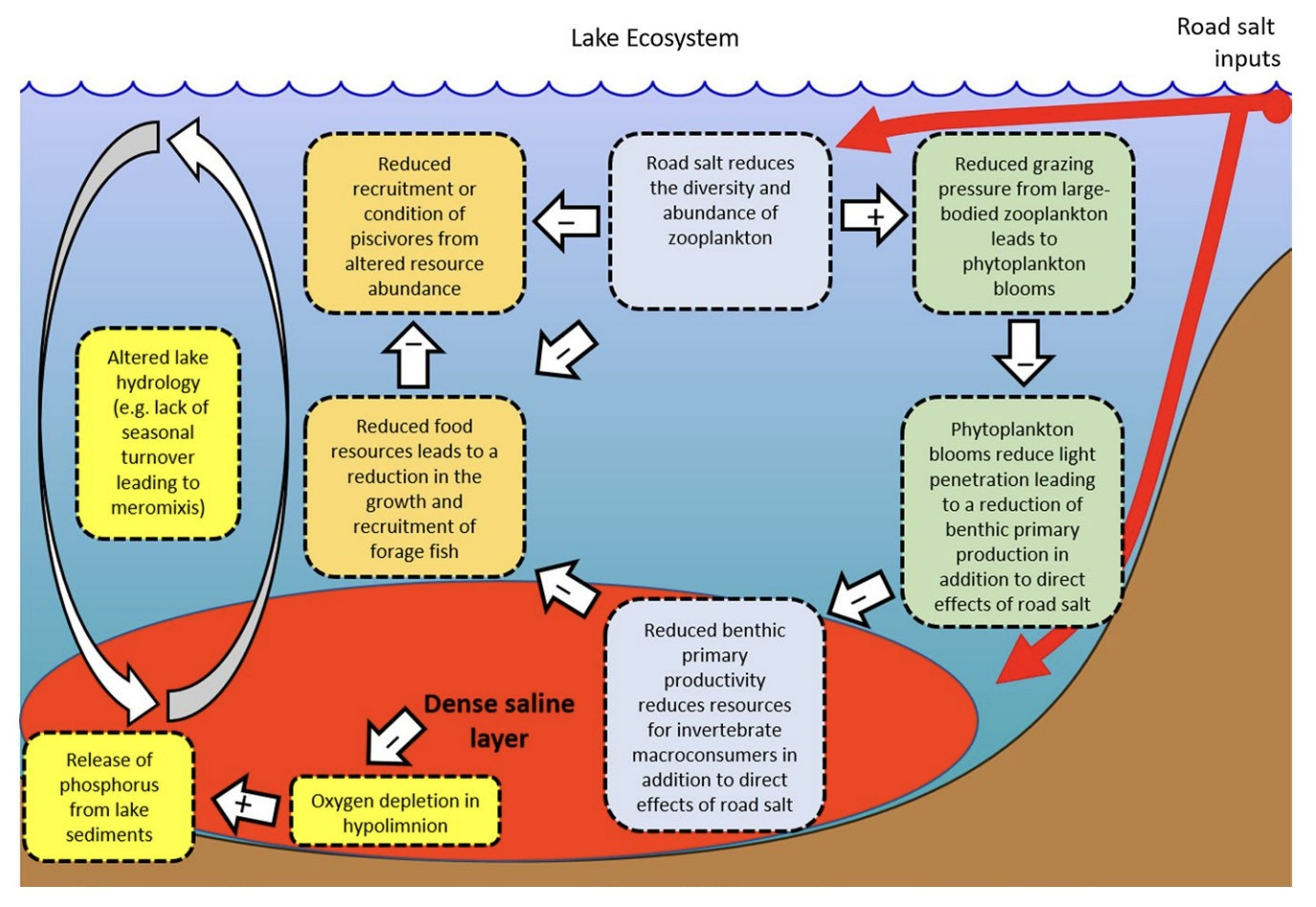
A 2018 study done by U.S.-based researchers noted that compared to rivers, streams and wetlands, relatively little is known about how road salts affect lake communities but the impacts can be severe. (William D. Hintz/Rick A. Relyea)
A previous investigation by The Pointer uncovered that in June and July 2022, when salt application is typically minimal, most of the 11 monitoring stations maintained by Credit Valley Conservation (CVC) recorded chloride levels above thresholds associated with long-term harm. Several spikes reached concentrations nearly three times higher than levels considered acutely harmful to aquatic life.
In 2001, a federal report found “high releases of road salts were having an adverse effect on freshwater ecosystems, soil, vegetation and wildlife”.
It took three years for Ottawa to release a “code of practice” to guide the public and private sectors about the optimum use of road salt while maintaining safe driving conditions during harsh winter periods. But no target or goals were ever set.
Researchers have long experimented with ways to reduce the amount of salt needed on winter roads, using different types of brine that salt is mixed into and applied before a winter storm, which then melts the snow without having to apply large road salt crystals which often bounce right into storm water drains, onto boulevards or accumulate before being carried off later and dissolving into watersheds.
Part of the solution can be found where the use of road salt began in North America: New Hampshire — a state that has since changed its practices.
In 2013, New Hampshire launched Green SnowPro, a program that provides limited liability protection to certified winter maintenance contractors and the property owners who hire them, as long as they follow best practices and are not negligent.
Contractors are required to complete training through the University of New Hampshire, pass an exam, submit annual salt use reports and maintain certification through refresher courses. Since its launch, the program has allowed participants to reduce salt usage by over 40 percent and cut operational costs.
Roads with engineered solar panels that cars can drive on are also gaining traction in research, using pipes that heat and help evaporate melted water so salt is not needed, but the technology has limited effectiveness in colder weather.
For more than a decade, Rhode Island has used a salt-water solution applied before snow falls, which has dramatically reduced the amount of salt on roads. But, again, the effectiveness of various approaches depends on the specific weather conditions of an area.
Different types of pavements that require less salt to keep them bare, are also being experimented with around the world, and are being used in jurisdictions where the weather conditions allow for less road salt use (road salt is used in cold places globally, with the U.S. applying about 20 million tons annually, followed by Canada at about 3.5 million to 5 million tons, depending on the particular winter conditions, with no other nation using close to that amount).
The concern in not taking action is particularly significant because chloride does not simply disappear when winter ends. Once salt enters the environment, it can remain in groundwater and surface water, contributing to an accumulation that becomes increasingly difficult to reverse.
The federal government's 2001 Priority Substances List Assessment Report for Road Salts, prepared by Environment Canada and Health Canada, identified environmental risks associated with the release of road salts. The assessment concluded that sufficiently high concentrations posed risks to plants, animals and aquatic environments.
In 2004, the federal government introduced its Code of Practice for the Environmental Management of Road Salts, recommending that road authorities develop salt management plans and adopt better practices for application, storage and snow disposal.
The code was intended to reduce environmental harm while maintaining roadway safety. It did not call for a complete ban on road salt. More than two decades later, the problem remains a concern for conservation authorities monitoring freshwater systems.
The Canadian Council of Ministers of the Environment has established chloride guidelines of 120 milligrams per litre for long-term exposure and 640 milligrams per litre for short-term exposure to protect aquatic life.
Doherty said these are the benchmarks CVC uses when evaluating chloride concentrations in the watershed. However, she stressed that concentrations below those thresholds do not necessarily mean a waterway is experiencing no environmental pressure.
Many local waterways naturally have much lower chloride concentrations, sometimes around 20 milligrams per litre. Aquatic organisms living in those environments have adapted to those conditions, meaning substantial increases can place additional stress on species even before concentrations reach the national guideline thresholds.
For the CVC, understanding those changes requires consistent monitoring over time, rather than looking at individual measurements in isolation.
The effects of road salt are not always immediately visible to residents. Unlike pollution that creates an obvious discolouration or smell, elevated chloride concentrations can quietly change the conditions that freshwater organisms depend on.
Doherty explained that heavily developed urban watersheds, including Cooksville Creek in Mississauga, are particularly vulnerable because of the amount of pavement and other hardened surfaces surrounding them. When snow melts or precipitation falls, water moves across those surfaces, collecting contaminants before entering stormwater systems and nearby creeks.
Salt is only one of several contaminants that can be carried through urban runoff, but its persistence makes it particularly concerning. The consequences can extend throughout the food chain. Freshwater species have adapted to particular chemical conditions, and increasing salinity can favour organisms that tolerate salt while placing others under pressure.
Lindamood said even microscopic organisms can play an important role in determining the health of an entire ecosystem. Aquatic microorganisms, including plankton, form an important foundation of freshwater food webs. Changes to their populations can affect the organisms that depend on them, creating consequences that extend to larger aquatic species.
The problem also involves how salt changes the physical conditions within lakes.
Doherty explained that saltwater is denser than freshwater, meaning higher concentrations can settle into deeper layers instead of mixing evenly throughout a lake. That process can interfere with the natural mixing of water, affecting oxygen distribution and the movement of nutrients.
The CVC has also identified a connection between these conditions and the movement of phosphorus in lake sediments. When salt-laden water interacts with sediments at the bottom of a lake, phosphorus can be released into the surrounding water. The nutrient can then become available to algae, potentially contributing to increased growth under suitable conditions.
Doherty said the timing of this process matters, particularly when salt accumulated during winter reaches waterways during warmer spring conditions. When elevated chloride concentrations persist into the warmer months, conditions can become more favourable for algae growth.
The consequences are not restricted to aquatic organisms.
The CVC additionally identified impacts along roadways, where salt spray and runoff can affect vegetation, soils and the habitats used by wildlife.
Doherty explained that roadside ditches and buffer areas can act as pathways for animals moving throughout the watershed. However, when salt accumulates in those areas, it can create conditions that are difficult for native vegetation and wildlife to tolerate.
Salt can also affect the ability of plants to grow back, creating opportunities for more salt-tolerant species, including invasive plants such as common reed, or Phragmites, to establish themselves.
These changes can gradually alter the composition of local habitats.
For Behnam Doulatyari, CVC's senior manager of Watershed Plans and Source Water Protection, the long-term accumulation of salt is particularly concerning due to impacts on groundwater. While the effects vary depending on local conditions, continued salt inputs can increase chloride concentrations in groundwater systems over time.
Doulatyari cautioned against making sweeping claims about the future of municipal drinking water supplies, noting that impacts depend on the characteristics of individual groundwater systems and water sources.
However, the potential consequences need to be addressed.
Within the Credit River watershed's source protection region, salt-related drinking water concerns have already been identified in Orangeville and Halton Hills.
Under Ontario's Clean Water Act, activities that contribute to identified drinking water threats can be subject to risk management requirements. This can include the storage and handling of road salt.
Doulatyari explained that legally binding risk management plans can be negotiated between municipal risk management officials and property owners to address activities that threaten drinking water sources.
But he said these measures do not necessarily address the broader incentive to overapply salt.
"The incentive and the bare pavement requirements sort of eliminates the benefit that you will get from the salt management plan for the reduction, because they still have those requirements to meet for their liability."
The concern is that even when private properties have measures in place to manage salt, the broader pressure to maintain completely clear surfaces can undermine those efforts. Once chloride enters the environment, removing it is difficult. The longer it accumulates, the more complicated the challenge becomes.
Email: [email protected]
At a time when vital public information is needed by everyone, The Pointer has taken down our paywall on all stories to ensure every resident of Brampton, Mississauga and Niagara has access to the facts. For those who are able, we encourage you to consider a subscription. This will help us report on important public interest issues the community needs to know about now more than ever. You can register for a 30-day free trial HERE. Thereafter, The Pointer will charge $10 a month and you can cancel any time right on the website. Thank you
Submit a correction about this story

