
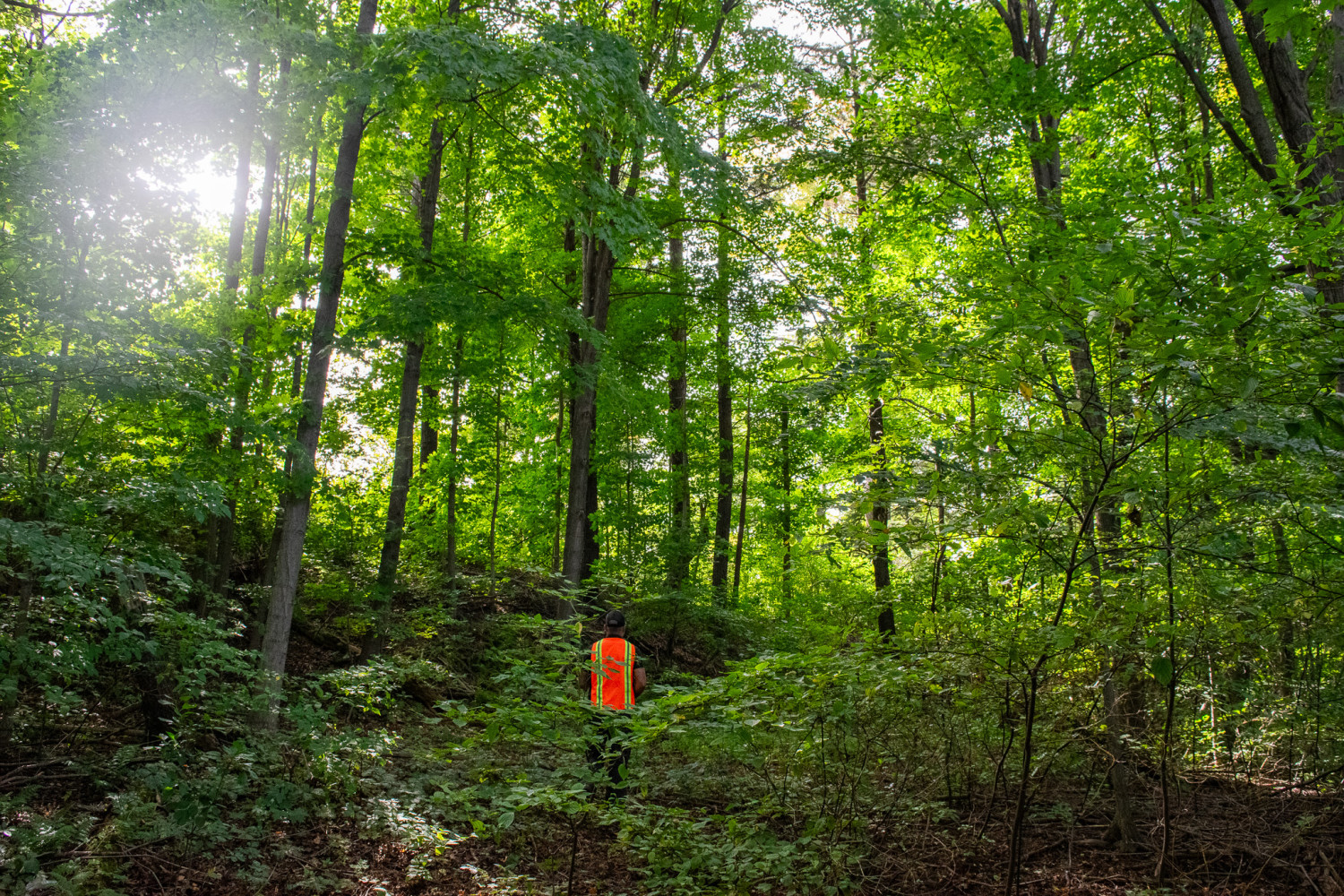
‘It’s an ecosystem’: Inside the Caledon woodlot teeming with life set to be cleared for Highway 413
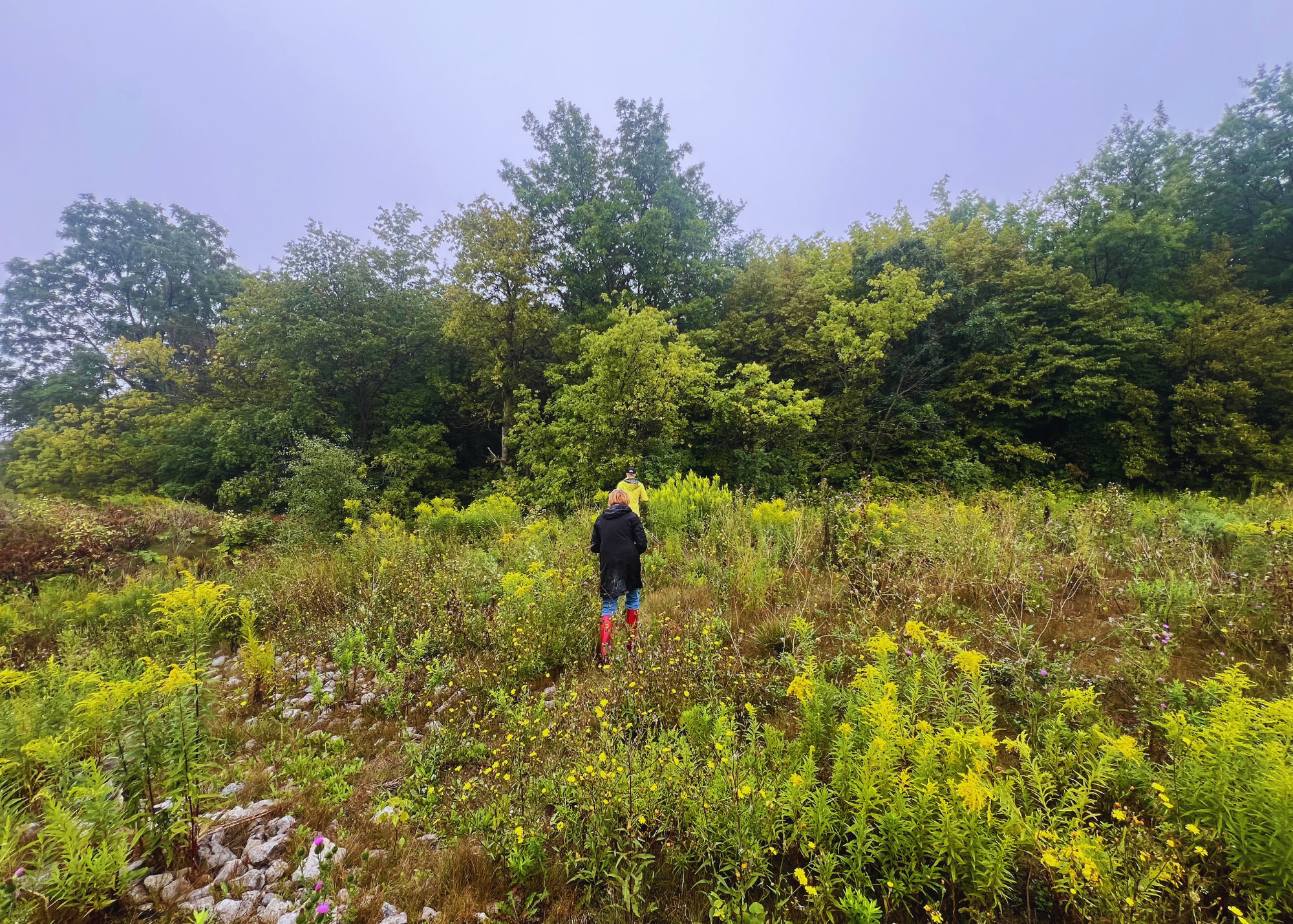
With raindrops dancing off their raincoats, Sharon Sommerville and Mike Marcolongo stood at the edge of a green Caledon woodlot on a dark, foggy morning. The loud chatter of Blue Jays and Chickadees echoed through the canopy they were about to enter—which could soon disappear to make way for Highway 413.
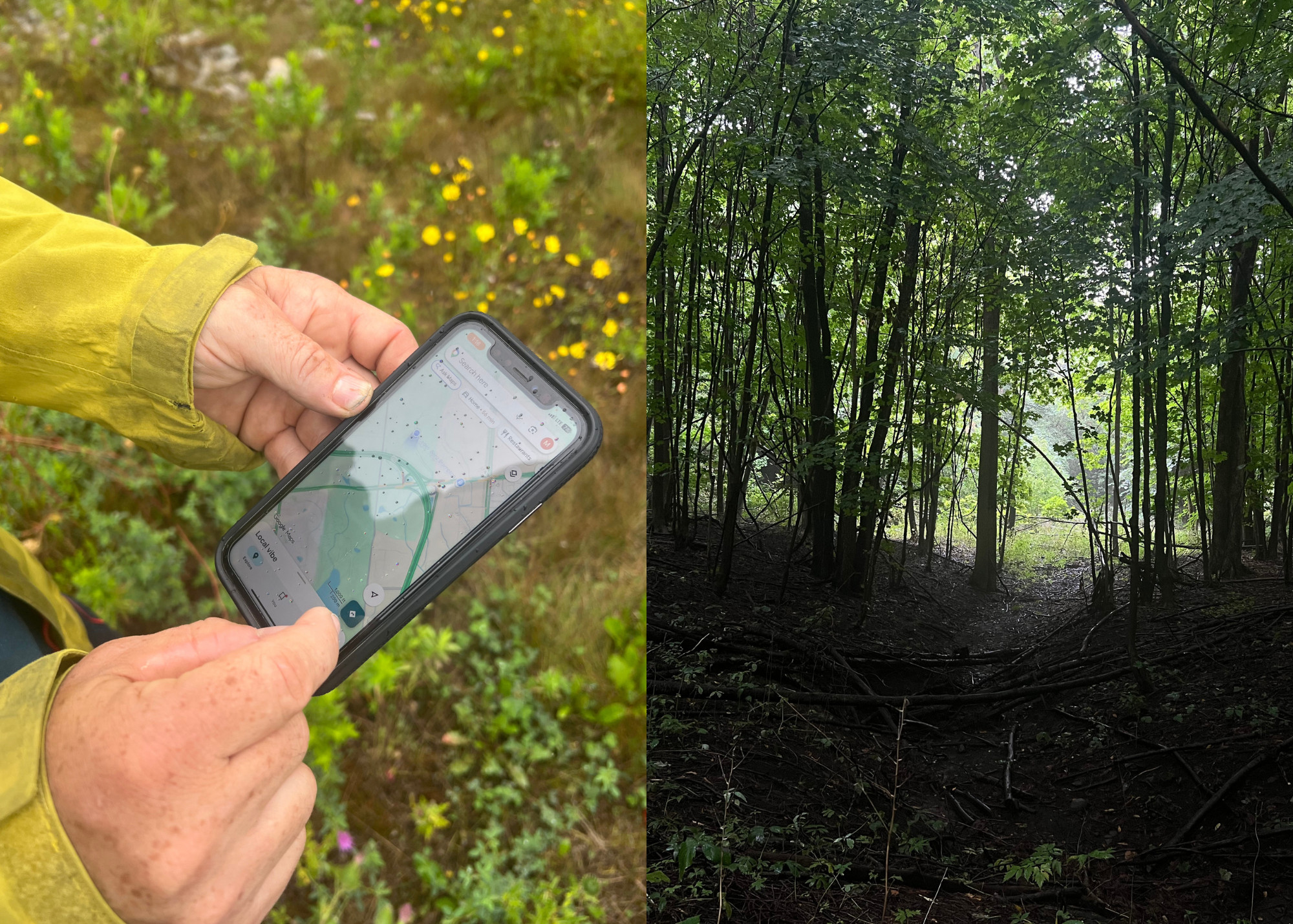
The flow of vehicles on Highway 410 sent a low, constant hum through the trees as Marcolongo studied Google Maps on his phone, trying to locate a creek he had seen referenced in documents obtained by Environmental Defence and Ecojustice through an access-to-information request from the Department of Fisheries and Oceans (DFO).
Just as he identified the way to get to the creek, an email popped on the screen: Ontario Transportation Minister Prabmeet Sarkaria was scheduled to deliver remarks and hold a media availability in Caledon the following morning.
“I bet it’ll be about the 413,” he said, putting his phone back in his pocket.
His inclination would be right.
As they stepped through the tall wall of green, branches creaking with every footstep, the forest unravelled itself tree by tree, plant by plant—many of the trees were marked with numbered tags and coloured tape, signs that the province had already been studying the woodlot and cataloguing the species within it before clearing could begin.
“That’s an elm. And then you’ve got ash, manifold maple, walnut, basswood, the North American beech tree and here’s a cherry,” Environmental Defence Canada’s Associate Director, Marcolongo, said on August 31, pointing at each one by one.
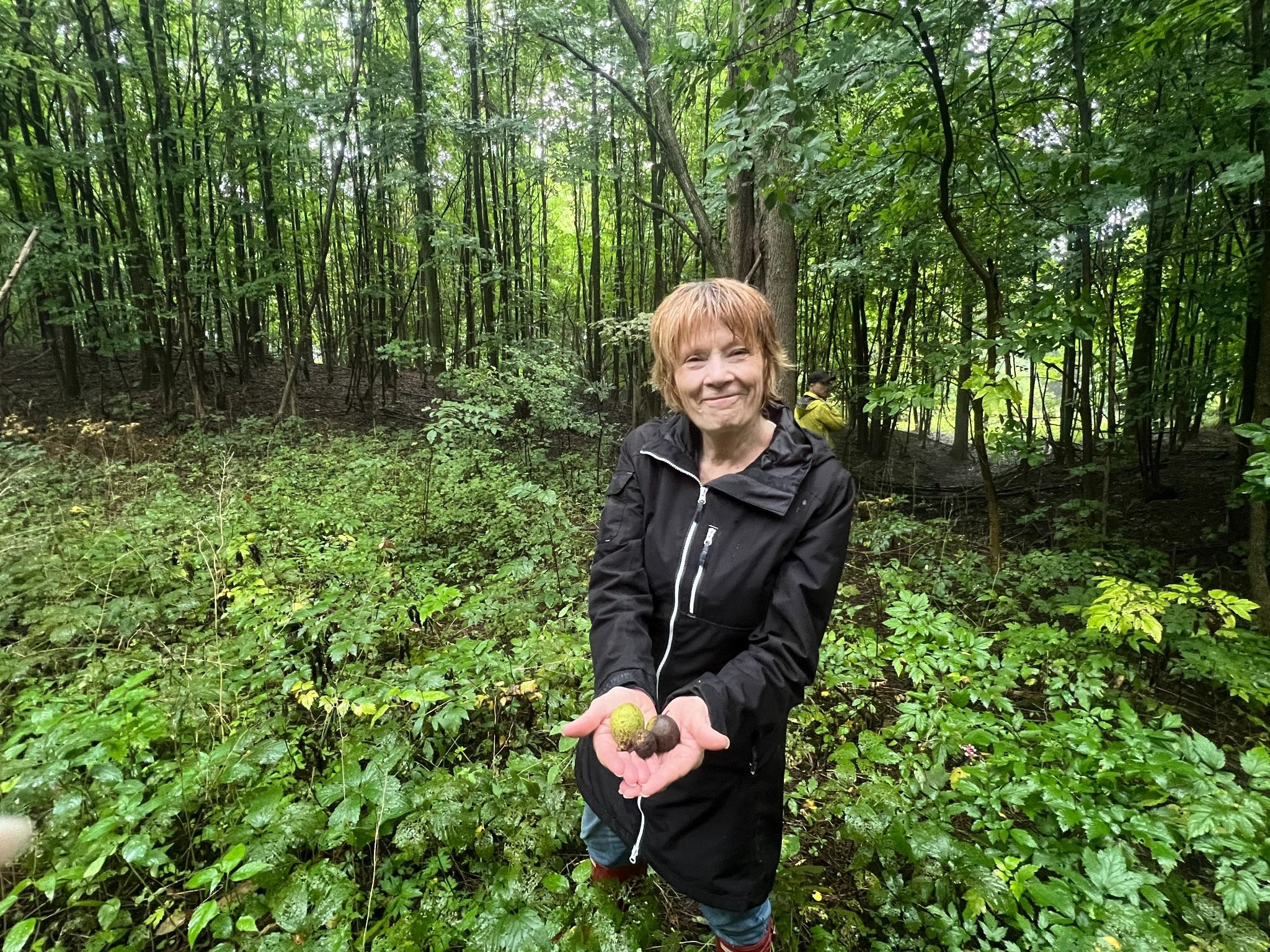
Caledon resident Sharon Sommerville holding walnut and butternut in a woodlot that will be cleared to make way for Highway 413 construction once federal permits are received. (Anushka Yadav/The Pointer)
Sommerville, a member of the citizens’ group Headwaters Stops the 413, scanned one cherry tree from top to bottom, “amazed” at the sheer size of the tree.
When she thought of cherry trees, she pictured the cultivated fruit trees found in gardens and orchards. This was different: a native tree, growing wild in the Carolinian forest.
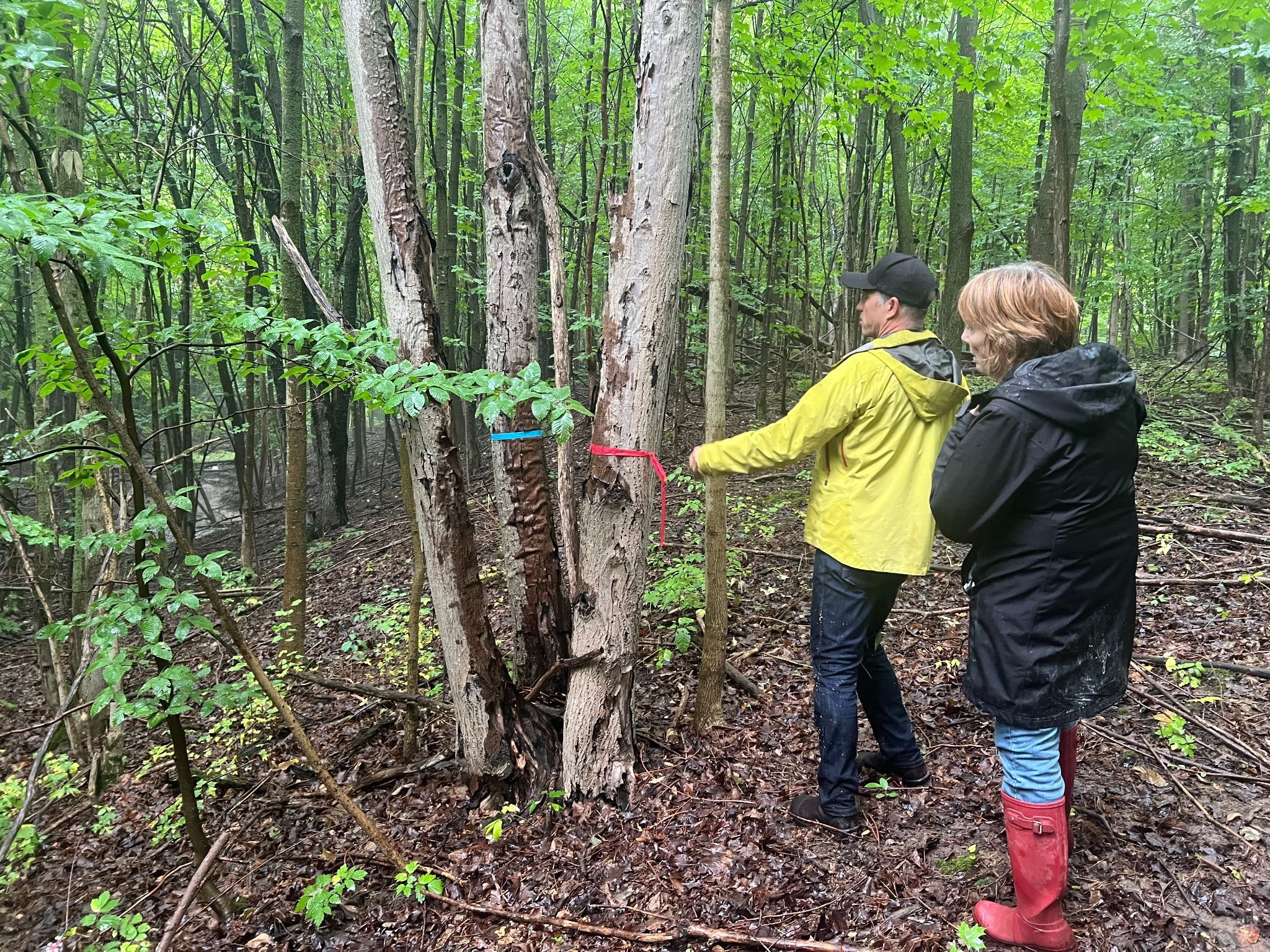
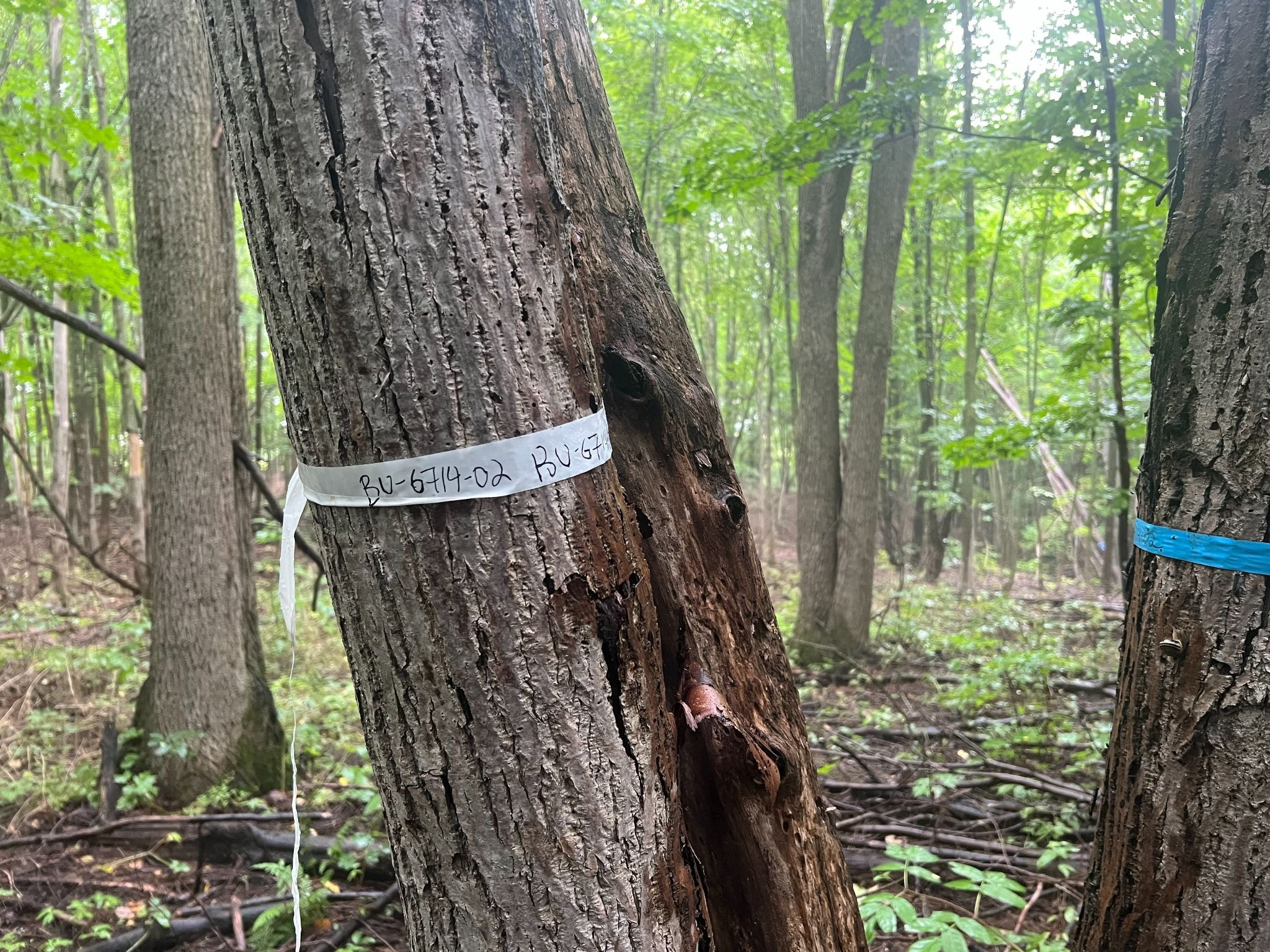
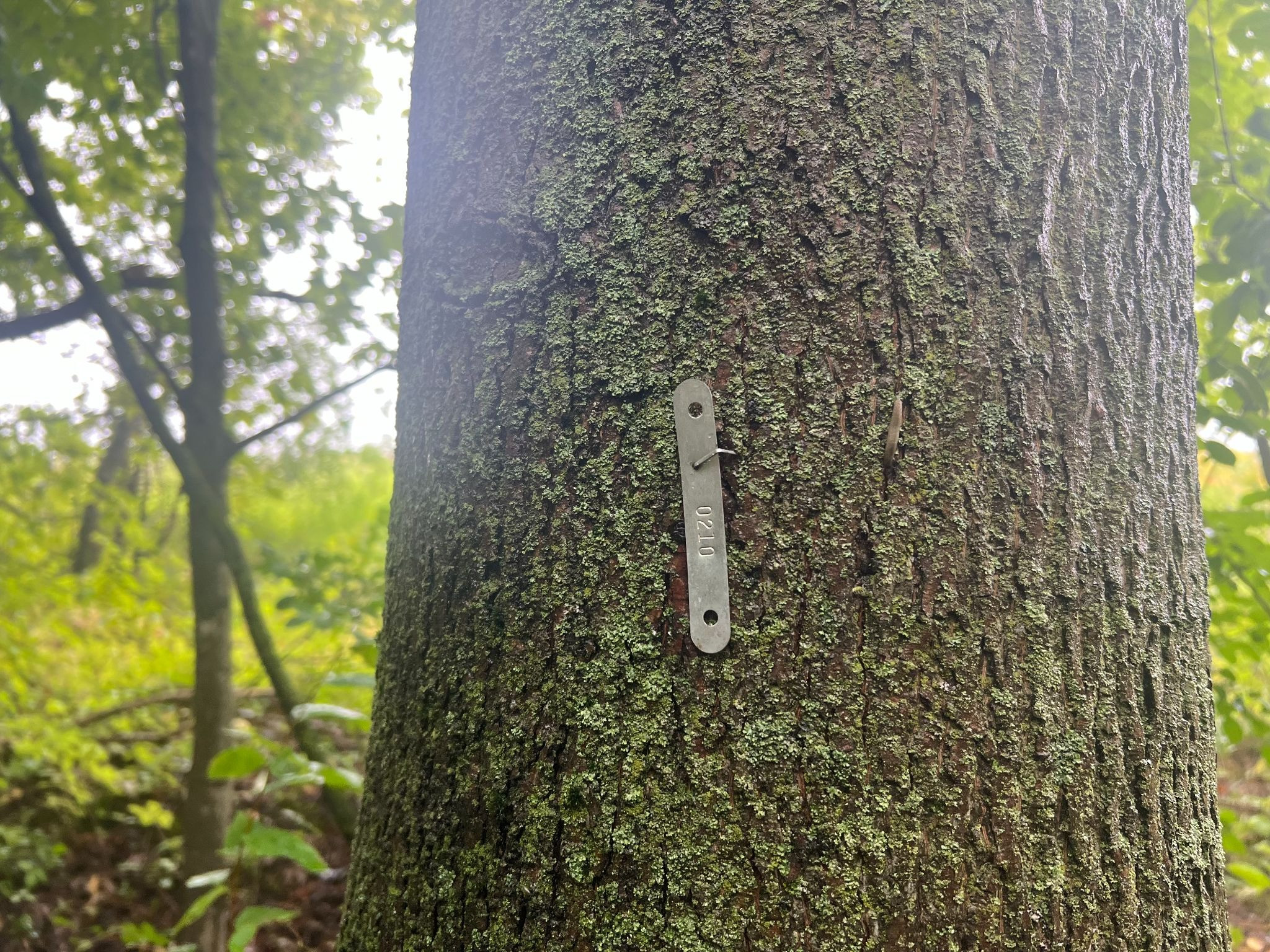
Silver tags can indicate trees inspected by arborists, assigned a number for work scope and assessed for health, species and retention value before development can begin. (Anushka Yadav/The Pointer)
Just as she was admiring the treasures of nature, Marcolongo stopped to reveal an unexpected discovery…
“That’s a butternut!,” he exclaimed.
Excitement for just a tree?
Not just any tree—an endangered species.
Butternut trees were designated as endangered federally in 2003 and in Ontario by 2008.
Much like the unchecked destruction of the natural world is hollowing out humanity’s future, a deadly fungus is slowly eating away at the butternut’s own existence.
Commonly known as butternut canker, the disease is caused by an invasive, non-native fungus that attacks the tree’s bark and cambium layer, disrupting the flow of water and nutrients. As the infection spreads, it can girdle branches and trunks, weakening and eventually killing the tree.
So, finding one healthy butternut tree in a 6.16-hectare (15.2-acre) provincial woodlot that could be cleared for Highway 413 was no small discovery.
But the number only grew as they started counting…
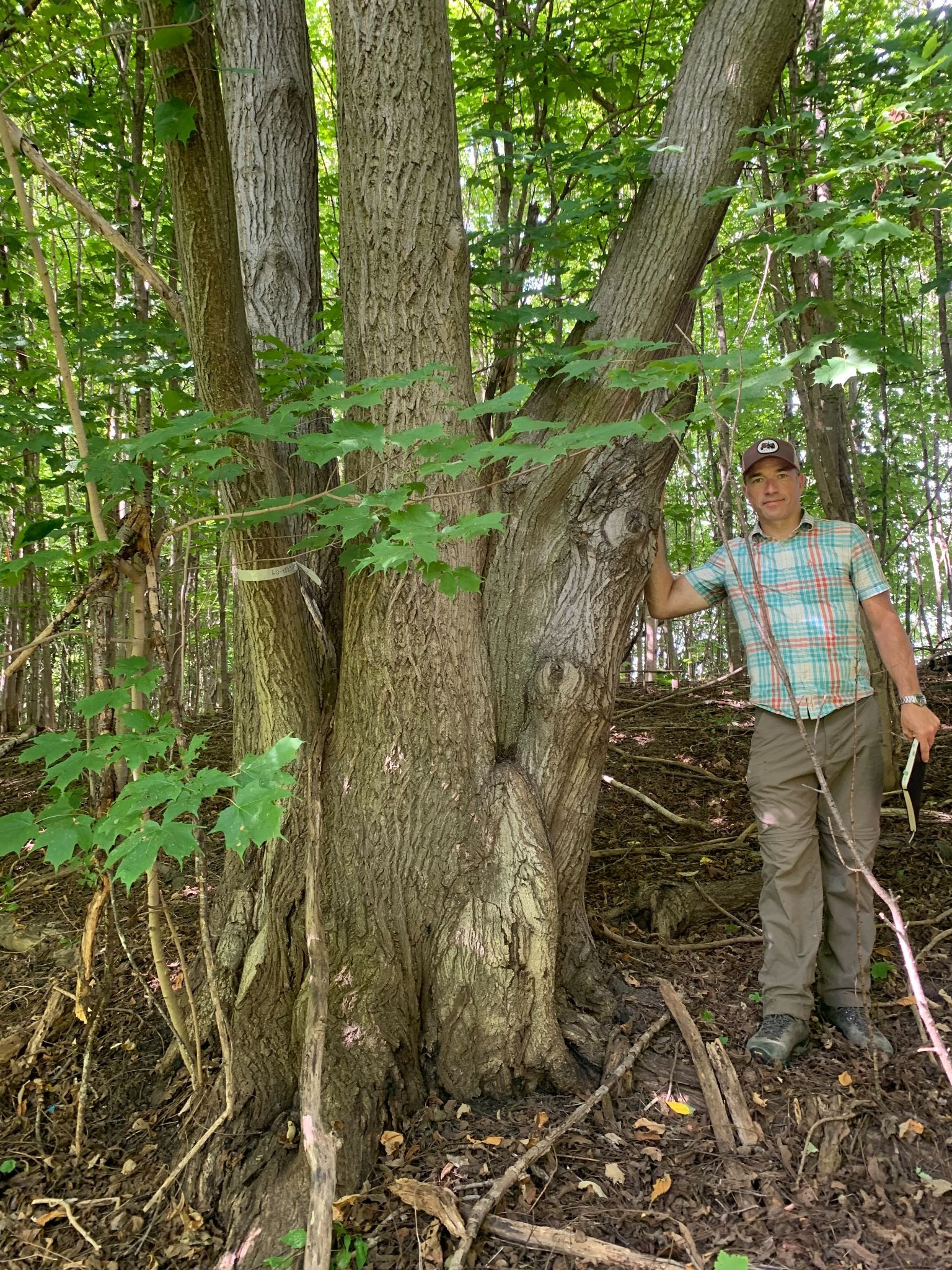
On September 8, Environmental Defence’s Mike Marcolongo made another visit to the Caledon woodlot with a forester that led him to find a “very large Butternut in healthy condition”. (First Photo: Supplied/Mike Marcolongo, Second Photo: Alexis Wright/The Pointer)
Through documents received by Environmental Defence via an Access to Information and Privacy (ATIP) request, MTO's own consultant confirmed that there are close to 80 butternut trees in the woodlot. On a short site visit, Marcolongo easily pointed out fifty butternuts in the woodlot, an unusually high concentration that speaks to the rare and favourable conditions the site provides for the species.
“What's interesting is, it's not the most mature forest. It's been logged probably 40 years ago,” he noted.
“But it seems like this must be one of the highest clusters of butternuts in southern Ontario. The woodlot, I imagine, would be a great candidate for restoring the endangered butternuts in Ontario.”
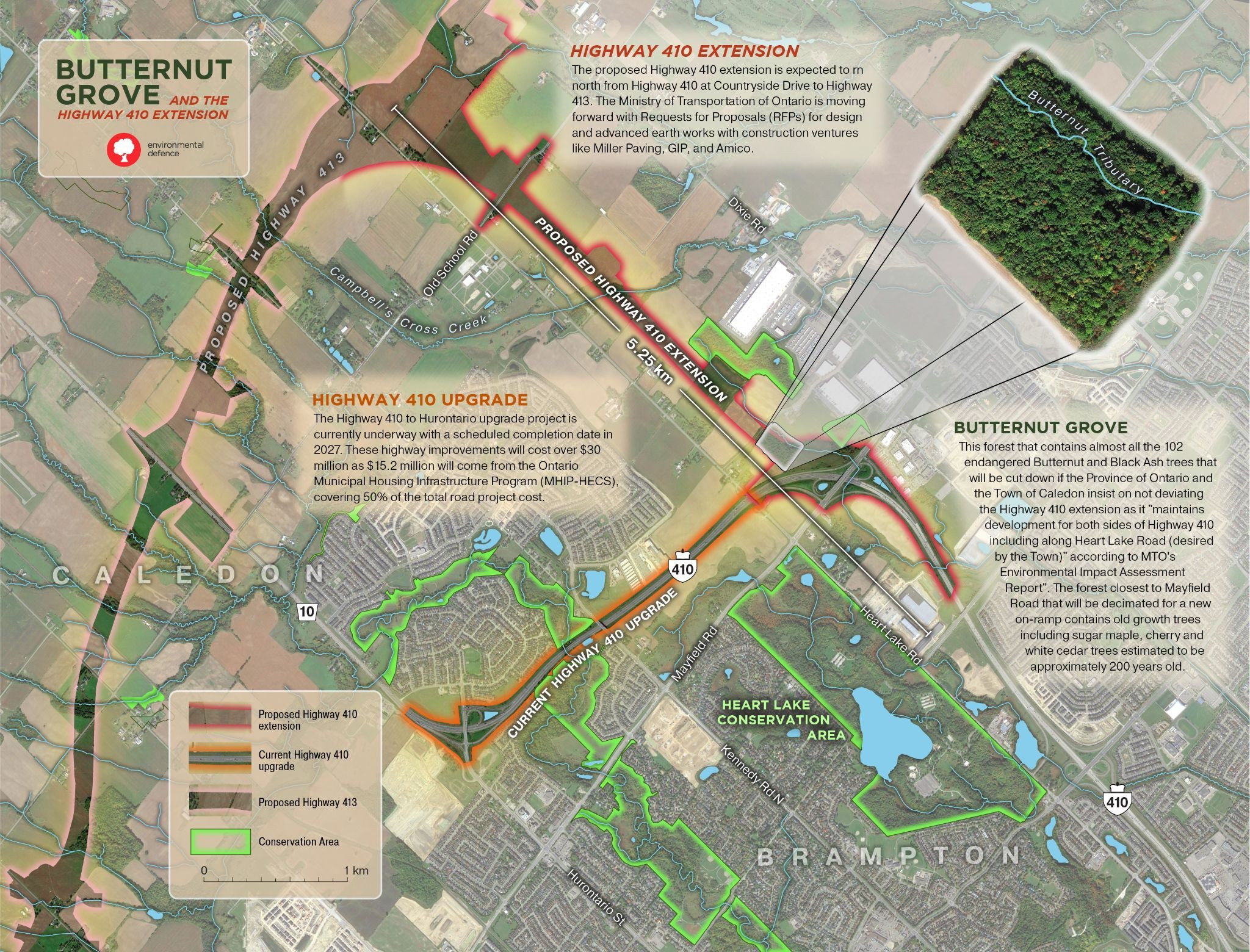
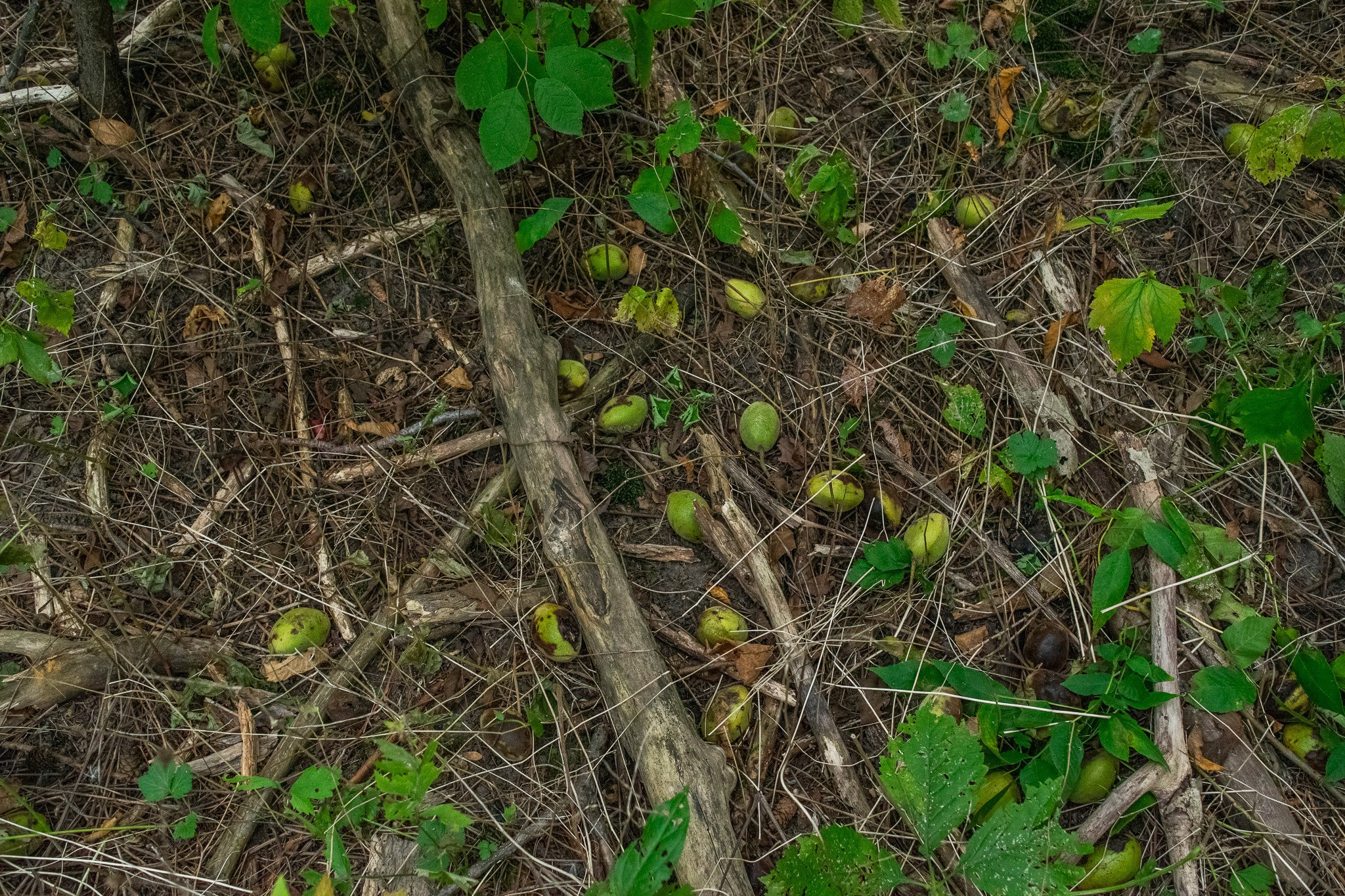
Environmental Defence initially estimated there are between 40 and 50 butternut trees scattered throughout the woodlot but documents obtained from the Ministry of Transportation revealed the number was much higher. (Graphic: Environmental Defence, Photos: Alexis Wright/The Pointer)
As Sommerville continued walking, she noticed another sign that the woodlot’s history may stretch far beyond the highway plans now hanging over it: trees that appeared to have been deliberately shaped into an L, their trunks bending sharply before rising again.
“This may be evidence of First Nation use,” she said.
Historically, trail-marker trees were deliberately bent as saplings by Indigenous peoples to mark paths through the forest, point travellers toward waterways or settlements, or identify places of significance.
Unlike a blaze cut into bark, a bent tree could serve as a living signpost for generations to come.
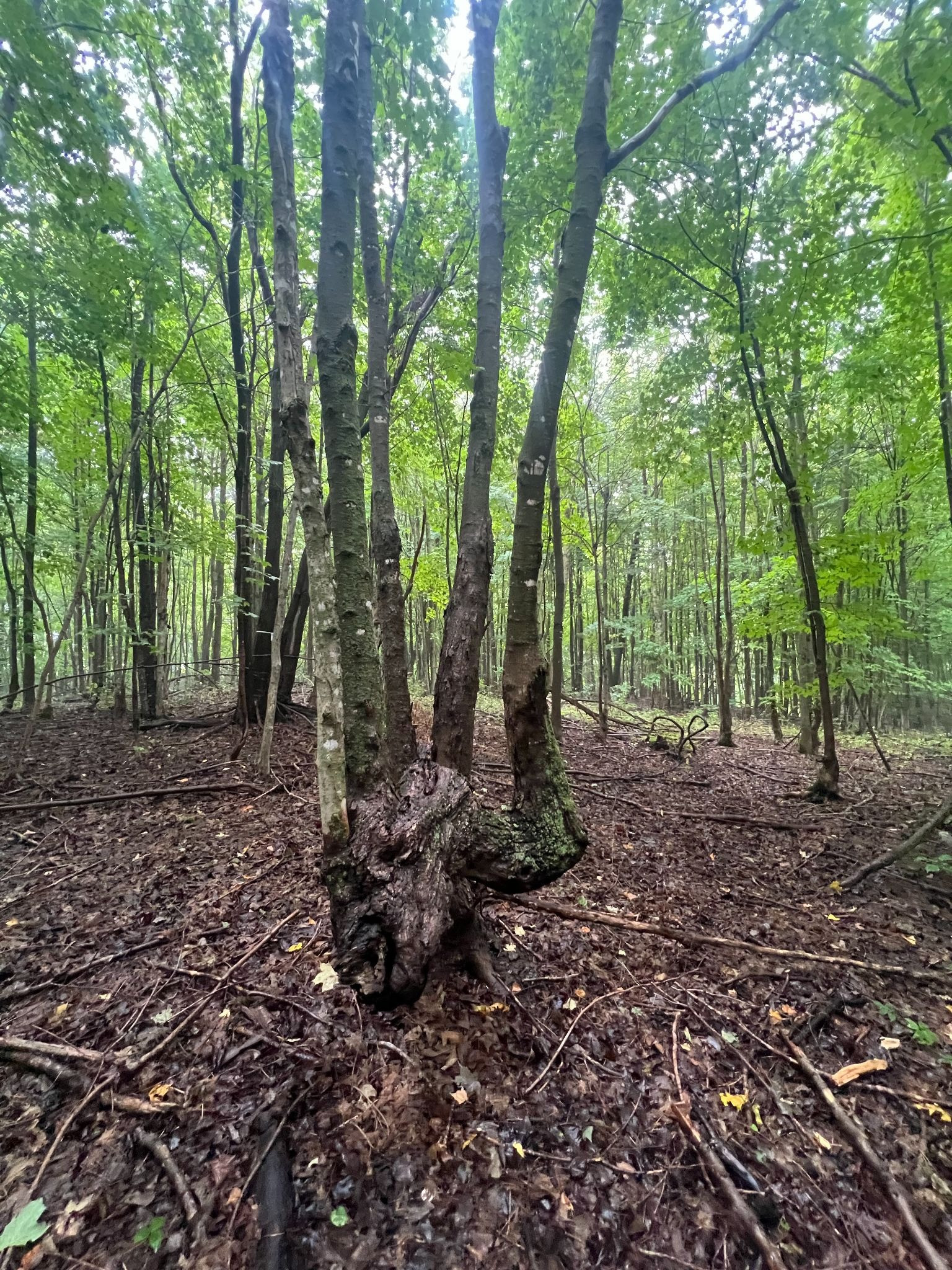
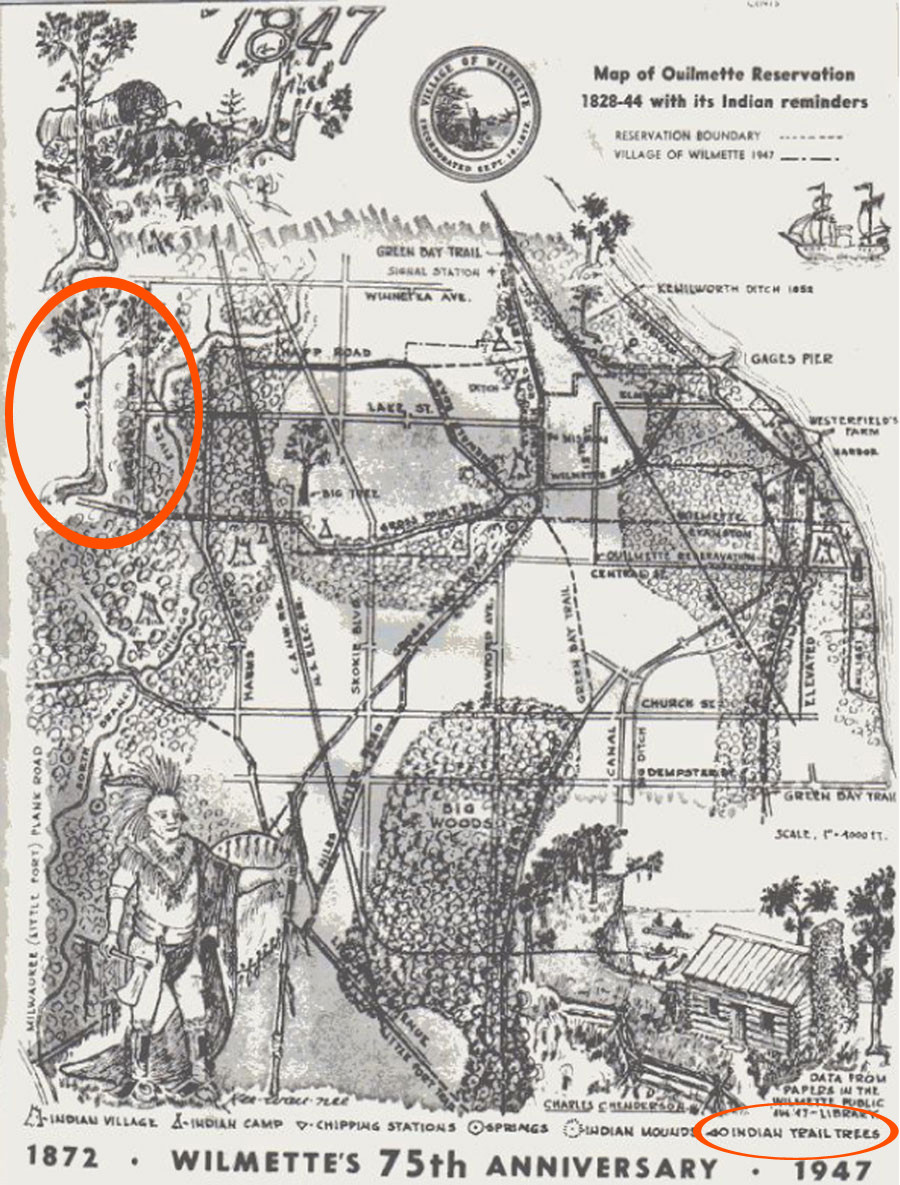
The first record of trail marker trees appeared in a document called Map of Ouilmette Reservation with its Indian Reminders dated 1828–1844. (First: Anushka Yadav/The Pointer; Second: Map of Ouilmette Reservation/Ottawa Rewind)
The practice has been documented in parts of the Great Lakes region, although the origins of individual bent trees can be difficult to establish with certainty. Many experts contend natural forces, disease and other human activity can also create similar, unusual shapes.
Soon, something else caught her eye; tucked beneath the canopy was a plant dotted with strange, white berries, each one marked with a dark spot in the centre.
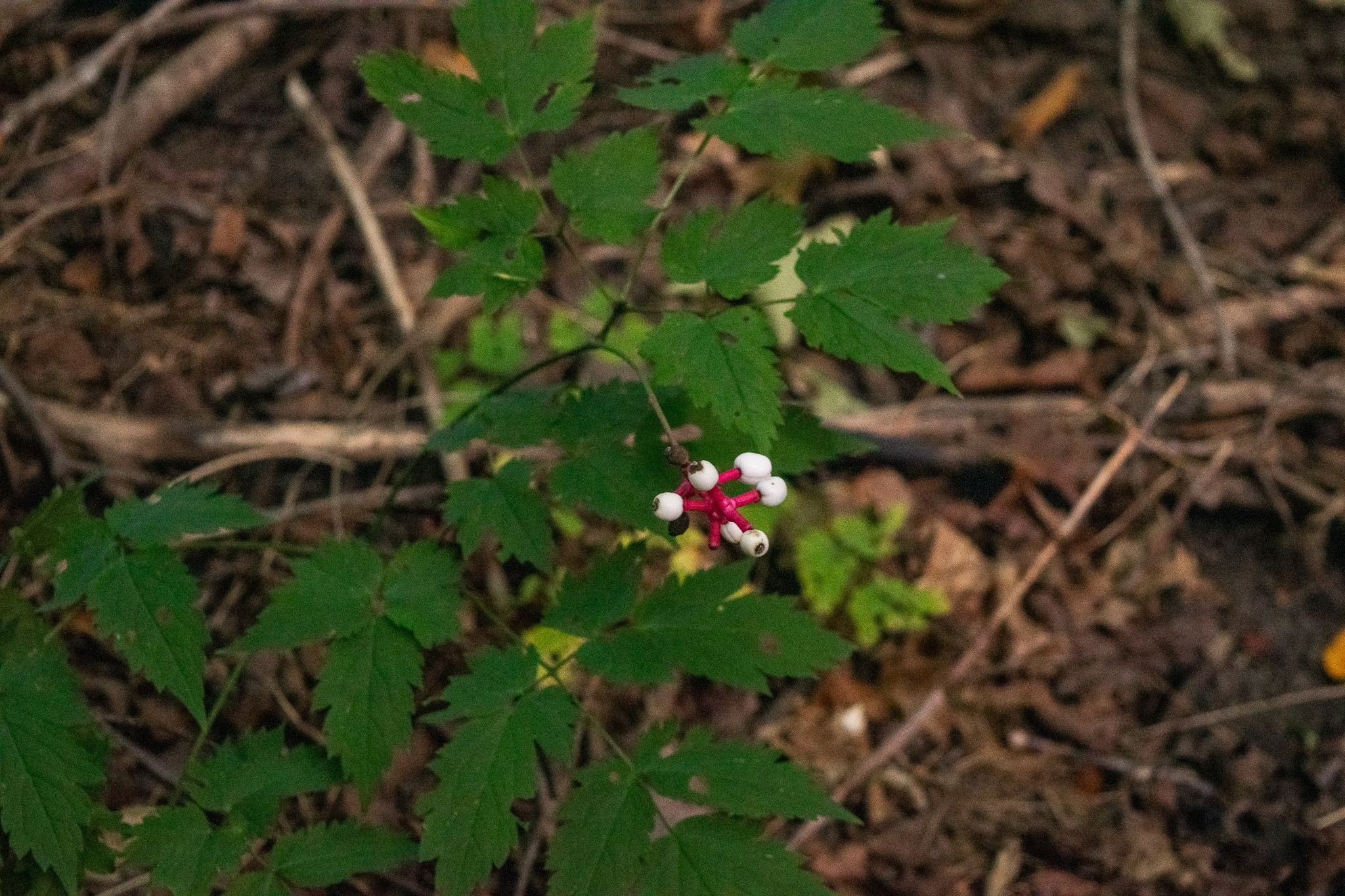
White baneberry or doll’s eyes is native to eastern North America, eastern Canada, and the Midwestern and Eastern United States. (Alexis Wright/The Pointer)
“Doll’s eyes,” Marcolongo identified.
That’s another name for white baneberry, a native woodland perennial, whose berries resemble tiny eyeballs and can grow up to three feet tall in the cool, shaded conditions of rich forests and ravines. While the plant is toxic to humans, some birds and native pollinators can eat the berries or visit the flowers safely.
There was another plant that shared that similar feature and one that Marcolongo remembered spotting in another direction: clusters of bright red berries belonging to Jack-in-the-pulpit.
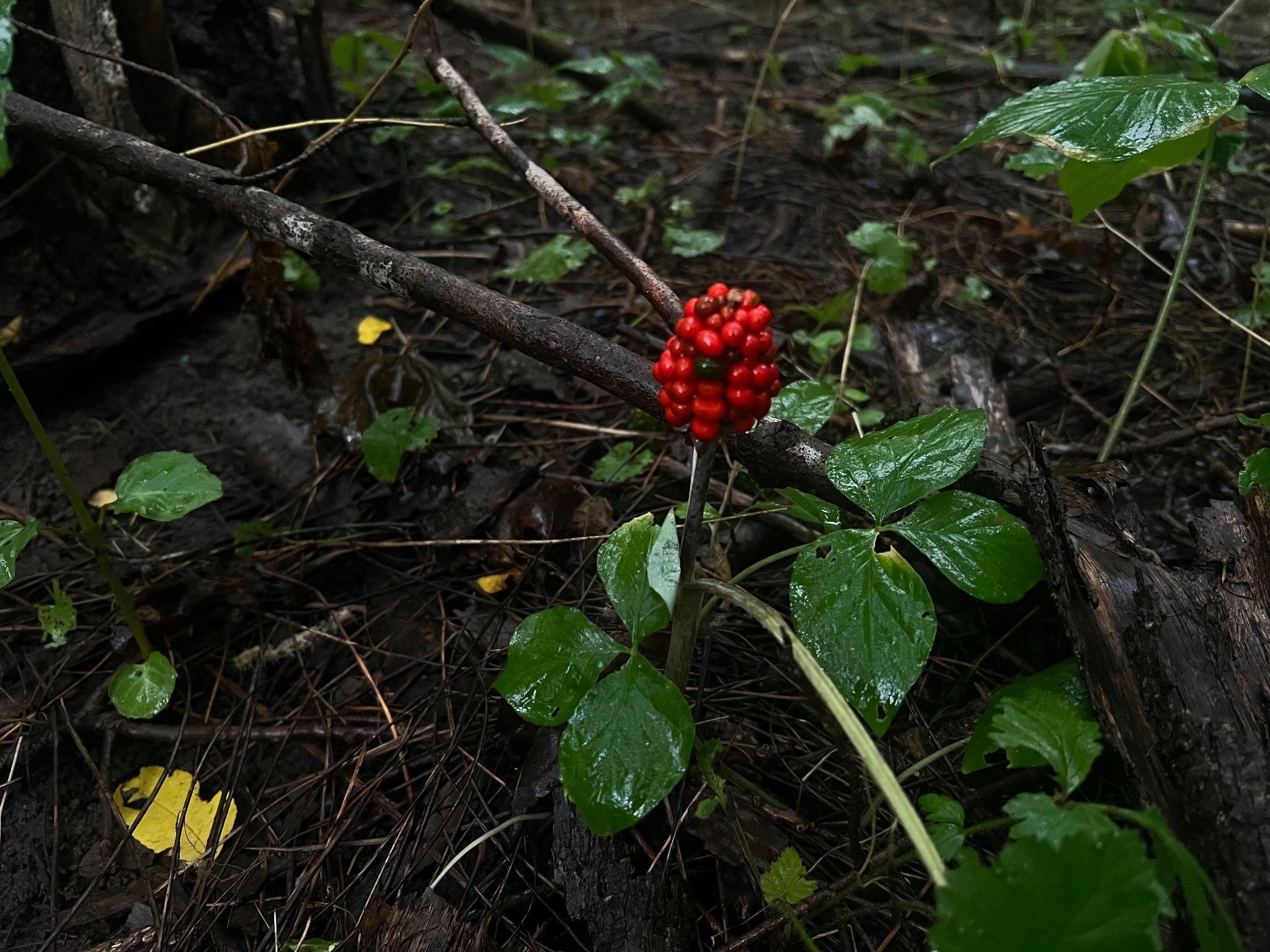
Jack-in-the-pulpit has a long history of Indigenous use including as a traditional medicine for ailments such as bronchitis, rheumatism and snakebite. While the plant is poisonous when eaten raw, it must be properly cooked before it can be eaten, as its corm contains calcium oxalate. (Anushka Yadav/The Pointer)
The native woodland wildflower whose unusual life cycle is almost as strange as its name emerges in spring with a hood-like structure called a spathe, arching over a central stalk known as the spadix.
But by midsummer, most plants disappear into dormancy while mature female plants can leave behind tight clusters of bright-red berries that may linger into fall—berries that are an essential part of the forest’s food web, providing food for songbirds, box turtles and small mammals.
That’s not all; crimson plant also has a long history of Indigenous use as a traditional medicine for ailments including bronchitis, rheumatism and snakebite.
Behind the Jack-in-the-pulpit cluster, he came across small channels carved into the ground by spring runoff.
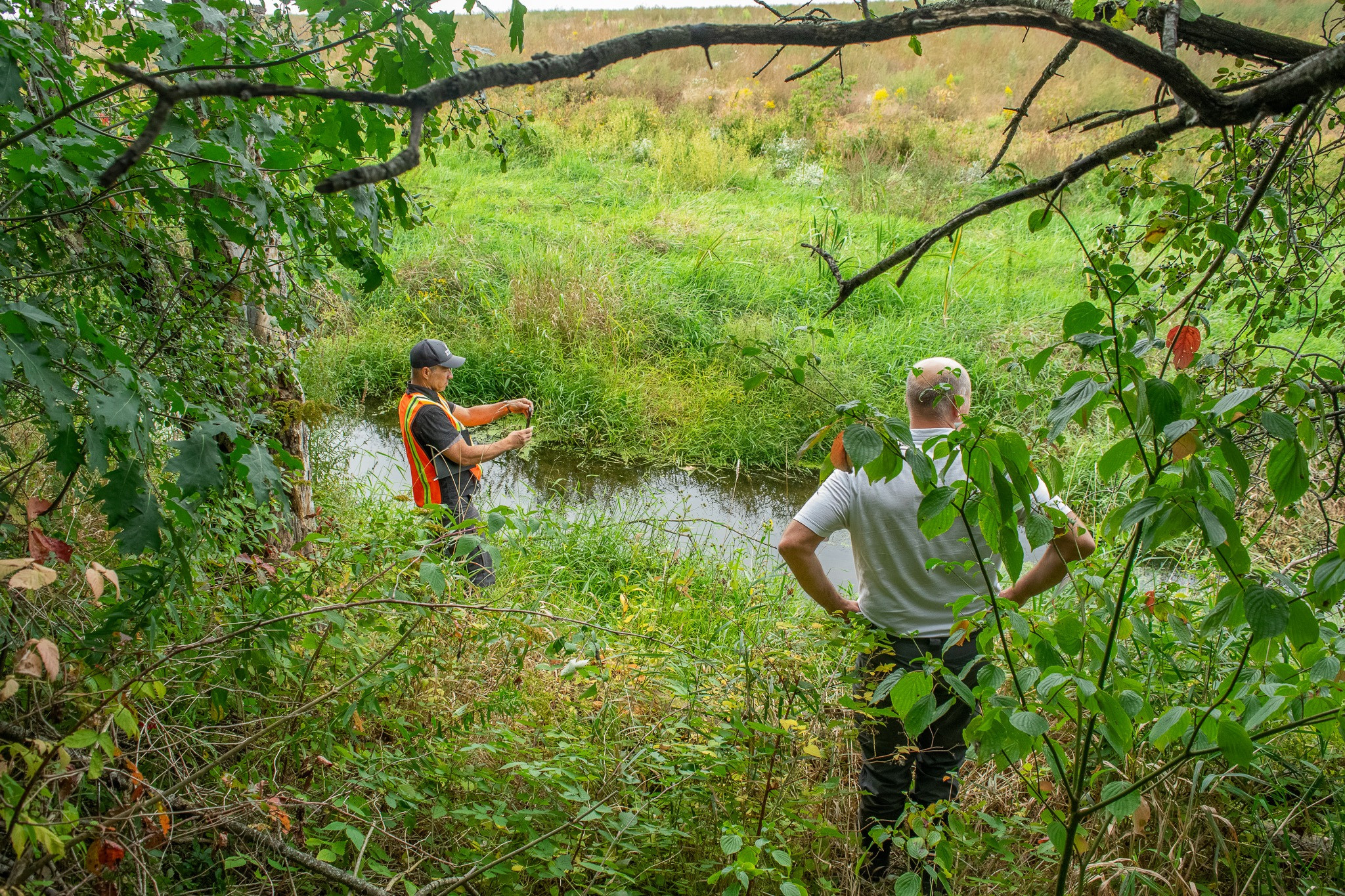
Marcolongo pointed toward a creek nearby, explaining that Fisheries and Oceans Canada had told MTO that development should stay 30 metres away from the watercourse.
They were standing roughly 40 metres away.
But the question was not simply how far the trees were from the creek. Water running off a cleared and disturbed forest floor would eventually make its way downhill and into the creek.
“When you cut down the forest, you start ploughing things, well, all the runoff runs into the creek,” he said.
“And the science would say you should also protect everything that runs into the creek, right?”
Sommerville also observed that several smaller streams and channels crisscrossed the area. Protecting the watercourses and their surrounding areas could leave developers with far less room to clear.
One seasonal stream in particular, which is difficult to detect on a standard map but can be seen through satellite imagery, runs beneath the proposed Highway 413 corridor before eventually connecting to a kettle pond near Heart Lake within the Etobicoke Creek watershed.
From a small kettle pond, the water flows into another pond, part of a connected wetland complex leading toward Heart Lake. (Anushka Yadav/The Pointer)
As Marcolongo and Sommerville went to take a closer peek at the creek, they were swarmed by mosquitoes, but the woodlot had a solution for that as well.
“Jewelweed,” Marcolongo said as he squished the plant between his fingers, explaining that its small seed pods were nearly ripe and could burst open with the slightest touch, sending their seeds flying.
“You can rub that; it's a good mosquito repellent.”
Sharon responded while laughing, “Ah, we could use that right now.”
“It's an ecosystem here. It's pretty damaged in a lot of ways but that doesn't mean you can’t rehabilitate it,” she added while exiting the green wonder.
But that’s not what the province has in mind…
On September 1, Sarkaria stood alongside outgoing Caledon Mayor Annette Groves, who did not seek re-election, to announce that the Ontario government had issued a notice of procurement to design and build the east section of Highway 413 as well as the Highway 427 Extension.
“The contract represents approximately one third of the corridor, marking a key milestone in the delivery of this priority project and in the province’s plan to reduce gridlock and drive economic growth across the Greater Toronto Area (GTA),” a statement by the province noted.
“Once awarded, the contract is expected to be the largest infrastructure procurement ever issued by the Ministry of Transportation.”
For those standing in the path of the proposed 59-kilometre mega-highway, the announcement sounded less like a road nearing construction and more like another chapter in a long-running campaign to make Highway 413 appear closer to reality than it is.
Calling the latest announcement “perplexing”, Marcolongo emphasized the highway remained “nowhere near construction-ready”.
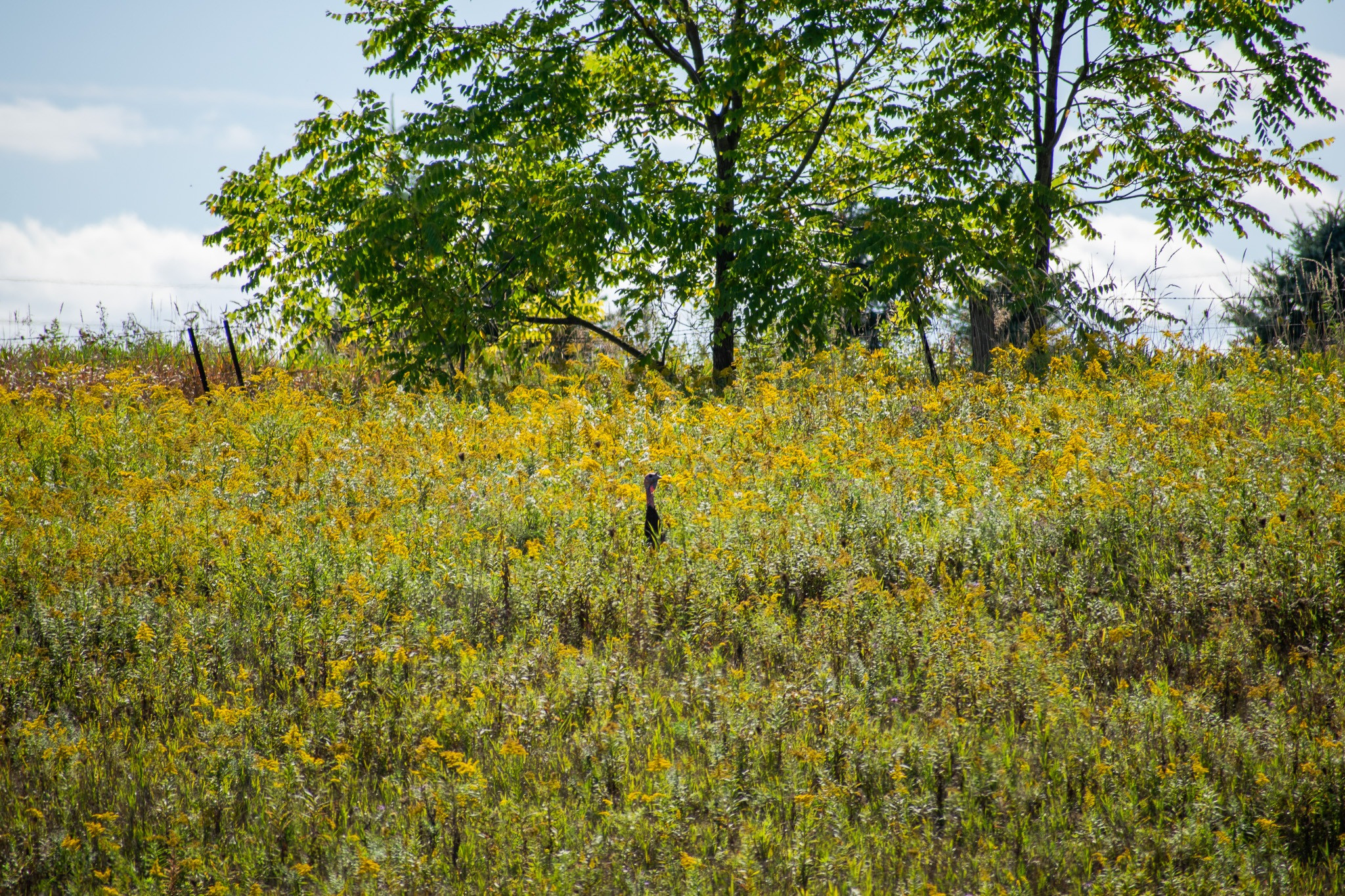
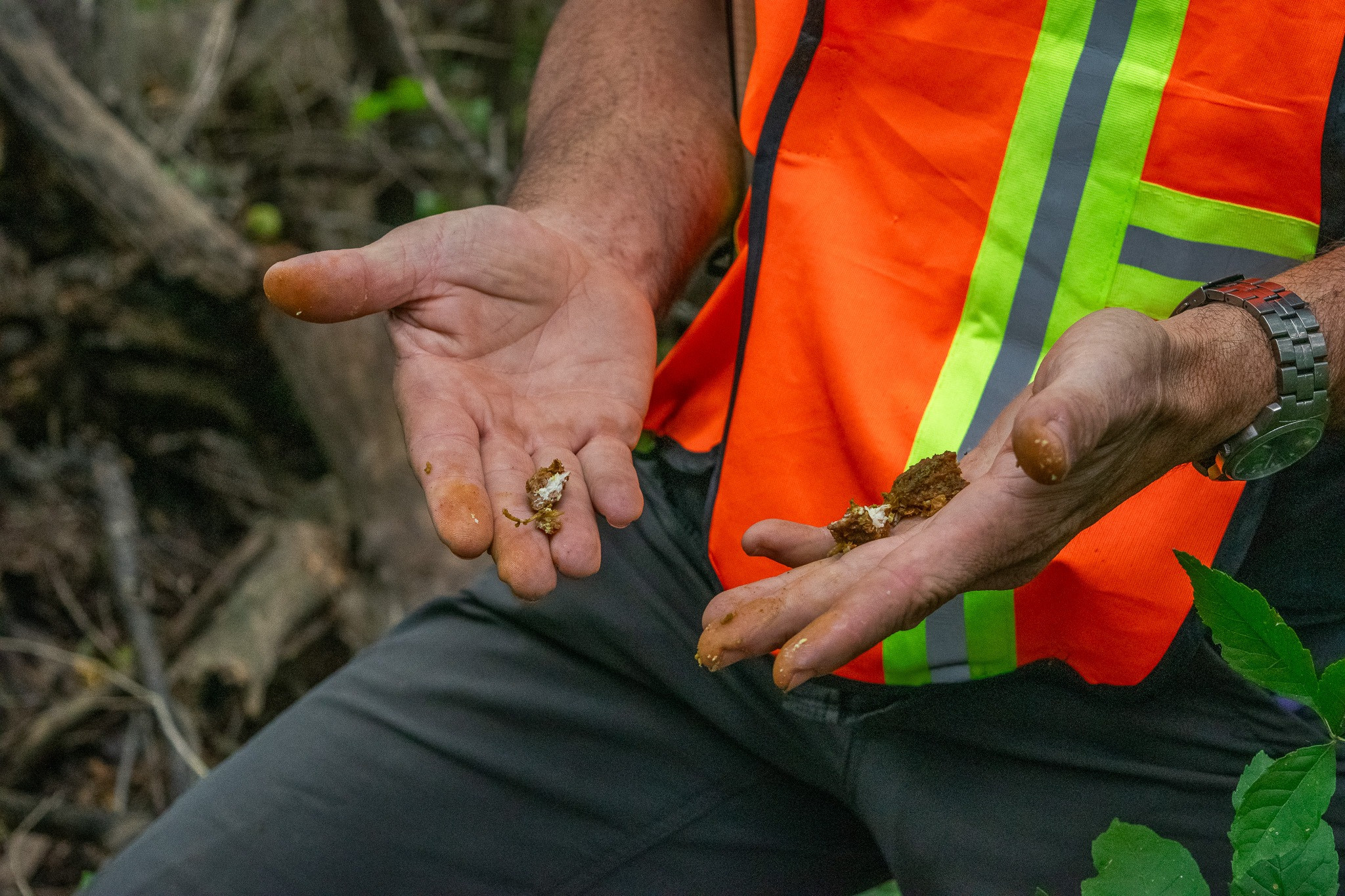
Signs of life are obvious across the Caledon woodlot. (Alexis Wright/The Pointer)
Nearly two years after Bill 212, dubbed the Reducing Gridlock, Saving You Time Act, introduced those early works, the only one to have been completed is a new embankment at the 401/407/413 interchange. Most of the other early works remain unfinished.
“The announcements made are surface-level gestures by a government desperately trying to convince residents that the solutions to the GTA’s congestion are around the corner,” Marcolongo said.
“When in fact this highway build is very, very far in the future — if it ever happens.”
Brampton resident Ahsan Raza, who drives taxis for a living, “12 hours a day and seven days a week” was largely unaware of Highway 413 until he began seeing social media videos from real estate agents promoting properties near the proposed highway, suggesting their value could increase.

Many real estate experts have already started promoting properties near the proposed Highway 413, touting the potential for increased property values as the highway moves closer to construction. (Screengrabs from YouTube & TikTok)
When he looked at the route of the highway, he could not understand why his tax dollars were being spent building a highway that “won’t connect to anything” — referring to the absurdity of the chosen route.
“If they really wanted to reduce traffic, they would open the [Highway] 407,” Raza told The Pointer.
As reported by The Pointer previously, Highway 413 is estimated to cost between $14 billion and $18 billion, and would save drivers just 30 to 60 seconds per trip, a far cry from the 30-minute figure touted by the PCs.
Marcolongo cautioned the price could extend beyond the construction bill as the 400-series highway would do little to solve congestion and could instead worsen pollution, gridlock and the cost of living as construction will pave over more than 400 acres of the Greenbelt and 2,000 acres of prime farmland “at a time when Canada’s independence from U.S. grocery imports is more important than ever”.
A consulting firm hired by Environmental Defence has already cautioned that Highway 413 would pump an extra 700,000 tonnes of carbon into the atmosphere every year, adding up to 17.4 million tonnes by 2050—an increase Ontarians cannot afford to bear the repercussions of at a time when the province has already gotten rid of its duty to report on its climate change targets.
According to the Financial Accountability Office, the province identified 51 highway and transportation infrastructure projects with $9.8 billion in planned spending over the next decade in the 2025 budget, with the ten largest projects alone accounting for $7.5 billion, more than a quarter of the total highways capital plan.
“These highways will do nothing to ease congestion, which is already costing Ontarians $45 billion per year,” he added.
“If this money were spent on transit instead, we could move double the amount of people per hour.”
Marcolongo wasn’t the only person left baffled by the announcement.
On September 2, Democracy Caledon president Debbe Crandall wrote an email to former Mayor Groves on her “capitulation on the 413” after campaigning against the highway in 2022.
“I continue to be dumbfounded how you can do a 180-degree turn from pre-2022. You campaigned to oppose the 413 and now you agree to have a quote in a news release by the provincial government to support it,” she said.
“How do you rationalize this?”
Crandall questioned whether Groves had explained the “flip-flopping” to the residents who voted for her because of her stern opposition to the highway or to Ontario Green Party leader Mike Schreiner, who had supported her campaign because she was “brave enough” to oppose the project.
“It's mind-boggling,” she continued.
Groves’ response was brief: “Email received” — no answer provided.
On November 15, Caledon’s mayoral-elect Christina Early will be sworn in alongside the new council for the Town of Caledon. Early has said she will not take a “public position on the merits of Highway 413” since she has property along the route that will be expropriated once construction begins.
Email: [email protected]
At a time when vital public information is needed by everyone, The Pointer has taken down our paywall on all stories to ensure every resident of Brampton, Mississauga and Niagara has access to the facts. For those who are able, we encourage you to consider a subscription. This will help us report on important public interest issues the community needs to know about now more than ever. You can register for a 30-day free trial HERE. Thereafter, The Pointer will charge $10 a month and you can cancel any time right on the website. Thank you
Submit a correction about this story

