

St. Catharines mayoral hopeful proposes a ‘new way forward’ for the city
Ann-Marie Zammit represents a new wave of politicians in North America. She places herself firmly in the camp of up-and-coming political figures, which disrupts the corporate-political pipeline of high-earning landlords and profiteering politicians.
On August 25, the City clerk certified Zammit's nomination, but her outreach to constituents began much earlier. She was the first of the four St. Catharines mayoral candidates to put in her nomination on May 1 at 9 a.m.
The Pointer got to sit down with her at Mahtay Café in downtown St. Catharines, where she often holds “Coffee on AMZ” sessions to listen to what constituents have to say. Zammit got candid, sharing her positions on Niagara’s amalgamation, housing first strategies, public transit, city parking, strong mayor powers, AI data centers, and what she calls “a politics of care” and what this might look like under her leadership.
The amalgamation of Niagara’s municipalities solidified her decision to run for mayor.
“The way amalgamation was forcibly put on the people of Niagara was apocalyptic,” she said. “There has yet to be any study to reveal that amalgamation provides the cost savings and efficiencies that proponents of it promise.”
A 2015 Fraser Institute analysis found that Ontario amalgamations from the 1990s to the 2000s did not yield any cost-saving benefits or lower property taxes.
Instead, property taxes and intra-municipal operating costs increased across all three amalgamated municipalities examined, even when compared with communities that had not been amalgamated. For example, Haldimand County experienced a 50 percent property tax increase since its amalgamation in 2001.
Zammit herself pointed to the failure of Kawartha Lakes amalgamation to save costs. The Fraser Institute analysis found Kawartha Lakes’ municipal employee compensation increased by 52 percent since amalgamation.
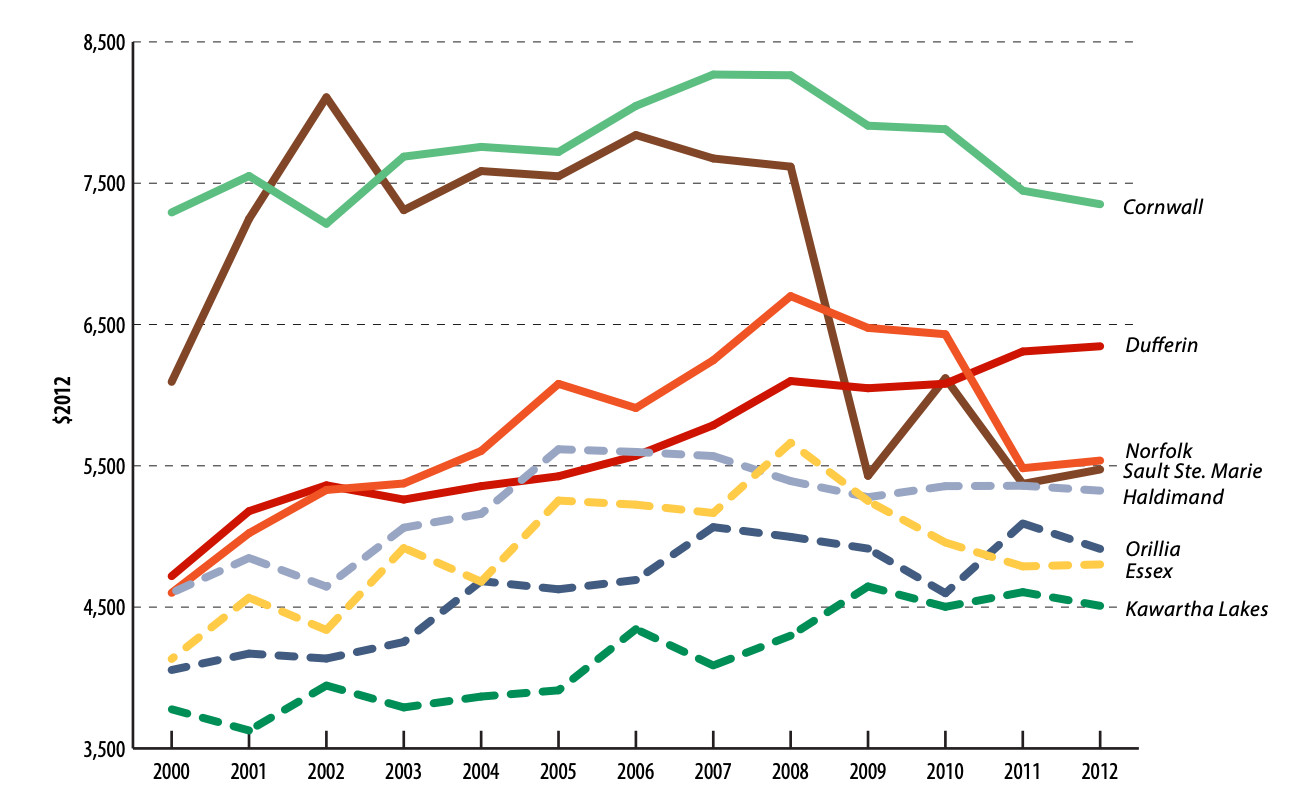
A Fraser Institute study of three amalgamated Ontario municipalities found that consolidation failed to deliver promised cost savings with property taxes in Haldimand County rising 50 percent, municipal employee compensation in Kawartha Lakes increasing 52.8 percent and long-term debt in Norfolk more than doubling between 2000 and 2012. (Fraser Institute)
The most alarming statistic in the report was the increase in long-term debt in communities which chose to amalgamate. In Norfolk County, the debt had increased 111 percent since amalgamation.
“Look to Hamilton, Toronto, and Kawartha Lakes,” Zammit said. “Look to how Peel Region is trying to pull apart after they amalgamated. Never has amalgamation been a positive.”
Having grown up in Fort Erie, her main concern for amalgamation is service distribution.
“The public transit that was promised to the residents in Fort Erie never manifested,” she says.
In contrast, incumbent mayor Mat Siscoe agreed with Niagara Regional Chair, Bob Gale, in favour of a four-city model in Niagara. On CHCH News, Siscoe cites budgeting issues with the regional government as one reason for support for a four-city model, despite the lack of cost savings evidence from other municipal amalgamations. “We’ve been talking about [amalgamation] for years. We put a study together – we haven’t seen the results of those studies yet, though.”
The incumbent claims that he hears from St. Catharines constituents that amalgamation is desirable in Niagara, yet surveys show the opposite is true.
“The privilege of serving as Mayor would carry an immense responsibility—one I take seriously. I want to be clear about both my vision and the limits of the role. A mayor is not a cure-all, and meaningful change doesn’t come from one office alone,” Ann-Marie Zammit says. (Ann-Marie Zammit)
A CUPE Ontario poll conducted in early March of 2026 found that Niagara residents reject amalgamation by a 3-to-1 ratio. 62 percent of those surveyed felt that Premier Doug Ford and the province need to step away from attempting to amalgamate the city.
When The Pointer asked Zammit the reason why she thinks amalgamation is being pushed by local and provincial representatives despite the policy’s clear unpopularity, she stated: “from my observations of what’s happening in other regions, the Premier wants to capitalize on underdeveloped land. Niagara has a large agricultural land resource, and we have reached urban boundaries.”
Overall, the forced amalgamation seems to be one wedge separating people from democratic representation.
Other moves such as Bill 100, which seeks to remove elected councillors, Zammit believes, are also for the purpose of what she calls a “shovels in the ground mandate”. Bill 100 seeks to reduce seven regional representatives to one.
However, Zammit emphasized that her platform is in favour of building up St. Catharines’ housing supply and infrastructure without forcing amalgamation or reducing local representation.
“There are over 3000 vacant dwellings in St. Catharines. Imagine what we can do with that many empty homes,” she said.
Zammit’s platform centers an explicit Housing First Strategy to increase housing supply and combat homelessness in the city. Her platform has looked to where Housing First strategies have been a success in other municipalities, like Medicine Hat, Alberta.
“Medicine Hat was able to achieve functionally zero homelessness through housing first initiatives,” Zammit noted. “Why can’t we do the same in St. Catharines?”
Zammit says that many of the constituents she speaks to express concerns about the safety of downtown. While visiting nursing homes and talking to the downtown businesses, she acknowledges that many feel that downtown used to be a more vibrant and safe community, but the unhoused population and broken sidewalks have made visiting the downtown anxiety-inducing for those with mobility issues and for the elderly.
When asked what a housing first initiative would look like in St. Catharines, she explained that “without increasing property taxes, we can simply reallocate. Allocation, in some ways, is more important than the total sum you pay. My government would see more of the property taxes residents are already paying to go toward housing.”
Zammit believes that when housing is supplied, the costs of EMS and repairing public infrastructure would come down as well. Housing First policies have been effective at bringing down policing and hospital costs in other municipalities where it has been tried.
One study by the University of Toronto uses mathematical modelling to explain how the Housing First approach compares to the Treatment First policies. According to the researcher’s findings, addiction and homelessness feed each other in a sort of social feedback loop.
Addiction leads to homelessness, while facing the conditions of being unhoused leads many to addiction. Policies which aim to address these interconnected issues can be relegated into two categories: housing-first and treatment-first.
“Housing-first prioritizes providing permanent housing as quickly as possible, with other supportive services offered afterward. Treatment-first, by contrast, takes the opposite approach [treatment for addiction comes first with aims to stabilize mental health well enough to get people into permanent habitats later]”.
The study’s results show, “investing in stable housing for marginalized populations was cost-effective, improved health outcomes, increased participation in addiction treatment and saved lives.”
“As mayor, I would use the surplus properties we have in the city to achieve housing-first initiatives that have worked in other cities.”
Under the current administration, year-to-date housing starts for August 2026 have been down for several housing types. The Canadian Mortgage and Housing Corporation releases city-specific data on housing starts by type. While improvement in apartment starts and completions was observed in the most recent report, single, semi-detached, and row housing unit starts are all down. These three housing types are also down in the “under construction” category, and completed homes are only marginally better in August, with semi-detached and row housing still showing downward trends. September’s numbers have yet to be released.
Zammit recognizes that an increase in housing supply will also put strain on city infrastructure. When asked how her administration will support the city’s aging infrastructure, she said the solution needs to come from dividing the tax pie to make infrastructure a priority.

As voters head to the polls this October, St. Catharines — the most populous city in Niagara Region — faces a range of pressing municipal issues from property taxes and stormwater infrastructure to flooding, housing affordability and downtown safety. (City of St. Catharines)
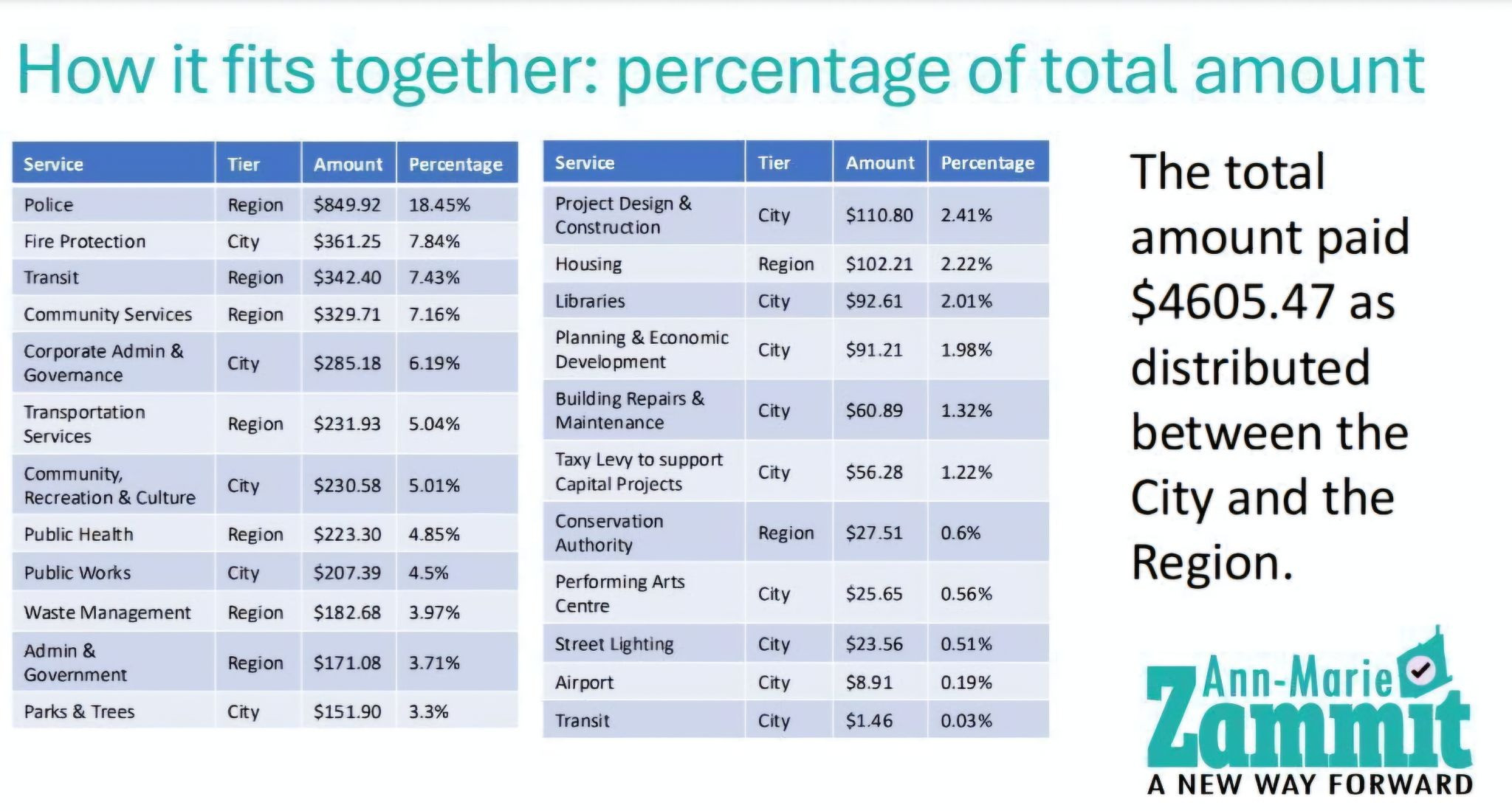
At a virtual town hall back in August, Zammit presented the current tax breakdown to demonstrate where municipal taxes are spent. The largest share of tax spending in Niagara, 18.45 percent goes to policing. In contrast, public works and housing take up 4.5 percent and 2.22 percent of tax revenue, respectively.
“People ask me all of the time, ‘where is the funding going to come from for a housing-first initiative’,” she noted.
“The answer is that we need to start working with regional councillors to create budgets that benefit the welfare of all people in St. Catharines. Policing becomes less of a necessary expenditure when housing is provided. That leaves more leftover for infrastructure repairs.”
In summer 2026, St. Catharines experienced record-level rainfall that flooded many residents.
“Climate change is real,” Zammit, who holds a degree in biological sciences, said, “and it is entering your basements.”
Transit is another major part of Zammit’s affordability platform.
“Canada is really bad at public transit,” she said. “Around 80 percent of Niagara is dependent on their cars to get around.”
Expanding Regional Service to Sundays is one of her goals for transit. Presently, there is no way to travel between municipalities in the Niagara Region on Sundays without a car.
“I remember celebrating my 50th birthday party in Paris,” she explained, the once-in-a-lifetime trip. “It was so easy to get on and off public transit … ride the metro, connect to a bus. Residents of Niagara deserve better transit service.”
Expansion of Niagara’s public transit service has stalled in recent years. The current transit commissioner for the region is Mayor Siscoe.
When asked why she thinks transit in Canada has not kept pace with Europe or even the United States, Zammit explained, “Policy is the main driver.”
Zammit has recently received endorsements from Amalgamated Transit Union (ATU) Local 846. The union is the largest of its kind, representing transit workers in Canada and the United States. They also promote mass transit wherever they are stationed.
The ATU’s official statement praised Zammit for taking “the time to meet with our members who are the engine behind the engines of the Region’s transit system. She recognizes and values the importance of the work our members perform every day.”
"Many complain to me that they can take a bus in St. Catharines to get to work, but because of the reduction in frequency during evening travel, they can’t take the bus home. They’re spending sizeable portions of their income on rideshares. More transit means more affordability for St. Catharines’ workers,” she said.
Another major factor in how Zammit views affordability is how the city government could do better at cleaning up industrial sites like 282 and 285 Ontario Street, known locally as “the GM site” since General Motors Canada operated on these addresses until 2010.
She has been a vocal proponent of holding the owners of the site accountable, and has delegated St. Catharines City Hall on this issue several times.
On September 15, Zammit delegated against the CIP proposal the council had put forward to fund the remediation of the contaminated site.
In her address to council, she said, “There are already CIPs available that provide incentives for brownfield redevelopment. All brownfields … face the same complex and expensive remediation and redevelopment challenges… We can also agree that residents have been asking for these lands to be cleaned up for the better part of a decade. The consistent response from the city has been, ‘we don’t want the taxpayer to bear the financial responsibility for the site’s cleanup.”
City officials like Mat Siscoe and Caleb Ratzlaff have repeatedly threatened that, somehow, the city’s residents would have to pay for the cleanup, such as at a town hall on March 31 in which Mayor Siscoe said the cost could leave the taxpayer on the hook for hundreds of millions of dollars.
Zammit stated at the September delegation that “this CIP is opening the door for the taxpayers to pay for the remediation of these lands.” She specifically critiqued Schedule 2 of the CIP, which states that “remediation costs are retroactively eligible for the incentive up to five years prior to making the application.”
“Redevelopment cannot occur without remediation. If the property owner [of the GM site] incurs costs listed over Schedule 2 over 5 years, then applies for the CIP, and gets approved, then the city will have to reimburse the property owner between 80-100 percent of the increase in annual property taxes generated by the project’s completion,” she explained.
“If the property owners pay $500,000 in property tax per year, and the property tax for the site increases to $1.5 million per year, that [is] the difference between $1.6 million and $2 million per year. Under the current CIP, the city would reimburse between $24 million and $30 million to the property owner over 15 years.”
The GM site has become a political flashpoint in the St. Catharines election. On June 1, The Pointer broke news of asbestos in the soil surrounding the property.

In July, the St. Catharines Property Standards Committee denied an appeal and ordered the property owners/lenders including Celernus Investment Partners to clean up contamination and secure the deteriorating 55-acre site with a compliance deadline extending to October 23, 2026. (Joel Wittnebel/The Pointer)
When The Pointer asked Zammit why she believes progress on the former car manufacturer’s property has not been cleaned for about a decade, she said, “People may be afraid to put responsibility on GM because it may impact jobs [at] other sites that General Motors has in [the] city, like the propulsion plant on 570 Glendale Ave.”
“I don’t want to live in a city where people just point the finger at people,” she continued. “I just want what’s best for the city, and this property is taking up space that could be used for all of our residents.”
Zammit received an endorsement from local activist group, Coalition For A Better St. Catharines, in late September. They have been working on making the GM site cleanup a priority for municipal leaders for ten years.
In their statement, they share clear frustration with the incumbent and praise for Zammit: “It’s time for the City to move on from Mat Siscoe…we’ve seen little positive news about the former GM site during his terms as Councillor and Mayor. Sadly, the site remains a dangerous health and safety hazard. Nothing has changed beyond painting fencing.”
The group noted it is “confident that as Mayor, Ann-Marie Zammit will do better” and “will put the interests of residents ahead of developers”, standing up to a delinquent property owner and ensuring taxpayers will not be left carrying the burden of the site cleanup.
Other affordability points in her platform include making parking free for two hours across the entire city. She aims to make parking free for residents at the beaches like Port Dalhousie as well.
“We should use the systems we already have to expand accessibility. I want to use the Play STC site so that residents can register for parking passes,” she said.
Zammit says many of the downtown businesses are telling her that parking is a major deterrent for customers. She connects this issue back to transit, stating, “expanding both transit and parking impacts local businesses in a positive way”.
Her platform also recognizes the red tape cutting that needs to be done to promote business in downtown. “Some people here ‘red tape’ cutting and they presume I mean cutting services or regulations. That’s not what I mean at all.”
She detailed conversations she has had with business owners, like the Sugar and Butter Baking Company on Summer Street. The bakery had opened during the midst of the Covid-19 lockdown, where businesses had to enter a draw to get a fire inspection before they could open. Sugar and Butter’s owner Sarah McKie had to wait four months for the draw to be completed before she could open. McKie had to pay rent while she waited for the inspection.
“Other businesses trying to open in this time just leave Niagara and set up shop in Toronto. This is the kind of red tape I’m looking to remove,” she added.
McKie endorsed Zammit on September 5, noting “[Zammit] is extremely well educated on the ins and outs of municipal politics and policies. She gives me so much hope for the future of the city.”
Zammit also has endorsements from other downtown business owners such as Gary Clemmensen of Mac Frugals on St. Paul Street. Mac Frugals has been in business in St. Catharines for over 60 years. He says, “I’ve known Ann-Marie Zammit for quite a while now. I think she would make an excellent mayor. And so, I can promise you that she has my vote.”
For Zammit, a platform of affordability needs to be spearheaded by a holistic approach, rather than piecemeal policies. “One thing leads to the next,” she said. “Stable housing opens the doors for more people to participate in the economy. Restaurants and businesses open up in a timely manner, and expanding transit and waiving parking fees opens access to the people to get to those businesses.”
Zammit’s organizing began with a position on her acting union, the Alliance of Canadian Cinema, Television, and Radio Artists. Zammit herself is an actor and has played roles in films such as What Will You Say, Serenity Spa, and Cows Come Home. ACTRA Toronto represents 15,000 actors from Niagara, the GTA, and all the way up to North Bay.
When asked what made her want to join the union, she said, “I love workers. I believe in workers. As actors, we are creative labourers. I wanted to change the policy to allow marginalized voices to collectively bargain, something only full members are allowed to do. Apprentice members cannot vote, and the apprentice members tend to represent the most underprivileged people in the industry.”
Film and TV contribute over $2 billion to Ontario’s economy. The fight for workers’ rights does not stop with acting.
When asked how Zammit would approach Artificial Intelligence (AI) data center proposals in St. Catharines, her reaction was adamant: “No. No A.I. data centers at all. This will be the hill I die on.”
Zammit explained that there are voice actors in her union who are fighting to be paid for AI-produced media that has stolen their voices. She is currently working with ACTRA to fight for AI controls.
“The entertainment industry is often the canary in the coal mine before new technologies inflict ricocheting economic effects on workers,” she said.
Turning this platform into policy means working with city councillors rather than overriding them. She calls for healthy debate in this upcoming election.
As mayor, she wants to do away with strong mayor powers, a 2022 provincial measure that expanded to St. Catharines in 2023 that aims at giving municipalities stronger powers to help meet the province’s housing goals.
Critics have called the measure “undemocratic” and cited the potential for misuse. According to the Association of Municipal Managers, Clerks and Treasurers of Ontario (AMCTO), the powers allow mayors to “create new chairs and vice chairs for committees, direct items to council that could potentially advance a provincial priority and direct staff to develop proposals to be brought forward for council consideration, and veto council’s passing of bylaws if all or part of the bylaw interferes with provincial priorities.”
Zammit wants to see these powers used in a more limited fashion than incumbent Siscoe has.
“We need to concentrate on consensus building. Strong mayor powers are antidemocratic,” she said. “It is up to me to do the work to get council on side. The current mayor has used his strong mayor powers many times for unilateral decision-making. When it comes to running a city, we need to work together.”
On March 26, The Pointer reported on Siscoe’s use of strong mayor powers for a single-source contract for Ontario Street that appears to violate conventions and rules laid down by previous administrations. There was no bidding process, and the contract was handed to a favoured vendor.
“My governing style will be led by a politics of care that provides real economic opportunities in St. Catharines. My campaign slogan has been ‘A new way forward.’ I want to rewrite the rules to benefit everyone in the city, no matter your socio-economic status. I want [to] rewrite the policy to leave things better than I found them,” she concluded.
Email: [email protected]
At a time when vital public information is needed by everyone, The Pointer has taken down our paywall on all stories to ensure every resident of Brampton, Mississauga and Niagara has access to the facts. For those who are able, we encourage you to consider a subscription. This will help us report on important public interest issues the community needs to know about now more than ever. You can register for a 30-day free trial HERE. Thereafter, The Pointer will charge $10 a month and you can cancel any time right on the website. Thank you.
Submit a correction about this story

