
Six residents protecting Ontario’s watersheds as PCs push unchecked development around Great Lakes
“Water does not resist. Water flows.
When you plunge your hand into it, all you feel is a caress.
Water is not a solid wall, it will not stop you.
But water always goes where it wants to go,
and nothing in the end can stand against it.
Water is patient. Dripping water wears away a stone.
Remember that, my child. Remember you are half water.
If you can’t go through an obstacle, go around it. Water does.”
Like the perennial water in Margaret Atwood’s poem ‘Water Flows’, some resilient individuals refuse to be bent, flowing around the obstacles of modern life—unchecked development, politics, human apathy…
Water sustains everything on Earth.
Why don’t we treat it that way?
Thank God, some of us do.
“When we live in the Great Lakes region, there’s so much water, we think it’s limitless,” Georgian Bay Forever Executive Director David Sweetnam tells The Pointer.
He was among the six Ontarians who were honoured by the Ontario Headwaters Institute on September 23 for dedicating years of their lives protecting the sensitive ecosystems in and around the province’s precious Great Lakes watershed.
Watershed Guardian of the Year Awards were bestowed to Sweetnam, and the Simcoe County Greenbelt Coalition’s Adam Ballah and Margaret Prophet while Don and Joanne Harris of Markdale, Brad Mulligan of the Beaver River Watershed Initiative, and Jarvis Strong of the Escarpment Corridor Alliance were honoured with Community Advocate Awards.
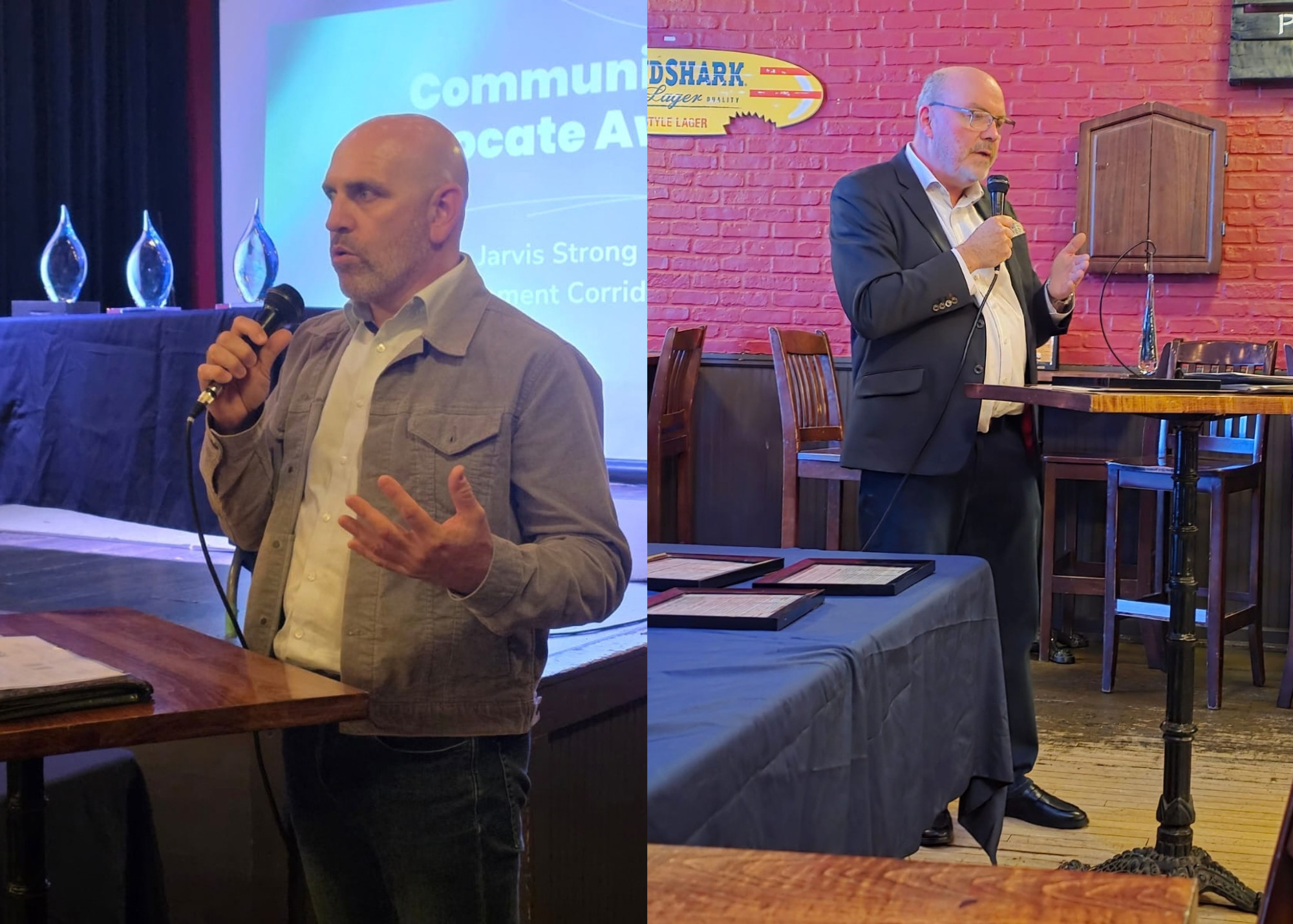
Jarvis Strong, Executive Director of the Escarpment Corridor Alliance, and Brad Mulligan of the Beaver River Watershed Initiative were recognized for their advocacy in a ceremony on September 23 in Barrie. (Ontario Headwaters Association)
The next day, the Ontario government announced up to $1.8 million for community-led projects involving wetland restoration, pollution reduction and habitat restoration to make the Great Lakes and their connecting rivers cleaner and healthier.
“The Great Lakes hold an impressive 20 per cent of the world’s fresh water – they feed and sustain wildlife, provide jobs and support industries like power generation, agriculture and tourism,” Todd McCarthy, Minister of the Environment, Conservation and Parks, said in a statement.
“By investing in local projects through the Great Lakes Local Action Fund, we are protecting a vital natural resource for future generations.”
While it is welcome news that, after spending $25,000 in public money to print and install the oversized bilingual “Lake Ontario, Now and Always” sign, the province is actually putting some money toward protecting the Great Lakes, the investment does little to make up for the damage the Doug Ford government has caused to the pristine waters of the same lakes.
Because protecting the natural world is not just about restoring what has already been damaged. It is also about preventing the damage in the first place.
And this is where the water gets murky…
Ontario’s Great Lakes Strategy remains outdated since its 2018–2023 review, signalling a lack of new provincial action.
In December 2019, the province proposed revoking nine sector-specific industrial wastewater regulations that regulated industrial water pollution from sectors like pulp and paper, oil refining, and chemical production under the Municipal Industrial Strategy for Abatement (MISA), transferring their requirements into site-specific Environmental Compliance Approvals to reduce duplication and provide industrial facilities greater operational flexibility while maintaining oversight through those approvals.
The MISA regulations had helped improve Great Lakes’ water quality in Areas of Concern but their pollution limits had not been updated since their adoption. Over the years, Ontario’s Environmental Commissioner made repeated calls to strengthen those standards—but instead, the Ford government completely disposed them off.
By July 2021, the changes took effect despite environmental experts’ warnings that moving away from sector-wide rules could weaken consistent protections for industrial wastewater.
Over a year later, Bill 23, titled the More Homes Built Faster Act, 2022, arrived to accommodate the Progressive Conservative (PC) government’s aggressive housing targets at the risk of violating the Great Lakes-St. Lawrence River Basin Sustainable Water Resources Agreement, signed with U.S. states to prevent harmful water transfers, by diverting millions of liters of wastewater from the York Region south to Lake Ontario.
Aptly dubbed “ecological insanity” by critics, it drastically weakened water and environmental protection by reducing the safeguards around critical wetlands and stripping powers from local conservation bodies by stripping their ability to consider “pollution: or “conservation of land” while reviewing and/or issuing development permits.
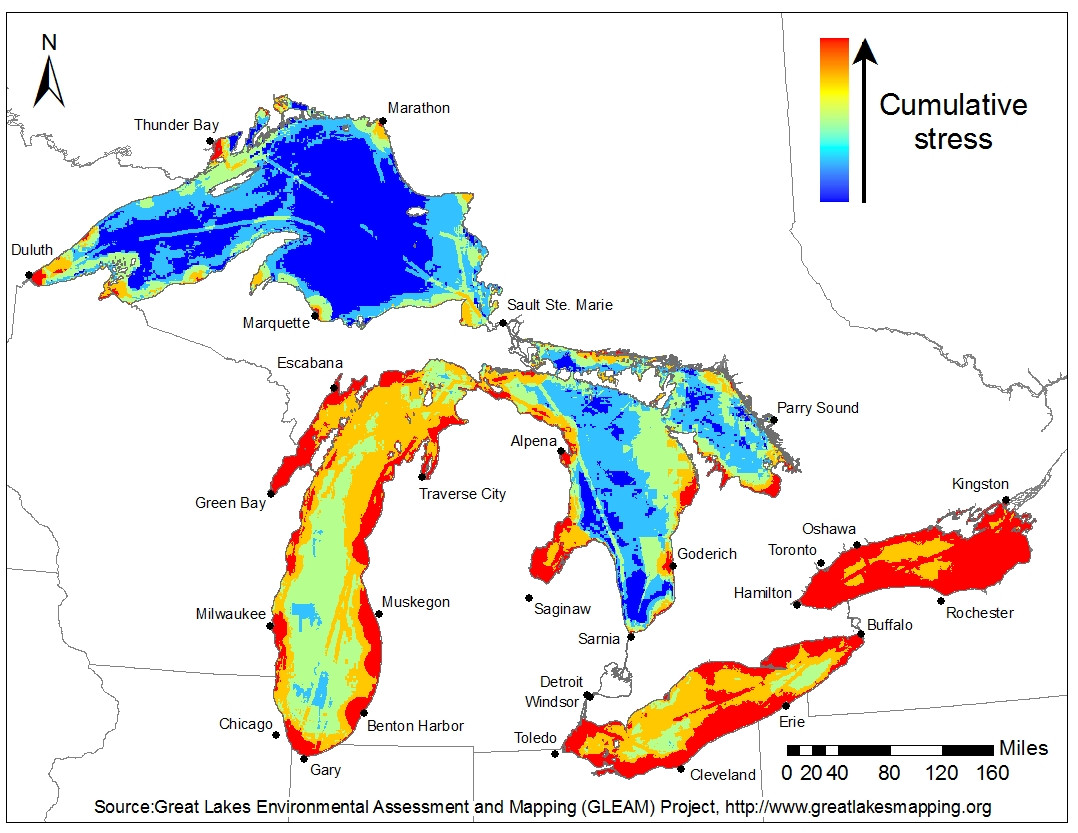
Recreational uses and stresses are higher around the coastal regions in Ontario for the Great Lakes. (NOAA)
Amidst a flurry of environmental rollbacks since being elected, the PCs announced plans to amalgamate its 36 independent conservation authorities into nine regional conservation authorities starting February 2027— a “hostile takeover” that conservation groups and municipal leaders fear could further erode watershed-based management, weaken local representation and expertise, and make it easier to centralize decisions affecting wetlands, floodplains and ecologically sensitive lands at a time when the province continues its push for environmentally destructive infrastructure projects like Ontario Place redevelopment, Billy Bishop Airport Expansion, Highway 413 and the Bradford Bypass.
While most of these projects await permits, the province announced it had started “major construction” of the Bradford Bypass (Highway 425) a 16.3-kilometre, four-lane freeway connecting Highway 400 in Simcoe County to Highway 404 in York Region in May.
While a 2022 Auditor General’s report estimated the project could cost between $2 billion and $4 billion, the Ford government claims the freeway will cut travel times by up to 35 minutes each way—a similar claim used for Highway 413. However, as reported by The Pointer, neither of the two highways will reduce congestion; even if Highway 425 is built, congestion will get worse by 2041.
However, what is certain is that the bypass will permanently slice through Lake Simcoe’s largest and most important wetland—the Holland Marsh.
The Holland Marsh, a designated Specialty Crop Area within Ontario’s Greenbelt protected for its rare and highly productive organic soil, spans more than 7,000 acres and produces a significant share of the province’s vegetables including delicious carrots, onions and celery—foods already at risk due to climate change-induced extreme weather.
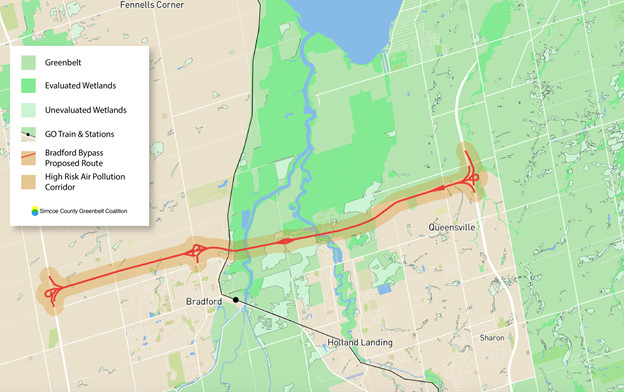
The Bradford Bypass is a 16-kilometre, four- to six-lane freeway that will cross several watercourses feeding into Lake Simcoe’s Cooks Bay and bisect the Holland Marsh. (Simcoe County Greenbelt Coalition)
The province’s own assessment identified the loss of nearly five hectares of provincially significant Holland Marsh and 7.9 hectares of the wider wetland complex while impacting 128 hectares of Greenbelt, alongside 64 hectares of meadowland, 22.4 hectares of deciduous forest and 20.6 hectares of deciduous swamp.
The highway would require 51 crossings over 34 watercourses including 31 culverts while at least 10 waterways would need to be realigned, that risk changing the flow of water and ecological connectivity.
The effects of these hydrological changes will be difficult to predict as 90 percent of the drainage and runoff is expected to flow into the Holland River before making its way to Lake Simcoe—that is already burdened with high phosphorus levels.
In 2015, the Simcoe County Greenbelt Coalition (SCGC) co-founders Adam Ballah and Margaret Prophet created a network that brought together more than a dozen local and provincial groups, that grew to fifty, to work towards “environmental protection and sustainability, building safe and caring communities”—one of their key initiatives has been to spread awareness about the environmentally devastating impacts of the Bradford Bypass, “a sinister, shorter cousin” of Highway 413 on the Holland Marsh.
“We look at green spaces and nature as places with potential. Potential for housing, potential for strip malls, potential for highways – not as if they already have a purpose,” Prophet said.
“We need to recognize they aren’t places with future potential, they are places that have important existing purpose in our wellbeing and our planet’s health.”
It is a lesson she had learned from former Toronto mayor David Crombie—and one that stayed with her as she navigated a career jump from being a public school teacher to working with a local ratepayers association advocating for protection of wetlands.
While juggling being a mother of two and volunteering to protect the natural world, she wrestled with the question: why were communities always reacting to threats after they emerged instead of deciding in advance what natural systems were too important to damage?
The initial Environmental Assessment (EA) conducted by the Ministry of Transportation for the Bradford Bypass in 1997 predicted elevated levels of benzene, a carcinogenic compound emitted by car exhaust. Previous governments shelved the project but the Ford government paved the way for the project with information that is decades old and failed to assess the health impacts as well as the additional pressures of the climate crisis.
“How many children need to develop cancer or how many people need to have heart attacks or how many people need to develop alzheimers before we start saying ‘Oh, maybe this isn’t worth it’,” Prophet said.
“When do we ever get to put what we need long term—our food, our water, air—when do we ever put those as like, okay, we’re not going to touch this? We’re going to build communities in ways that don’t damage that.”
She hadn’t always set out to be on this path; even today, being called an “environmentalist” seems foreign to her some days.
Growing up in the scenic county of Haliburton, nature was never an issue to be debated or protected, it was simply home—to her and to several species that traversed its 600 lakes and rolling hills on the Canadian Shield.
Her family owned a resort on a lake, and for the first 19 years of her life, Prophet swam in it, hiked around it and cross-country skied through the landscape that surrounded her.
“It (nature) was just so embedded into my day-to-day that I didn’t really think that I needed to have a position on the environment,” she said.
“It was a shocking thing to realize that to certain people thinking about protecting the environment is actually a very radical or terrible idea.”
She paused before continuing: perhaps, “it was the naivety of growing up in a small rural town”.
“I don’t consider myself an environmentalist,” Prophet reflected.
“But I don’t know how you could separate living and being healthy from your environment…it is our habitat.”
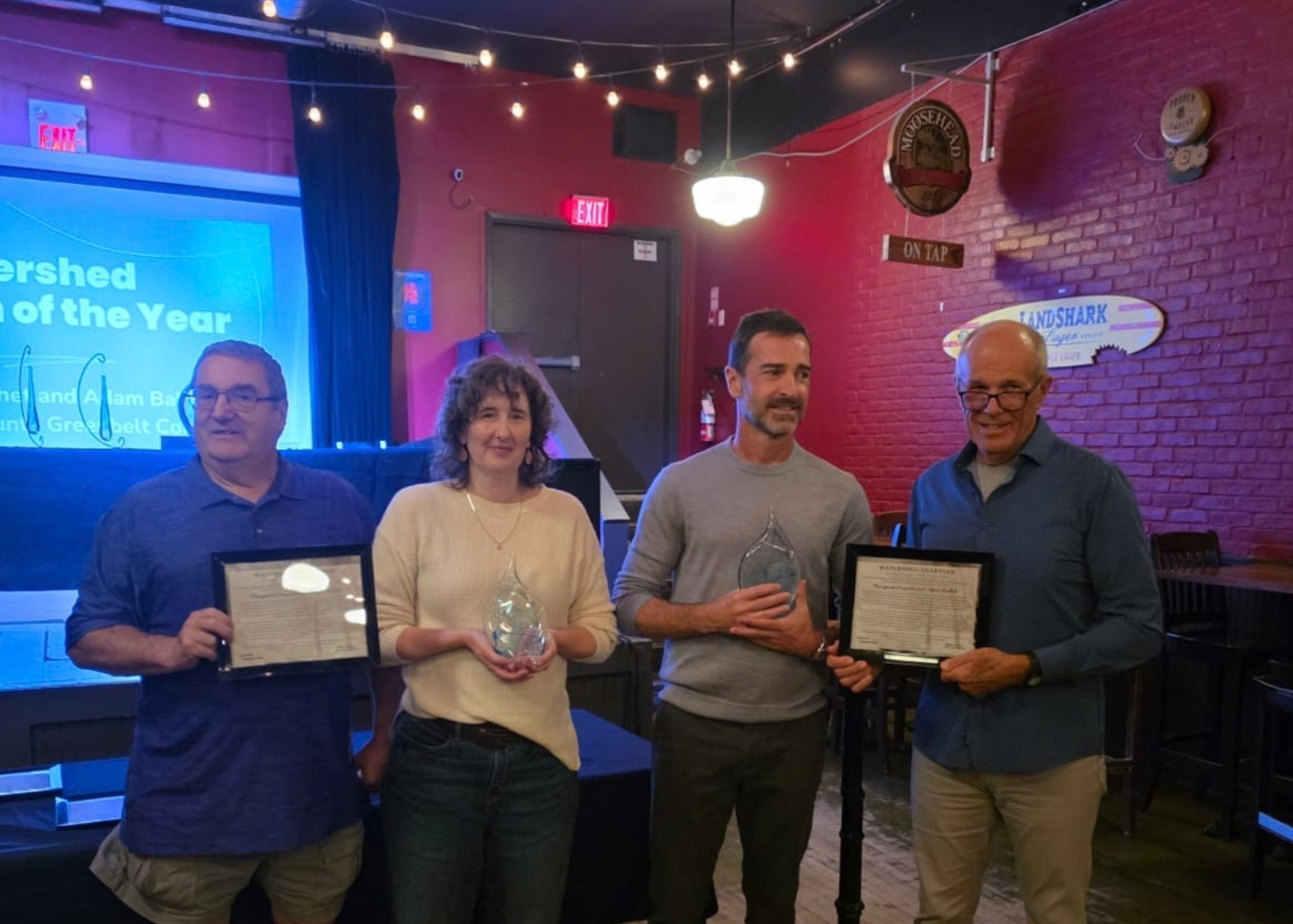
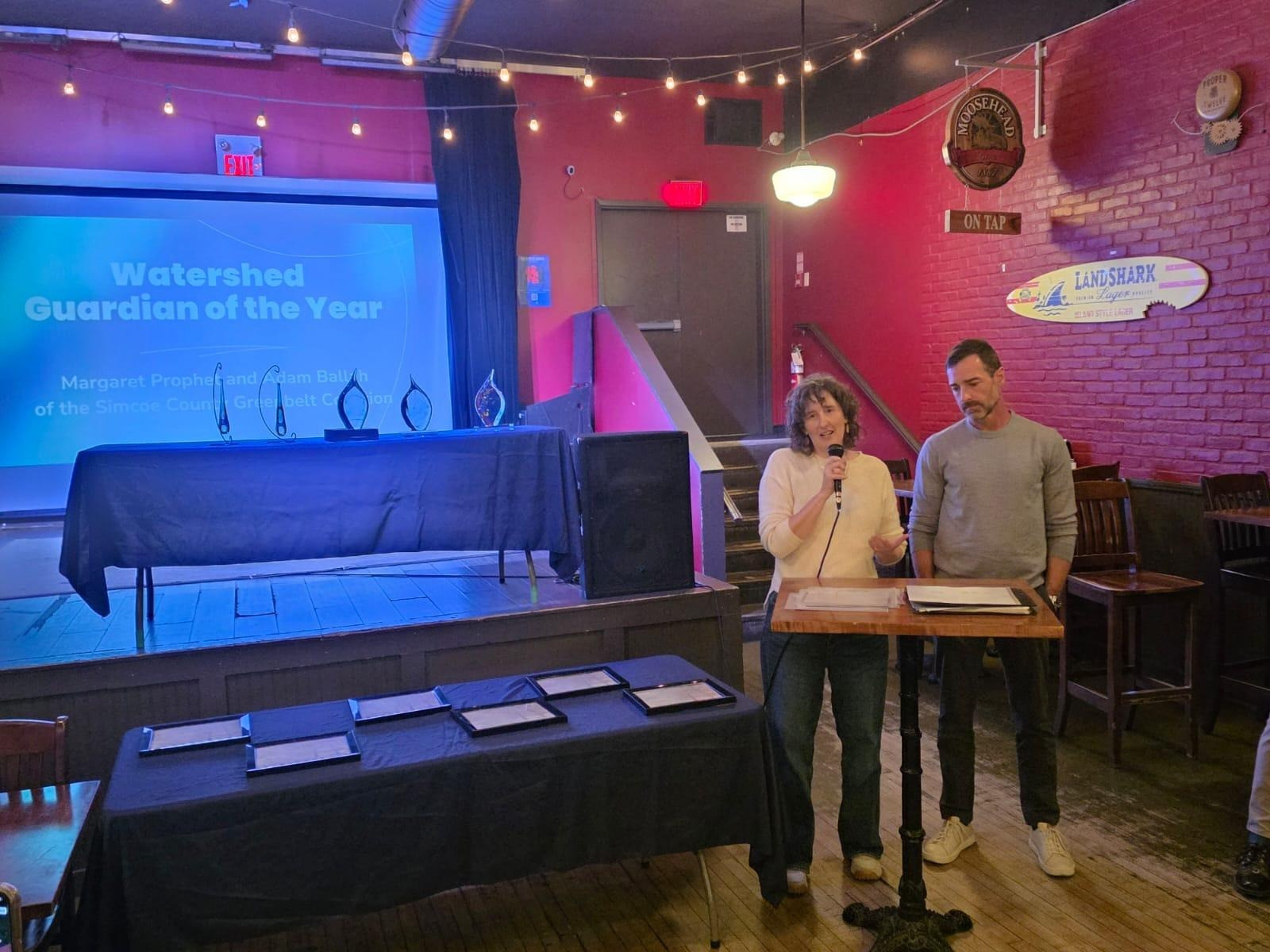
Margaret Prophet and Adam Ballah of the Simcoe County Greenbelt Coalition with their Watershed Guardian Awards, flanked by Andrew McCammon of the Ontario Headwaters Institute on the left and David Jeffries, President of the Coalition. (Ontario Headwaters Institute)
It makes the usual divide between environmental issues and human issues difficult to understand for her at times.
“When people say, ‘I don’t really care about the environment,’ I’m like, really? You don’t care about water? You don’t care about whether your streets are safe? You don’t care about whether the air is clean,” she added.
Part of SCGC’s work is building those conversations and “changing hearts and minds” whether that is through bringing member groups together, helping municipal leaders develop stronger water policies or giving residents the information and tools to understand what is at stake.
Prophet says her happy place is when the coalition “creates a map or when we stop a ministerial zoning order that was going to take up a significant wetland in Simcoe County”.
West of Simcoe, in Grey County, David Sweetnam feels most at home when he is looking out across Georgian Bay, where rugged bedrock, white pine forests and sandy shores stretch along the northeastern arm of Lake Huron.
The ombre of green and blue landscape always takes him back to YMCA summer camp days on Beausoleil Island, where his relationship with the Bay began as a young boy.
Years later, at 17, he returned to the island for a summer job with Parks Canada, spending his days cutting firewood, building boardwalks, replanting trees and working alongside wardens and naturalists as part of the Conservation Corps youth program.
“It was a great, great job. Eight girls and eight boys and three chaperones to make sure everybody behaved,” he told The Pointer.
How could anyone take the bounties of nature for granted? It didn’t take him long to figure out the answer to that question.
In the summer of 2009, Sweetname, a biochemistry expert by education, found himself semi-retired after he sold his computer services company and started spending more time on a boat with his family overlooking the “beautiful, pristine” waters of Lake Huron.
While creating everlasting memories, he began noticing the remnants of “thoughtless human activity” where he expected to find only open water and shoreline from beer cans in deep water, garbage scattered along beaches and plastic moving through ecosystems.
“I started talking to other people there why it was important for all of us as boaters to protect the water and evangelize for it,” he said.
“I was also thinking, I can’t be retired forever. What do I do?”
On a hot July day, while scrolling through Workopolis, he came across a job posting that seemed almost tailor-made for the life he was already living: Georgian Bay Forever was looking for its first executive director.
He thought to himself, “I do that every weekend anyways. Every one of these things is what I just do naturally.”
Sweetnam applied for the position and by October 2009, he was one of the first employees of the charity and “had to wear many, many hats.”
One of his early priorities was helping shift the conversation around Georgian Bay’s changing water levels away from emotion and misinformation and toward data and science.
The Bay was experiencing a prolonged period of low water, raising concerns about connections between open water and coastal wetlands and the implications for fish and wildlife. Cottage communities were also worried about access to water-access-only properties.
“There was a ton of misinformation and not really a good internalization of the fact that climate was changing,” he learned.
“Emotional misinformation travels very quickly. Factual rebuttals and truth-telling takes a lot of energy and a lot of effort.”
Using “good hard facts and science”, he helped communities understand how changing precipitation and evaporation patterns could affect both water quantity and quality.
But he had yet to meet the Georgian Bay Islands National Park’s “number one ecological stressor” as described by Parks Canada: Phragmites, an invasive reed that can grow into dense walls along shorelines, crowding out native plants, impairing wildlife and altering the character of coastal wetlands.
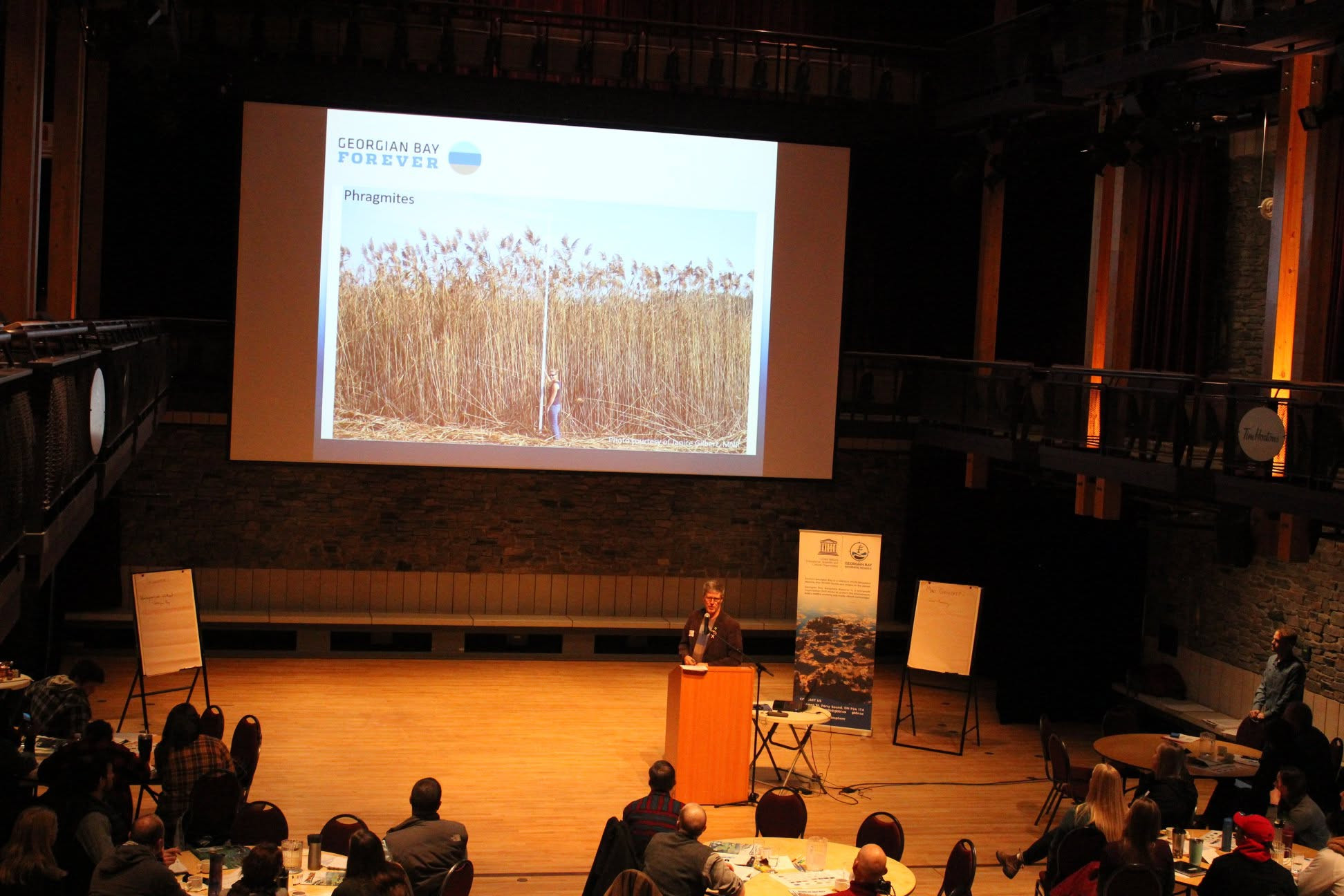
Georgian Bay Forever’s David Sweetnam has spent countless hours giving informational sessions on phragmites as a growing ecological challenge for Georgian Bay waters. (Georgian Bay Forever/Facebook)
In 2012, Georgian Bay Forever began working with communities to map and manage infestations using a method that involves cutting the invasive plants below the waterline and returning to monitor the sites for regrowth.
“We have about 1,200 coastal wetlands right now, infestation sites that we’re managing,” she shared.
“We've eliminated it at about half of those sites.”
Sweetnam’s leadership also helped draw attention to microplastics, tiny fragments and fibres that have been making their way into waterways through human activities including household laundry.
In 2019, Georgian Bay Forever partnered with researchers at the University of Toronto’s Rochman Lab to investigate whether washing-machine filters could reduce the amount of synthetic fibres entering wastewater.
Filters were installed in 100 Parry Sound households and later in another 300 homes in Collingwood, allowing researchers to compare what was being captured before it could reach the water. The study found synthetic clothing can shed hundreds to thousands of microfibres during a wash with researchers finding one of their filters tested captured an average of 87 percent of fibres by count.
It has also brought communities together for shoreline cleanups which began revealing another problem hiding in the debris: fragments of polystyrene foam used in docks and buoys.
“Animals can get into it and kind of dig it all out as nice cozy spots for them to live,” he noted.
“But that means all the little particles of polystyrene were floating all around the water and washing up on shore.”
Georgian Bay Forever worked with local leaders and Longtime PC Members of Provincial Parliament (MPP) for Parry Sound—Muskoka, Norman Miller, to introduce a private members bill to prohibit the use of unencapsulated polystyrene for flotation devices.
In 2021, Bill 228, dubbed Keeping Polystyrene Out of Ontario's Lakes and Rivers Act, received royal assent. However, the regulations needed to implement the legislation remain incomplete to this day.
“Somebody who builds docks, there’s still no guiding regulation that says this is exactly what we expect you to do. All there is is a law that says it’s illegal to use unencapsulated polystyrene,” Sweetnam explained.
“This is an opportunity for the government of the day to take a win…All you have to do is write the regulations…I don’t understand why there would be any reluctance to doing it.”
In August, as he was collecting samples for water-quality testing, travelling from Midland toward Collingwood and the outer reaches of Nottawasaga Bay, he took a moment to remember the 17-year-old boy who once arrived on Beausoleil Island without knowing where life would take him.
“Every time I’m out there, I actually pinch myself and go like, ‘I’m actually in the office right now. You’re a lucky guy,” he said, beaming.
“But when you care about a place and you care about the water and you care about the ecosystems, you know you always have that burden on your shoulders.”
Climate change is already adding new pressures to his favourite place in the world and he has one message for Ontarians and those across the border: the Great Lakes may look endless but that does not mean they are invulnerable.
“It’s up to us collectively, all together, to protect the water…because we’re always connected to it,” he said.
Prophet agrees and believes that while she is grateful for being recognized as a Watershed Guardian, “what would be even better is if we had a government that really cares about water”.
“If at the end of the day, nobody remembers my name, that’d be great as long as the next seven generations of Ontarians have clean, plentiful water to drink,” she said.
Email: [email protected]
At a time when vital public information is needed by everyone, The Pointer has taken down our paywall on all stories to ensure every resident of Brampton, Mississauga and Niagara has access to the facts. For those who are able, we encourage you to consider a subscription. This will help us report on important public interest issues the community needs to know about now more than ever. You can register for a 30-day free trial HERE. Thereafter, The Pointer will charge $10 a month and you can cancel any time right on the website. Thank you
Submit a correction about this story

