
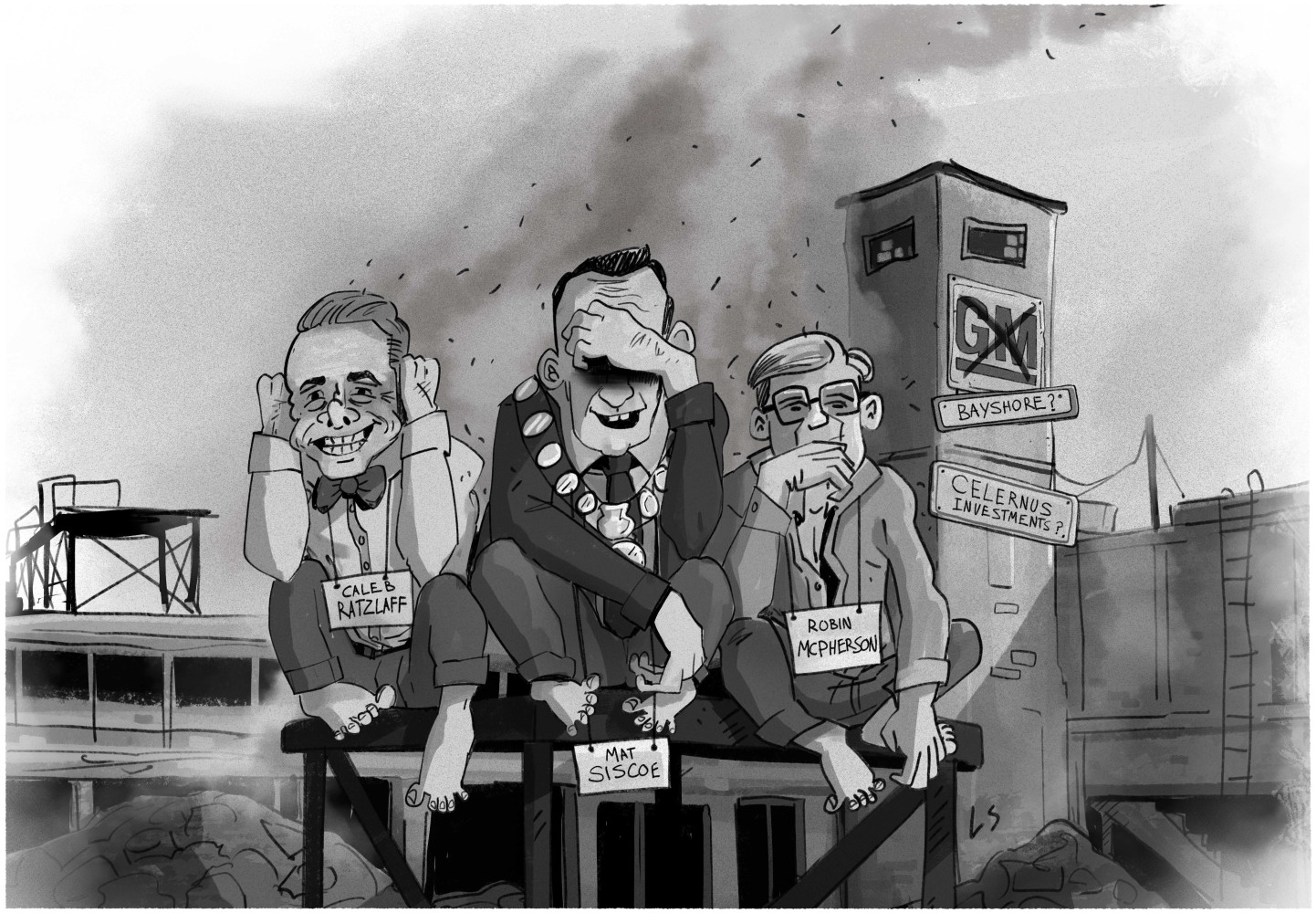
Hear no evil, see no evil, speak no evil in St. Catharines
Four years ago, St. Catharines voters elected a mayor and two Ward 4 councillors who had made promises about the future of the former General Motors property and what they would do to address the blight and safety concerns surrounding the massive 55-acre industrial site in the heart of the city.
Those commitments formed a big part of the political blueprint Mat Siscoe put forward when he was elected mayor, while Robin McPherson and Caleb Ratzlaff were chosen by voters to represent them in the St. Patrick’s Ward, home to the former GM lands.

A large billboard was paid for by The Coalition for a Better St. Catharines earlier this year, after residents grew frustrated with the failure of local elected representatives to act. (Ed Smith/The Pointer)
Now, four years later, all three are seeking re-election, while the property remains largely unchanged. Sitting in the heart of the city and surrounded by established neighbourhoods, businesses and green space, the 55-acre site has become a glaring symbol of deterioration and continuing concern for the community.
The developer responsible for the property, BayShore, has a checkered past, and the married couple listed as the company’s owners has repeatedly ignored its obligations.
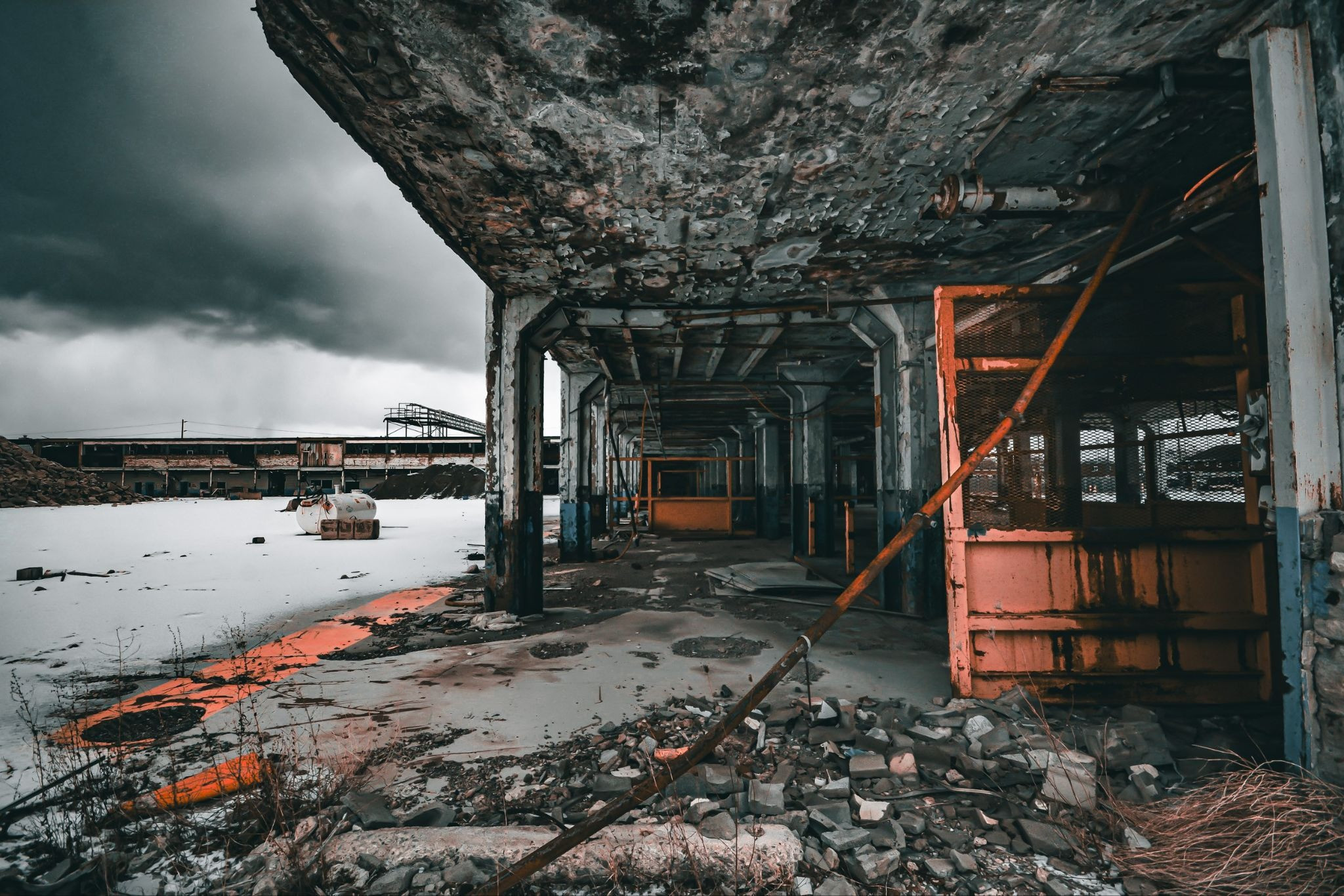


Residents are demanding candidates prioritize the clean up of the crumbling former GM site next to downtown, after those elected four years ago promised action on the 55-acre property, then ignored residents after they were voted in. (The Pointer file photos)
Buildings and structures have continued to crumble, documented safety hazards remain and asbestos has been identified in soil on the property. Environmental investigations have also documented contaminants of concern, including PCBs, petroleum hydrocarbons, polycyclic aromatic hydrocarbons and metals associated with the site's long industrial history.
For an increasing number of residents and business owners, the concerns extend beyond the physical condition of the property. Questions surrounding its ownership, the pace and effectiveness of municipal action, the extent to which the City has accommodated the interests of the site’s property owners and who will ultimately bear the cost of remediation have caused growing frustration over the City's handling of the site.
With four weeks left until the election The Pointer examines the promises that have been made by local elected officials hired to represent the residents of St. Catharines.
Mat Siscoe’s record on the former GM property extends back more than eight years, well before he became mayor in 2022. During his years as a Ward councillor he repeatedly made the site a prominent issue, describing the problems surrounding its redevelopment as “a major impediment to the quality of life” for residents of the St. Patrick’s Ward. He said City Hall needed to continue using “all options available to us” to bring the property to a point where residents could be proud of its redevelopment rather than frustrated by a stalled industrial site. He said there should be “no stone unturned” in pursuing solutions.
His campaign messaging on the former GM site has remained consistent: a commitment centred on urgency, action and concern about the property’s impact on the community. That theme was evident in his 2018 campaign for a seat on council and carried forward into his 2022 campaign for mayor.
Siscoe then decided to run for mayor and his election contributions that helped finance his 2022 campaign reveal the support he received from those tied to the former GM property.
His campaign-finance records show he received the maximum allowable individual contribution of $1,200 from two donors with direct ownership interests in the former GM lands, along with a significant number of other large contributions. In total, Siscoe received 37 separate donations of $1,000 or more during his 2022 mayoral campaign. In addition to the two donors with direct interest in the GM site were numerous other individuals with connections to the development industry in Niagara and elsewhere.
None of these contributions was unlawful, but they raise questions about Siscoe’s record on the former GM property. For residents and critics that have voiced frustration with what they regard as a lack of meaningful action on the site during his term as mayor, the campaign donations add another layer of concern.
For the first three years of Siscoe’s term, there was little progress at the site.
In June 2023, a stormwater containment and filtration system was put into operation after the Ministry of the Environment, Conservation and Parks (MECP) had identified ongoing PCB leakage from the site. The system was designed to capture contaminated stormwater and treat it before discharge, and residents were given assurances that it was operating and that PCB levels were no longer considered a problem.
Those guarantees fell apart two years later. In October 2025, The Pointer reported that Peter’s Environmental, the company contracted to install and maintain the system, had registered a lien of more than $1.7 million against the property over unpaid work. When asked whether the system was still functioning, City officials acknowledged that they had no idea and did not consider it their responsibility to know, stating at the time that “the city has not heard from these parties regarding these issues” while placing responsibility on the MECP.
The Pointer subsequently confirmed the filtration system had disconnected piping, open equipment hatches and a powered-down control panel, with the operation appearing to be inactive.
The system intended to prevent contaminated runoff from leaving the property had apparently been inactive, while neither the City nor the PC government publicly provided clear answers about who was monitoring or maintaining it. Subsequent reporting confirmed that the system was offline and may have been shut down as early as the end of 2023. Residents have subsequently been told by the MECP. The Ministry and the City have not provided any more information on the issue.
Then, as reported by The Pointer, in late 2025 Siscoe directed staff to proceed with a single-source contract of up to $250,000 for a secondary planning exercise encompassing the GM lands. He argued that the work was necessary to advance planning and development in the area. Critics, however, including senior City planning staff, had previously made it clear that meaningful secondary planning could not be done before the technical studies on the former GM site were completed by the landowner. A report from staff made it clear “it is imperative that any outcomes (of the planning process), are grounded in the realities of the site’s known constraints”.
Those technical studies are required before public planning processes can happen in order to establish the full extent of the contamination beneath the property: what hazardous substances are present, where they are located, in what concentrations and whether contaminants have migrated beyond the site.
The findings, once a full assessment is done, are critical to determining the environmental and public-safety constraints that will govern the property’s future, including what can safely be built there, what areas may require extensive remediation or containment and what measures will be necessary to prevent further exposure or off-site movement of contaminants. No such study has been done. Until that work is completed the true scale of the environmental challenge, and the limitations of any future redevelopment, cannot be fully understood.
Despite those warnings, Siscoe used his strong mayor powers to direct the City to undertake a single sourced secondary planning process, committing significant municipal resources to develop a plan which is in no way binding and could ultimately have no practical value. Once the landowner does decide to do the technical studies (the City can not force them to be done), it is possible that if the land is too badly contaminated, nothing identified in the secondary plan could ever be built on the site. In effect, Siscoe used his strong-mayor powers to create a secondary plan that is not “grounded in the realities of the site’s known constraints.”
Then, in February this year, Council debated concerns about the giant metal catwalk spanning Ontario Street, a structure attached to a partially demolished building on one side and supported by a steel tower on the other. Residents raised concerns that the deteriorating condition of the surrounding property increased the potential of a collapse of the catwalk.
Rather than commissioning its own independent assessment, the City relied on an engineering report obtained by the property owner that concluded the bridge itself was in good condition, but it also explicitly stated that its foundations were not visible during the inspection and that the review focused exclusively on the bridge framing. Despite those glaring gaps, Siscoe argued the report established the structure was safe for vehicles and pedestrians travelling beneath it.
For residents who had already lost confidence, the decision to rely on an assessment commissioned by the owner, rather than an independent municipal inspection, became another source of concern.
In April, Siscoe again invoked his strong mayor powers, this time directing staff to prepare a plan that offered financial incentives intended to encourage the property owners to proceed with remediation and redevelopment of the former GM lands.
The resulting Community Improvement Plan (CIP) proposed that municipal tax dollars be granted to the developer in exchange for a completed remediation and redevelopment of the site. The CIP provided the opportunity for the developer to receive 100 percent of its remediation costs from the taxpayers; a cost Siscoe has publicly put at $100 million or more.
The plan also allows the property owner to claim certain eligible costs incurred as far back as five years before entering into an agreement with the City. That means taxpayers could potentially be responsible for qualifying costs associated with work carried out years before the municipal incentive agreement was even in place.
His calculated decision to use strong mayor powers to force this proposal in the final hours of his first term as mayor was seen by some residents as a contradiction to the assurances he had repeatedly given at town hall meetings over the previous 12 months. Multiple times in the various wards of the city, Siscoe expressed that he would not expose residents to the financial burden of cleaning up the former GM property.
For Gwen Kennedy, director of the citizens advocacy group The Coalition for A Better St. Catharines, Siscoe’s CIP plan marked a stunning turn of events. “I attended town hall meetings where he (Siscoe) used the $100 million cost of a clean up as a fear tactic and claimed that he would not take on anything that put such a burden on the local taxpayer. Now we see a plan that comes directly from him, involves no consultation with the public or his council and puts the entire cost on the residents of this city. It's a betrayal of everything he has been saying for the past nine months.”
Ultimately, his proposal at Council failed to progress. After hearing from residents who strongly opposed the plan, Councillor Kevin Townsend immediately brought forward a motion to defer the debate. Council supported Townsend's motion, and the proposal was taken off the table. It could, however, be revived by Siscoe if he is re-elected and chooses to bring it forward again.
For Caleb Ratzlaff, the 2022 campaign marked his first run for municipal office and the beginning of his political record on the GM property.
Once he entered the race for a council seat in 2022 he wasted no time in identifying the GM site as a hot button issue, using it to help propel him into office. His campaign was direct and to the point in regard to the GM site.
He called what had happened at the former industrial property “a travesty”, while promising to use “all the tools at the city’s disposal to “move the GM site forward safely”. In a video he only recently took down from the internet he had himself filmed walking the perimeter of the site as he talked about the burden it placed on the community, while accusing the owners of the property of being “scumbags”, summing up his campaign position with a strong and hopeful statement: “We can’t afford more delays.”
His council ward mate Robin McPherson’s political history with the property predates the 2022 election. She first ran, unsuccessfully, for council in 2018, before being appointed to fill a council vacancy that occurred in early 2022. She subsequently won the seat in the October 2022 municipal election.
Throughout her various campaigns, McPherson emphasized the City’s authority to act on the former GM lands. She criticized council for “kicking the can down the road” on important decisions, including progress on the property, and argued that property standards should be used to compel the owner to address what she described as a “huge eyesore”. Her comments reflected the same basic expectation she would carry into office: that the City had both the authority and responsibility to take meaningful action on the property and once elected she would do her part to make things happen. While campaigning in 2018 she said, “... the (GM) property is a huge eyesore and property standards should be forcing BayShore (the developer) to clean it up,” adding that nearby residents were concerned about health problems. She argued that the City should exercise the powers available to it under the Municipal Act.
Her 2022 campaign finance document states that, like Siscoe, she received the maximum allowable individual contribution of $1,200 from the same two people with ownership interests in the property.
Together the two ward councillors along with the mayor have used the site as a platform for building a populist consensus on the need for action during their campaigns; their follow-up once elected to public office has left residents to wonder.
Kennedy explained how the Coalition has closely tracked what it considers a lack of meaningful progress at the property. She cited the continued deterioration of buildings and structures, the inoperable condition of the stormwater filtration system, the ongoing investigation by the MECP which she said has raised more questions than it has answered, the unresolved risks associated with the large catwalk spanning the property above traffic and pedestrians, as well as the recent confirmation of asbestos in soil at the site.
Taken together, Kennedy argues, these issues demonstrate that the risks are far from being resolved and that most of the issues have only become more serious as the site continues to deteriorate with the passage of time.

A bus ad taken out by The Coalition for a Better St. Catharines. It has sponsored two transit bus ads in its continued efforts to force elected officials to finally take action at the former GM site. (Supplied)
While The City's own Property Standards enforcement officers eventually documented the extensive deterioration at the site, residents have asked why it took an impending municipal election for city officials to finally send an inspector onto the property. Kennedy noted that despite these late efforts nothing has changed, as those orders have been appealed. The property owners have now taken the matter to Ontario's Superior Court of Justice.
While the Coalition is seeking to ensure that residents’ concerns and interests are represented in court, Kennedy says the problem should never have reached this point.
“With dangerous structures, tunnels, open shafts, and asbestos throughout, it is essential to the health of the community to expedite compliance with the city’s orders,” Kennedy said. “I can’t help but wonder why it should be like this. Why should it be left to residents to defend themselves against threats like this, what about all those promises that were made throughout the years?”
Many residents, she said, have lost confidence in the City and their elected officials, leaving the Coalition with no choice but to seek intervenor standing in the coming court case.
“We felt compelled to seek standing. The judge should hear what we think, feel and live with because of this site. Our elected officials and the City as a whole have not shown us that they are up to the task.”
The Coalition has been persistent in its fight over the former GM property since shortly after demolition work on the site was halted in 2018. In January 2020, the group presented the City with a petition demanding action and warning about the dangers the property posed to the surrounding community at the time. The petition carried approximately 2,200 signatures from St. Catharines residents, the vast majority lived in neighbourhoods immediately surrounding the property.
In response, then-councillor Siscoe supported a motion with his then ward mate Karrie Porter addressing the GM property and claimed: “Councillor Porter and I would wager every member of council has said if there’s a stone we can overturn to try and fix whatever we can fix, we’re going to do that.”
That type of language has become part of the political legacy of the property: strong claims and assurances, followed by years of inaction and political excuses.
For critics, the former GM site has become a recurring symbol of unfulfilled promises, an issue that gains prominence during election campaigns, only to recede once the votes are counted as the complexities of the property, its ownership and its environmental challenges are once again cited as reasons for delay. The result, they argue, is a familiar cycle: promises of action during campaigns, explanations for inaction once elected, and the same unresolved property waiting for the next election.
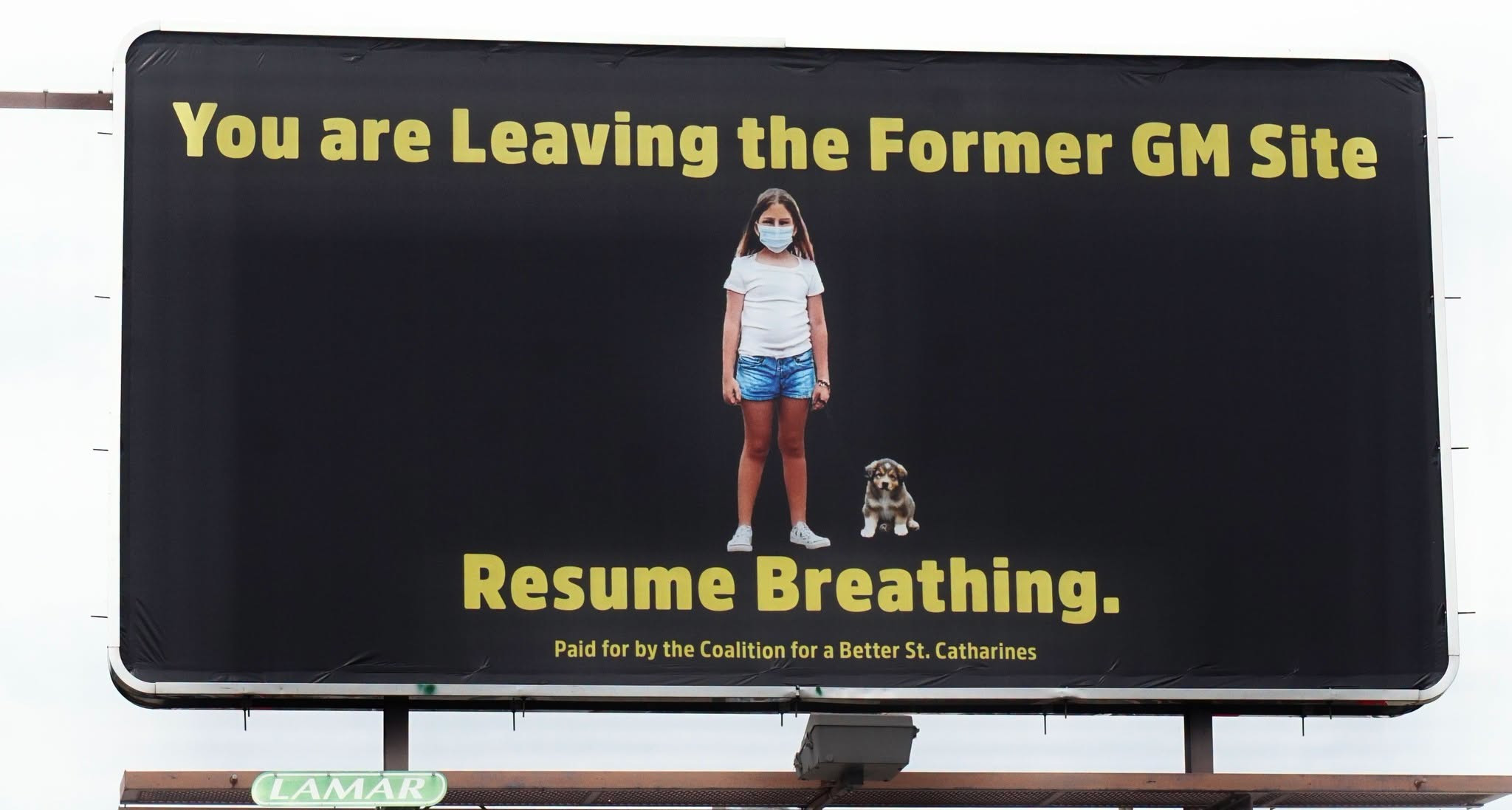
Despite strong words and promises from the mayor and ward councillors, residents say they are no better off than they were four years ago. Another billboard was erected this month. (Ed Smith/The Pointer)
That is not to say absolutely nothing has been done by the city.
In 2024, McPherson and Ratzlaff promoted a community project to paint the plywood hoarding surrounding the site. They called it Renew the View and billed it as a way to “Build a brighter united community”. In the fall of that year they held a “Community Paint Day” bringing residents from the surrounding neighbourhoods together to create murals “celebrating their community”.
For frustrated residents, painting the fence became a symbol of the gap between elected officials and their constituents as they decried what they saw as an attempt to “paint over” and normalize the problems. Many questioned the decision to invite families including young children to participate in an event on an industrial site that has been described by the mayor himself as among the most toxic in the province.
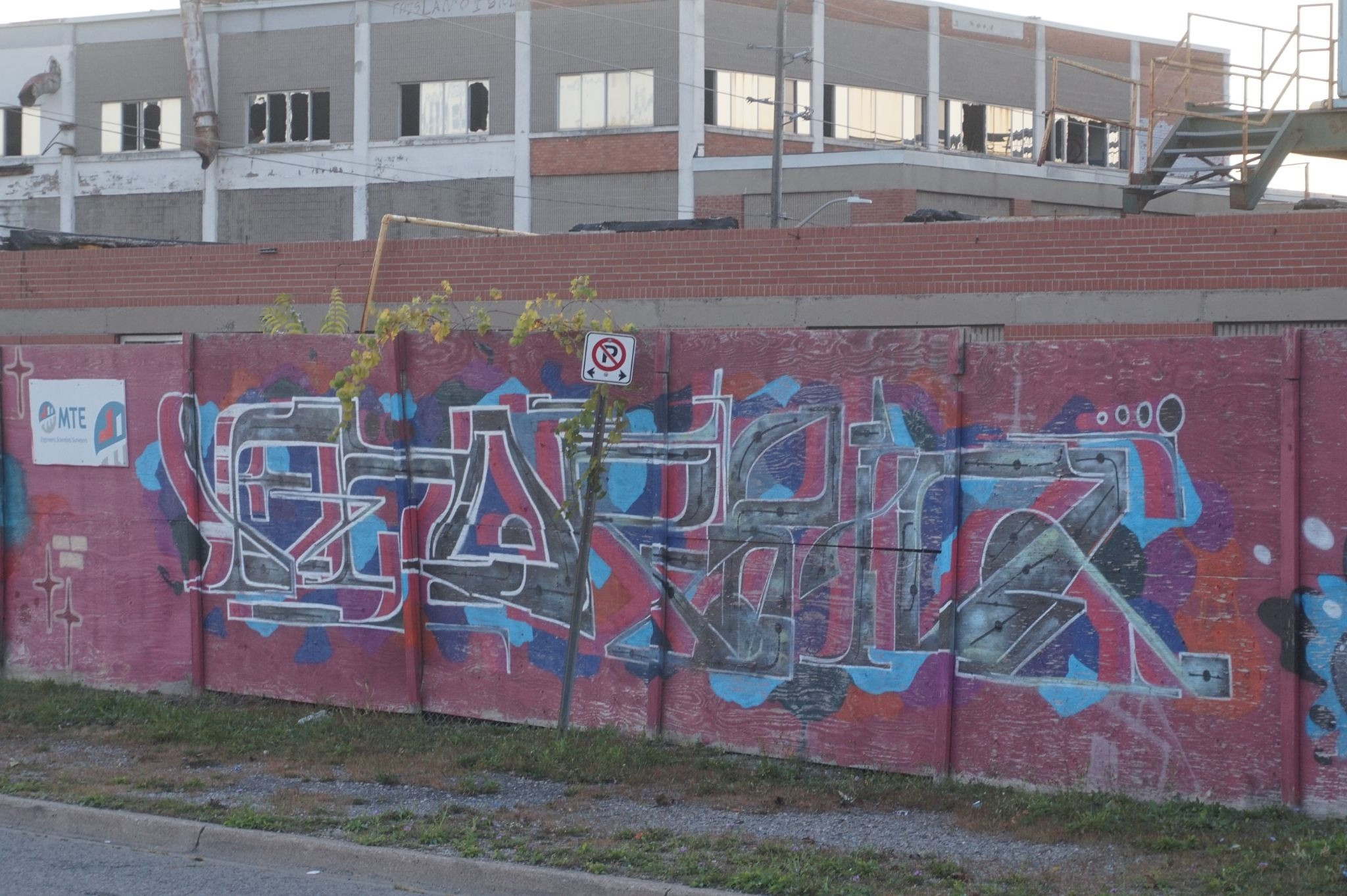
“Renew the View”, a city sponsored program to “Build a Brighter, United Community” by bringing people together to paint the plywood fencing that surrounds the former GM site. By 2026 the shine was fading. (Ed Smith/The Pointer)
As this political term draws to a close the site remains much the same as it was four years ago. It has not gone unnoticed.
Kennedy says, “another four years has elapsed, four years of empty promises and Mayor Siscoe and Councillors Ratzlaff and McPherson have changed nothing.”
Email: [email protected]
At a time when vital public information is needed by everyone, The Pointer has taken down our paywall on all stories to ensure every resident of Brampton, Mississauga and Niagara has access to the facts. For those who are able, we encourage you to consider a subscription. This will help us report on important public interest issues the community needs to know about now more than ever. You can register for a 30-day free trial HERE. Thereafter, The Pointer will charge $10 a month and you can cancel any time right on the website. Thank you
Submit a correction about this story

