
‘Residents heard loud & clear’: Mississauga council unanimously approves one-year moratorium on AI data centres
Forty-nine days after first moving to freeze new approvals, Mississauga has officially hit pause on large-scale data centre development for one year, to study the environmental and social impacts of one of the fastest-growing pieces of the voracious digital economy.
“You have been heard loud and clear.”
That is what Ward 9 Councillor Martin Reid told residents gathered at Mississauga City Hall Wednesday morning, moments before council voted 10-1 to make the decision without hearing from members of the public who had hoped to address the future of data centres in the city. Ward 7 Councillor and mayoral candidate Dipika Damerla was the only member who voted against the motion brought forward by Mayor Carolyn Parrish to move directly to a vote on the interim control bylaw (ICBL) — bypassing the 21 delegates who had come to City Hall to speak on the issue.
Though Damerla and residents supported the central issue that was approved moments later, they disagreed with the decision to cut out the public from further debate before the eventual decision was made.
“I dislike the idea that people were denied the ability to speak their voice,” resident George Tavares, who registered to delegate and is also running for Ward 7 in the upcoming elections, told The Pointer.
“What if one or two people that were in favour of the data centre, and they wanted to say something…this is a gap, and it means the City of Mississauga didn’t follow their parliamentary procedure.”
Tavares fears residents who registered to delegate on the ICBL but did not get the opportunity to speak because council moved directly to a vote could potentially be subject to Council Procedure By-law 0044- 2022's 12-month restriction on speaking on the same subject again.
The City confirmed that the bylaw provision won’t apply to the residents since “they did not speak” at the council meeting. “They can speak on this topic in the future,” a spokesperson clarified.
Reid emphasized that moving directly to a vote was not about silencing residents: “We’re saying that we’ve heard your voice loud and clear, and we’re trying our best to move this forward in the best possible way.”
“We did have a number of hours of deputations previously,” Ward 6 Councillor Joe Horneck added, referring to the council meeting on July 29, when a fulsome public dialogue unfolded with hours of delegations from residents before council voted for a more detailed staff report on data centres and how an interim control bylaw would be shaped.
“Any information that’s come between now and then has further supported the need for the control bylaw.”
Shortly after the decision, council members voted unanimously in favour of the ICBL temporarily prohibiting the development of data centres and other “Major Digital Infrastructure Facilities” with a total peak load power demand of 10 megawatts or greater.
In July, Prologis officials had warned that if the ICBL passes, the real estate firm would appeal the decision at the Ontario Land Tribunal (OLT).
“I am happy as a taxpayer to contribute to a legal fight, to show leadership and to set a precedent for other municipalities to finally follow someone that has the spine to stand up against corporations that love to lobby and make a quick buck,” Ward 8 councillor candidate Rahul Mehta said during the July council meeting.
The Pointer reached out to Prologis for comment but did not receive a response ahead of publication.
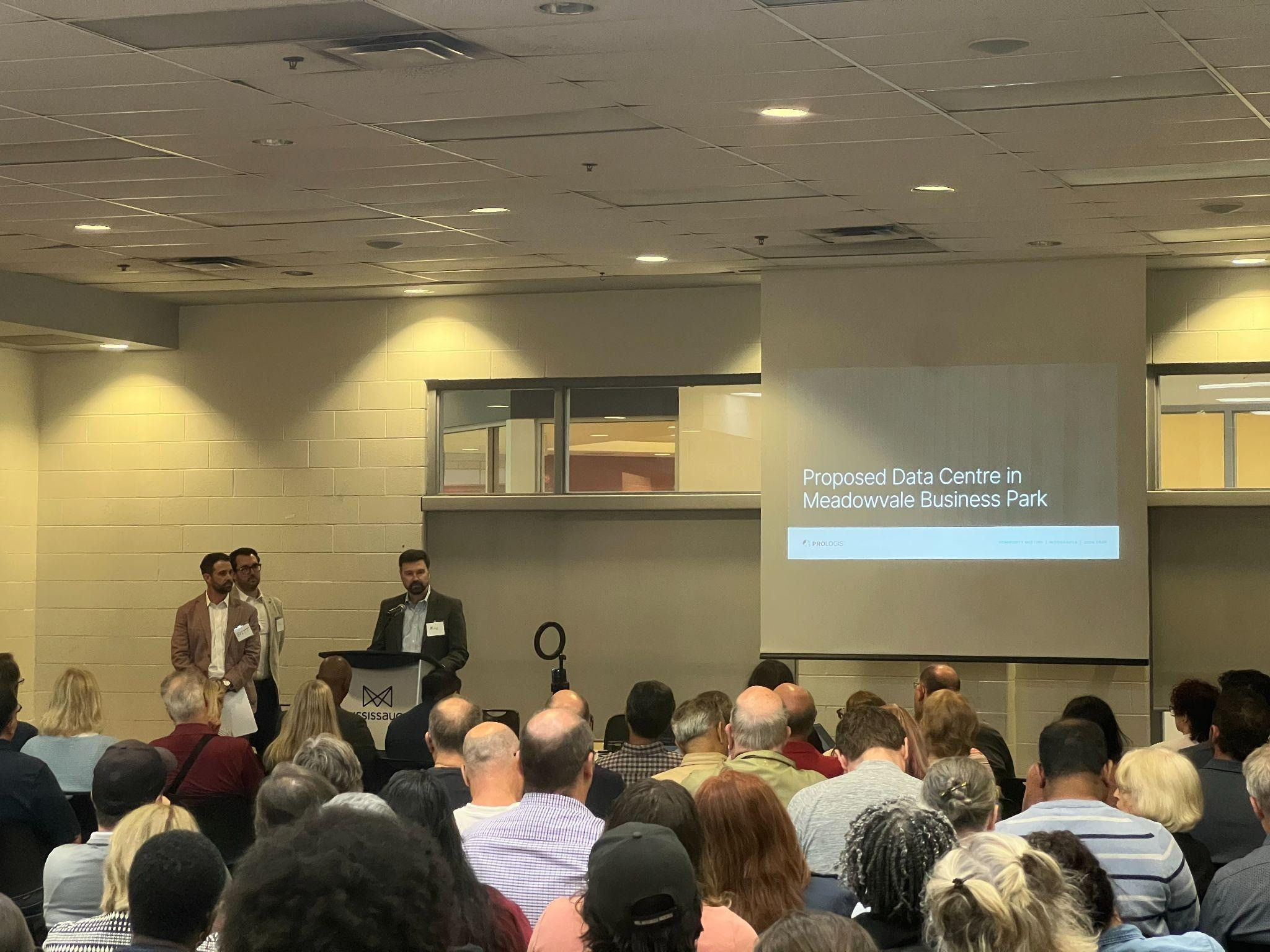
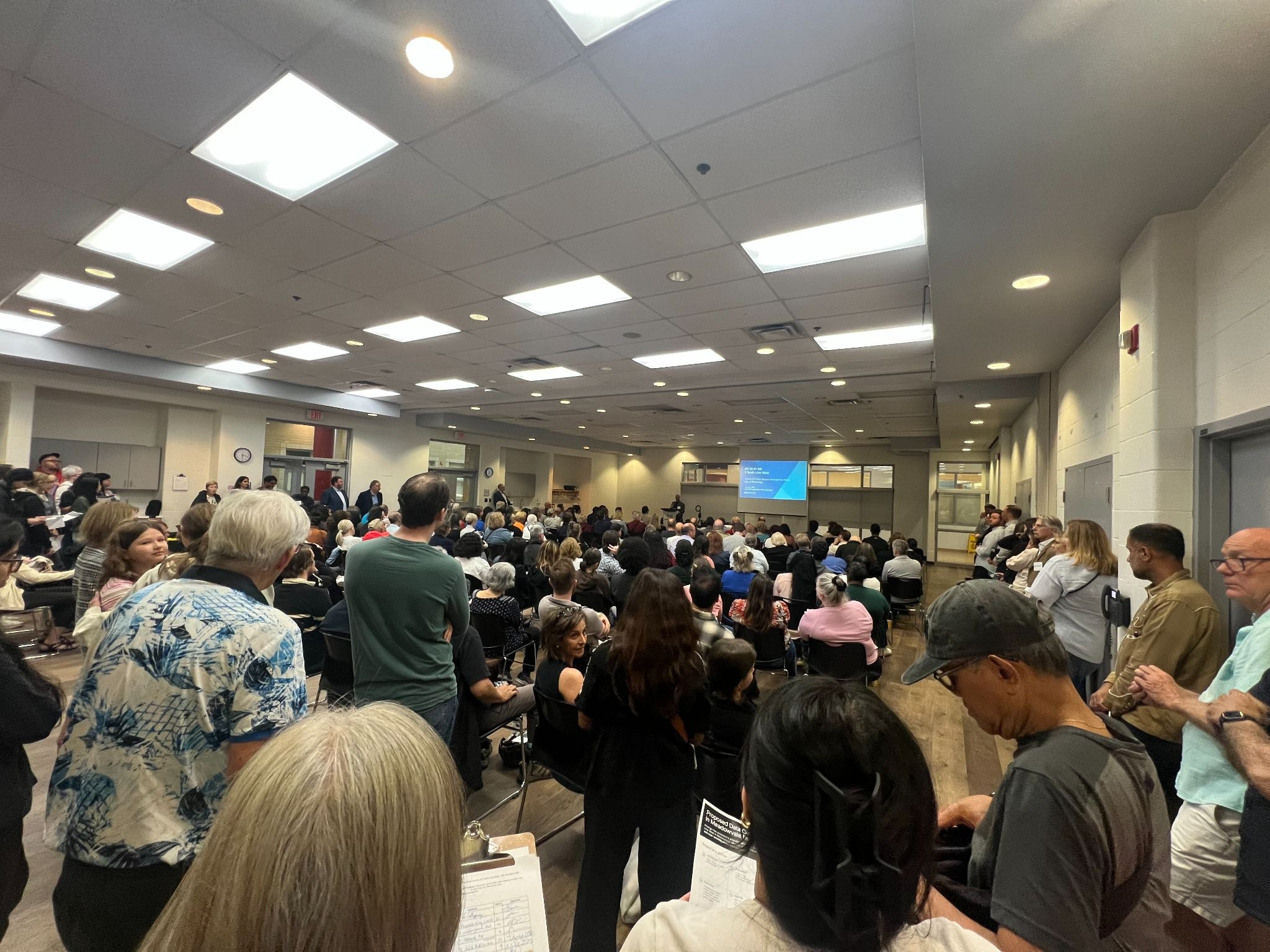
Three representatives from Prologis walked attendees through basic information about the proposed data centre at a Town Hall in June but residents felt key details that relate to their concerns were missing. (Anushka Yadav/The Pointer)
The interim control bylaw gives the City up to one year, with the flexibility to extend the freeze for an additional year if necessary, to step back and examine whether current planning rules are equipped for facilities whose demands can extend far beyond the walls of the buildings themselves, ranging from electricity and water consumption to noise, heat, emissions, infrastructure capacity and potential impacts on public health and the environment—concerns that residents had explicitly made clear during a public Town Hall meeting on June 25.
The comprehensive review will also consider the roles of the provincial and federal governments in regulating the sector.
Once the detailed study is complete, staff will bring recommendations to council to guide future planning policies and regulations for artificial intelligence and cloud computing along with the physical infrastructure required to power it, as mass-scale computational applications that require vast resources become more and more common in our rapidly advancing digital/information economy.
While Mississauga currently permits data centres in designated Employment Areas, the City's zoning framework does not specifically define them; instead, they are classified under “Warehousing, Distribution and Wholesaling or Science and Technology Facilities”, rather than as dedicated AI infrastructure.
The scale of newer proposals has prompted the City to examine whether those classifications remain appropriate. Critics believe they are outdated, shaped long before the scale of current and future resource consumption for modern operations was properly understood.
City staff clarified the bylaw would not apply to facilities that were “legally existing” prior to Wednesday’s vote, or to projects that had “received building permits prior to the date of the ICBL,” meaning those projects could be carved out of the one-year pause.
However, it prevents the conversion or enlargement of certain existing warehouse, distribution or science-and-technology facilities where computer systems and servers would push the resulting facility's peak power demand to 10 megawatts or more.
“This is your win today,” Damerla told residents.
“You guys sounded the alarm. You guys came forward. You guys advocated, and if there’s an ICBL that passed today, and there’s a moratorium on data centres, it’s because of you.”
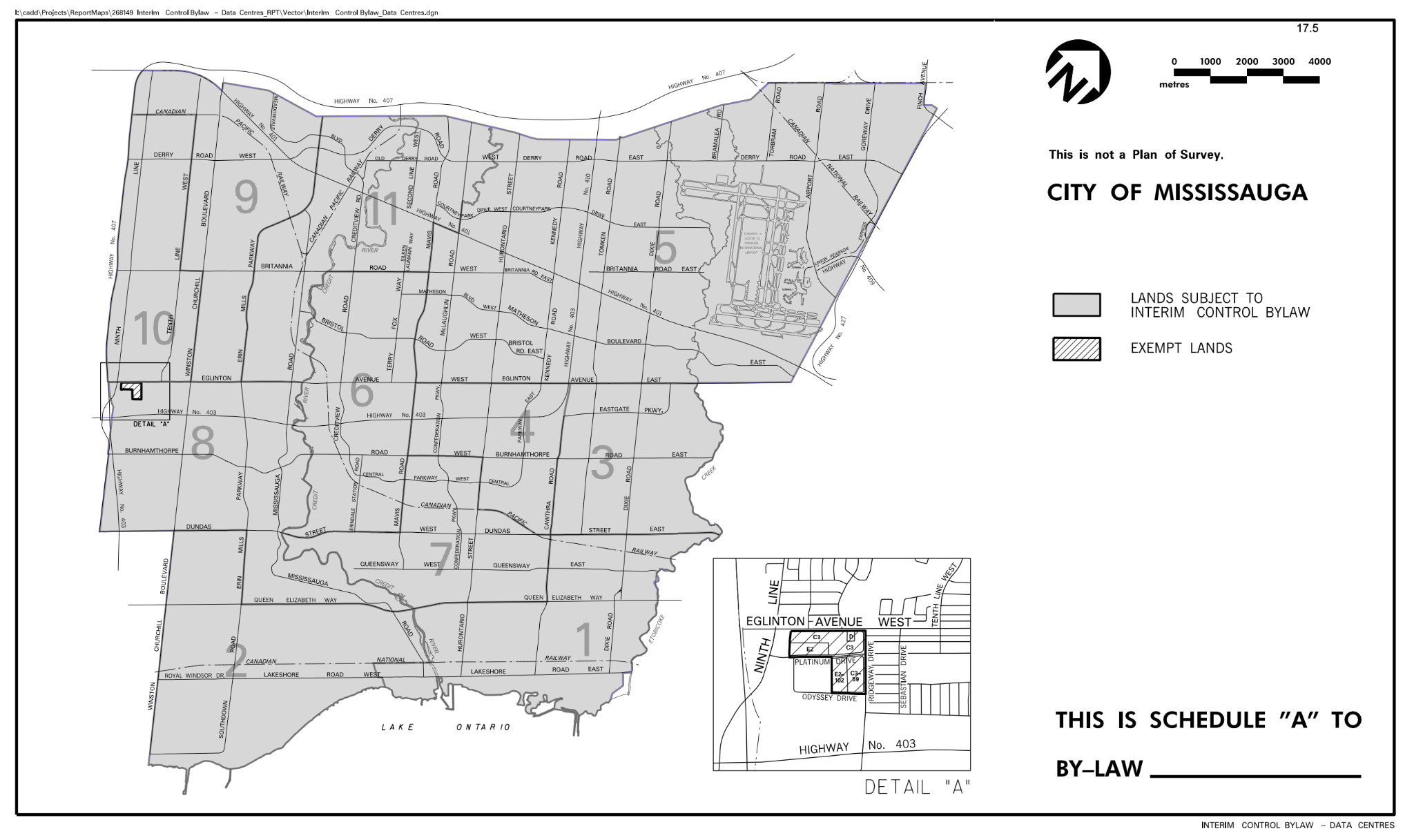
The September 16 interim control bylaw applies to all lands within Mississauga, restricting their use for “Major Digital Infrastructure Facilities” while City staff reviews Official Plan policies and zoning regulations; it excludes the construction, conversion or enlargement of facilities with a total peak load power demand of less than 10 megawatts. (City of Mississauga)
While many residents are “really happy” with council’s latest move, Tavares reminded that the ICBL is “a 12-month ticking time bomb”.
“All we've done is push the goalposts back…The people of Mississauga now have to do as much work as the council,” he reminded.
“We now have to reach out to all of the MPs and MPPs across Ontario to make sure that they start asking the right questions and try to push a better version of data centres in the city or in Ontario, or else, all we do is push it back a year, and we’re still going to have data centres and the worst version of it.”
Ward 10 Councillor Sue McFadden expressed disappointment that the province failed to deliver on its promise of outlining the “guardrails” for data centres by September 15.
“By putting in this interim control bylaw, hopefully, within the next few months, we will get that information and we can move forward with it,” she said.
The province proposed data centres cover the full costs of their electricity use and any generation or transmission upgrades they require rather than shifting those costs onto other ratepayers. It also supported technologies like closed-loop and waterless cooling, noise-reduction measures and waste-heat recovery to reduce unwanted impacts.

Ontario has a choice: we can build the economy of the future and ensure Canadians’ data remains in Canada, or we can get left behind and risk Canadians’ data being sent to the U.S. and elsewhere,” Premier Doug Ford said on August 13 as he unveiled the province’s Data Centre Playbook. (Doug Ford/X)
While a “step in the right direction”, critics identified “huge gaps” in the playbook regarding transparency, public oversight, and environmental protection that leave Ontarians vulnerable to rising energy costs and uncoordinated development.
Shion Guha, a University of Toronto professor and public-interest technologist who studies AI governance, viewed the guidance, which lacked details or enforcement, as a “missed opportunity” feeding into a “vicious cycle” of reactive governance.
The Ford government did not address Indigenous consultation or provide a clear timeline for turning the Playbook into legislation, leaving the long list of questions that prompted municipalities to impose their own moratoriums unresolved.
A recent Leger poll shows a deep divide among Ontarians’ support for AI data centres in the province: 44 percent supported the development of data centres used for artificial intelligence in Ontario while 43 percent were in opposition.
Across Canada, two concerns remain top of mind when it comes to potential impacts of data centres: higher household electricity bills, cited by 81 percent of respondents, and environmental impacts such as electricity and water use and greenhouse gas emissions cited by 79 percent.
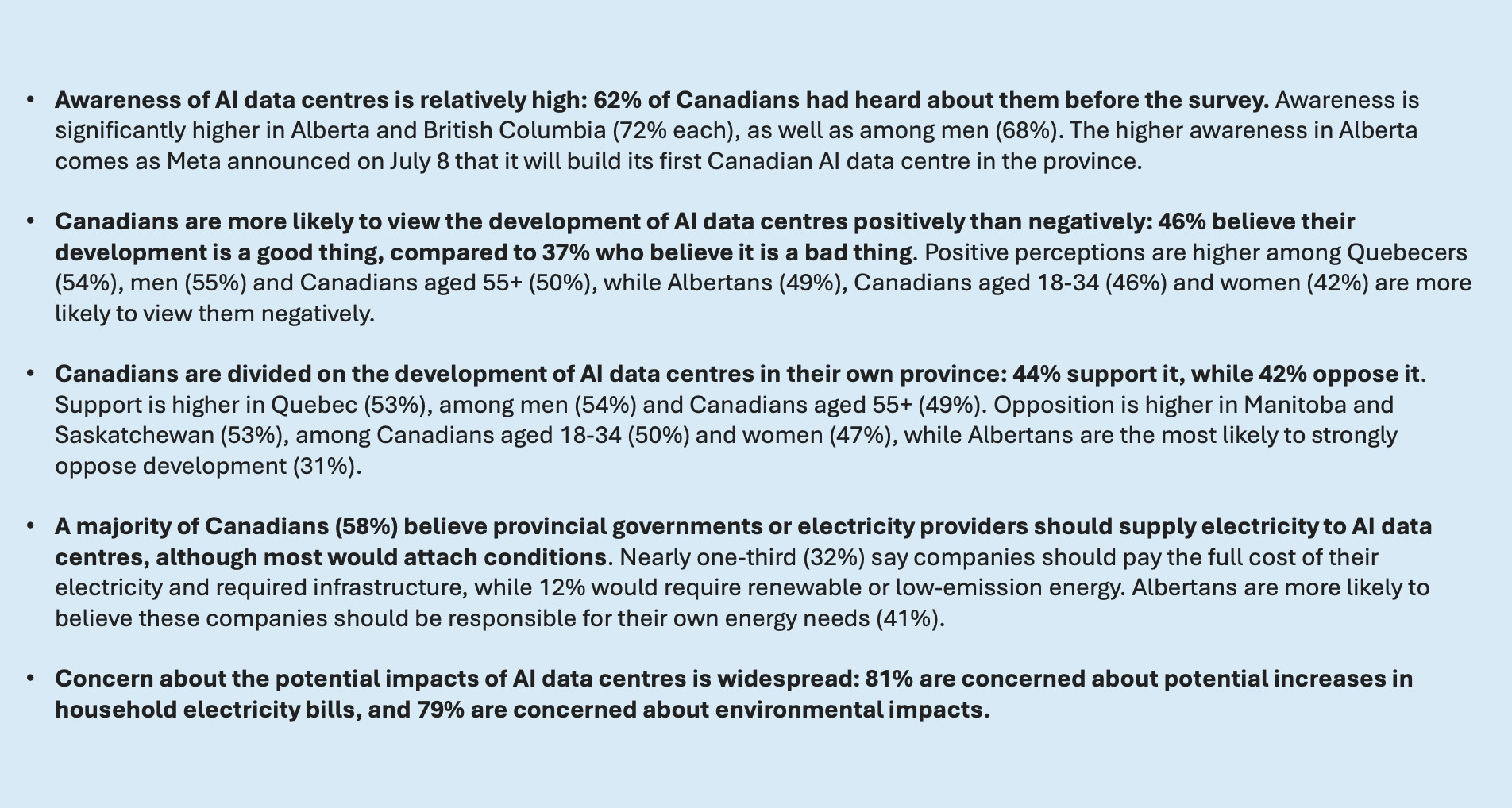
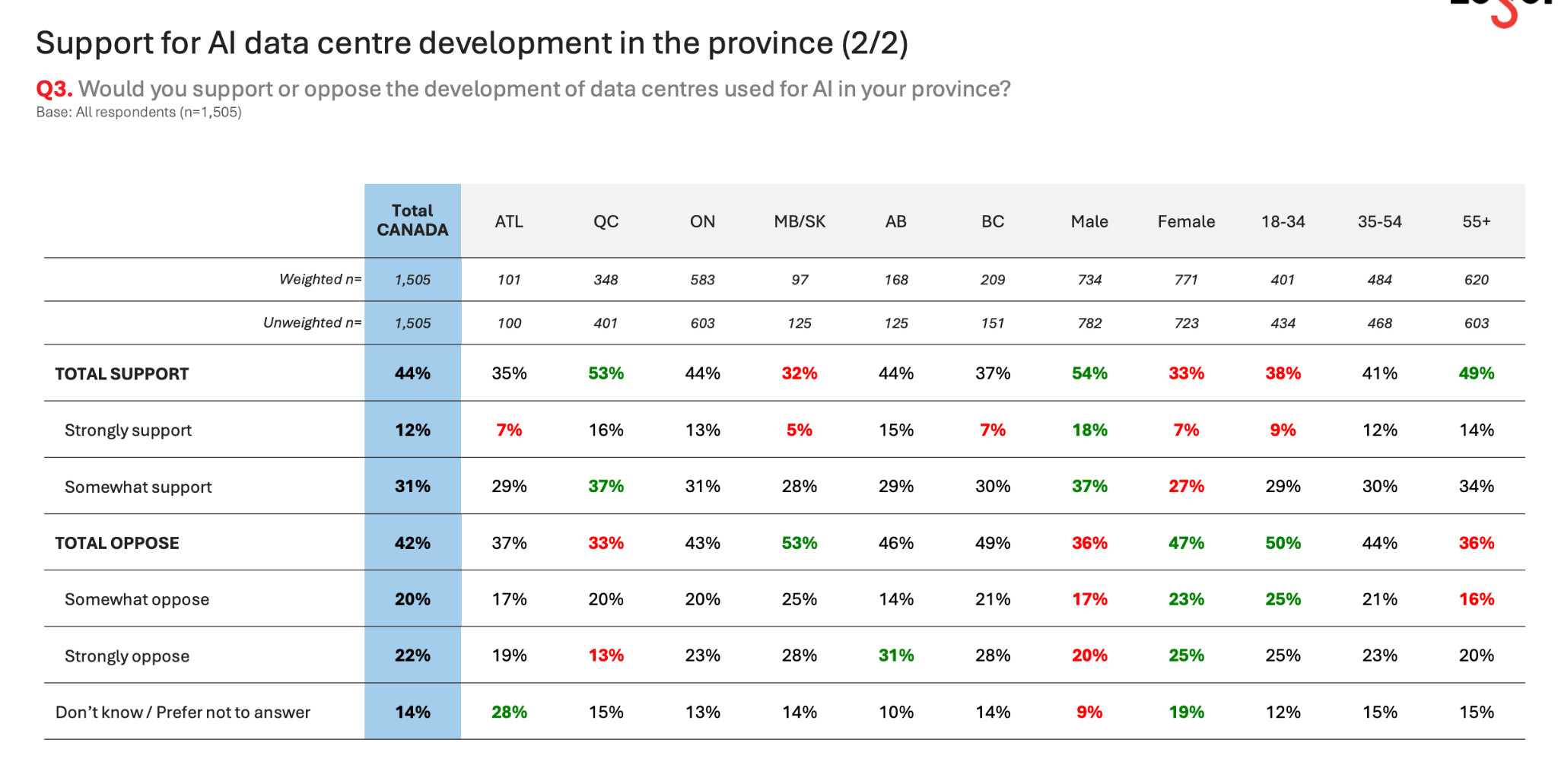
“Canadians generally recognize the potential value of investing in AI infrastructure…Opinions become more divided when development is proposed within respondents’ own province. Nationally, 44 percent support AI data centres in their province, while 42 percent oppose them,” a new Leger poll found. (Leger)
On September 3, Ottawa released its own AI framework, titled ‘Canada’s Responsible Data Centre Development Principles’, which set out five expectations namely: projects create lasting local benefits, avoid shifting electricity costs onto Canadians, minimize water use and environmental impacts, be transparent about local impacts and provide strategic value to Canada.
Amazon Web Services, Anthropic, Bell Canada, Cohere, eStruxture, Hypertec, Meta, Microsoft, OpenAI and Telus are among the companies listed as signatories that support the principles.
However, much like Ford’s plan, the framework is non-binding.
It also does not create a new federal approval process. Federal AI minister Evan Solomon emphasized that provinces, territories and municipalities retain their existing responsibilities.
“This is not for the federal government to say what a city, a town, a rural place in a province or territory should ask — but they should be armed with the fact they are beginning not three steps back, but three steps ahead,” Solomon said.
He continued, “if we don't build the infrastructure of the future here, we will have to buy it from somewhere else. And if we don't innovate here, we will rent that from someone else.”
Email: [email protected]
At a time when vital public information is needed by everyone, The Pointer has taken down our paywall on all stories to ensure every resident of Brampton, Mississauga and Niagara has access to the facts. For those who are able, we encourage you to consider a subscription. This will help us report on important public interest issues the community needs to know about now more than ever. You can register for a 30-day free trial HERE. Thereafter, The Pointer will charge $10 a month and you can cancel any time right on the website. Thank you
Submit a correction about this story

