
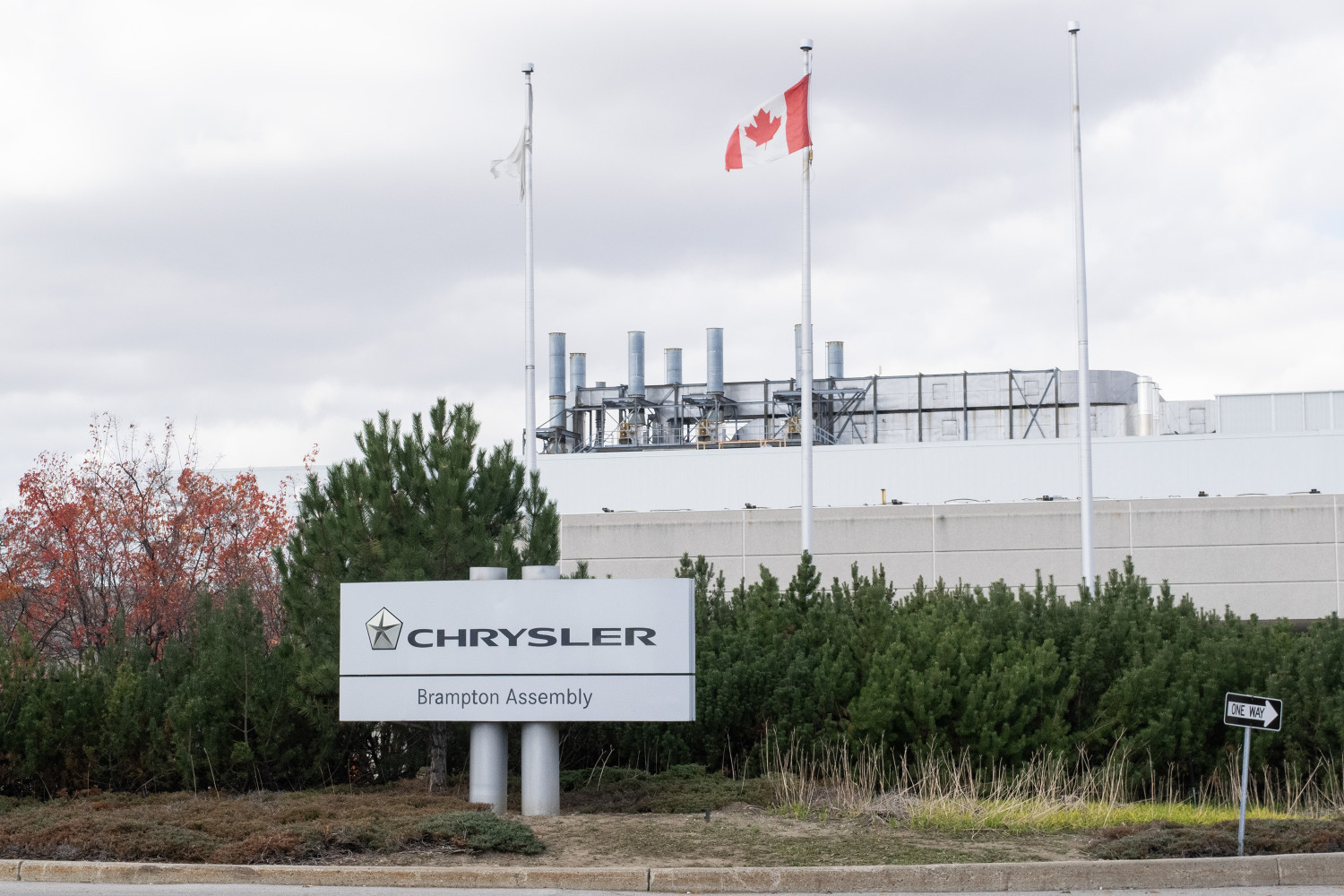
Stellantis ‘seriously considering’ selling Brampton Assembly: Unifor warns thousands of jobs at stake
The Stellantis Brampton Assembly Plant that has been idle for nearly three years and the subject of repeated broken promises from its Netherlands-based owner, is now facing its most serious threat yet after word the company is considering a permanent closure and sale.
Unifor, the union representing more than 2,200 laid-off workers at the 2000 Williams Parkway facility, says the automaker told them this week it is “seriously considering” shutting the plant down for good, a move the union warns would wipe out thousands of jobs across Brampton’s economy, ending nearly four decades of vehicle assembly in the city.
Unifor National President Lana Payne told reporters at a press conference in Toronto on Friday, August 14, that Stellantis informed the union two days earlier of its intent to open discussions with another firm about a potential sale of the Brampton property.
Payne called the situation a “lose-lose scenario” for both workers and the automaker, and said she was making the information public to avoid any misunderstanding among the roughly 3,000 workers who once built cars at the plant.
In the August 14 press conference, Vito Beato, President of Unifor Local 1285, attempted to remain optimistic.
“I look forward to discussing opportunities for our plant and a path back to vehicle production when we get to the bargaining table because closure is not an option,” he said. “To give up on workers now is the wrong move because these jobs are way too important to lose.”
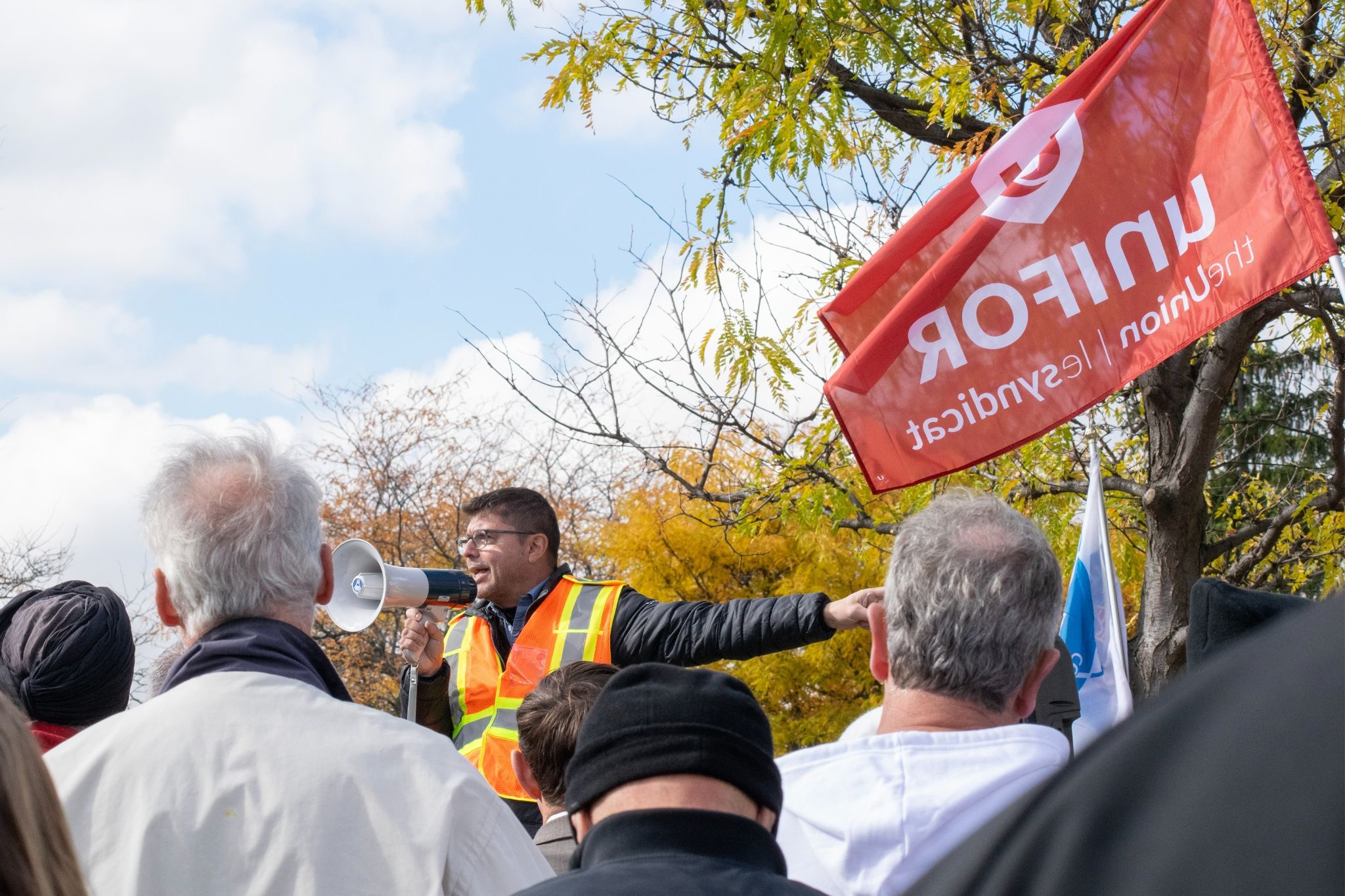
Vito Beato, President of Unifor Local 1285, said that “closure was not an option” for the Brampton Stellantis plant.
(Alexis Wright/The Pointer)
Unifor stressed the company has not issued formal written notice of closure, and that no buyer, sale agreement or transaction timeline has been made public.
Under the union’s collective agreement with Stellantis, the company must give at least one year’s notice of any closure or sale.
The Pointer reached out to Stellantis spokesperson Lou Ann Gosselin for comment. In an emailed statement, Gosselin said, “We are preparing to enter the collective bargaining process and have nothing to announce at this time. Our focus remains on finding a sustainable manufacturing solution for Brampton Assembly.”
The statement echoes the company’s repeated, vague assurances over much of the last year.
Unifor says the potential closure is tied directly to the fallout from U.S. tariffs on Canadian-made vehicles imposed under the Trump administration. The union has spent the past 18 months calling for federal action to prevent exactly this kind of threat to Canada’s auto sector.
Unifor sent out a national statement addressing the rumours of imminent closure.
“The closure of the Stellantis plant would cause a serious reduction in Canada’s automotive footprint impacting thousands of jobs across the region,” the statement detailed. “There is no replacement for the high-paid, union jobs developed under auto sector collective agreements built up over 80 years.”
Union officials will be connecting with company executives and every level of government in the coming days.
“Our members can be assured that we will use the opportunity of upcoming contract negotiations with Stellantis to discuss this matter and to ensure jobs and incomes are protected to the best of our ability,” the statement reiterated.
With the worst-case scenario now knocking on the door of thousands of Brampton auto workers, some may have already seen the writing on the wall after years of ill-defined assurances and signs the company was slowly pulling away from its Brampton operations.
At the start of last year, the nearly four-decade-old assembly plant in Brampton was in the midst of a $1.3 billion renovation to enable production of the next-generation Jeep Compass, a compact crossover SUV, including hybrid and fully electric models; production of the North American Compass model was scheduled to start in late 2025.

Latest Statistics Canada data suggests the timing could have been favourable for Jeep Compass in Canada as electric vehicles accounted for 11.5 percent of new vehicle registrations in June, up 56 percent for the same month last year. In Ontario as well, EVs reached a record 9.4 percent of new vehicle sales, nearly double the share recorded in June 2025.
(Jeep Canada)
When the retooling was announced in 2022, the modernization came as a huge relief to the almost 3,000 workers at the plant who had endured years of uncertainty after Stellantis had made clear the longtime production of Chrysler and Dodge vehicles made in Brampton would be coming to an end (Stellantis North America replaced Fiat-Chrysler in 2021 after the giant Dutch-owned manufacturer had previously merged a number of car makers).
Then, in February last year, the retooling effort was paused amid the uncertainty created by U.S. President Donald Trump’s tariffs on the auto sector.
It has been downhill ever since.
Around the same time the retooling was put on hold, Stellantis sold off 32 acres of the giant property at 2000 Williams Parkway to Dream Industrial Limited for $80 million. While Stellantis described the sale as part of an effort to streamline operations and optimize its real estate portfolio, the timing alongside the work stoppage raised concerns about the automaker’s long-term presence in Brampton. With Stellantis prioritizing Jeep Compass production in Italy at the time, the land sale sparked growing speculation that Brampton’s role in the company’s North American manufacturing strategy was being squeezed.
Unifor raised concerns at the time that the sudden work pause in Brampton could have a bad outcome in an increasingly tense sector. In a press release on February 20 last year, Payne called the decision to stop retooling plans in Brampton from moving forward a “matter of grave concern”.
“The company has reassured the union that vehicle production plans are still in place for Brampton, although the timing of this announcement raises very serious concerns for Unifor members both in the plant doing the retooling work and those on layoff (since the previously manufactured Chrysler and Dodge models stopped production),” he noted.
The automaker assured its workforce the pause would only last eight weeks. While this optimistic message was conveyed to Brampton workers, Stellantis officials appeared less sure of the plant’s future.
In April last year, Doug Ostermann, the Chief Financial Officer of Stellantis, during a conference call with analysts, said the company would have to make tough decisions about its future, and “recalibrate its North American investments” after seeing revenue drop by 14 percent in the first quarter of the year compared to the same time last year.
Following this, during a May 2 meeting with Unifor officials, the automaker informed the union that the work stoppage would be indefinite, only telling workers that further information would be provided in June.
It left approximately 3,000 staff laid off since late February in limbo as they anxiously waited to find out if they still had a job.
Beato criticized the company for statements at the time assuring workers they would be back building cars at the facility by the fourth quarter of the year, saying the extended retooling pause made the original timeline next to impossible.
“It doesn't add up,” he said at the time. “The longer it takes for the company to make a decision, the longer it takes for us to go back to start building cars. So the best thing for us to do, and we let the company know this, is to do what we do best, to start building cars and brands."
When the financial results were eventually released, it left Brampton workers even more uneasy. According to Stellantis, in the first six months of the year the automaker’s revenue was already down 13 percent year-over-year, or $2.67 billion.
"(It) has definitely made our members even more concerned than they were, for sure," Beato told The Pointer at the time.
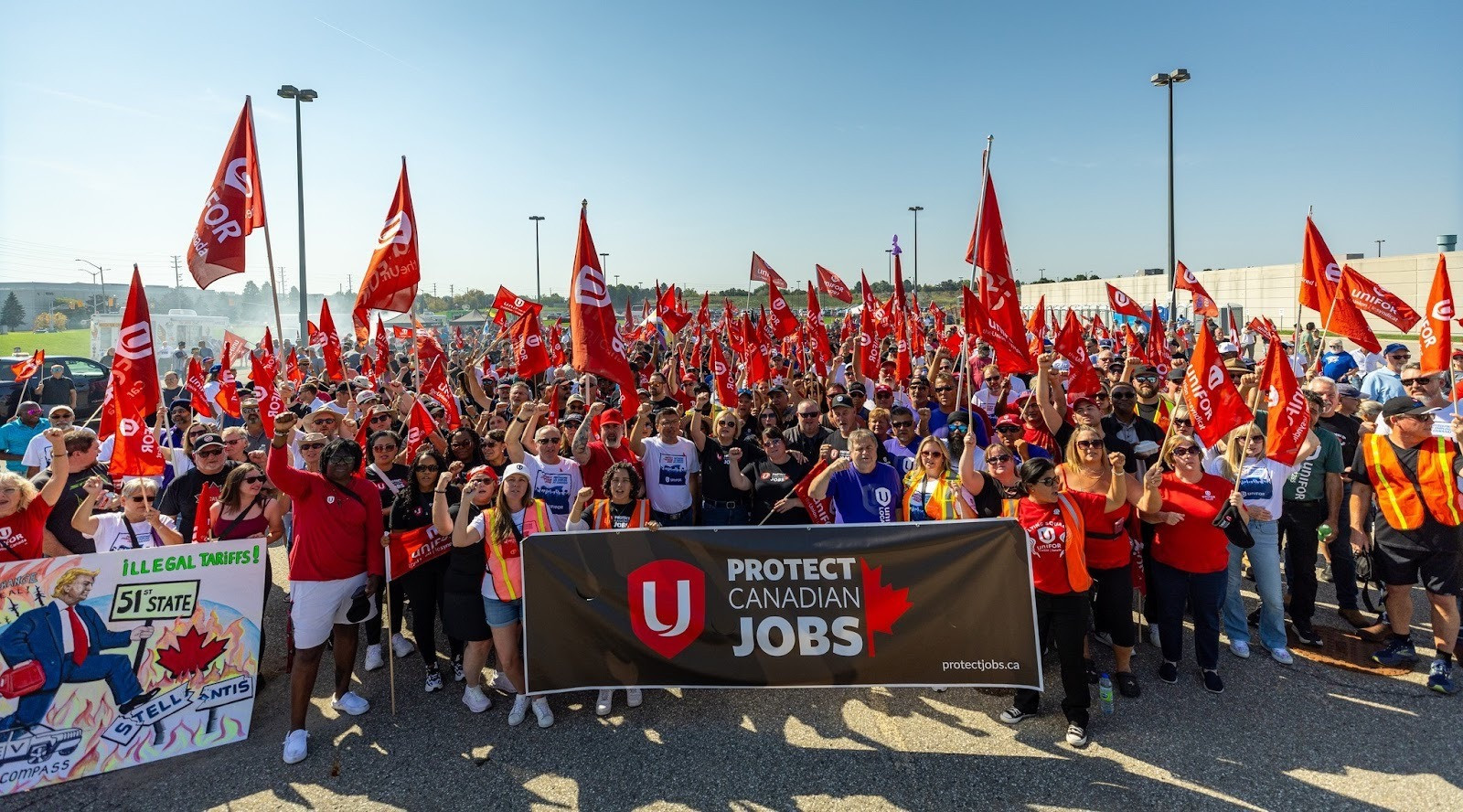
In October 2025, thousands of Brampton auto workers rallied outside the idled facility, demanding Stellantis resume efforts to prepare the facility for production.
(Unifor Local 1285)
According to the press release announcing the financial results, Stellantis still planned to launch the new Jeep Compass in the second half of 2025. But in what would turn out to be a potentially prophetic message, the release made no mention of the Brampton plant, despite Stellantis being contractually obligated to the production of electric Jeep Compasses in Brampton as outlined in its 2023 collective agreement with Unifor. As part of the deal, the provincial and the federal government each committed $132 million for the retooling effort underway at the plant prior to the work stoppage in February 2025.
Frustration with the lack of information boiled over in October last year. At the beginning of the month, thousands of workers rallied outside the shuttered facility, demanding Stellantis restart the work to retool the plant.
“Our members don’t deserve this. They deserve to know when they're going to go back to work, and they deserve to go back to work and build the best cars,” Beato told The Pointer at the time. “We still have no new information. We're 20 months into a retool now, and eight months have passed since the pause date, with still no answers.”
Ten days later, the hammer fell.
Stellantis announced it was investing $13 billion to expand production in the United States by 50 percent, with plans to launch five new vehicles and 19 new products over the next four years.
This included shifting the planned Next Generation Jeep Compass from Brampton to Illinois.
Thousands of workers found out about this potentially life-altering news, not through a meeting or a face-to-face announcement, but a robocall.
“Our members received a robocall from the plant manager…very impersonal, the first time that the company has communicated with our members (since February), so very disrespectful and disgusting behaviour by the company,” Beato said at the time. “We had no time to process this…Over 3,000 members of the Brampton assembly plant, over 1,000 members in the parts supplier base, and over 10,000 members in the Brampton community…Don't know if we're going to have a job or not.”
Following calls from Payne and Beato for the federal and provincial governments to “take immediate action to protect Brampton and our entire auto industry”, Industry Minister Mélanie Joly wrote to Stellantis CEO Antonio Filosa demanding the company “respect its obligations flowing from the billions of dollars of financial support extended to you over decades”.
“Stellantis agreed with the Government of Canada and the Province of Ontario to maintain its full Canadian footprint, including Brampton, in exchange for substantial financial support. Anything short of fulfilling that commitment will be considered as default under our agreement,” Joly’s letter warned, describing these commitments as “legally binding”. “The business decision to move the mandate of the Jeep Compass is unacceptable. It jeopardizes the future of Brampton and its unionized workforce. It is critical that you quickly identify new mandates for Brampton that ensure the facility remains central to your manufacturing footprint, and that contracts with Canadian suppliers be honoured.”
Unifor, in a statement, said that the closure of the Brampton plant could deal a serious blow to Canada’s automotive industry.
(Alexis Wright/The Pointer)
At the time, Prime Minister Mark Carney expressed “disappointment” over the company’s decision to shift electric Jeep Compass production to the U.S. and said the global head of Stellantis told him the automaker is looking for a new model to fill the idled Brampton facility, which will take some time.
Later that month, amidst ongoing rallies by Unifor outside the shuttered facility, Stellantis officials claimed: “Canada is very important to us. We have plans for Brampton and will share them upon further discussions with the Canadian government.”
The vague responses from the corporation again left many workers on the ground frustrated, and frightened for their futures.
“For a lot of us in my situation—I've got 28 years in this plant and need 30 to retire—in two years, I could be homeless if there's nothing coming in,” one employee told The Pointer at the time. “It would be nice if our corporation would actually be honest and open and tell us straight up what we're looking at.”
In December, Stellantis announced an expansion of its workforce at its Windsor facility, which included some workers transferred from Brampton.
But the company continued to avoid making any commitments about the future of the Brampton facility.
Stellantis continued to repeat its abstract commitments about the Brampton plant in the early months of 2026.
Beato told The Pointer that a meeting with Trevor Longley, president of Stellantis Canada, on February 12 was positive. At the time, Longley was working with a team to ensure production resumes in Brampton with a yet-to-be-determined model of cars that will roll off the line, Beato said.
“He even went as far in the meeting as saying, ‘if we were going to close Brampton we would have closed it already’,” Beato said in an update posted to the local union’s Facebook page. “We will take the positivity, but it’s just words, is what they were, he’s saying all the right things, (but) we need some meat and potatoes, we need some results.”
Then in April it was reported the company was considering the idea of assembling mostly pre-built Chinese EVs at the idled plant.
This was quickly rejected by the federal government and condemned by union members.
“It would decimate our auto industry,” Beato said, noting it would add a “fraction” of operations at the Brampton plant, leaving thousands of employees at the plant and others in the local supply chain out of work.
Now, the potential permanent closure comes as Unifor’s collective agreement with Stellantis, covering the Brampton, Windsor, and Etobicoke plants, is set to expire September 20, putting the Brampton plant’s fate squarely in the middle of upcoming contract negotiations.
Email: [email protected]
At a time when vital public information is needed by everyone, The Pointer has taken down our paywall on all stories to ensure every resident of Brampton, Mississauga and Niagara has access to the facts. For those who are able, we encourage you to consider a subscription. This will help us report on important public interest issues the community needs to know about now more than ever. You can register for a 30-day free trial HERE. Thereafter, The Pointer will charge $10 a month and you can cancel any time right on the website. Thank you
Submit a correction about this story

