
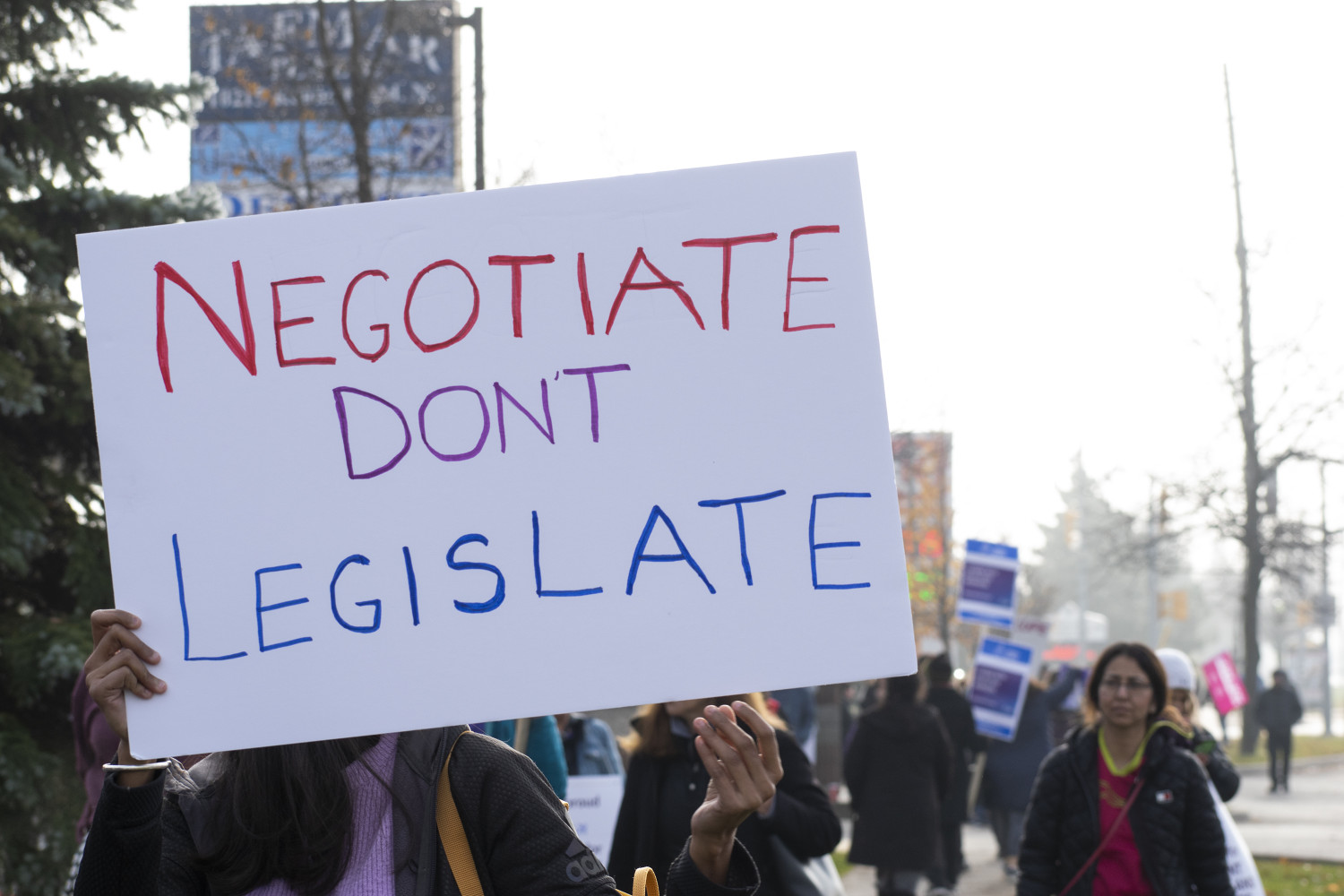
Peel’s public and Catholic school boards file budgets without public consultation after provincial takeover
While the Dufferin-Peel Catholic District School Board budget still remains sealed from public view, the Peel District School Board’s own 2026-2027 budget, approved by trustees on June 25, was recently posted on the board’s website.
It is the first budget released since the provincial takeover of the PDSB, after the education ministry cited infighting and a misuse of funds as justification to strip the board of its governance responsibilities.
The $2,165,117,310 budget for 2026/27 cuts the board’s projected deficit from a preliminary $35 million to $10.9 million, which is a reduction that the PDSB attributes to $24.1 million in “Supervisor Savings” achieved by the person sent in by the Province to take over. Most of the savings are concentrated in central office staffing adjustments, including the elimination of 25 positions labelled as surplus, along with school management and facilities staffing reductions tied to vacancies and attrition.
The DPCDSB’s 2026-2027 operating budget shows an expenditure of $1.067 billion, while “the DPCDSB continues to face substantial structural financial pressures driven by enrolment decline, a significant employer-paid Long Term Disability (LTD) plan and increasing operational service demands,” the proposed budget outlines.
The 2026-27 deficit for the DPCDSB after “Supervisor Savings” is $35.4 million. It is projecting an accumulated deficit of $150.7 million as of August 31, 2027.
In her cover letter for the budget, dated June 30, outgoing PDSB Director Rashmi Swarup, who is retiring early amid a storm of controversy, wrote that “every effort was made to minimize impacts on students, classrooms, and direct supports,” and that the bulk of the board’s savings came through “restructuring, consolidation, and right-sizing of central and administrative functions.”
Swarup is leaving behind a complex legacy. Many advocates for anti-Black racism said that her tenure was filled with empty promises.
Before the recent Catholic Board’s budget could be tabled, parents, teachers and community organizations expected to provide feedback in person. However, since the provincial takeover, this was overruled in place of a feedback form on the DPCDSB website, which contained information on the budget presentation.
Chandra Pasma, NDP MPP for Ottawa West-Nepean and the party’s education critic, said the lack of consultation matters because the budget is what ultimately determines what happens in schools. “They’re incredibly important, both for transparency and because parents and teachers and education workers and community members deserve to have a say in our schools,” she said.
Pasma pointed to a deeper structural problem: the budget will only become public once it has already been adopted, and the English-language school boards no longer have the power to remove their own director of education or CEO–only the Minister of Education can.
“So people will find out after it’s a done deal,” she said. “They can have any budget that they want here, and there’s zero consequences.”
Lori Austin, president of the Dufferin-Peel Elementary Unit of the Ontario English Catholic Teachers’ Association (OECTA), said the lack of consultation on the budget is consistent with how the board has operated all year under supervision.
“We’re not included in really anything,” she said. “We’re excluded from conversations about supervision, about the future of education and governance in this board. So, it’s nothing new to us.”
Jennifer Puow, president of the Dufferin-Peel Secondary Unit-OETCA, said she and Austin have repeatedly tried to reach the supervisor and the board’s director directly, without success.
“We’ve been trying, both Lori and I, wholeheartedly to make contact with the supervisor, to have consultations with the supervisor, with the director - and before that with the trustees - and we have been cut out at all levels,” she said. “They’re being excluded, and their voices are being excluded from conversations about things that are truly important in the classroom - and people making decisions have had zero experience in the classroom,” she added, noting the board’s director was once a classroom teacher, while the current supervisor, Rick Byers, was not. “Meaningful solutions require meaningful consultation, and it’s simply not happening.”
The Ministry did not respond to requests for comment.
Austin said the lack of input comes as the schools are facing mounting pressures. She mentioned problems of overcrowding in classrooms, growing special education pressure and staff shortages. She also pointed out that there is aging infrastructure at some of the board’s older schools in Brampton where she said health and safety issues - including elevated lead levels in drinking water - have affected learning. The board’s newcomer assessment program also lost its dedicated teacher to reassignment this year, with the position left vacant.
Beneath the improvements that the budget is promising, the line items point toward the pressures that Austin, Puow and Pasma flagged as most urgent.
PDSB’s Special Education Fund fell by $7.5 million year over year, including a $5.4 million cut to per-pupil special education funding and a $828,000 reduction to the fund covering specialized equipment for students with disabilities.
David Bosveld of the Black Education Fund (BEF) said community members have been shut out of every process while the boards have been under supervision, including the budget. In an emailed statement he said the supervisor answers only to the minister rather than to the community the board serves.
“No one from this board has contacted our organization about the budget,” he said.
Austin said the Province’s use of supervision distracts from a funding model she described as “broken” across Ontario.
“Nearly half of Ontario’s school boards are facing deficits,” she said. “It’s not a problem with individual school boards - it’s a problem with the funding model, and supervision isn’t going to solve that.”
Pasma said any budget DPCDSB files should prioritize funding for educational assistants and child and youth workers, along with measures to bring down class sizes. “We have such a long line of urgent issues within education that it’s almost hard to single a couple out,” she said. “But really, just starting with those additional supports for kids to make sure that they’re able to succeed and they’re not falling through the cracks.”
Regarding the online feedback form the Ministry has provided, Pasma said that it was not a suitable substitute for public consultation.
“The dialogue, that engagement, allowing parents to bring forward whatever issues they have on their minds, is a really important part of the process,” she said.
Dialogue and engagement received another blow this year when livestreaming school board meetings was officially banned.
During a routine meeting of the Special Education Advisory Committee (SEAC) in the evening of May 19, PDSB trustee for Ward 6 and 11 in Mississauga Jill Promoli was informed that the meeting was not livestreamed. This came as a surprise to her as these meetings were usually streamed online for those parents who could not attend in person.
Following the meeting, Promoli posted a video to her X account expressing outrage at this new development. In the video, she says those present in the meeting only found out this new information just 20 minutes after it had begun. She also says that no prior warning was given that these meetings will not be recorded, and that some parents found out by texting the chair, Lea Ann Mallett, that they could not follow what was happening.
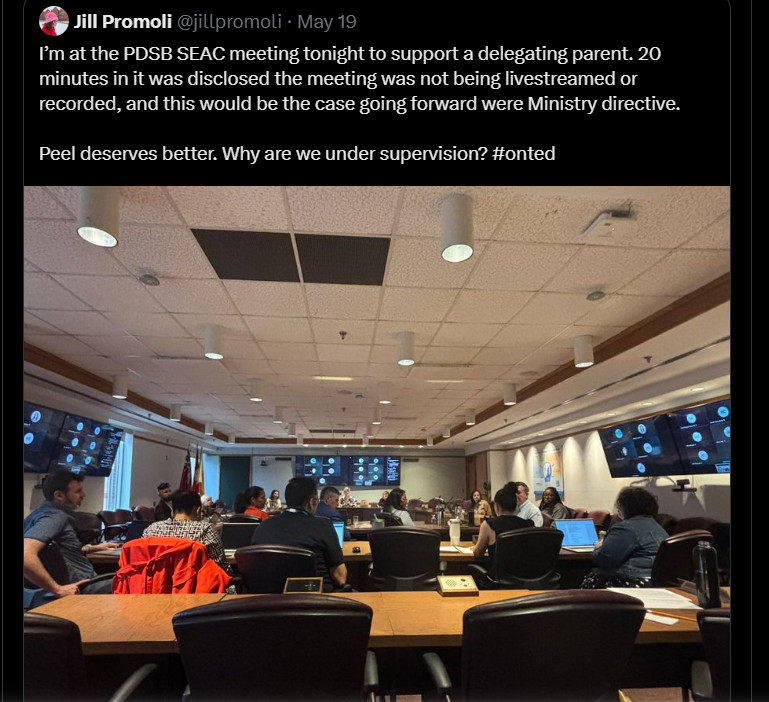
Jill Promoli’s X account shows the Special Education Advisory Committee (SEAC) meeting she was attending, when she was informed that the meeting was not being recorded.
According to the Accessibility for Ontarians with Disabilities Act (AODA) Alliance, this is because the provincial government has banned school boards under direct provincial supervision from livestreaming.
Education Minister Paul Calandra, according to the AODA, has said he “made this decision to maintain meetings that are productive, professional, and focused on improving student success and achievement, rather than serving as a forum for political commentary.”
The October 2025 report from the AODA has criticized this move.
“This is no justification for hampering the voices of parents of students with disabilities/special education needs.”
The PC government assumed full control over the PDSB in March of this year, citing infighting and financial unsustainability as issues. This led to the appointment of Heather Watt as the supervisor, who has PC connections, but limited experience in the education sector.
This is the eighth school board the PC government has taken over.
Following such takeovers, the government has introduced initiatives such as banning the livestreaming of meetings - including those of the SEAC. This has raised concerns of transparency and accessibility from parents and advocates.
Pasma said that the livestreaming ban was “completely outrageous” and that it takes away the “transparency and accountability to the local community”. She said that shutting parents out of the decision making process in schools was unacceptable.
Lea Ann Mallett, Executive Director of Learning Disabilities Association of Peel Region (LDAPR) and chair of the SEAC in the PDSB was in the meeting when they were informed of this decision. She said that the decision to ban livestreaming meetings made her “furious.”
“I was really upset,” she said. “I thought if anybody should have known that the livestreaming had been terminated, it should have been me because I'm the one who facilitates the meetings.”
Mallett says the supervisor not informing of the ban prior to the start of the meeting was also poor communication on their part, saying that “there’s nothing secret about these meetings.
“We're talking about important issues that impact the access of our children and youth with special needs to the learning tools and the support that they need,” Mallet said. “Everybody should be able to log in and watch that. I don't understand. This is another example of Ford government secrecy. Even when it's not needed, they do it. It makes no sense at all.”
With regards to Calandra’s comment on livestreams being a “forum for political commentary,” both Pasma and Mallett said that it was not the case in their experience. Pasma said that the participants do not interrupt these meetings.
“It's really a lens for them to see what is happening and what kinds of debates are taking place,” she said.
Mallett was more critical of Calandra’s comment, saying that it was an “excuse.”
“I'm not going to sugarcoat that,” She said. “That is an excuse. There's never been some political explosion. We operate by Robert's Rules of Order. We're just trying to get through to work with the PDSB staff and get as much information as we can around the budget, around services to kids."
Pasma said many parents have voiced frustration at this new move.
“I know that there's many families who are deeply frustrated that they don't know what is going on, that they are being blocked from knowing what is happening,” she said. “And at a really crucial time where supervisors are making decisions that are deeply harmful for kids with disabilities, and they're being given even less information about what's happening.”
The public has the right to know what is happening at the board level about the decisions being made, Pasma said.
This is coming at a time when an audit by the Ontario Office of the Auditor General revealed that special needs students in Toronto Catholic District School Board (TCDSB), Peel District School Board (PDSB) and the Upper Canada District School Board (UCDSB) were informally excluded from school without documentation or rationale. The report showed that many parents of special needs students had to wait more than a year for specialist assessments in order to get a placement.
Mallett said that the report was just more confirmation of the Ford government’s underfunding of the education system.
"If you're continuously underfunding the public education system, you're going to get substandard results. It's pretty basic math," she said.
“The special education system is completely broken and that's what parents and students and advocates have been saying for some time now,” Pasma said. “Kids are languishing on wait lists.”
She continued to say that the ministry has a pattern of ignoring the needs of children with disabilities. This includes the complete abdication of responsibility by the PC government to fix the underfunding and address allegations of abuse with the Provincial Demonstrations School Branch, a provincially-run school board for children who are deaf, deaf-blind and living with disabilities. The provincial government has paid out $23 million to settle class action lawsuits against the board following allegations of widespread abuse dating back decades. Despite these disturbing allegations, no reviews have been conducted to identify the root cause of the issues. The PCs have instead labelled attempts to get answers as “opposition rhetoric”.
“When you look at their policies on disabilities in general across the life spectrum, you really see that they don't see people with disabilities as deserving of support and equity.”
Email: [email protected]
At a time when vital public information is needed by everyone, The Pointer has taken down our paywall on all stories to ensure every resident of Brampton, Mississauga and Niagara has access to the facts. For those who are able, we encourage you to consider a subscription. This will help us report on important public interest issues the community needs to know about now more than ever. You can register for a 30-day free trial HERE. Thereafter, The Pointer will charge $10 a month and you can cancel any time right on the website. Thank you
Submit a correction about this story

