
AI is now screening non-emergency calls to Peel Police; experts concerned how it will respond to region’s diverse population
If you live in Peel and want to report a non-emergency to police, the voice that greets you on the other end may not be human.
On July 23, Peel Police announced the force would introduce an AI-powered assistant, built by Hyper, a Toronto-founded startup acquired by Motorola Solutions, to field a portion of the roughly 273,000 non-emergency calls received annually. The artificial intelligence (AI) determines in real time whether the caller will get routed to online reporting, community resources, or escalated to a live operator.
Peel Police says the goal is simple: free up communications operators to handle calls for real emergencies.
But researchers who study policing say the rollout raises tough questions about language bias in one of Ontario’s most diverse regions, data retention, and what happens to the caller if the AI gets something wrong.
Deputy Chief Anthony Odoardi framed the change around a “high-tech must lead to high-touch” philosophy, meaning while the system is meant to preserve capacity for 911 operators, it is not a replacement for human contact.
According to a press release from Peel Police, a caller can request a human operator at any time.
“If the voice assistant detects an emergency, cannot assist the caller, or does not understand the request, the call is immediately transferred to a live operator,” the release adds.
No details have been provided by Peel Police about how the artificial intelligence determines what qualifies as an emergency.
There is little doubt that freeing up operators to deal with the real emergencies is desperately needed in Peel.
According to Peel Police, non-emergency call volumes are up eight percent since 2020, requiring more operators to handle these matters. The demand for non-emergency operators has led to the region’s 911 response times struggling to reach set targets.
Peel’s rollout of the Next Generation 911 (NG911) platform in 2024, which enhances call routing and data sharing of critical information, has helped improve 911 wait times by 78 percent, to an average 13-second response.
Hyper (formerly HyperYou) is an AI company founded by Canadian entrepreneurs Ben Sanders and Damian McCabe, designed to autonomously resolve non-emergency calls in more than 30 languages.
Motorola says Hyper’s tools have already been adopted by police services in Ontario, Manitoba and the U.S., including Toronto Police Service and the San Diego County Sheriff’s Office.
Patrick Watson, an assistant professor at the University of Toronto who researches policing and police oversight, describes himself as an “AI skeptic”.
He says issues could arise with the Large Language Model (LLM) on which the now-implemented AI is based. Peel’s high call volume and demographic diversity makes it a uniquely difficult test case, he says.
“[It’s] premised on conventional uses of languages. Whereas the population that’s going to be calling in here is maybe more accustomed to using vernacular terms,” he says. “You couldn’t really pick a more challenging petri dish to try this experiment. At least in the province of Ontario, and I would suggest maybe in the world.”
He also raised questions about mistakes or AI “hallucinations”. A 2023 study found that AI voice systems are prone to inventing information at a higher rate.
“I think the real danger is the false negative, where that call goes off into the ether.”
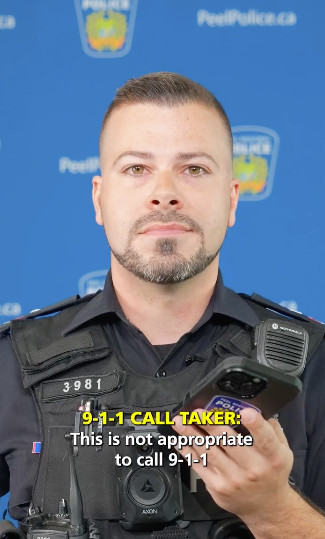
Misuse of the 911 emergency line is still quite common in Peel. In a social media post from July, Peel Police highlighted a recently received 911 call where someone called to complain about the state of a hotel room they rented. Peel Police used the incident as a reminder to only call 911 in the case of an emergency.
(Peel Regional Police/Instagram)
Regarding Odoardi’s comment that “high-tech must lead to high-touch”, Watson said that it’s “techno-optimistic.”
“I think there are trade-offs here in terms of data security, in terms of oversight and awareness.”
Tandeep Sidhu, an assistant professor of sociology and criminology at the University of Manitoba, said Peel Regional Police’s rollout likely marks the start of a wider pattern rather than an isolated pilot.
AI adoption is accelerating across large public-service institutions generally, he said, and policing is not an exception. The technology’s reliance on existing training data raises particular risk in a region such as Peel.
“When it comes to Peel region, for example, a community with a very large newcomer population, these models may or may not be able to effectively interpret different situations that people are facing.”
Peel Police held three public consultations in 2025 before they decided to implement the new AI. The September and November consultations covered human rights in the age of AI, predictive policing and community perspectives on machine learning, along with privacy, data protection and policy in the use of AI.
Generally, the report found those who participated in the consultations were supportive of innovations that reduce administrative burdens and could “support more responsive policing in a rapidly growing region”.
From the report’s conclusions, it’s clear many remained skeptical about AI and its implementation by Peel Police.
“Participants across all three sessions expressed a clear expectation that technology should serve the people of Peel—not the other way around,” the report released in April details. “They called for proactive, transparent communication, strong oversight structures, safeguards against bias, and meaningful avenues for ongoing public involvement.”
Sidhu said that although Peel Police maintains certain safeguards, such as human oversight, impact assessments and bias testing, these have not been implemented yet. For now, they are proposed requirements. According to the community consultation report, an AI in Policing Policy is currently being drafted.
Sidhu also raised questions about consent. He wonders whether the callers’ voices and personal details are being used to train the system itself, without the residents, especially newcomers, understanding the trade-off. Like Watson, he cautioned that AI tools inherit the biases already embedded in policing data.
“AI is not a neutral, objective technology. The AI system effectively works like a calculator: 2 + 2 is always going to equal 4. It doesn’t account for this broader socio-political and socio-economic context.”
Sidhu recommended that there be a formal trial period and a public-facing accounting of the technology, including what data it uses, what agreements are signed and what safeguards actually are in place, before any wider rollout.
Peel Police have not publicly disclosed how much the technology is costing taxpayers.
The AI will also be of no use to Peel Police in solving another main contributor to its slow response times: 911 misuse.
The new technology will only handle calls to the non-emergency line, but a real problem is residents dialling 911 with matters that are far from emergency situations.
In July 2023, nearly 50 percent of the 911 calls received by Peel’s dispatch centre were deemed non-emergencies, an increase of 10 percent over the prior year.
Chief Nishan Duraiappah called the 911 dispatch centre “one of the biggest bottlenecks” for the force.
On July 8, Peel Police were forced to remind residents that 911 is for real emergencies after someone called 911 to complain about the state of a hotel room they rented.
The increasing misuse of 911—a number designated for emergencies only—goes back to 2019, when an Amber Alert resulted in nearly 400 nuisance complaint calls the same night 11-year-old Riya Rajkumar was found dead.
Along with the investment in 911, it’s clear Peel Police will need to continue investing in public awareness and education to prevent residents from calling 911 with matters that do not require police.
The force’s budget has doubled in just eight years. The Pointer previously reported that Peel’s total police budget grew 23.3 percent in a single year, driven by Brampton Mayor Patrick Brown and other members of the Peel Police Services Board. Brown led a Peel Region Council vote against a proposed value-for-money audit of the police budget. Critics called the refusal to allow outside scrutiny irresponsible, given rising cost-of-living pressures on taxpayers.
Peel Police’s 2026 operating budget rose to $837.3 million, an 81 percent increase from $462.5 million in 2021, with the total budget on pace to surpass $1 billion in the next two years, for a force serving roughly 1.6 million residents. Peel Region Council said the largest driver of recent tax hikes is the police budget including Peel Police’s 9.9 percent increase for 2026. The force received a 23.3 percent increase in 2025 and 14 percent in 2024, about 50 percent in just three years. This amounts to over a quarter-of-a-billion-dollars in extra funding in three years, without any external audits being approved.
With the new AI system now implemented for the non-emergency line, it’s unclear if police leadership and a board described as ineffective will communicate the outcomes of the program to the public.
Email: [email protected]
At a time when vital public information is needed by everyone, The Pointer has taken down our paywall on all stories to ensure every resident of Brampton, Mississauga and Niagara has access to the facts. For those who are able, we encourage you to consider a subscription. This will help us report on important public interest issues the community needs to know about now more than ever. You can register for a 30-day free trial HERE. Thereafter, The Pointer will charge $10 a month and you can cancel any time right on the website. Thank you
Submit a correction about this story

