
Ford government will return to court in youth-led charter challenge over harmful pollution
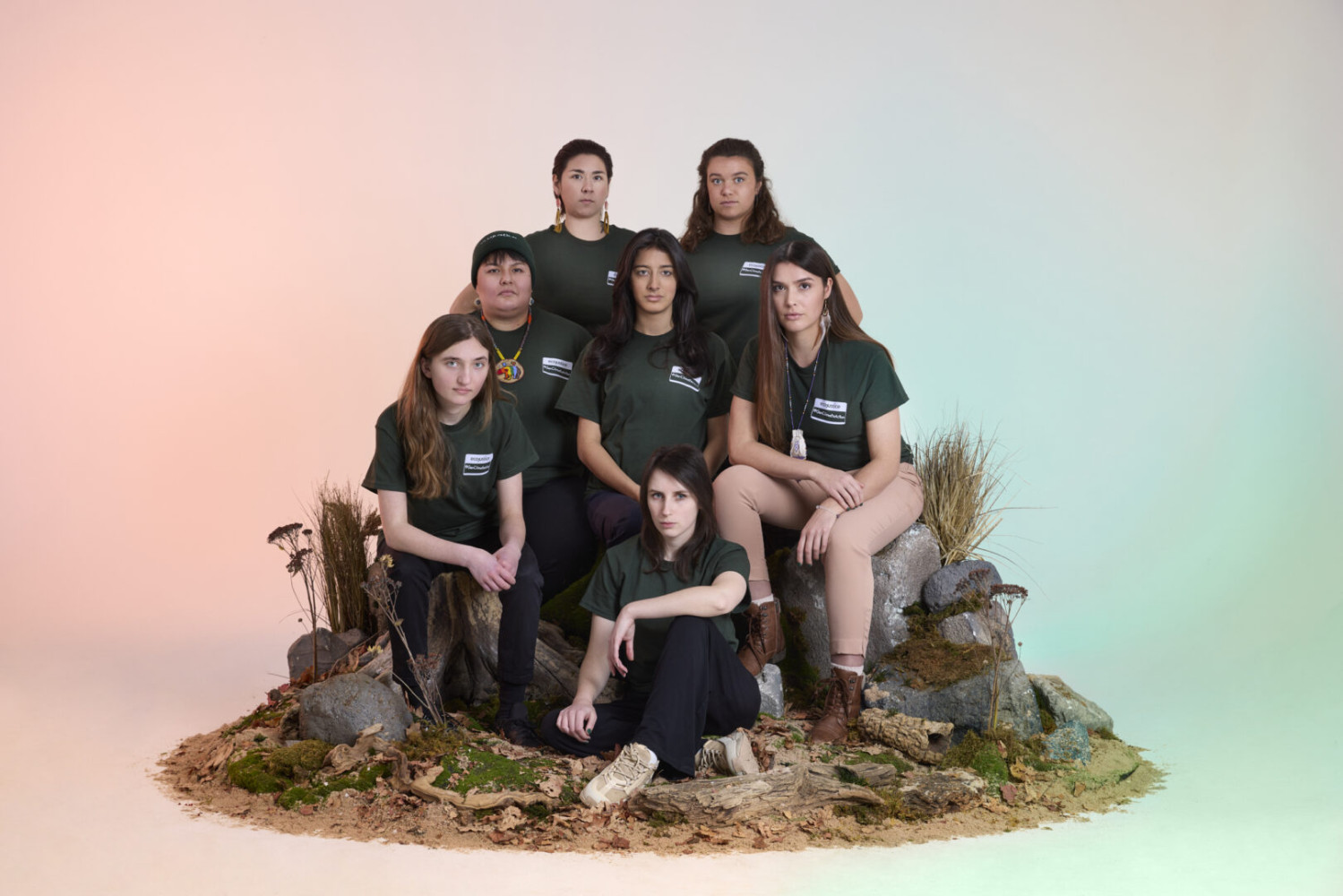
Seven young Ontarians behind one of Canada's most closely watched constitutional climate cases are preparing for the next phase of their seven-year-long legal battle after the Ontario Court of Appeal confirmed their lawsuit will return to the Ontario Superior Court, despite the Doug Ford government's repeal of the provincial climate accountability framework.
“It's a moment of clarity,” Ecojustice Director of Litigation Practice, Julia Croome, told The Pointer.
“While we hoped for the speedier route, we fought back to the Court of Appeal because the climate crisis is here on our doorstep: smoke, fires, heat.”
The Mathur et al. legal fight began in 2019 when the young climate activists challenged the province’s weakened greenhouse gas targets. They argued that Ontario’s retreat from climate action endangered their futures and violated their Charter rights to life, security, and equality under Sections 7 and 15 of the Charter of Rights and Freedoms.
“When you’re seven, climate action isn’t just policy, it’s a promise. A promise that the world I grow up in will be safe and beautiful and alive,” 18-year-old climate activist and lead plaintiff Sophia Mathur said at the Environment and Sustainable Development Committee on October 30 last year.
“While the devastation of climate change is real and frightening — fires, floods, smoke-filled summers — I don’t want my generation’s story [to] be one of despair, I want it to be one of accountability and courage. Efficiency, costs, and timelines aren’t just numbers; they represent people’s lives…that complexity can’t be an excuse of inaction.”
It was a raw moment of honesty, as Mathur spoke openly about her fears and frustration, warning both Queen's Park and Ottawa that the cost of prioritizing economic growth over environmental protections will ultimately be borne by future generations.
She was expecting to get some answers on at least the Ford government’s climate record last year at the Ontario Superior Court of Justice in December when an “unexpected development” impeded the long-anticipated court hearing.
On November 25, just days before arguments were set to begin, Bill 68, the Plan to Protect Ontario Act (Budget Measures) was passed with little to no debate, repealing sections 3 to 5 of the Cap and Trade Cancellation Act, 2018, the Province’s only legal requirements to set greenhouse-gas-reduction targets and to create and publicly report on a provincial climate plan.
The Province defended its stance: economic uncertainty stemming from U.S. tariffs was making long-term climate planning more difficult.
“Targets are not as important as results,” environment minister Todd McCarthy said while emphasizing that the Progressive Conservative government is focused on practical, achievable outcomes rather than “unrealistic objectives”.
The Province, however, never clarified why the amendments to the Cap and Trade Cancellation Act were buried in Bill 68 and never listed on Ontario’s Environmental Registry, cutting Ontarians out of the feedback process entirely.
To critics, Bill 68 was just a continuation of the PC’s strategy to abandon responsibility or avoid facing the music in courts.
“When someone has to change the rules mid-game, it's usually because they're losing,” Ecojustice lawyer Fraser Thomson remarked.
A year after the Charter case was filed, the Ontario government tried to end the game altogether by dismissing the lawsuit, arguing the political choice of setting GHG reduction targets was a policy decision outside the courts’ jurisdiction—a motion denied by Justice Carole Brown of the Ontario Superior Court of Justice in November 2022.
In December 2024, the Province filed an application for leave to appeal the case to the Supreme Court of Canada after the Court of Appeal delivered a landmark ruling in October that year, reviving the Charter challenge. The province’s top court found the provincial climate target and plan must be reviewed for constitutional compliance, rejecting the argument that the case improperly asked courts to impose new climate obligations on the government.
On May 1 last year, the country’s highest court declined to hear the Ford government’s appeal, upholding the Ontario Court of Appeal’s decision and confirming that Ontario’s climate targets must comply with the Charter of Rights and Freedoms—sending the case back to Ontario’s Superior Court.
The case was never heard. Following the passage of Bill 68, the Ontario government took the position that the application submitted by the seven activists became “moot”.
On Wednesday, the Court of Appeal directed the litigation continue before the Superior Court judge originally tasked with hearing the case to determine whether the repeal of Ontario's climate legislation renders any part of the case “moot” and whether the seven applicants' Charter claims should proceed.
A panel of judges reiterated the Superior Court is the proper venue for deciding those questions, where the factual record can be expanded and the constitutional issues fully examined.
“The Ford government has shown a clear pattern of avoiding accountability for its climate failures. If the government truly believes in its climate record, it should not be afraid to defend it in court,” Croome added.
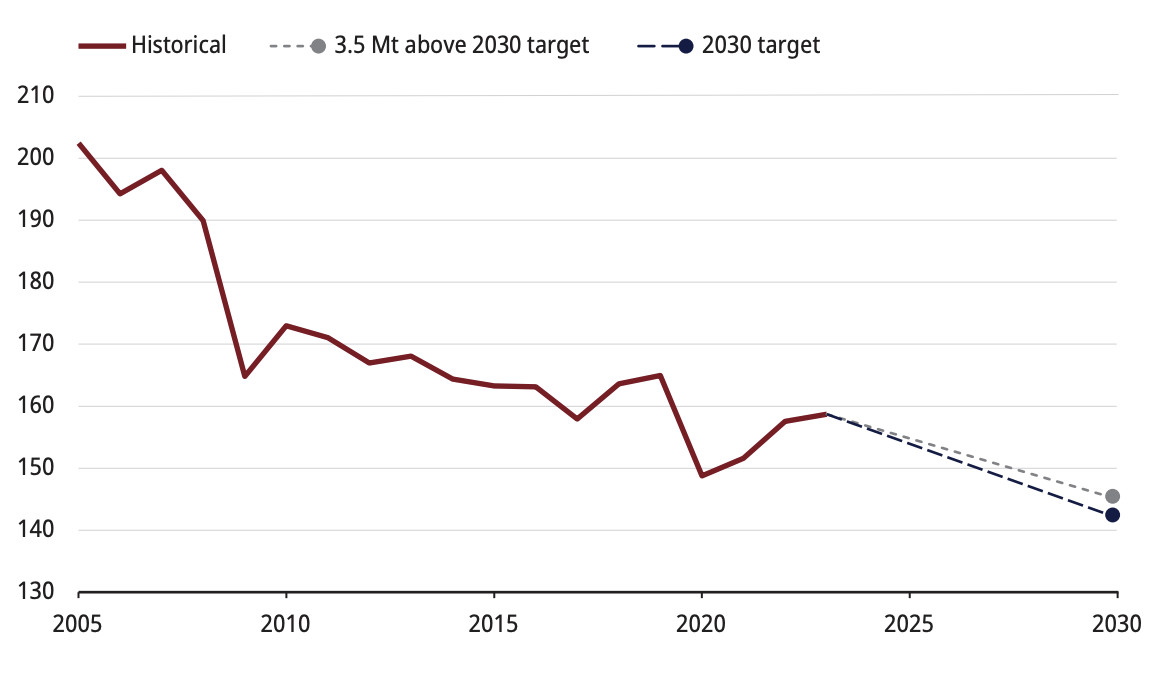
A 2025 Ontario Auditor General report highlights the province is set to miss its 2030 climate target, contrary to the government’s claims. The report noted that because the government’s emissions forecast relies on assumptions and policies that are highly uncertain, outdated, or unlikely to be fully implemented, there is a strong likelihood the province’s actual emissions will be even higher than projected, widening the gap well beyond 3.5 megatonnes.
(Auditor General of Ontario)
In September 2025, Ontario’s Auditor General warned the province was not on track to meet its 2030 climate target and may be even further behind than initial estimates.
Ontario’s goal is to cut greenhouse gas emissions 30 percent below 2005 levels by 2030, which means dropping from 202.4 megatonnes in 2005 to 141.7 megatonnes by the end of the decade. To get there, the province still needs to reduce another 17 megatonnes from where emissions stood in 2023, equivalent to taking 3.7 million fossil-fuelled cars and nearly half of all passenger vehicles in Ontario off the road.
A January 2025 projection from the Ministry of the Environment, Conservation and Parks admitted the province will fall short by over 3.5 megatonnes.
The Auditor General asked the PC government to report annually to the public on progress made on GHG emissions reduction in Ontario, including updates on the implementation of initiatives taken to reduce GHG emissions and the status of Ontario’s GHG emissions.
The recommendation was in line with Ontario Superior Court Justice Marie-Andrée Vermette’s ruling in April 2023, where she harshly criticized the PC’s emissions plan, calling the gap between Ontario’s targets and global reduction needs “large, unexplained and without any apparent scientific basis” — even though she ultimately sided with the Province’s argument that the case was based on provincial obligations not yet recognized under the Charter.
Nearly nine months after repealing climate targets, in July, the Ford government quietly eliminated the Climate Change and Resiliency Division, the provincial body responsible for reducing greenhouse gas emissions and helping communities prepare for the worsening impacts of climate change—the same time as one of Ontario's worst wildfire seasons on record stained the skies orange and blanketed communities in hazardous PM2.5 smoke, forcing young and seniors alike to remain indoors.
The Mathur case started with a fight over former provincial climate obligations. It has since become a test of something far larger: whether the Charter can protect young people and future generations from government decisions that deepen the risks of a rapidly changing climate.
“This fight is personal,” youth applicant Alex Neufeldt said.
“As a new mom, I would do anything to protect my baby. She, and all children, deserve a safe and livable future. My fellow applicants and I should not have had to spend our teens and twenties fighting our own government over a worsening climate crisis. But after more than six years, we're still here — because this government’s failures will shape the rest of our lives, and our children's lives too.”
For Mathur, the last few years have seen her balance school with courtrooms and meetings with lawyers; far from a conclusion, her battle has only extended.
On June 15, Ecojustice, on behalf of Mathur, two other young activists, Environmental Defence and the Canadian Association of Physicians for the Environment (CAPE), filed an application for judicial review alleging the federal government no longer has a credible plan to meet its legally binding 2030 climate target.
Ahead of Justice Vermette’s rehearing of the Mathur case, which has yet to be scheduled, Croome remains hopeful the courts will recognize that the Ford government’s environmental rollbacks amount to a Charter breach—that will compel “governments to act and actually protect Canadians, protect Ontarians from the climate crisis”.
Email: [email protected]
At a time when vital public information is needed by everyone, The Pointer has taken down our paywall on all stories to ensure every resident of Brampton, Mississauga and Niagara has access to the facts. For those who are able, we encourage you to consider a subscription. This will help us report on important public interest issues the community needs to know about now more than ever. You can register for a 30-day free trial HERE. Thereafter, The Pointer will charge $10 a month and you can cancel any time right on the website. Thank you
Submit a correction about this story

