
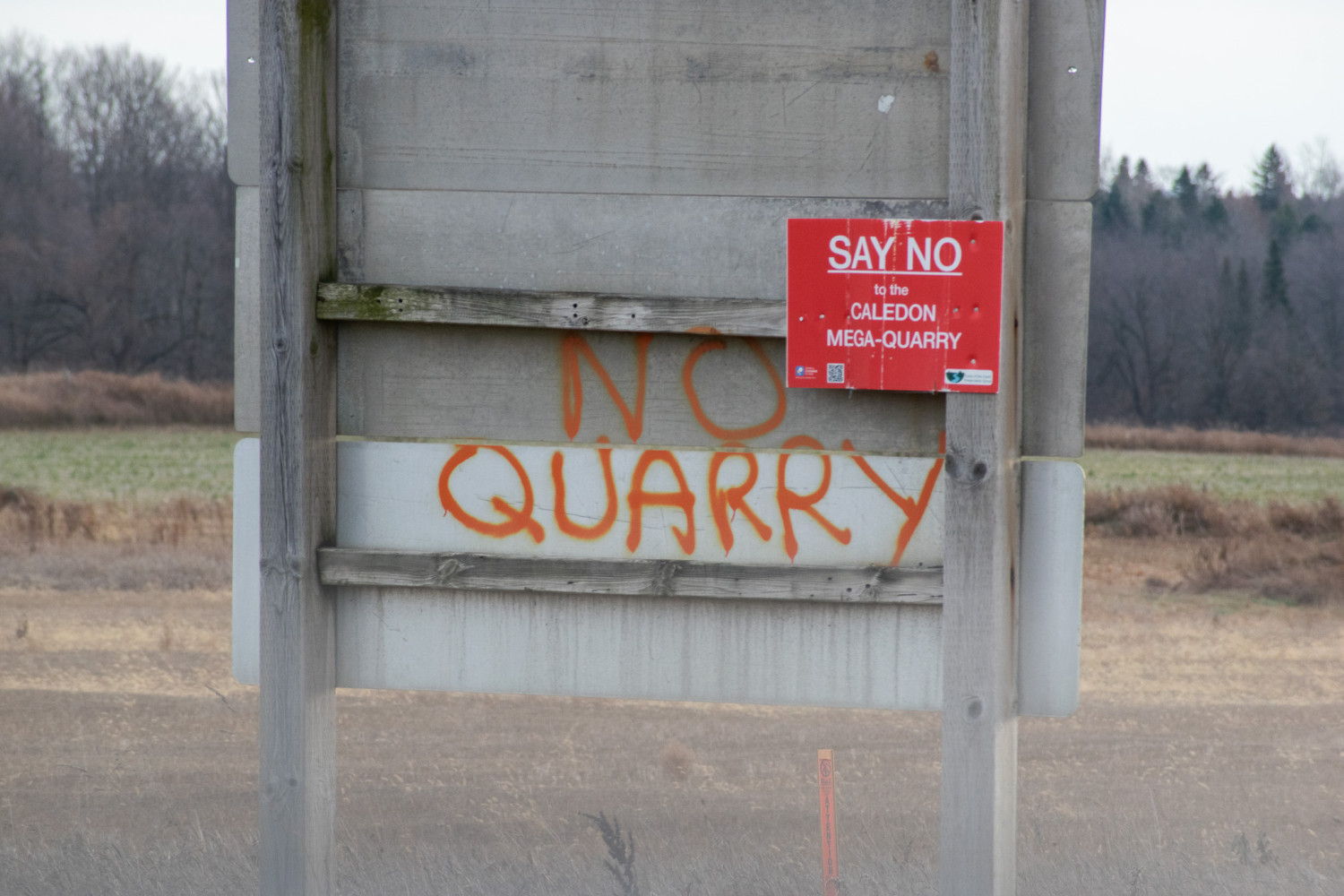
Ontario’s authoritarian reality: Ford government erases four years of Caledon’s critical gravel policy work
“Please do not let this story end quietly…The people of Ontario deserve to know exactly what happened here in Caledon—that after four years of long, evidence-based policy work, meaningful consultation was replaced by heavy-handed, unilateral provincial action.”
That was the “one request” from Debra Wilson, board member and director for the Forks of the Credit Preservation Group (FCPG), to Caledon council on July 28 after the Doug Ford government officially put an end to the Town’s four-year precedent-setting effort of building a “gold standard” framework for regulating the extractive aggregate (gravel) industry to protect the health of Caledon residents, their beloved green landscapes and pristine waters.
For the past three months, the efforts of Caledon’s most dedicated citizens and municipal staff over four years were laid out before Queen’s Park officials, exhorting provincial decision makers to reconsider provincial policies around gravel extraction that will devastate large swaths of the verdant rural community, which is larger than Toronto.
The PC government’s substantially weakened aggregate policies imposed on Caledon were being challenged but the opposition from local voices appears to have fallen on “deaf ears”, after Ford’s PCs warned the Town to withdraw the majority of its proposed revisions or face further action.
“Caledon had a simple request of the province: please engage in meaningful consultation,” Wilson said, expressing her disappointment.
In a recent memo, Caledon Council was informed that staff was stopping work on new aggregate policies after the PC government stripped the municipal government of its delegated authority to approve the proposed Official Plan Amendment (POPA 2026-0006), leaving the final decision in the hands of the Minister of Municipal Affairs and Housing.
The saga began in October 2022 when council enacted an Interim Control By-law (ICBL) to temporarily freeze approvals for new gravel pits and quarries — three years after a proposal for an 800-acre, below-water-table limestone blasting quarry by CBM Aggregates, a subsidiary of Brazilian aggregate giant Votorantim Cimentos, was first brought to the Town’s attention in the summer of 2019.
For decades, Caledon residents have watched vast stretches of the town's natural landscape transformed into gaping pits that pock huge stretches of greenspace now cleared for aggregate extraction (material used to make concrete for homes, roads and infrastructure).
The constant rumble of trucks and thick clouds of dust have haunted their everyday lives around the roughly 1,800 hectares currently licensed for extraction (most of them concentrated in Ward 1). It has resulted in the creation of local community groups that have engaged with the Town and the Province for stricter aggregate policies and to debunk industry claims that Caledon needs more aggregate operations to support Ontario’s appetite for stone, sand and gravel—a claim used by CBM as well to challenge the Town’s ICBL. That argument was later dismissed by the Ontario Land Tribunal (OLT) on March 14, 2025.
A Forks of the Credit Preservation Group expert used the Ministry of Natural Resources’ online information and licensing tools to calculate that “at minimum 13.4 million tons of gravel per year were generally excavated, but in reality, only about 3 million tons per year are actually taken,” FCPG member Anthony Fairclough, said.
There is an “unlimited amount of aggregate licensed to be extracted in Caledon”, Fairclough added. Existing aggregate operations could meet current demands without the need for new pits or quarries.
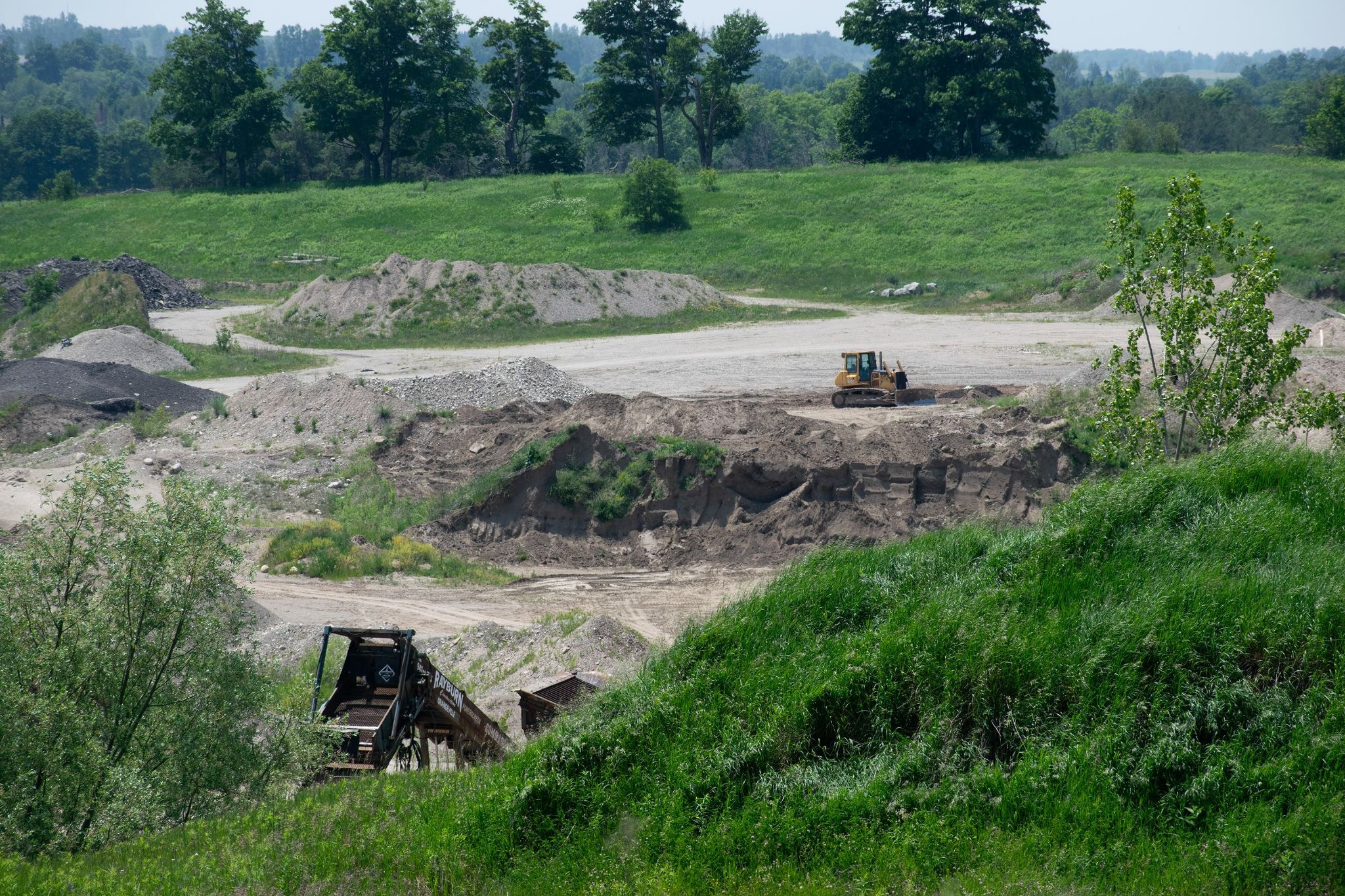
Moonscapes created for aggregate extractions are a common occurrence in Caledon.
(Alexis Wright/The Pointer)
The ICBL also mandated a review of the Town’s aggregate resource policies, officially starting work on Official Plan Amendment 1 (OPA 1).
In October 2024, OPA 1 was adopted, following extensive discussions with experts and residents, establishing updated mineral aggregate resource policies, modernizing extraction guidelines, integrating scientific and community inputs to balance industry needs with the protection of rural communities and the natural environment.
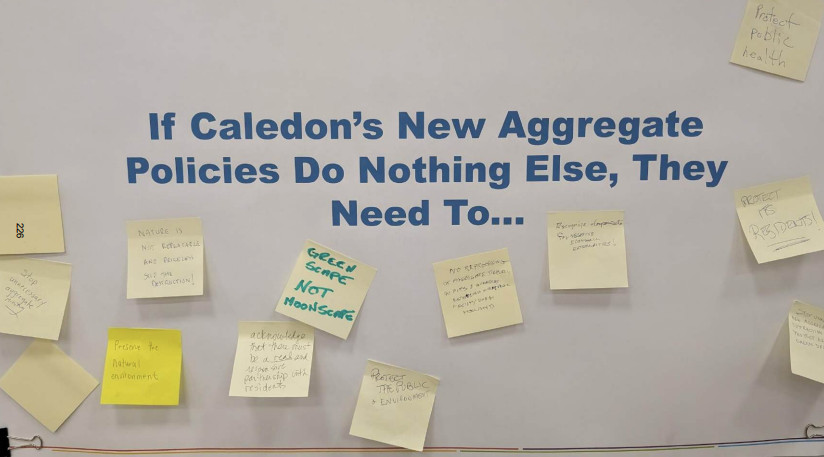
Residents were asked for their input in creating the Future Caledon Plan as well as the aggregate policies that would define the community’s wellbeing.
(Town of Caledon)
Among its key measures, OPA 1 proposed prohibiting aggregate operations in evaluated and unevaluated wetlands, strengthening requirements for blast, vibration and flyrock management. It adopted the 2021 World Health Organization air quality guidelines for PM2.5 and PM10, two harmful types of particulate matter, at a time when the province is still adhering to the older 2005 WHO standard.
Critics argued it still lacked mandatory setbacks from homes and relied too heavily on discretionary language.
While the Province approved Caledon's new Official Plan in October 2025, OPA 1 remained under review until January 6 this year.
When Flack’s approval finally came, it included 60 provincial modifications that scrapped many of the Town's enhanced, essential protections including the WHO-based air quality standards, private well safeguards and several local measures addressing noise, dust and truck traffic.
The Ontario Stone, Sand & Gravel Association (OSSGA), a not-for-profit association representing over 280 sand, gravel and crushed stone producers, supported all 60 provincial modifications to OPA 1.
The Ministry contended the changes were “final” — “not subject to appeal” — and were necessary to align with provincial planning policies and legislation including Provincial Planning Statement, 2024 (PPS), Greenbelt Plan, Oak Ridges Moraine Conservation Plan and Niagara Escarpment Plan. However, Town staff argued their proposed policies went beyond provincial baseline standards to protect its community and the environment better.
The following month, council directed staff to review the changes and report back on priority matters for a potential new amendment updating the Town's zoning bylaw.
Staff opted to repeal and replace the bylaw already under appeal at the Ontario Land Tribunal rather than defend it and revise it simultaneously.
Following public consultations in March and a statutory meeting in April, that work was abruptly interrupted on May 4, when the Town received a letter from the Minister of Municipal Affairs and Housing.
“I strongly recommend that the Town withdraw its proposed amendment and proceed with implementation of its current Official Plan, including the mineral aggregate policies approved through Official Plan Amendment 1,” Minister of Municipal Affairs and Housing Rob Flack said on May 4.
“If the Town does not do so, the Ministry may need to take further action to protect provincial interests.”
The sharply worded letter from Queen’s Park set off an extended debate over planning authority and the limits of municipal control under Ontario’s Planning Act—which have already been challenged by recent legislation forced through by the Progressive Conservative government including Bill 100, the Better Regional Governance Act, which grants Flack the power to hand-pick the heads of council in eight upper-tier municipalities like Peel.
Staff warned council that the province could revoke Caledon's delegated planning approval authority or intervene directly through ministerial powers, stripping the Town of control over the process and eliminating appeal rights.
Council had three options: proceed with the proposed aggregate policy amendments as drafted, make limited revisions to address provincial concerns or withdraw the proposal entirely.
After deliberating on whether to press ahead or avoid a provincial intervention, councillors agreed they should not abandon policies protecting air quality, groundwater and public health.
“I don't believe that the things that we're asking for here are divergent from the provincial interests at all,” Councillor Doug Maskell expressed during the meeting.
“Clean water is an interest of everybody, clean air is an interest of everyone, preserving habitats is for everyone.”
Following the May meeting, Groves and municipal staff kicked off discussions with the province, advocating for the environmental protections as part of the Town’s stronger aggregate policies.
Meanwhile, on May 27, the Ontario Stone, Sand & Gravel Association (OSSGA) met with the Minister of Natural Resources, Mike Harris, for “a constructive discussion on aggregate policy”.
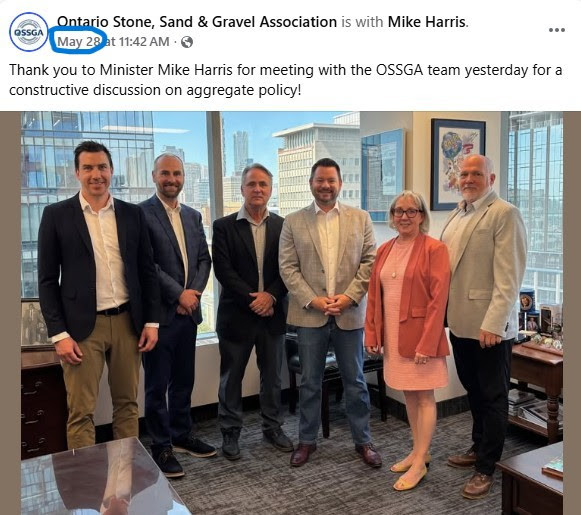
In a July 30 newsletter, the Forks of the Credit Preservation Group highlighted the timeline of the province’s decision to stop Caledon’s efforts to build stronger aggregate policies just days after the Ontario Stone, Sand & Gravel Association’s meeting with the Minister of Natural Resources, Mike Harris (third from the right).
(Ontario Stone, Sand & Gravel Association/Facebook)
On June 9, the Province moved to remove Caledon’s delegated authority to approve the proposed Official Plan Amendment (POPA 2026-0006). Ten days later, it formally took away the Town's authority if the amendment was adopted by council, ensuring the final decision was in the hands of the Minister of Municipal Affairs and Housing—again, “not subject to appeal”.
“The aggregate industry claims it wants to work with communities, to hold public meetings, to get public input; but when our small municipality challenged their business's usual mindset, this billion-dollar industry felt compelled to seek provincial intervention,” FCPG’s Wilson said.
“We believe that revealing the truth about this industry is also a success. Today's decision is not the end of this work.
“The next council will inherit both the challenge and the opportunity to continue it.”
The memo by the Town’s planning department asserted that the research “completed through this project may still be used in the Town's ongoing advocacy work”.
Longtime planner Victor Doyle said the Province’s move to limit Caledon’s authority over its aggregate policies was “not surprising at all”.
“Others will be watching,” he told The Pointer, warning the decision could discourage other municipalities from pursuing stronger protections.
“That’s why the stone association and the independent producers always take a really active role in these municipal policy efforts. They don’t want precedents to be set that are contrary to their interests.”
As a former provincial Manager of Planning for Central Ontario, Doyle said he was “much more open and receptive” to municipalities setting standards above provincial requirements since provincial policies are intended to establish minimum protections.
“So if they're the minimum, why shouldn't a municipality be able to impose somewhat higher standards?” he noted.
“This type of letter is typical of the minister and province coming down like a ton of bricks on everybody and thinking they're the mayor of every town in Ontario.”
Doyle explained the Province’s intervention could potentially limit the Town’s ability to impose stronger standards on future aggregate applications including the CBM blasting quarry.
Former Caledon councillor and resident Ian Sinclair, who has long drawn on his planning expertise during delegations and public question periods at Town Hall, reminded council that the fight was not over, because the Town has defeated the aggregate industry — twice — in the past.
“They just absolutely hate us,” he remarked.
In 1978, the Town of Caledon Official Plan satisfied a provincial directive that required municipalities to safeguard essential sand, gravel and bedrock deposits from incompatible urban encroachment. The approach would have left roughly 80 percent of the town in a non-conforming use situation.
Sinclair, who was the director of the now-defunct Caledon Ratepayers Association representing Ward 1, recalled the growing public pressure at the time, combined with the election campaign period, led the former mayor John Clarkson to pass a motion revoking the Town’s aggregate policies and sending the issue back to the Province.
The fight extended through legal channels as residents geared up for a potential court challenge against the provincial government, which led to deliberations with provincial officials and the creation of the Cabinet Corners settlement, which prevented large-scale aggregate designations and zoning from moving forward in the area.
“The aggregate industry was pretty upset,” he said.
The fight over aggregate policy marched on as changes to Ontario’s planning framework reshaped the balance between provincial and municipal authority.
In 1982, the Province revised the Planning Act, introducing the concept of “provincial interests” and provincial policy statements, followed shortly after by the Ministry of Natural Resources’ first aggregate-specific policy framework.
The Cabinet Corners arrangement remained in place for a decade until a broader review of Ontario’s land-use planning system led to the creation of more comprehensive provincial policies covering areas such as agriculture, health and aggregates.
Sinclair recalled that changing just six months later after the Mike Harris government was elected, which drifted away from detailed provincial policy guidance.
It prompted him to warn municipal planners that Caledon needed to strengthen its own policies. Working with the Region of Peel, he helped develop the Caledon Community Resource Study (CCRS), which was completed in 1991 and integrated provincial planning policies with local aggregate considerations.
The Town of Caledon translated the CCRS findings into OPA 161, which was formally approved by the former Ontario Municipal Board (OMB) in 2004.
“The aggregate industry tried to get a home free by having designation and zoning in the first Official Plan for the Town. They lost,” he said. “Then they got a PPS (Provincial Planning Statement that sets the minimum rules and standards for land use planning and development) but it wasn’t the same. Then they found out the full PPS applied to aggregates wasn’t in their favour.”
Sinclair recommended Caledon do “another John Clarkson” — repeal the aggregate policies in OPA 1, send them back to Municipal Affairs and Housing Minister Rob Flack “in protest” and ask the Province to reimburse Caledon for the costs of its work including consultants, the interim control bylaw and the aggregate resources working group.
“Give us our money back. We were in good faith; you haven’t lived up to it,” he added.
His third recommendation was to circulate the revoking memo to all Ontario municipalities, the Rural Ontario Municipal Association (ROMA) and the Association of Municipalities of Ontario (AMO) to draw attention to provincial interference in local planning decisions.
Councillor Lynn Kiernan inquired about the potential risks of escalating the dispute with Queen’s Park: “I don’t want to make it worse”.
“At this point, you have nothing to lose,” Sinclair responded. “If things are really tough, we [Caledon] have a deep history of rebelling and [we] should.
“And I suspect there's a ground movement among municipalities in Ontario. This is in favour of this current conservative government's top-down, dictatorial approach, removing [municipalities’] choice at how their communities can grow and be designed.”
Maskell agreed that it could set a domino effect and send “a very clear message to the Province that they need to act in the best interests of the people in those jurisdictions and in the best interests of the people of Ontario”.
He emphasized many municipalities dealing with aggregate industry were already working with Caledon Town staff, expressing interest to adopt the “gold standard” that Caledon was creating.
“My worry is, what's the next issue? Where we go down this road and they say…we're just going to change the regulation,” Maskell added.
He subsequently brought forward a motion directing the Town to continue advocating against the Province’s decision by sending letters to Municipal Affairs and Housing Minister Rob Flack, AMO, TAPMO and Dufferin-Caledon Member of Provincial Parliament Sylvia Jones expressing council’s “disappointment and frustration” with the provincial government’s handling of aggregate policies.
The Town will further request that AMO issue a communication to Ontario’s 444 municipalities outlining the Province’s actions and the potential implications for municipalities across the province.
Groves said council could pursue those advocacy efforts while also taking a more diplomatic approach by raising the issue directly with Flack during its delegation at the AMO conference in Ottawa from August 16 to 19.
She added that a special council meeting could be called, if necessary, to review options, including further motions and the costs associated with Caledon’s aggregate work.
The motion, which passed unanimously, also called for an open letter that told the tale of Caledon’s four-year advocacy efforts on aggregates, the PC government’s response and the impact of the minister’s directive to be published in local and provincial media.
Email: [email protected]
At a time when vital public information is needed by everyone, The Pointer has taken down our paywall on all stories to ensure every resident of Brampton, Mississauga and Niagara has access to the facts. For those who are able, we encourage you to consider a subscription. This will help us report on important public interest issues the community needs to know about now more than ever. You can register for a 30-day free trial HERE. Thereafter, The Pointer will charge $10 a month and you can cancel any time right on the website. Thank you
Submit a correction about this story

