
White elephant or game-changing vision? Mississauga wants public input on massive downtown redevelopment
Mississauga council is continuing to look into its dynamic downtown vision for the city’s core, but is the grand multi-billion-dollar design destined to be a white elephant for taxpayers, or will it finally push the giant suburb into big-city status?
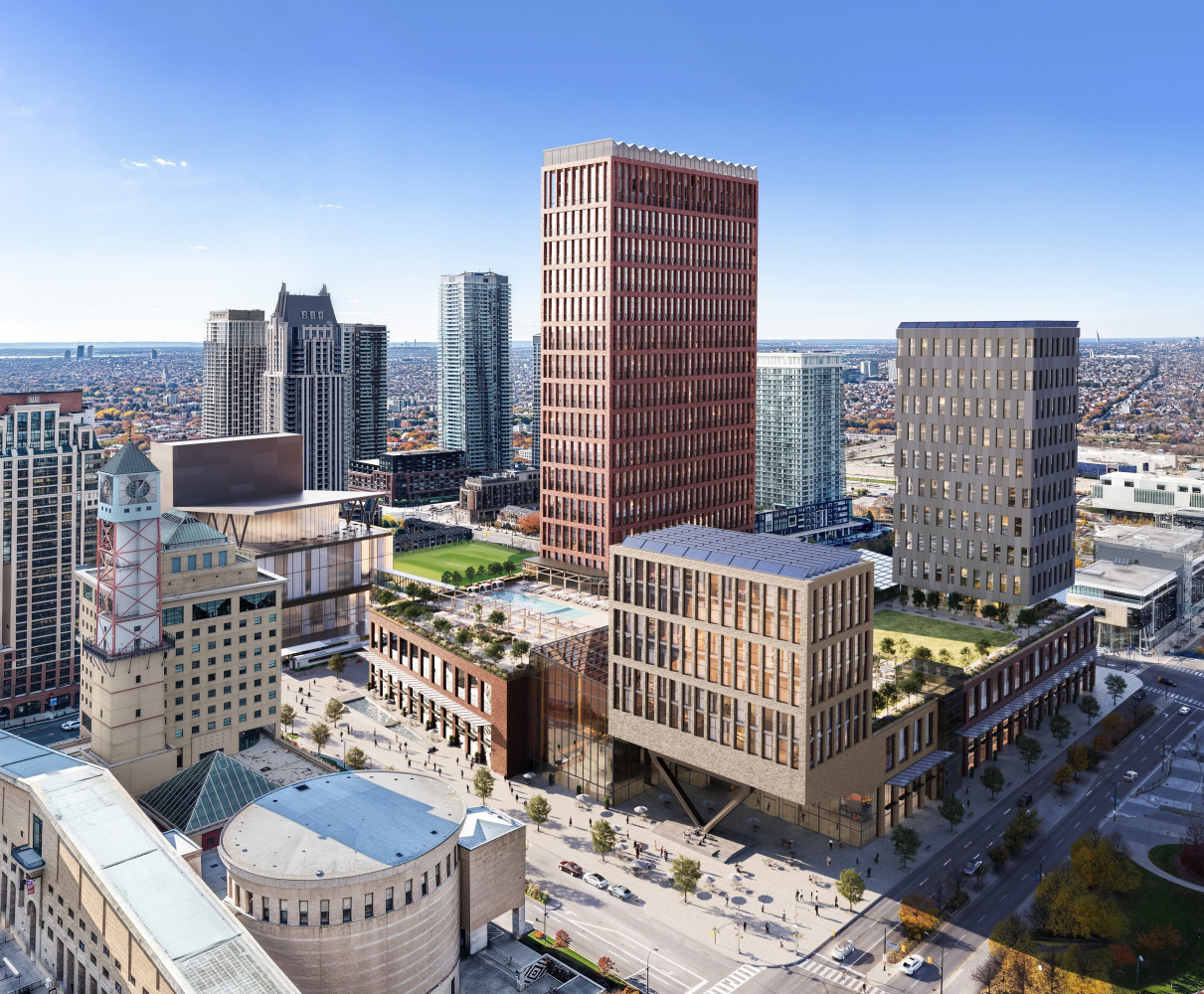
Given early approval in March, council proposed a new vision for parcels of City-owned properties in the downtown, intending to construct a convention centre, hotel, residential tower, 5,000-seat entertainment venue and a “Sky Park”.
If built, the $2.5 billion proposal would become one of the biggest projects in Mississauga’s history, and the most significant development the area around City Hall has seen in decades, transforming approximately 12 acres of land belonging to taxpayers with a “once in a generation opportunity”.
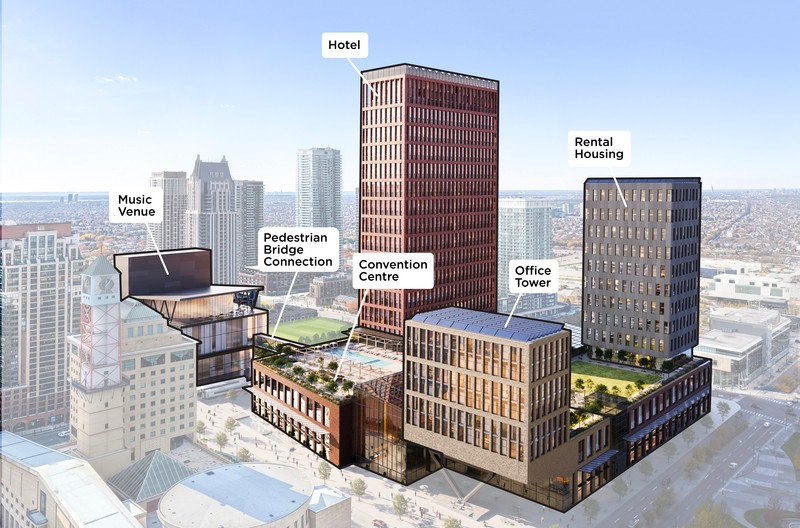
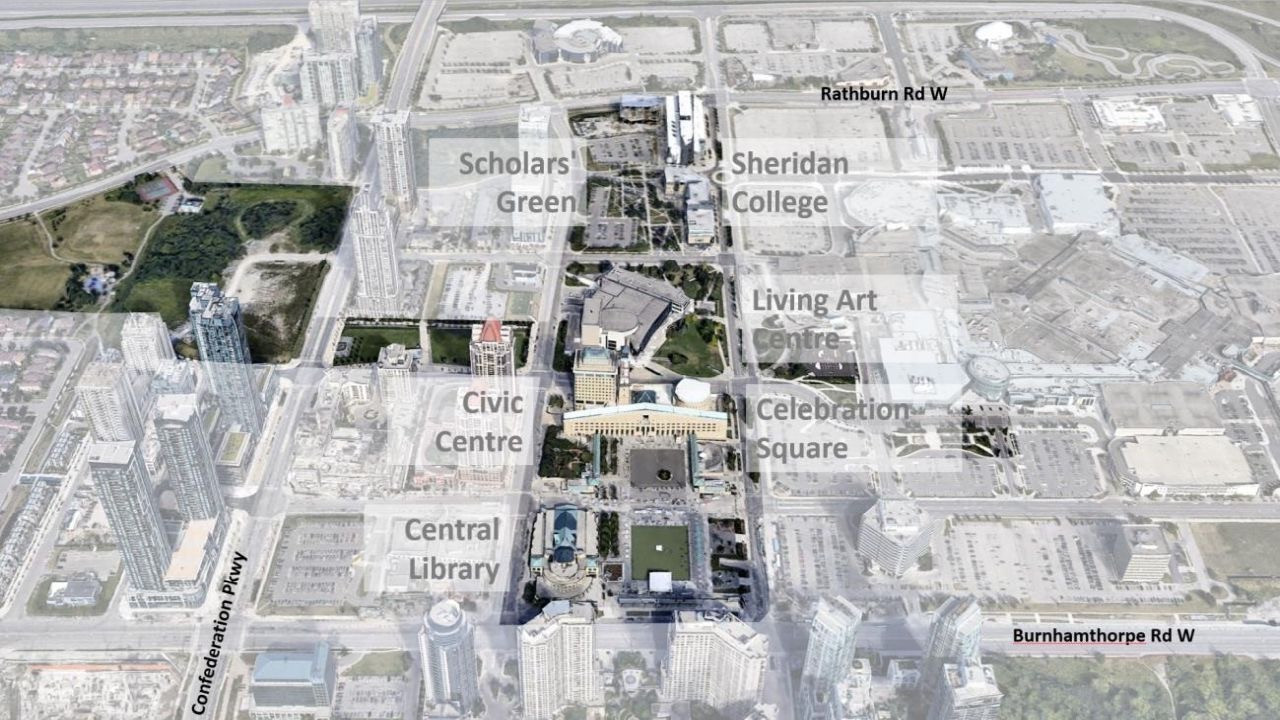
Renderings of the lands the City of Mississauga owns and has plans to significantly develop in the next 15 years.
(City of Mississauga)
Mayor Carolyn Parrish is seeking re-election after winning a byelection two years ago when Bonnie Crombie stepped down to lead the Ontario Liberal Party. The two are now running against each other, along with Councillors Dipika Damerla and Alvin Tedjo who are also seeking the mayor’s job in this October’s municipal election.
Questions were raised when Parrish brought the downtown idea forward in March, after she had aggressively opposed a very similar plan brought forward by her former council rival and legendary Mississauga mayor, Hazel McCallion more than two decades ago.
Critics questioned if it was just a campaign stunt by Parrish, and asked how such a huge commitment could be proposed with no idea what it would cost taxpayers as affordability continues to be one of the biggest concerns facing voters.
Several residents who spoke at the council meeting in June felt the generational mindset to be lackluster and ill-timed with the upcoming municipal election in October.
“What I find frustrating and concerning is why we are rushing something mere months before an election. A once-in-a-generation opportunity is not debated months before a municipal election without residents asking why the process is moving so quickly,” Mississauga resident Rahul Mehta said. He expressed frustration over the proposal, which he felt was already cemented before residents were ever asked about it. Mehta is currently registered to run for a council seat in Ward 8 in the upcoming October election.
“We should be involving the public in every step of the process, especially in an election year.”
During the initial discussion in early March, some councillors expressed skepticism after the presentation by City staff and sought further input from residents on the design. Staff previously said details for further studies of the area and public consultation would come back to council in June.
Staff returned on June 24 in front of Mississauga council, outlining a $300,000, city-wide public consultation and market analysis for the proposed transformation of the Living Arts Centre (LAC), a budget request council ultimately approved.
The approval did not authorize construction, commit taxpayers to funding the project or endorse a final design. Instead, it marked the beginning of what staff described as an iterative engagement process, intended to gather public feedback while consultants prepare the financial, commercial and economic studies that would determine whether the proposal is viable.
Staff said the $300,000 approved for public consultation and feasibility work will come from the City’s Municipal Accommodation Tax Reserve, which is funded through taxes paid by visitors staying in Mississauga hotels rather than through residential property taxes.
Discussed in their presentation to council, City staff outlined how they planned to move forward with gathering public feedback before preparing a final business case:
- Online surveys and polls where people can share their thoughts and priorities for downtown, amenities they would like to see, or concerns they have;
- A dedicated project webpage with information about the proposal;
- Public open houses and information sessions where residents can ask questions and speak with City staff;
- Pop-up booths at libraries, community centres and other public spaces where residents can also learn about the project and provide feedback;
- Workshops and focus groups to have more detailed discussions with residents and community organizations;
- Educational videos explaining the proposal before asking for feedback.
Community and public engagement for the project is expected to begin in September and continue into January, with mirrored timelines for the hotel, convention centre and music venue project-proposal updates.
Staff plan to return to council in April next year to provide direction and possible funding arrangements based on community responses, before transitioning to focusing on partnership, planning and zoning approval by the middle of next year.
As nothing has been chiseled into shape, staff emphasized all of the questions can come back to council for further deliberations and changes depending on the will of residents.
Several councillors questioned how residents could meaningfully weigh in on a project without knowing what it could ultimately cost. Similar concerns were raised when the project was introduced back in March.
Damerla, the Ward 7 Councillor, compared the situation to offering someone a free car—nice in theory until they add the hefty price tag that follows. She said asking residents if they want a new convention centre without discussing costs would lead almost everyone to say yes, but the price point could sway public opinion.
While the City has marketed the project as another alternative to help deal with the housing crisis (part of the plan includes a 20-storey rental apartment) resident concerns come as Mississauga is already facing mounting financial pressures and struggling to develop housing to match the growth targets the province has pushed onto the city in recent years.
In the downtown core alone, staff estimates the population will grow from 36,000 in 2021 to nearly 89,000 by 2051, a main factor driving the proposed vision.
Announced on March 30, Ontario and the federal governments said they would cost match $8.8 billion dollars ($4.4 billion from the province and $4.4 billion from the federal government) under the Development Charge Reduction Project (DCRP) over ten years for municipalities across the province, but only if they reduced development charges by 30 to 50 percent for at least three years in order to be eligible for the funding. The goal is to bring down fees builders have to pay to cover local infrastructure costs so they will be incentivized to construct more homes and pass the development charge savings onto consumers. Applications opened for municipalities on June 1 and were only open for 19 days.
In a special council meeting on June 3rd, the City slashed DCs on all one-bedroom, one-bedroom plus dens, two-bedroom, and three-bedroom rental units between 50 percent and 100 percent, and further extended the deadline given to developers from December 31, 2027, to March 30, 2029.
Council approved the significant reductions to development charges in an effort to stimulate housing construction and improve the City’s eligibility for provincial funding programs in an attempt to revive a housing market that has largely stalled in recent years.
At the same time, Mississauga’s local leaders are already struggling with the required local funding contribution as part of the overall $16 billion for the new Peter Gilgan Hospital that is already wildly over its initially approved budget; and the $65 million in annual funding the PC government wants City Hall to cover for operating costs of the Hurontario LRT which continues to roil residents with its multitude of delayed timelines and interruptions to businesses along its construction route; council members also have to budget for infrastructure and transit to accommodate 16,000 units being built at Lakeview Village, along with the massive Brightwater community rising up farther west along the waterfront.
Mississauga is applying for $2.2 billion under the DCRP, after Peel Region as a whole was only awarded $1.3 billion to cover its own costs that are typically funded through development charges collected by the upper tier municipal government (the lower tier municipalities, Mississauga, Brampton and Caledon, each collect their own local development charges for the costs such as community centres, libraries and utilities not covered by the upper tier).
Part of the City’s $2.2 billion request to the Province for funds to offset the loss of development charges that City Hall will not collect from builders, was $500 million for a new music centre that is part of the downtown redevelopment.
“If everything happens and we get the money coming in from the government, we could be on the hook for only $50 million. But if we don't get that kind of money, we're on the hook for $500 million,” said resident George Taveres who is running for Ward 7 councillor.
With mounting budget pressures already pushing in on them, councillors are now being asked to consider an additional $2.5 billion dollar project with no idea how much of the cost will fall on taxpayers.
“Approximately 49,750 housing units in our downtown core are already pre-zoned, development-ready and waiting for building permit applications. If nearly 50,000 homes are already development-ready, what's preventing these homes from being built?” Taveres asked.
He questioned councillors on whether the project truly enables housing or leaves the city worse off than before.
“There’s an important difference between reviewing evidence and simply accepting the conclusions drawn from it. Residents deserve an explanation, which specific development sites cannot proceed without this project.
“Those are measurable questions. They deserve measurable answers.”
Mayor Parrish, who has pushed for the downtown proposal, especially the convention centre, despite arguing against it under late mayor Hazel McCallion when she originally brought a similar motion forward almost three decades ago, said “Our downtown is a desert. There's nothing there.”
The blunt remarks from Parrish didn’t sit right with Mehta, who believes the Living Arts Centre is vital for the area. The focus should be on investing in it, he said.
“I resent the fact that our mayor called the city centre a desert where there's nothing happening, it's not a waste of space. We have a Living Arts Centre that's functional that needs repairs.”
According to staff, upgrading the facility to increase the types of events and concerts it could host would cost at least $120 million. The LAC costs Mississauga taxpayers upwards of $3 million each year just in maintenance and state of good repair work alone.
Parrish previously acknowledged the 30-year-old LAC as a burden for years.
“It’s dark all week, and on the weekends, it lights up a bit,” she said.
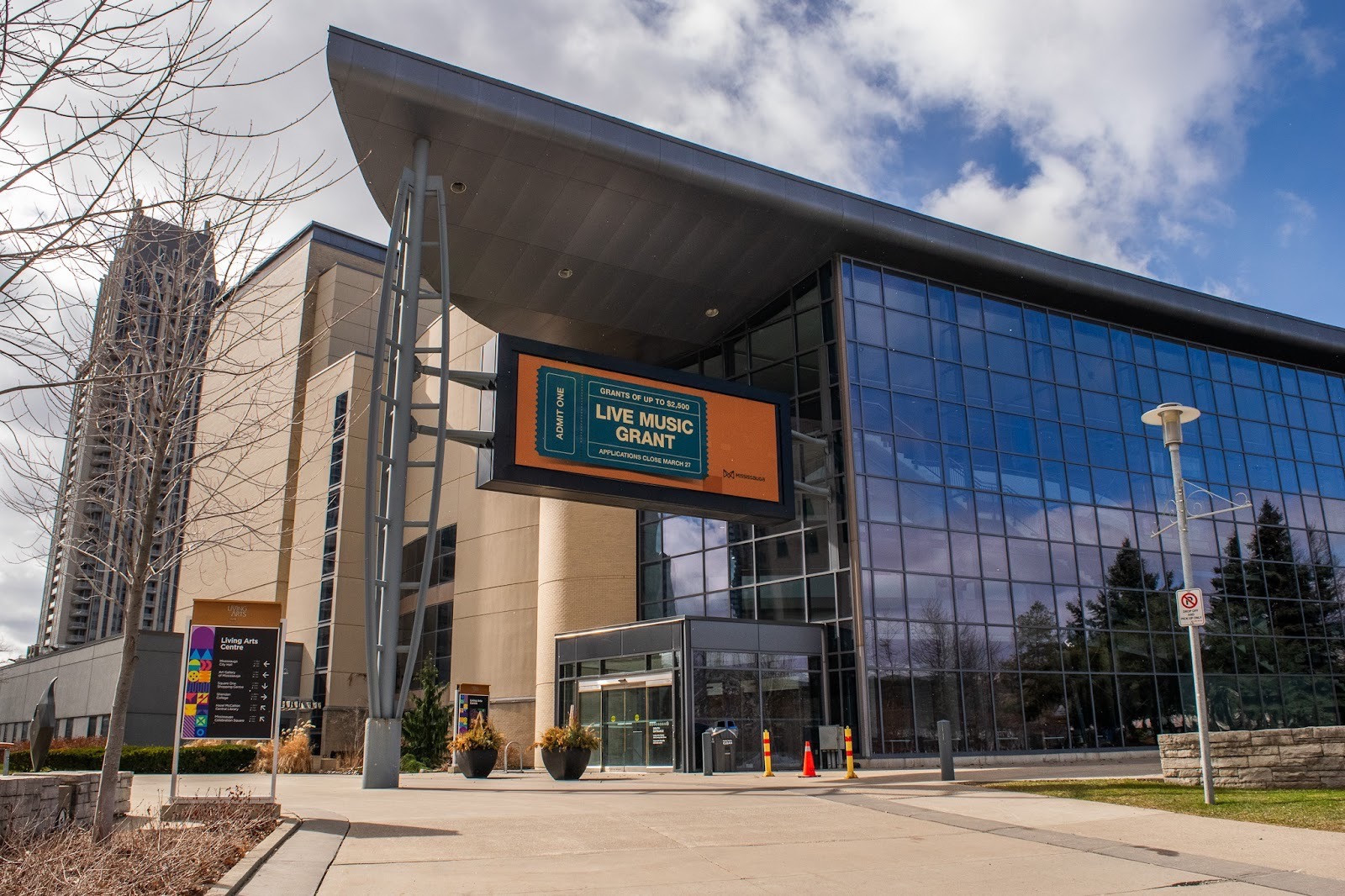
For decades critics have complained that Mississauga’s Living Arts Centre has not been well utilized, costing taxpayers millions every year.
(Alexis Wright/The Pointer)
According to a previous Mississauga staff report, once created, the new venues and commercial establishments could boost employment by creating 6,000 to 8,500 permanent jobs. The report also highlights how tourism currently keeps taxes lower for residents by an average of $1,100 per household.
In 2024, visitors spent roughly $2.3 billion in the city, creating $3.6 billion in total economic activity and supported more than 21,400 jobs. The economic activity also generated $493.6 million in all levels of government revenue, with $86.3 million going directly to City Hall. Staff are hopeful the hotel, entertainment venue and convention centre could push that number higher.
Parrish emphasized the plan may be retracted at any time, and may never happen if council decides.
“This project will take many years, perhaps more than a decade, and yet we are putting forward money and asking for hundreds of millions from higher levels of government today,” Mehta said.
“Consider slowing down. Consider an independent review of costs, benefits and alternatives.”
Email: [email protected]
At a time when vital public information is needed by everyone, The Pointer has taken down our paywall on all stories to ensure every resident of Brampton, Mississauga and Niagara has access to the facts. For those who are able, we encourage you to consider a subscription. This will help us report on important public interest issues the community needs to know about now more than ever. You can register for a 30-day free trial HERE. Thereafter, The Pointer will charge $10 a month and you can cancel any time right on the website. Thank you
Submit a correction about this story

