
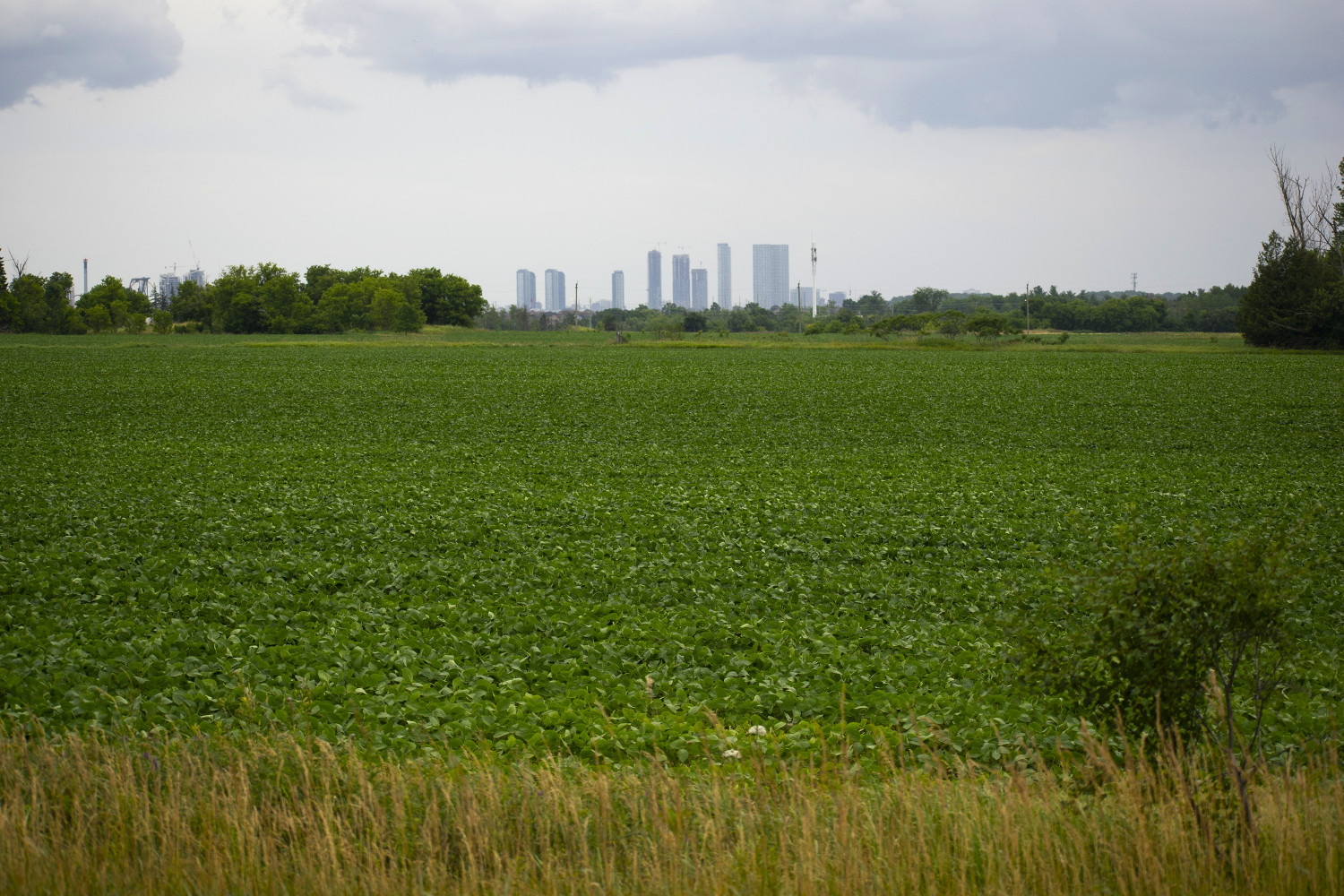
‘Not for the faint of heart’: Democracy Caledon’s rezoning challenge against municipality reaches Ontario Superior Court
After a painstaking year-and-a-half, Democracy Caledon president Debbe Crandall had a “surreal” feeling when her long fight for her group’s day in court finally arrived. The group legally challenged the Town of Caledon’s rushed zoning changes that would allow large-scale residential development pushed by Mayor Annette Groves in 2024, after developers gave her marching orders.
“It was really gratifying…after two years of living with this, it was so cool to be hearing this on a grander scale,” Crandall told The Pointer.
“It made me feel very proud that we have had the courage to do this. Because it's not for the faint of heart.”
The past year, especially, has tested her in ways both public and gravely personal.
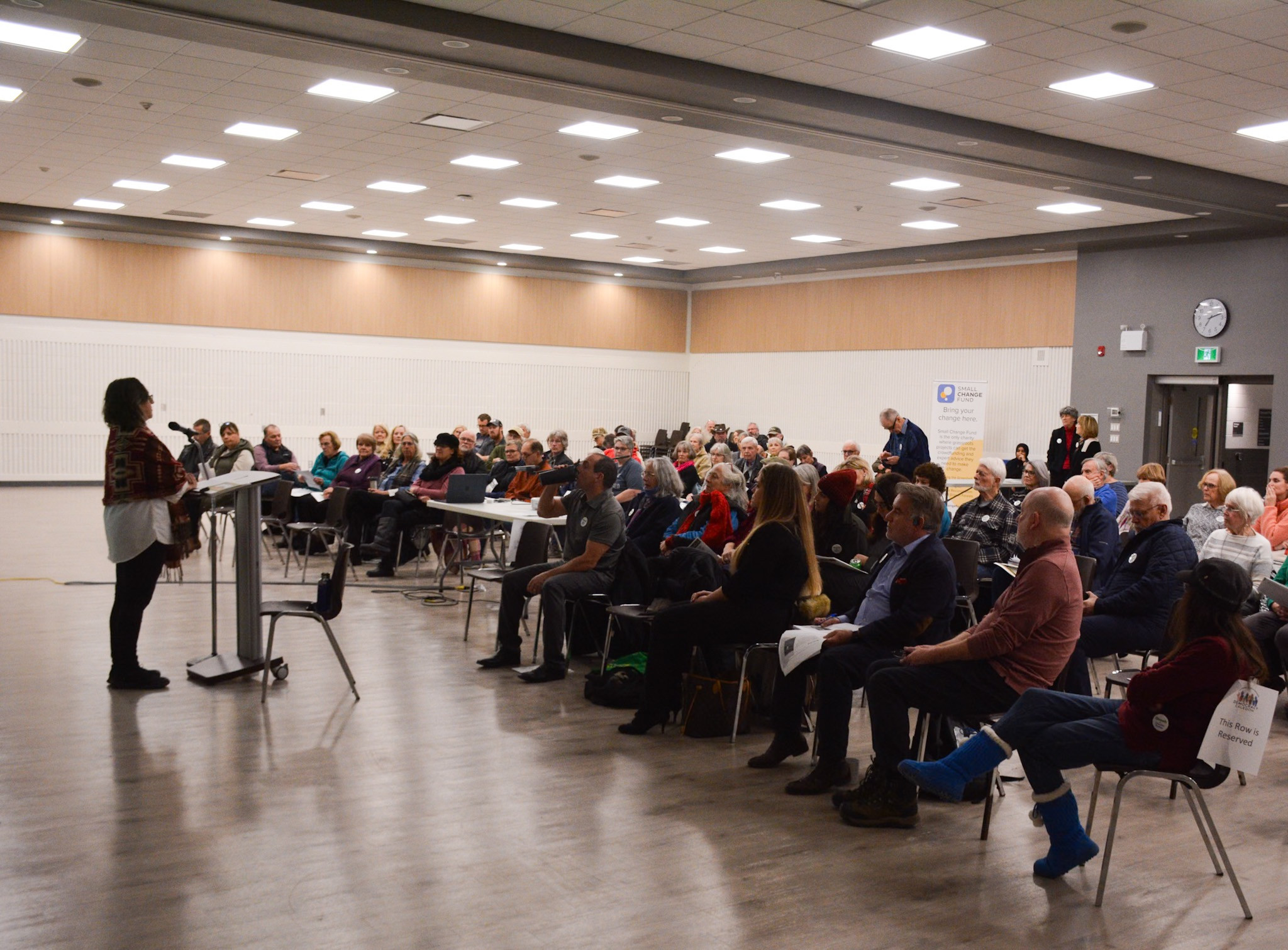
Caledon residents gathered at a recent community meeting where sweeping developer friendly rezoning approvals by Mayor Annette Groves were discussed.
(Joel Wittnebel/The Pointer)
Recovering from a leg injury, she is relearning how to walk without crutches, an exhausting process, requiring patience. But not as frustrating as watching the direction the Town of Caledon was heading in. She remained steadfast as she continued to show up, determined as ever, at council and public meetings and recently, outside the Mayor’s Gala in Mississauga, where she stood in protest, calling for a halt to Highway 413 and unchecked development.
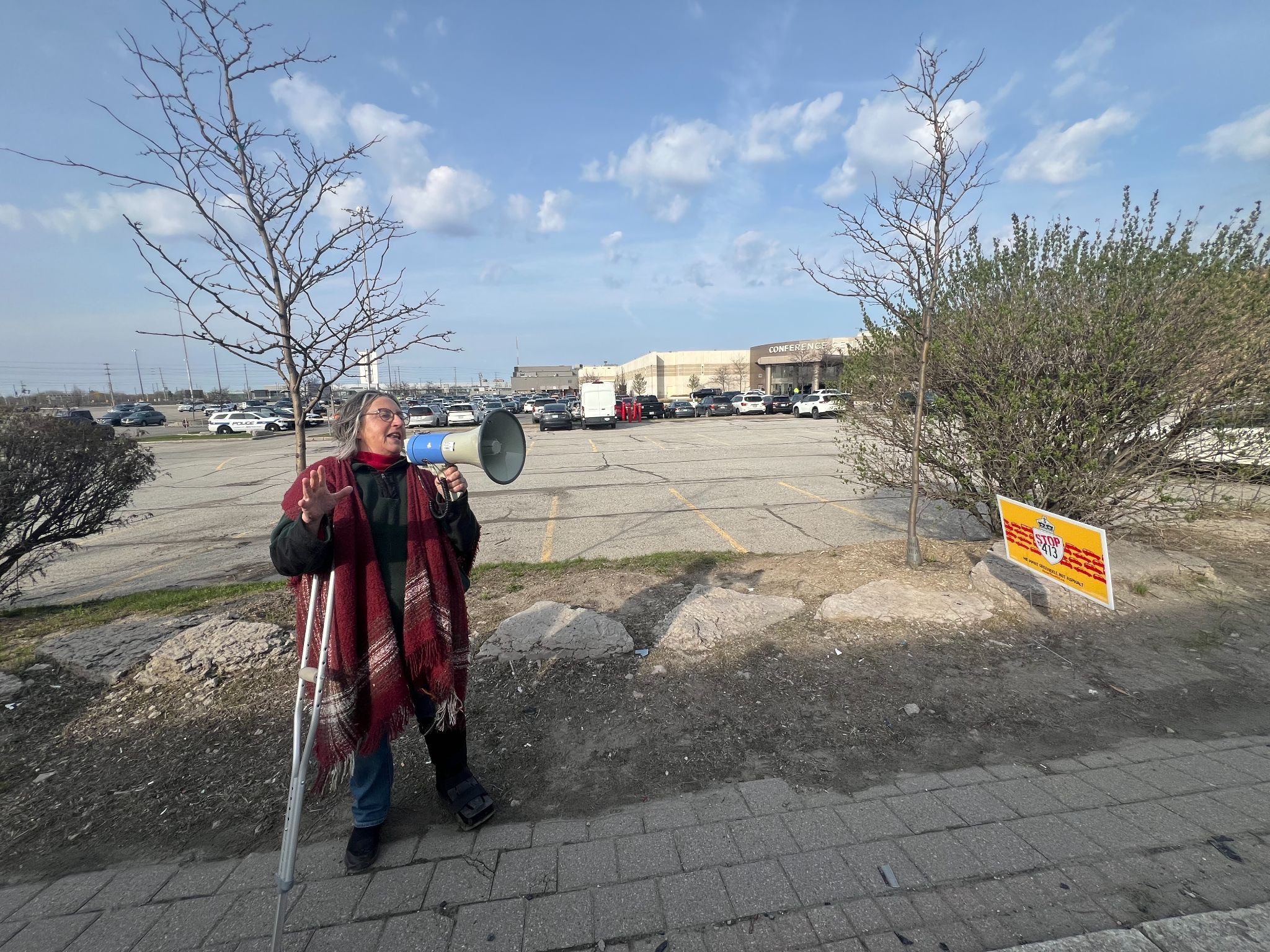
Democracy Caledon president Debbe Crandall speaking at a protest on April 24 outside the Mayor’s Gala in Malton.
(Anushka Yadav/The Pointer)
But there was one day that Crandall and fellow Democracy Caledon volunteers awaited eagerly…
On December 5, 2024, the non-profit group’s legal counsel first filed a notice of application with the Ontario Superior Court of Justice, challenging the legality of the 12 zoning bylaw amendments approved by Caledon Council earlier that year—brought forward by Groves using strong mayor powers and drafted by the law firm Loopstra Nixon. The lawyer who drafted the bylaws, Quinto Annibale, also represented one of the developers who stood to gain from the rezoning. The Town of Caledon has refused to explain why this conflict of interest was not considered.
“We wish we weren’t in this position. We do not relish being here where we are in litigation with our town council. This is not a happy place for us. Somebody had to stop this,” Crandall said on December 11 during a meeting introducing Caledon residents to the legal fight.
“The Mayor and her fellow ‘sprawlinators’ ignored repeated calls from hundreds of Caledon residents to explain why the rush?...there’s too much at risk for us to do nothing.”
On May 4, that argument was put to the test as Justice Rosemarie Juginovic, who was appointed as a Judge at the Superior Court of Justice of Ontario in Brampton in October last year, heard careful explanations of complex land-use planning principles from both sides.
Crandall said their lawyer, Roberto Aburto, spent “quite a lot of time” explaining the “hierarchy” and “basic principles of planning”.
“Our basic argument is that the Town illegally advanced when they approved the pre-zoning on the 12 parcels without the necessary secondary plans, draft plans of subdivision, but most importantly, their growth management and phasing plan,” she reiterated.
The Town’s legal team, led by Christopher Lee of Loopstra Nixon, advanced three main arguments, according to Crandall: The first questioned whether the case should even proceed, citing restrictions on third-party appeals to the Ontario Land Tribunal.
“He argued that this had never been done before,” she said, referring to the use of Section 273 of the Municipal Act, wherein courts can overrule municipal decisions that do not conform with approved policies. “Which, of course, we vehemently oppose.”
Crandall says Nixon defended the Town’s approach as “unorthodox but necessary” in the context of the housing crisis and provincial targets.
The third argument was that the holding provisions attached to the zoning changes corrected any procedural gaps.
Crandall “again vehemently disagrees” with that position, arguing it still leaves infrastructure planning disconnected from growth decisions.
“By forcing all of these applications to come forward in a kind of race to the finish line, it’s pushing the Region to extend servicing without a strategic approach,” she explained.
“The idea of the growth management phasing plan is they would work with the Town to see which communities come first and how they would phase them.”
The Pointer reached out to Lee for a statement but he said his firm was “unable to comment at this time” as the matter “is part of an ongoing court proceeding”.
The bylaws, which would have greenlit the construction of 35,000 housing units, first appeared as a communication item on a March 26, 2024 Planning and Development Committee Agenda to expedite planning procedures for 12 development applications in the areas of Bolton, Alloa, Mayfield West, Tullamore and Wildfield.
Once completed, it would mark the largest urban development in Caledon’s history, with the potential to double the town’s population and dramatically alter its character and landscape.
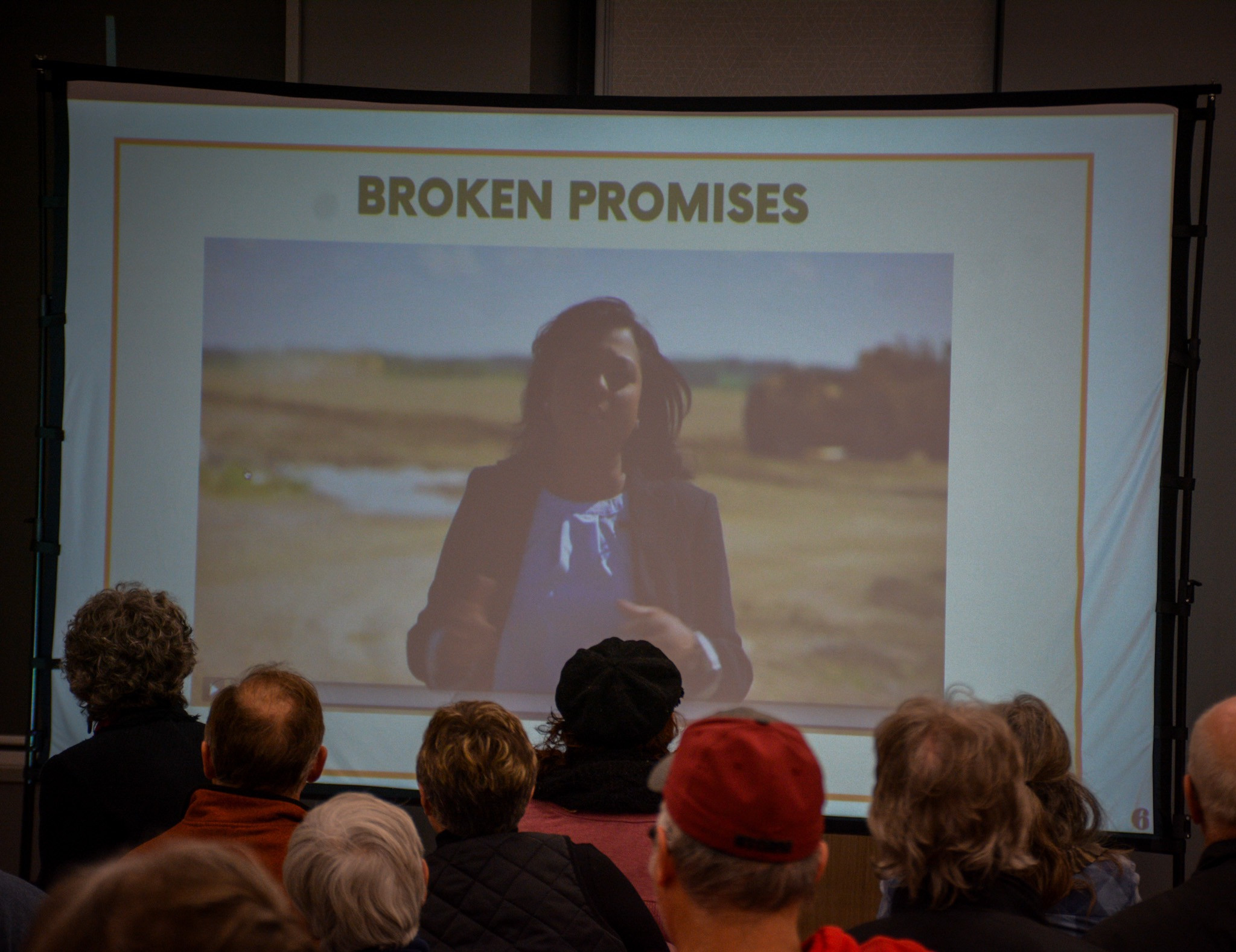
Residents watch videos from Mayor Annette Groves used during her campaign for mayor when she promised to protect Caledon’s green spaces and farmland and advocated for smart growth.
(Joel Wittnebel/The Pointer)
The infrastructure to support such massive growth comes with a price tag in the billions with the potential to cripple taxpayers but no financial analysis of the infrastructure costs to build the new homes was presented.
Groves repeatedly claimed developers would bear the costs required for water infrastructure, roads, community centres, police and fire stations, paramedic services, libraries, parks and a lengthy list of other needs that will accompany the massive growth of some 100,000 new residents.
The only three councillors who expressed disapproval over the hasty process, lack of community consultation and risks to taxpayers since the beginning of the proposal were Lynn Kiernan, Christina Early and Dave Sheen.
On April 25, when the Town hosted its first public meeting to consider the 12 bylaws, hundreds of residents filled multiple rooms and overflow spaces at the Town Hall. The meeting lasted into the early morning hours with the majority of residents opposing the plan, labelling it “undemocratic” and “rushed”.
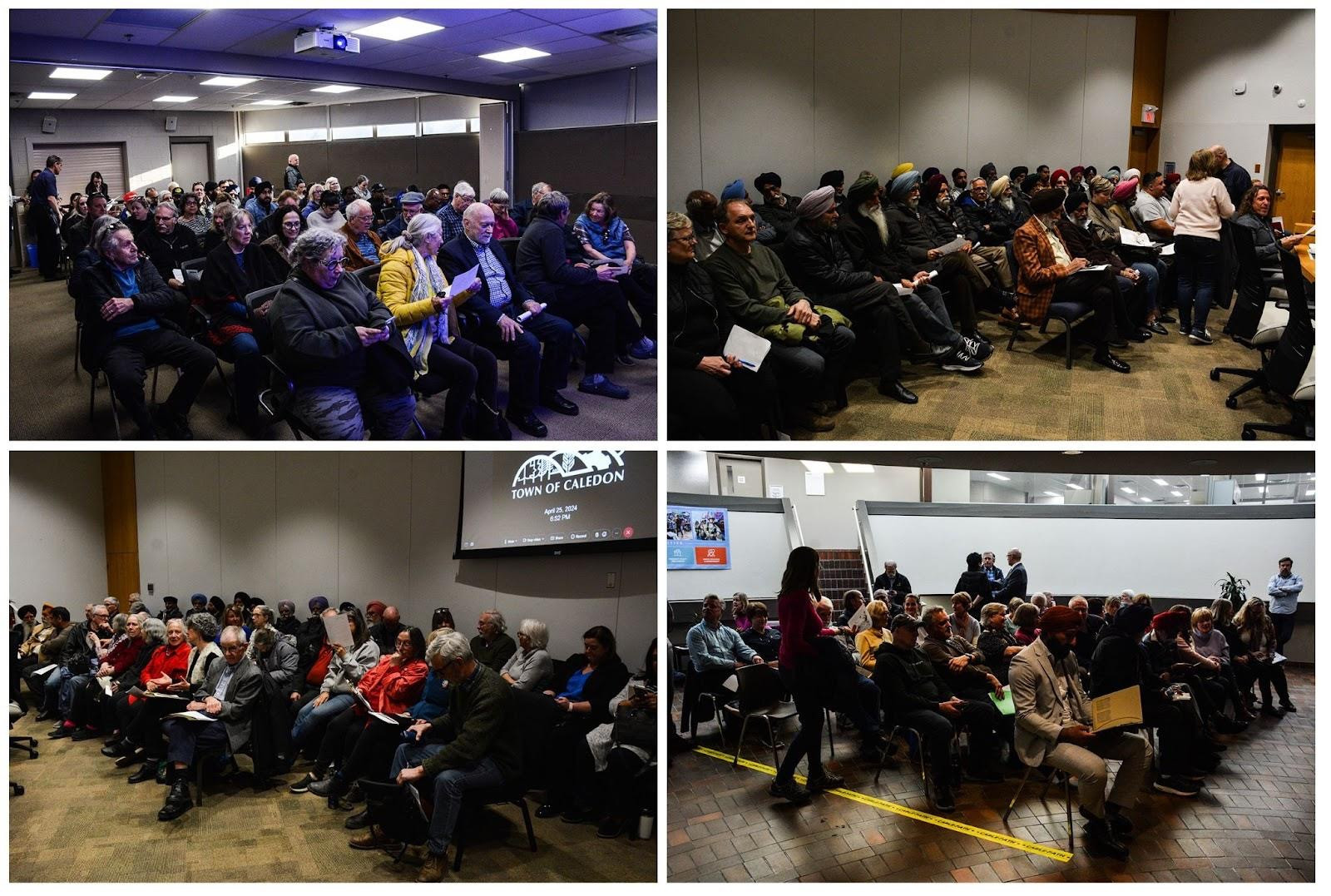
Hundreds of residents filled Caledon Town Hall in early 2024, the vast majority in opposition to the proposed zoning changes.
(Joel Wittnebel/The Pointer files)
Just twelve days before, Democracy Caledon hosted its first public meeting, where nearly 150 people showed up to share their concerns about the plan being rammed through. The mayor, who was in attendance at the meeting, defended her position, often getting visibly angry as she tangled in several back-and-forths with residents.

Caledon Mayor Annette Groves defending her controversial plan during a public meeting, hosted by Democracy Caledon, on April 17, 2024.
(Joel Wittnebel/The Pointer files)
Four public information sessions were held: May 15 in Southfields Village, May 23 in Bolton, May 27 in Alton, and June 10 in Caledon East—all of which were well-attended by residents.
The Region of Peel sent 12 letters to the Town, one for each parcel of land, expressing concerns that the bylaws were “premature” and in violation of numerous conditions under the Region’s planning policy documents.
The Region pointed out that nine of the 12 parcels in the zoning amendments were not needed to meet Caledon’s housing target and 10 do not align with Peel’s Official Plan.
It warned that the water infrastructure alone for the 35,000 proposed homes, which exceeded the provincial target of 13,000 units under the PC government’s Bill 23 housing plan, would cost billions of dollars.
A previous analysis by The Pointer of the Region’s work revealed most of the 12 parcels lacked critical studies on environmental impacts (putting the Greenbelt, one of the world’s largest protected green spaces, at risk), transportation, servicing and would devastate several species at risk in the area—most of which have now lost protection under the provincial government’s Bill 5.
Despite Mayor Groves repeatedly mentioning affordable housing, the proposed zoning bylaw fails to include any provisions to ensure the new units will include options considered affordable.
The bylaws also do not meet Peel's greenfield development requirement to ensure a minimum density of 67.5 residents and/or jobs per hectare, as mandated for such growth.
Opponents of Groves’ developer-driven approach argue they support growth but oppose unplanned sprawl that lacks infrastructure. They favour compact, sustainable development around existing population centers like Bolton, a mantra Groves herself repeatedly extolled for years, even during her bid for mayor. It remains unclear why she changed course immediately after winning her seat.
Not only did Groves ignore the Region of Peel, she also failed to ensure that its comments and concerns were included in the public record, as required.
Ontario’s Minister of Municipal Affairs and Housing, Paul Calandra, also sent a letter to the Mayor and Town Clerk.
“Because the proposed Zoning By-law Amendments would permit development within the protected corridors (for the GTA West Highway, also known as the 413 Highway), passage of the proposed Zoning By-law Amendments, particularly for [six of the land parcels Groves wants to approve for development] would be inconsistent and not conform with provincial and regional policy directions.”
The strong opposition forced Groves to delay the vote on the bylaws. But instead of holding off until after the summer as she promised, she suddenly sprang the vote on residents in June, with none of the key questions answered.
On June 18, Mayor Groves announced that Town staff advised her the reports regarding the bylaws were ready to be brought forward at a June 25 meeting for Council to consider and vote on.
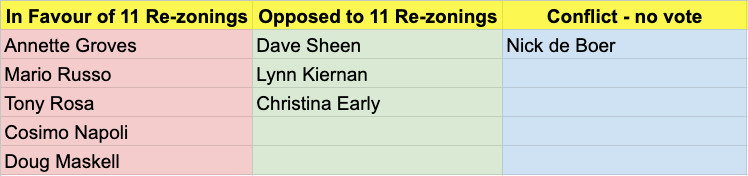
Results of the vote to approve 11 of the 12 Zoning Bylaw amendments (the 12th was passed later).
All council members, except Sheen, Kiernan, and Early, approved the 11 bylaws that first went to a vote, while Councillor Nick de Boer declared a conflict of interest, following legal advice. The final bylaw was approved shortly after.
If the room full of residents was not enough evidence, a survey conducted in July 2024 by Toronto market research firm Pallas Data and sponsored by Small Change Fund on behalf of Democracy Caledon revealed 60 percent of Caledon residents opposed the controversial rezoning decision to pre-zone 5,000 acres of prime farmland for urban development while 58 percent felt the decision primarily benefited developers.
“We feel compelled to act to protect Caledon’s character, and the rights of all of us to plan our own community, not the developers who don’t live here,” Crandall told The Pointer on December 11.
Democracy Caledon’s legal team, which includes environmental lawyer David Donnelly and land-use planning expert Roberto Aburto with Dentons Canada law firm, argued the rezoning fails to align with the Official Plans of Caledon (both the Town’s Official Plan and the Future Caledon Official Plan) and Peel Region and should be quashed for "illegality" under Section 273 of the Municipal Act.
Section 24 of the Ontario Planning Act mandates that “no bylaw shall be passed that does not conform to an official plan,” and Section 237 of the Ontario Municipal Act asserts that “a non-conforming bylaw is illegal and should be quashed.”
Subsection 24(1) of the Planning Act further stipulates that “where an official plan is in effect, no public work shall be undertaken” unless specific exceptions apply.
Official Plans in Caledon and the Region of Peel explicitly require council to review supporting technical studies before approving new development. In this case, that did not happen. The zoning bylaws were approved without those studies—Groves claimed the necessary secondary plans would be completed following approval. That stipulation, however, was only added following public outcry; the original amendments contained no such condition.
Section 5.5.6 of the regional Official Plan demands these studies to ensure efficient infrastructure planning and development—studies that were not submitted before the council vote, when it was required “as a matter of law.” This is the main reason the Region of Peel recommended the plan championed by Groves not proceed as it was “premature”.
“Direct the local municipalities, in cooperation with the Region, to prepare growth management and phasing strategies for Designated Greenfield Areas and Strategic Growth Areas within the Regional Urban Boundary,” the Peel Official Plan states.
The Caledon Official Plan also requires secondary plans to be in place before any new zoning is allowed.
“Applications for development within the designated greenfield area should only be submitted where a secondary plan is in effect,” it reads.
Donnelly pointed out that no secondary plans exist for the 12 rezoned properties, and council did not receive the mandatory “supporting studies and technical analysis prepared to the satisfaction of the town,” as stipulated in the Official Plan.
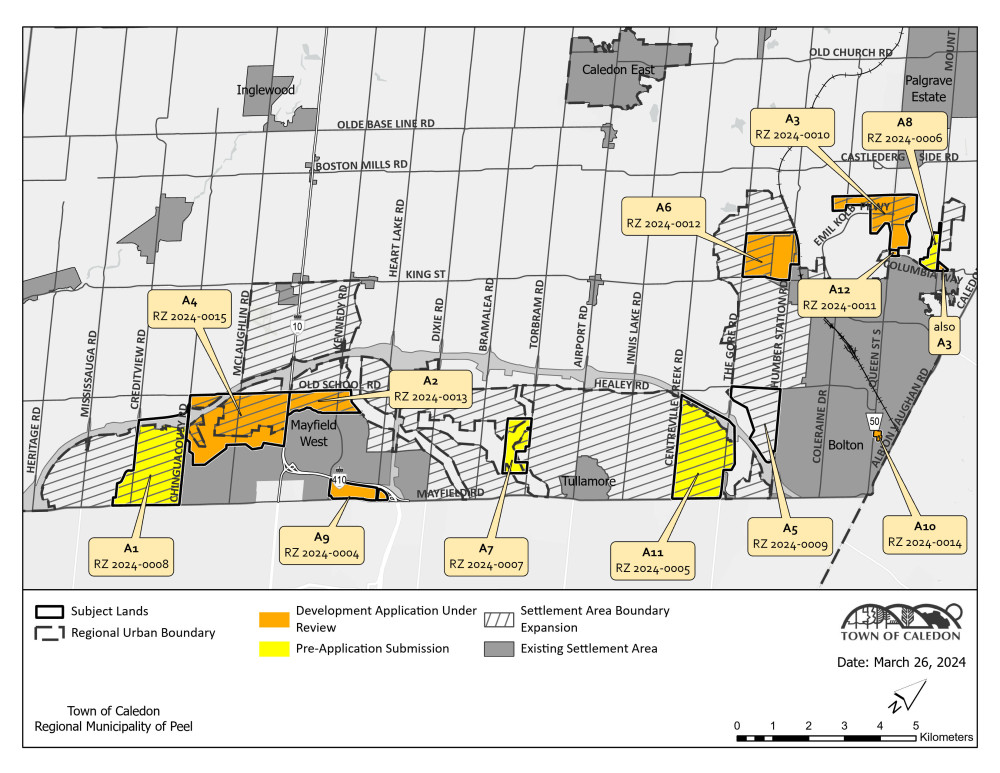
Map of the 12 parcels of land approved for rezoning.
(Town of Caledon)
“Official plans are absolutely, positively crucial,” Donnelly noted.
“They make development and infrastructure spending transparent and predictable through a rigorous public participation process.”
Typically, residents voice their needs for infrastructure and how funding should be allocated. But in Caledon, the situation is the “opposite.”
“It is not permitted for council or the mayor to ignore the wishes of residents. They cannot assume the role of experts or claim to know better how to spend your money,” Donnelly asserted.
On December 10, the Town of Caledon, in a press release, stated it would be “vigorously defending” the rezonings and accused Democracy Caledon of using scare tactics to mislead residents—asserting the bylaws were approved in accordance with provincial and municipal legislation and “in keeping with all procedural requirements” of the Planning Act and Municipal Act.
Putting up a legal guard was the only viable path forward for Democracy Caledon after the Ford government eliminated residents’ ability to appeal planning decisions at the Ontario Land Tribunal, the traditional course of action for contesting municipal approvals by developers and/or residents.
Advocates like Crandall hoped that by neglecting key federal and provincial legislation, Groves' plan could be deemed illegal by the Ontario Superior Court of Justice.
Crandall said it is a “novel”, “precedent-setting case” that extends beyond the boundaries of Caledon.
“The integrity of the planning system that has served Ontario very well with an ordered, tiered planning system…is at risk,” Crandall said.
“What is to stop other jurisdictions from taking the same action? It’s upending the entire process.”
Justice Juginovic did not issue a decision, instead reserving her ruling, which could take several months.
“It could be three to six months…all we can hope is that it comes out sooner than later,” Crandall added.
“We also have not yet paid off all of the bills…we have still lots of fundraising to do.”
Until then, Democracy Caledon members will be taking a deep breath, giving themselves “a little bit of time” to absorb the enormity of the past few years, and what led to the events on May 4. Then, they will regather their impressive energy and get ready for the municipal election less than six months away.
Email: [email protected]
At a time when vital public information is needed by everyone, The Pointer has taken down our paywall on all stories to ensure every resident of Brampton, Mississauga and Niagara has access to the facts. For those who are able, we encourage you to consider a subscription. This will help us report on important public interest issues the community needs to know about now more than ever. You can register for a 30-day free trial HERE. Thereafter, The Pointer will charge $10 a month and you can cancel any time right on the website. Thank you
Submit a correction about this story

