
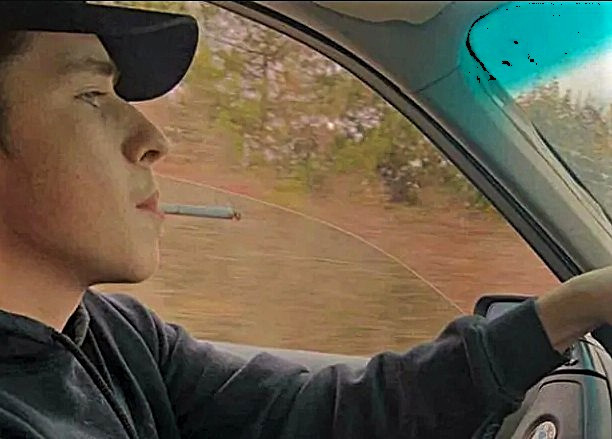
‘The law targets the inherently risky activity of driving after consuming cannabis’: Driver sentenced to 17 years after killing Caledon mother and 3 daughters loses appeal
An Ontario court has dismissed a pair of appeals by Brady Robertson, the man who killed Karolina Ciasullo and her three young daughters in June 2020 when he drove his car at 130 kilometres-an-hour on a Brampton street, slamming into her SUV while he had at least eight times the legal limit of THC in his bloodstream.
The Ontario Court of Appeal supported the decision of the trial judge, and doubled down on the court’s scathing assessment of Robertson, who was attempting to overturn his 17-year sentence.
The appeal court described his decision to get behind the wheel with eight times the legal limit of THC in his blood as “highly irresponsible and dangerous” resulting in “catastrophic consequences”.
“The harm caused by the appellant’s conduct was devastating. Karolina Ciasullo and her three young daughters were killed, leaving Michael Ciasullo without his entire immediate family. The trauma he continues to endure is profound. Karolina’s parents lost both their daughter and their granddaughters, and the impact of this tragedy has reverberated through their extended family, friends, colleagues, and first responders,” the decision underscores.

Karolina Ciasullo and her three daughters were killed by Brady Robertson.
(Facebook)
In December 2021, prior to Robertson’s sentence, Michael, through a family member, told the court “that day, all of me died”.
“MADD Canada was pleased that the Ontario Court of Appeal upheld the 17-year sentence for Brady Robertson for taking the lives of Karolina Ciasullo and her three daughters: Klara, Lilianna, and Mila. This is one of the highest sentences in Canada for impaired driving causing death and reflects the devastating choices the offender made that day,” Arielle Nkongmeneck, Director of Communications for MADD, wrote in an email to The Pointer.
“We are also pleased to see that the Court of Appeal upheld the 5ng/ml per se limit as constitutional. As the court said, ‘The law is not limited to deterring only those who are demonstrably impaired; rather, it targets the inherently risky activity of driving after consuming cannabis, much like the blood alcohol regime.’ This decision reflects the risk that driving impaired by cannabis represents and aims to protect the public.”
The appeal court decision elaborated on the decisions Robertson knowingly made.
“The appellant drove at extreme speeds in an unregistered and uninsured vehicle, without a licence, while suspended, and after consuming intoxicants. His driving record of 15 convictions over a short period demonstrates a persistent and escalating disregard for the law and for public safety,” the appeal court decision elaborated. “Even more troubling, he continued this behaviour after what should have been a clear warning: a separate incident two days earlier in which he crashed into a sidewalk barrier while in a stupor. Although no one was injured in that earlier episode, it underscores the seriousness of the conduct for which he was ultimately sentenced.”
Two days prior to the deadly June 18 crash, Robertson passed out behind the wheel, drove over a sidewalk and struck items outside a cafe as a passerby tried to open his car door while the vehicle was still moving, before he regained consciousness and sped away. The disturbing scene was captured on a widely circulated video. During the trial Robertson claimed it was not him, despite the obvious evidence.
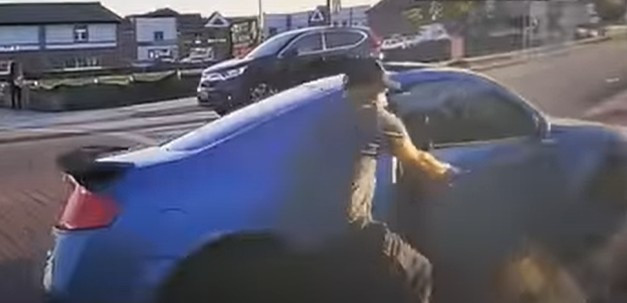
A pedestrian attempts to enter Brady Robertson’s car after he passed out behind the wheel and rolled onto the sidewalk.
(Ontario Court of Justice)
“Shortly thereafter, he led police on a high-speed chase, reaching speeds of up to 130 km/h in a 60 km/h zone before evading capture. These incidents formed part of a disturbing pattern of reckless and dangerous driving that culminated in the fatal collision,” the ruling details.
Robertson got behind the wheel with at least eight times the legal limit of THC, the active ingredient of cannabis, in his bloodstream. Travelling at 130-kilometres-an-hour, he fled from police toward the intersection of Countryside Drive and Torbram Road in north Brampton, swerving out of control around cars stopped at the red light before violently slamming into the family SUV, sending it into a concrete light pole which fell directly onto and collapsed the top of the vehicle.
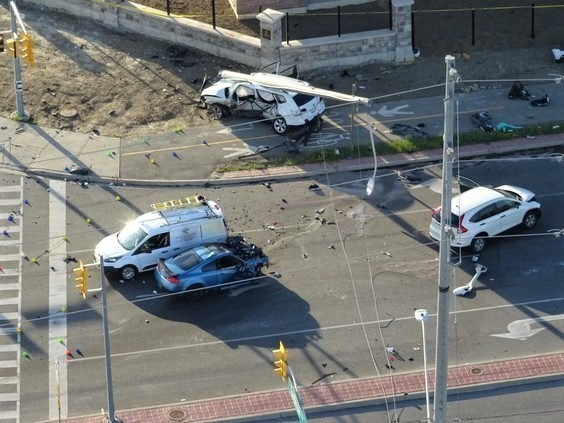
The Brampton crash scene in 2020.
(Ontario Court of Justice)
After the collision, Robertson pleaded guilty to four counts of dangerous operation of a motor vehicle causing death, but not guilty to four counts of impaired driving and a dangerous driving charge for the incident that occurred two days prior. His not-guilty plea on the impaired charges included an attempt to get blood sample evidence thrown out and a constitutional challenge that argued the effects of cannabis are different from person-to-person and therefore guidelines for legal limits should not be applied universally. That challenge was ultimately dismissed.
In his appeal, Robertson renewed this failed constitutional challenge of the THC limit of 5 ng/mL, arguing the limit is "arbitrary and overbroad”. This appeal was dismissed.
“Parliament’s adoption of a THC limit reflects a measured and familiar approach, analogous to longstanding blood alcohol limits, targeting the voluntary and inherently risky conduct of driving after consuming an impairing substance. The resulting legislative line is neither arbitrary nor overbroad,” the decision details.
Robertson also appealed the 17-year sentence, describing it as “demonstrably unfit and excessive”.
This was also dismissed.
“The 17-year sentence was not the product of error in principle and is not demonstrably unfit. The trial judge carefully weighed the exceptionally aggravating features of this case: the loss of four lives, the appellant’s profound disregard for public safety, and the pattern of dangerous driving reflected in two separate high-risk police pursuits. While the judge also considered the appellant’s mitigating circumstances, she reasonably concluded that these factors did not outweigh the gravity of the offences. The sentence was justified and consistent with the governing principles of sentencing,” the decision explains.
MADD said tougher sentences for driving while under the influence of cannabis, which was legalized in 2018, are appropriate.
“We have seen sentences for impaired driving causing death and injury increase over the last decade or so as Parliament and judges begin to adequately recognize the serious risk to public safety that individuals who choose to drive impaired represent. Too many families are devastated by the loss of loved ones and too many Canadians suffer life altering injuries.”
The 17-year ruling was one of the steepest sentences handed down in Canada for impaired driving causing death.
While the appeal court upholding the sentencing decision reinforces the justice system’s desire to chart a new path for Canadian courts to hand down stricter penalties for those involved in deadly impaired driving collisions, there are signs that more change is still needed.
On May 4, 20-year-old Ethan Lehouillier was sentenced to eight years in prison for an impaired driving crash in 2025 that killed three children. The family was stopped near the intersection of Highway 401 and Renforth Drive when Lehouillier ran a red light and slammed into their vehicle at 170 kilometres per hour.
Outside a Toronto courtroom on Monday after the sentence was handed down, Jade Galve, the children’s mother, said that eight years was simply not enough.
“We need to strengthen our justice system with harsher penalties for impaired driving so people are aware and make better decisions before getting behind the wheel.”
Email: [email protected]
At a time when vital public information is needed by everyone, The Pointer has taken down our paywall on all stories to ensure every resident of Brampton, Mississauga and Niagara has access to the facts. For those who are able, we encourage you to consider a subscription. This will help us report on important public interest issues the community needs to know about now more than ever. You can register for a 30-day free trial HERE. Thereafter, The Pointer will charge $10 a month and you can cancel any time right on the website. Thank you
Submit a correction about this story

