
Patrick Brown can’t explain how his pared down shell-game budget will be funded; 4.36% tax increase almost double the inflation rate
Brampton Mayor Patrick Brown, who has left a trail of controversy on each stop of his tumultuous political career, just pushed through a now approved 2026 financial blueprint that delays critical infrastructure work, lacks spending on major city building projects like the downtown flood plan, leans heavily on new debt and relies on unsecured grant funding from upper levels of government.
Adding to the budget chaos is the need to borrow from reserve accounts that are only supposed to be used in special circumstances, and unexplained funding sources for some of the spending required in 2026.
Brampton residents will pay 4.36 percent more in 2026 to cover their property tax bill, almost double the rate of inflation. The budget approved Friday will have a 1 percent impact on Brampton’s portion of the tax bill—before the 3.36 percent increase from the Region of Peel is factored in—to fund the city’s share of Peel Memorial’s phase-2 expansion.
The special 1 percent levy will generate approximately $15.3 million for part of the local share contribution toward Memorial’s new addition. City Hall’s share is estimated to be approximately $125 million. At the end of 2025, the reserve account for the municipality’s share of the project had a balance of $90.4 million.
Brown’s initial proposed budget, which he brought forward under the strong mayor system, initially called for a 1.5 percent increase to the City’s share of the property tax bill—despite Brampton’s budget shrinking by 1.4 percent this year.
To shave the figure down to 1 percent, a motion was approved Friday that orders staff and council to “include a provision for efficiency savings and/or revenue increases in the amount of $4,147,956 and have staff be directed to achieve this amount in the 2026 fiscal year.”
There was no council discussion about how the $4.15 million in savings will be found, or what will happen if costs actually go up, as has been the pattern under Brown, who has repeatedly pushed through budgets, only to see the amount eventually spent under his leadership balloon far beyond what council approved at the beginning of the year. For example, even when he was told that rapidly rising diesel costs to operate the huge transit fleet would far outpace what was budgeted, Brown ignored the warnings from staff, who had to scramble when the allocated money to purchase diesel ran out well before the end of the year.
Brown’s financial shell game is continuing in 2026.
Friday’s motion directed finance staff to take out a “short-term internal loan” from reserve accounts to cover $19.4 million that will be needed in 2026 to keep the operating budget afloat. These types of rate stabilization reserve accounts are only supposed to be used in unique, unforeseen circumstances, for example, in an emergency due to a major storm to cover operating costs when there is a major disruption.
Brown is dipping into these rainy day funds because, according to critics, he continues to fail at financial leadership.
“He is not very fiscally responsible. He is not being transparent,” said Tracy Pepe, a Brampton resident and vocal community advocate who ran for council in 2022 and uses social media to highlight her concerns with City Hall. “This is the problem with the council, they are not transparent.”
Relying on reserves has been a hallmark of Brown’s poor fiscal management since being elected in 2018. His budgets have been heavily criticized by experts in and outside Brampton.
“Brampton businesses are losing confidence in the City's ability to plan because of the shifting numbers that seem to shift very quickly,” Glenn Williams, a seasoned accountant speaking on behalf of the Brampton Board of Trade, told councillors when the 2022 budget was presented. He highlighted contradicting information in different reports, last-minute publication of documents and a capital funding shell game as some of the alarming concerns.
Last year, it got worse. A May financial status report authored by staff revealed almost $1.2 billion approved in recent budgets for capital needs and collected from taxpayers over the past few years was not spent as of the beginning of the year, due to mismanagement under Brown.
The C.D. Howe Institute’s Nicholas Dahir, who analyzes municipal budgeting processes, described Brampton’s chaotic financial management as “a confusing mess” when the staff report came out, pointing out that amounts approved by council are routinely not needed at the time or go unspent because of poor management, while taxpayers are on the hook for services and infrastructure they paid for but never got.
“I take it you've dived into the financial statements and budgets of Brampton,” he told The Pointer at the time. “I imagine it was quite confusing looking at what they present at the start and what they present at the end," he said.
“They typically present (the budget) on a cash basis, separating out operating spending and capital spending… whereas at the end of the year they report the results on an accrual basis. And so that mismatch does sort of undermine engagement, people don't quite get that it's a confusing mess. It's hard to follow exactly what's going on.”
With Brown’s latest budget Brampton taxpayers will pay more, despite deep cuts to planned investments; and the “confusing mess” of capital projects not moving forward, despite collecting the money from taxpayers, will continue.
Meanwhile, Brown’s numerous claims of turning Brampton around remain stalled, with no sign of his “Innovation District”, world class cricket stadium, Downtown Revitalization, tunnelled LRT into the city centre, standalone “Brampton University” or many of the other promises he has made, despite millions collected from taxpayers for these since-ghosted projects starting when Brown was first elected in 2018.
The approved 2026 budget includes more shell games: according to the motion approved Friday, the internal loan will be paid back by the “2nd Hospital Levy subsequent to fulfilling the $125 million commitment to William Osler” which manages Peel Memorial, along with Brampton Civic Hospital and is responsible for raising $250 million for the Memorial expansion. It asked City Hall to cover half this amount, a common arrangement in municipalities to support the construction of new healthcare infrastructure. What is not common is taxpayers being asked to pay for this badly needed new healthcare project, only to see Brown lend that money to cover costs completely unrelated to Memorial’s expansion.
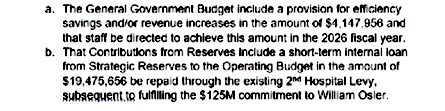
The Friday motion detailing how money intended for Peel Memorial's expansion will be used under Patrick Brown's leadership.
(City of Brampton)
With the implementation of the Memorial levy, Brampton Councillor Gurpartap Singh Toor asked City staff how long it will take to reach City Hall’s $125 million commitment, and how the new financial arrangement will help.
“With this adjustment, we will now have that completed by 2029, which is in line with the cash flow requirements of the project.” Staff claimed it matches the provincial funding timeline for the project. The PC government still has not funded Memorial’s expansion and has failed to publicly provide a timeline for its completion.
Throughout the 2026 budget process, Brown and many of his council allies have misleadingly claimed that Brampton taxpayers will see no increase to their property bill this year. It is a blatantly false claim and critics have said it is being used in an election year to help council members hang onto their seat.
“We all know that is not the number that will appear on our final tax bill,” Idris Orughu, a Brampton resident and community advocate, said during the January 27 council meeting.
“Calling this a low increase is the best failure in transparency.”
Brown and other members of council have stayed away from the 4.36 percent figure that represents the increase Brampton property taxpayers will see on their 2026 bill. This does not include the 7.8 percent increase on the utility bill for 2026.
Orughu urged council to find cost efficiencies and curb unnecessary spending, arguing that homeowners in Brampton are already grappling with multiple challenges like inflation and high mortgage costs.
“You are asking residents to tighten their belts while the city spending continues. People are hurting in this city. Homeowners are fed up, tired, and exhausted,” he said when the 2026 budget was being discussed by council members.
He pointed out the excessive spending of council members on foreign travel, the secretive $11 million Argo transit project, and the controversial acquisition of 175 Sandalwood Parkway West—a building that was purchased for $78 million on Brown’s insistence, even though it had sold three years earlier for just $32 million.
“Homeowners are being asked to pay more without getting value in return,” Orughu said. “Brampton residents feel they are paying big-city taxes for small infrastructure.”
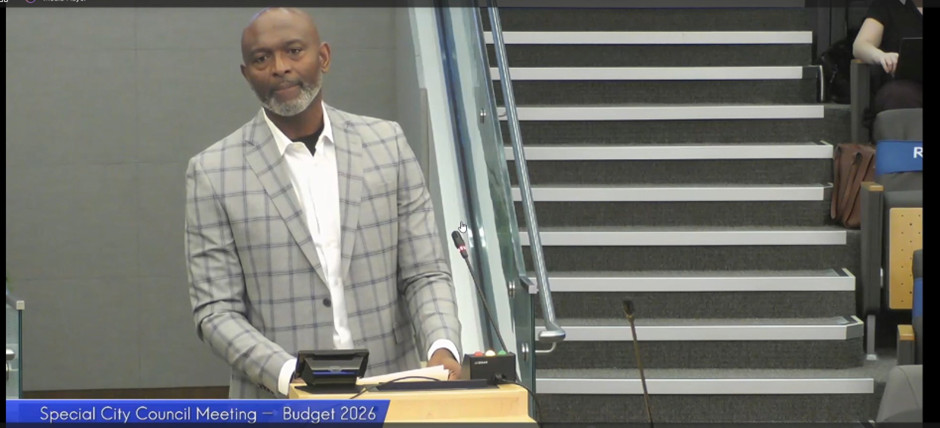
Idris Orughu, a Brampton resident and community advocate, expressed frustration over the misrepresentation of the overall tax increase residents will pay in 2026.
(City of Brampton)
The issues Orughu raised during last month's budget meeting regarding extensive spending by the council on foreign trips to supposedly attract overseas investment in Brampton, and the approval of millions of dollars for the secretive Argo transit partnership have been previously detailed by The Pointer.
Travel records obtained through freedom of information requests have revealed that the bloc of councillors loyal to Brown spent tens of thousands of dollars on expensive overseas trips, to Taiwan and Portugal, the United States, and Phillipines, with no meaningful investments or substantial results for the City. The Pointer has documents that will soon be published detailing other lavish travel around the world.
Meanwhile, Brampton’s overall budget (capital + operating) is shrinking year-over-year, from $1.398 billion last year to $1.378 billion this year, a 1.4 percent decline.
In the struggling downtown, where sustained investments are required, $4 million from the Downtown Revitalization funding has been slashed in the 2026 budget. Brown has consistently neglected the downtown core. After winning the 2018 election, Brown immediately cancelled the Downtown Reimagined project which was supposed to transform the city’s aging Four Corners area. As much as $100 million that had been committed to improve the crumbling state of the city’s centre was suddenly removed from the capital budget.
Among other commitments from Brown to Brampton taxpayers that have never materialized are the world-class cricket stadium, a project that appeared in the budgets previously but kept being postponed and is now nowhere to be seen; the standalone Brampton University (a scandal that handed $630k in taxpayers' money to close friends and associates of Brown and Santos, his key councillor ally) he promised years ago is no longer mentioned in his budgets; a tunneled LRT into downtown, which he claimed would be paid by Ottawa and Queen’s Park (money which was never secured) is also not mentioned in the budget document, despite his efforts to mislead the public about the LRT.
In the 2026 capital budget, $220,000 is included for the study of the possible future extension of the Hurontario-Main LRT, which currently has no funding commitment from the upper levels of governments, even though Brown mailed thousands of campaign-style brochures to residents paid by taxpayers, claiming the project is moving forward.
His repeated tax freezes implemented during his early years are now contributing to a capital backlog, after the badly needed projects were either delayed or cancelled. Many, despite being approved and paid for, are missing from this year’s budget.
No new investments, for example, have been planned for the necessary transit maintenance and storage facility and Riverwalk project.
Neither of these two projects is mentioned in the capital section of Brown’s budget; they are only listed in the Funding Sources Summary section. The transit facility requires $50 million in 2026, which was initially planned to be paid through development charges, but now, in this year’s budget, that amount will be covered by debt. The long-delayed Riverwalk project, a vital initiative to fix the downtown’s flooding problem and to revitalize the city centre, has $15.3 million outlined in the budget, which was supposed to be covered through subsidies and grants as previously planned; instead, the funding source is not known, simply mentioned as “other” in Brown’s budget.
There are numerous capital needs that are approved in the budget with no funding source explained, in the column described as “other”.
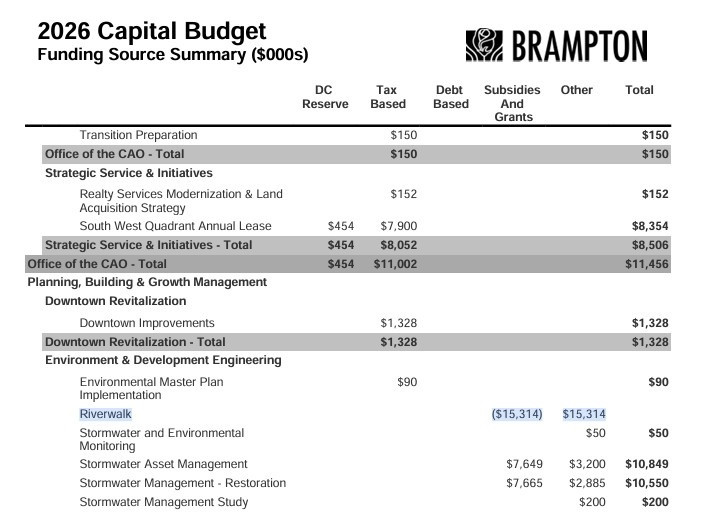
The Pointer sent questions to the City seeking clarification on these funding changes, but no response was received. It is unclear what “other” means and where the money will come from.
The budget documents explain a key focus for City staff in 2026 will be clearing projects from the growing capital backlog (which included 583 active capital projects at the end of 2024). The Pointer previously reported that the City has collected $1.2 billion from property owners over the past few years to address its capital needs but never spent that money.
The list of these previously approved projects has grown since last year. During the January 20 special council meeting, finance staff said the unspent capital (where the dollars have been collected from taxpayers for specific work they thought their money was paying for, but it was then never used) is now between $1.5 billion and $1.6 billion.
Nearly 35 percent of the City’s entire capital budget is reliant on subsidies and grants from upper levels of government with no indication the money has been committed by Ottawa or Queen’s Park. City staff did not respond to The Pointer’s inquiry about approvals by upper levels of government.
Municipal budgets typically do not assume revenue unless it can be reliably counted on. Brown has a history of claiming funds have been secured without any guarantees.
Brown’s budget will also push Brampton further into debt. At the end of 2026, the City will have nearly $390.5 million in loan obligations to pay back.
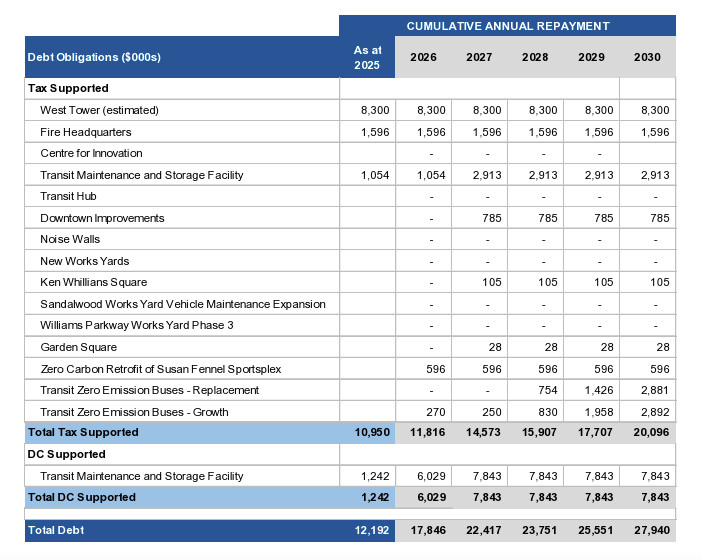
By 2030, Brampton taxpayers could be covering more than $20 million in debt payments annually to fund necessary projects.
(City of Brampton)
While debt alleviates the need to place the immediate burden on residents—many are dealing with financial pressures themselves during a time of record unaffordability—it only draws the pain out long-term, as residents will be forced to make interest payments for years to come. Brampton taxpayers are already paying $10.9 million annually to finance the debt taken out for projects like the controversial $205 million City Hall West Tower expansion, completed a decade ago, and the new fire headquarters. That repayment amount is expected to nearly double by 2030 due to the debt Brown continues to take on, which will guarantee high property tax increases for decades to come.
Email: [email protected]
At a time when vital public information is needed by everyone, The Pointer has taken down our paywall on all stories to ensure every resident of Brampton, Mississauga and Niagara has access to the facts. For those who are able, we encourage you to consider a subscription. This will help us report on important public interest issues the community needs to know about now more than ever. You can register for a 30-day free trial HERE. Thereafter, The Pointer will charge $10 a month and you can cancel any time right on the website. Thank you
Submit a correction about this story

