
Niagara Falls Integrity Commissioner ignores Councillor Strange’s blatant wrongdoing—erodes public trust, advocates say
For the second time in as many months, Michael Maynard, the Integrity Commissioner for the City of Niagara Falls, has concluded that direction by Councillor Mike Strange to supporters who were told to block out a women’s rights group from council chambers, did not constitute a breach of the City’s Code of Conduct.
Since his arrest on May 3 last year when he was charged with intimate partner assault, Strange’s presence on council and participation in public meetings where critical decisions on local governance are made, have been the source of controversy.
Police charged him with assault after responding to his home in the early morning hours, when officers found an injured woman at the scene and Strange was apprehended. His trial is scheduled for April 2026; Strange has publicly maintained his innocence.
The most recent integrity commissioner finding, detailed in a 46-page report, came after a complaint filed by Niagara Falls resident Margaret Gilbert. She wrote that Councillor Strange’s conduct ahead of a council meeting when members of the group Women of Ontario Say No (WOSN) sought to address council to discuss proposed new provincial legislation, bill 9, which would amend Ontario’s Municipal Act to include more uniform rules to govern local elected officials and introduce stronger accountability mechanisms in cases of harassment and assault, was a violation of the Code. The legislative changes are expected to come into effect this year and are aimed at strengthening workplace safety, while holding municipal elected officials to a higher standard of conduct with mechanisms for removal from office. WOSN has insisted that councillors facing criminal charges should be required to take a leave of absence until their legal case is resolved.
When some of the group’s members sought to address Niagara Falls council ahead of a provincial government public hearing in the city this past summer on the proposed new legislation, Mayor Jim Diodati denied them the opportunity to raise their concerns and educate local elected officials about some of the legislative criteria they were advocating for. He claimed, without explanation, that if given the opportunity to address the proposed legislation, the women would use the council chamber to bring up the criminal case against Strange, and the mayor said this was explicitly prohibited.
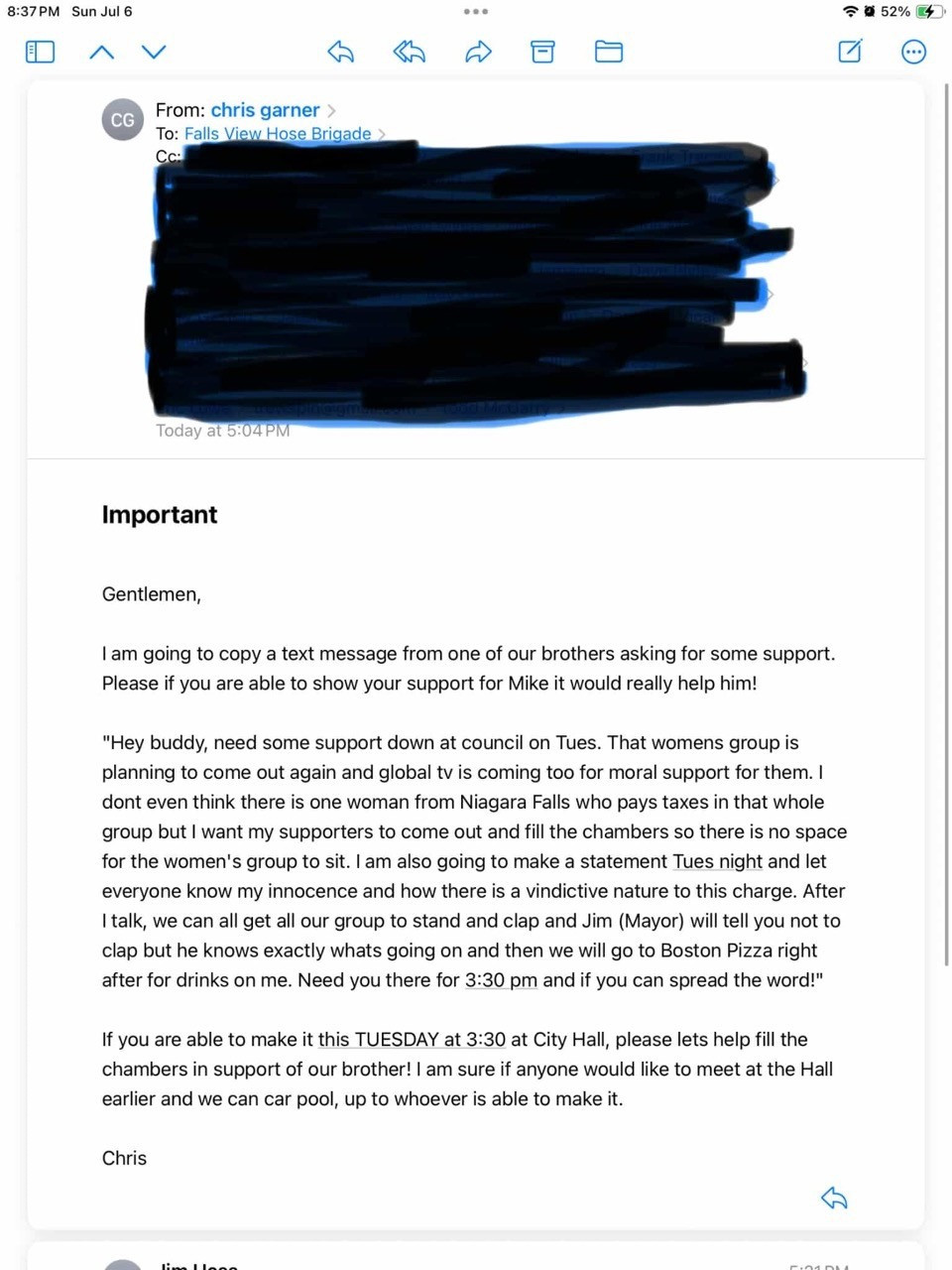
Behind the scenes, Councillor Strange later encouraged supporters to attend a council meeting weeks later where he would defend himself before the public and claim he is innocent of the intimate partner assault charge. He instructed a group known as the Falls View Hose Brigade, made up mostly of present and former firefighters, to fill up the chamber so the women would have no place to sit, and then they should stand and cheer when Strange declared his innocence.
The Pointer obtained a copy of the message Strange sent to the group, offering free pizza and beer in exchange for their help to drown out the women:
Despite clear Council Code of Conduct rules that prohibit the type of behaviour Strange and Diodati used to silence the women’s group, Maynard, who is hired to enforce the Code and ensure council members do not violate its rules, dismissed the complaint.
“Most of the Complaint does not raise investigable issues or otherwise does not require more than cursory consideration or elementary preliminary analysis to dismiss. This includes particularly the fact that a Code of Conduct should not be used to disrupt normal political activities, such as rallying support for an individual or an issue,” he claimed in a decision advocates and experts have described as incoherent and laughable.
The Niagara Falls Council Code of Conduct clearly states all council members commit to “at all times conduct themselves with decorum” and ensure a “decision-making process of Council” that is “open, accessible and equitable and respects the City’s governance structure… City residents should have confidence in the integrity of their local government and of their Members; the conduct of each Member is of the highest standard; and the conduct of each Member demonstrates fairness, respect for differences and a duty to work with other Members together for the common good… A Member shall at all times conduct themselves with propriety, decency and respect and with the understanding that all members of the public, other Members of Council or a Local Board, and staff are to be treated with dignity, courtesy and empathy, recognizing that a Member is always a representative of the City and of their elected office or appointment. A Member shall at all times conduct themselves with decorum… and in a manner that demonstrates fairness, respect for individual differences, and an intention to work together for the common good and in furtherance of the public interest.”
Maynard, as he has done in the past, ignored these rules.
His claims closely mirror a prior ruling involving a separate complaint on the same issue, reinforcing what critics argue is no longer an isolated bad decision but a pattern.

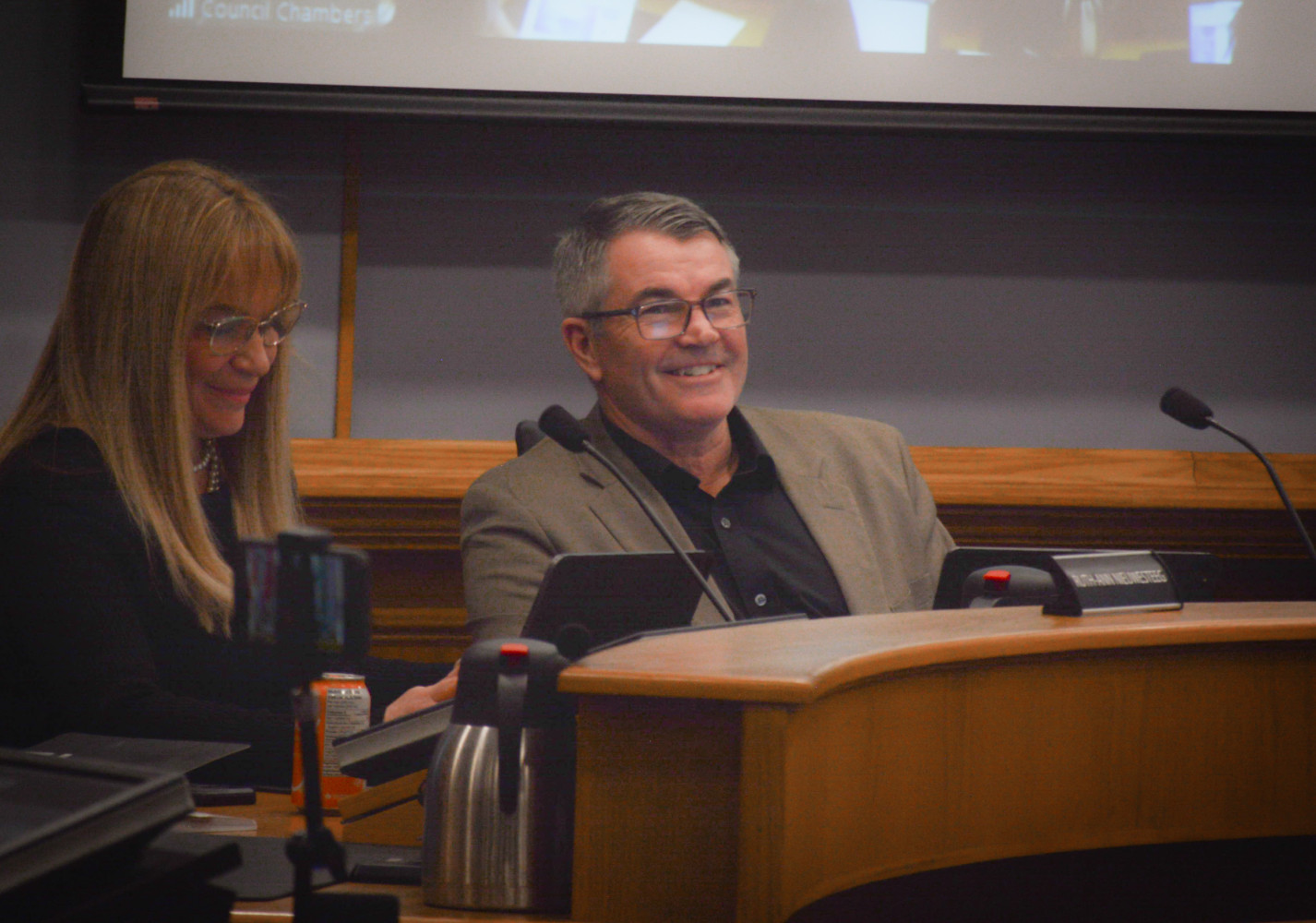
Councillor Mike Strange was charged with assaulting his intimate partner in May last year. He denies any wrongdoing. The matter will go to trial in April.
(Jerry Manco for The Pointer)
The latest decision by Maynard, which is not legally binding, has drawn comparisons to The Pointer’s earlier reporting on Joedy Burdett’s complaint against Councillor Strange, which similarly exposed how an integrity commissioner is free to make deeply subjective interpretations.
Gilbert filed her complaint in August. What followed was a five-month process marked by long periods of silence and multiple rounds of written submissions.
Gilbert said she did not receive the final report until January 19, the day before it appeared on the public council agenda.
“I didn’t even know the investigation was finished until I saw it posted,” she said. “After months of waiting, that’s how I found out.”
Throughout the process, Gilbert was required to respond not only to Strange’s own statements but to formal submissions drafted in legal language by a lawyer retained at what she believes was the taxpayers’ expense, to defend Strange. When the integrity commissioner, who is not a lawyer, later sought additional clarification from Strange and Mayor Diodati, those responses were again provided through counsel. According to Gilbert, she was never given an opportunity to reply to those later submissions.
“This was never two people telling their side of the story,” Gilbert said. “It was a resident versus a legal team.”
Critics say Maynard’s refusal to investigate council behaviour during meetings effectively guts the integrity system.
Emily McIntosh, the founder of Women of Ontario Say No, said Maynard’s interpretation of the current Municipal Act, wrongly claiming he has no power to investigate the conduct of council members during council meetings (it is unclear where he drew this claim from) ignores how power actually functions within municipal government.
“You’re asking councils to request investigations into themselves,” she said. “That assumes political allies will voluntarily hold each other accountable. In reality, it entrenches protectionism.”
Maynard claimed in his finding, without any explanation of what legislation he used for justification, that conduct during a council meeting has to be governed by the chair.
In a circular reasoning, Maynard used a submission by Strange’s lawyer, Rocky Vacca, who used a claim by Maynard from one of his previous findings in a separate complaint, that “self-policing” was the role of a chair, or mayor, during council meetings, and that the integrity commissioner has no authority to make decisions on whether or not the Council Code of Conduct is violated during a council meeting. According to Maynard’s unsubstantiated claim, a mayor, or any other member of council could chair a meeting, repeatedly violate the Code of Conduct, then avoid any consequence because they could simply excuse their own behaviour, or the behaviour of any other council member during the meeting, when almost all the legislative heavy lifting of the job occurs, and when some of the most damaging abuse of the Code can occur. Nowhere in the Municipal Act is Maynard’s interpretation mentioned. Critics such as McIntosh said it makes no sense to claim a mayor, or another council member who chairs a meeting, can be the defendant in a complaint, the jury, and the judge.
McIntosh noted that the disturbing dynamics displayed by Diodati, Strange, and even Maynard (who they, as part of a majority of council, can hire and fire at their whim), disproportionately affect women and advocacy groups, particularly in councils where gender imbalance and entrenched hierarchies have existed forever.
At the heart of Gilbert’s complaint was the message sent by Councillor Strange to supporters encouraging them to attend council and, in his own words, “make no space” for WOSN members in the public gallery. WOSN members and supporters were planning to attend the July council meeting in a show of solidarity after McIntosh was twice denied a chance to speak to council.
Strange’s language is not disputed. It appears in the public record and was referenced during council proceedings. Maynard’s report does not analyze his words.
He reframes the councillor’s direction to the male Hose Brigade supporters as a benign call for personal support.
“It was never a realistic outcome that the gallery would be filled in such a way that members of Women of Ontario Say No would have no place to sit,” Maynard claims. It’s unclear how he came to this subjective conclusion. The chamber can easily be filled by a group of a few dozen people, and it is common for council members to fill a municipal council chamber with supporters.
Maynard failed to address if an elected official directing supporters to “fill the chambers so there is no space for the women’s group to sit” is a violation of the Code of Conduct, which states council members are required to ensure a “decision-making process of Council” that is “open, accessible and equitable… and the conduct of each Member demonstrates fairness, respect for differences and a duty to work with other Members together for the common good… A Member shall at all times conduct themselves with propriety, decency and respect and… in a manner that demonstrates fairness, respect for individual differences, and an intention to work together for the common good and in furtherance of the public interest.”
“This is not inferred intent,” McIntosh said, describing the actions of Strange and Diodati in clear violation of the Code. “It’s explicit.”
“The councillor doesn’t deny what he said…He (Maynard) reframes it based on whether it would work. That misses the point entirely.”
In most workplaces, ethical and disciplinary standards assess conduct based on intent and appropriateness, not on whether harm was maximized. Critics argue Maynard’s analysis departs sharply from common workplace protections.
“If someone in any other workplace said, ‘Let’s crowd them out,’ the issue wouldn’t be whether it worked,” Gilbert said. “It would be, why they said it.”
Maynard also failed to address the following remark by Strange in his message:
“That women’s group is planning to come out again… I don’t even think there is one woman from Niagara Falls who pays taxes in that whole group…”.
According to Maynard’s report: “marshalling political support is common and ordinary in politics,” and he claims it would be “an absurd waste of taxpayer dollars to review a politician practicing politics in its most basic form”, concluding, “I refrain from doing so.”
In her initial filing, Gilbert made it clear this type of language was central to her complaint. She wrote:
“...imagine replacing each instance of ‘women’s group’ or ‘woman’ with terms such as ‘Jewish group’, ‘Black group’, or similar”.
She goes on to argue that if those segments of society had been marginalized instead of women it would be clear how inappropriate Strange’s language was.
When contacted for comment, Maynard’s office responded that “it is not our practice to publicly comment on Code of Conduct matters beyond what we report to Council in accordance with the Municipal Act, 2001.”
According to the Ontario Ombudsman, complaints about an Integrity Commissioner will only be considered “as a last resort,” and will review whether or not the IC:
- considered the issues presented;
- followed a fair process;
- obtained and considered relevant information; and
- provided sufficient reasons for their decision based on the evidence.
Gilbert questions why Maynard did not address a clear contradiction in Councillor Strange’s own submissions. In his written response to the complaint, Strange claimed, “I did not ask anyone to share (the message) with the Falls View Hose Brigade.” However, in her submission, Gilbert explicitly drew attention to an interview with Global News in which Strange said: “Yes, I invited my fellow members of the Falls View Hose Brigade because at the last meeting I felt targeted by protesters.”
Niagara Regional Councillor Haley Bateman, one of three women arrested at a Niagara Falls City Council prior to July 8 for trying to draw attention to the proposed provincial accountability legislation, said Maynard’s report reflects a broader failure to take women’s experiences of intimidation seriously.
“I am appalled that, through his 46-page report, the Integrity Commissioner has effectively endorsed a councillor making disparaging comments about a group of women,” Bateman said.
She described WOSN’s advocacy as essential to exposing systemic inequities and advocating for safer workplaces for both councillors and staff.
“Any councillor who does not champion the need for a safe work environment likely benefits from the current political system.”
Strange’s conduct is a textbook example of why reform is urgently needed, Bateman said.
“Councillor Strange inserted himself into a debate that was never about him. Meanwhile, Mayor Jim Diodati prioritized Councillor Strange’s personal interests over those of his constituents.”
She pointed to Strange’s own words: “‘I want my supporters to come out and make no space for the women’s group to sit.’...Those words are now part of the public record,” Bateman said. “And they reflect conduct he continues to defend and normalize.”
Gilbert and McIntosh also described the cost of filing a complaint as prohibitive and contrary to the principles of accountability and good governance.
Niagara Falls imposes a $500 fee to file an integrity commissioner complaint, despite the Ontario Ombudsman twice directing council to remove such a prohibitive fee. “The fee alone deters people,” Gilbert said. “Then you add legal intimidation and public shaming, and most residents won’t even try.”
McIntosh said the fact there is no process to review IC decisions leaves complainants with court challenges as the only recourse, an option she described as financially and practically unrealistic.
McIntosh linked the Niagara Falls case directly to the need for reform under Ontario’s Municipal Accountability Act (Bill 9), which remains stalled despite widespread support from municipal leaders, MPPs and sector organizations.
She emphasized that Bill 9 is only a first step.
Among the systemic failures she identified:
- no standardized qualifications or training requirements for Integrity Commissioners;
- municipal councils hiring and firing their own ICs;
- cost barriers to filing complaints;
- no independent appeal mechanism.
“The entire advocacy effort is about aligning municipal governance with standards that already exist elsewhere,” she said. “If conduct wouldn’t be tolerated in the public or private sector, why do we allow it here?”
She argued that true accountability requires independent oversight, potentially through the provincial Ombudsman or a centralized Integrity Commissioner system. Bill 9 is proposing the creation of a provincial IC which would handle certain types of complaints.
For Gilbert, the outcome has reinforced a sobering conclusion.
“This isn’t accountability,” she said. “It’s a system that exhausts people until they give up.”
Bateman warned the implications extend far beyond Niagara Falls.
“When intimidation is defended instead of corrected, public trust erodes,” she said. “People stop believing local government is a safe or fair place.”
Email: [email protected]
At a time when vital public information is needed by everyone, The Pointer has taken down our paywall on all stories to ensure every resident of Brampton, Mississauga and Niagara has access to the facts. For those who are able, we encourage you to consider a subscription. This will help us report on important public interest issues the community needs to know about now more than ever. You can register for a 30-day free trial HERE. Thereafter, The Pointer will charge $10 a month and you can cancel any time right on the website. Thank you
Submit a correction about this story

