
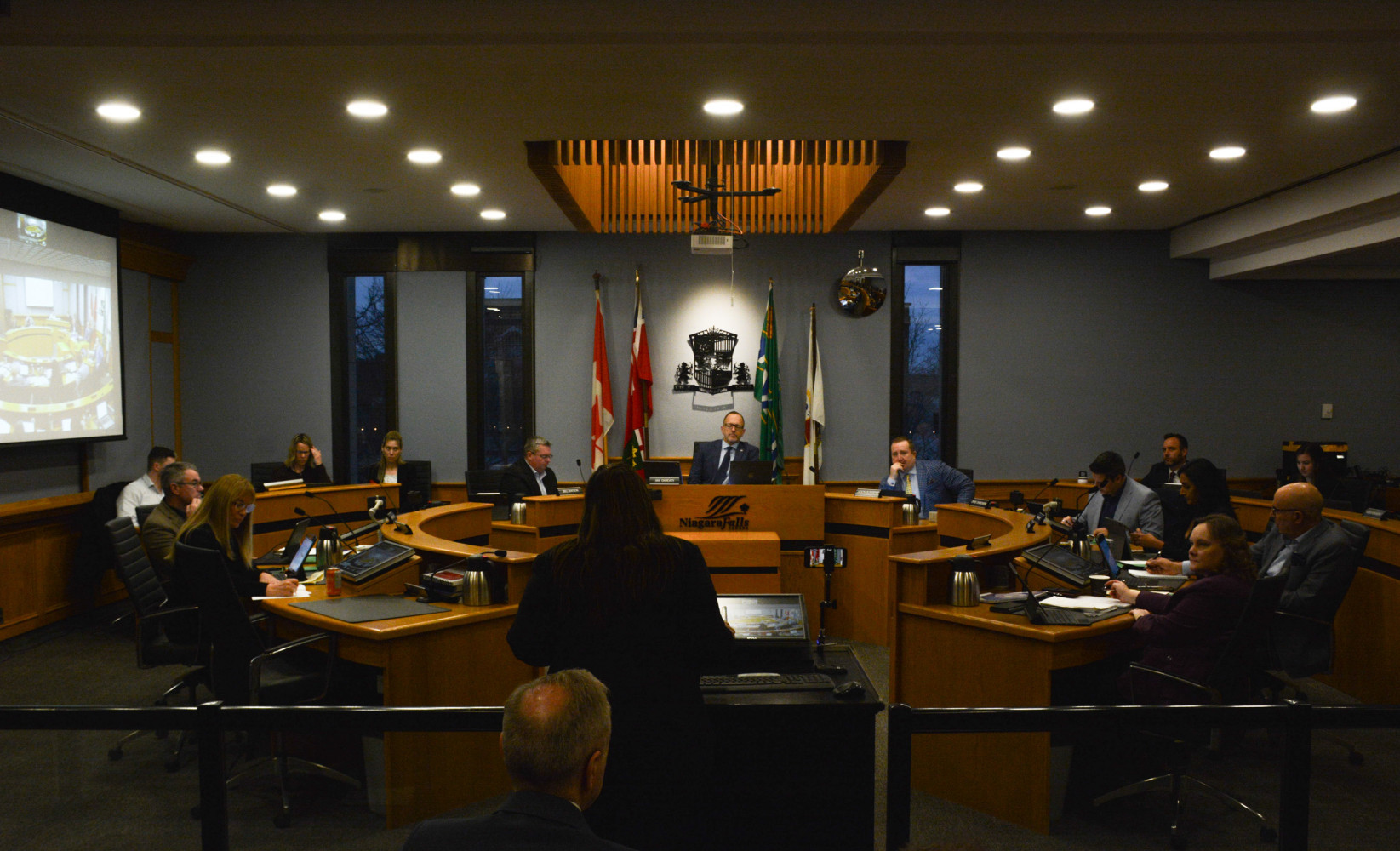
Legal experts, advocates slam Niagara Falls Council for sending $4K bill to silence resident who filed complaint to integrity commissioner
The decision by Niagara Falls council members was made in a matter of minutes, without legal advice, without guidance from senior staff, and has left many residents, advocates and legal experts stunned.
Niagara Falls City Council voted last week to send resident Joedy Burdett a bill for $4,000 after he filed a Code of Conduct complaint to the municipality’s controversial integrity commissioner who summarily dismissed it without investigation.
For Burdett, his saga took a bizarre turn on October 28 when he filed a Code of Conduct complaint against all members of council for refusing to allow him to speak at two separate public meetings. Burdett maintains that staff blocked his participation on September 16 and October 7, and that council’s failure to intervene or correct the situation constituted a breach of the Code by the entire council.
In a January 20 report, Integrity Commissioner Michael Maynard dismissed the complaint, stating Burdett had not paid the required $500 filing fee—in fact, he had paid it, but an administrative error led to the payment not being recorded properly by the City.
Maynard is not a lawyer but serves as the integrity commissioner for 23 municipalities. Many of his decisions in defence of the councils that hire him (and can fire him) have been described by residents as blatantly biased. Last year he unwittingly exposed his lack of knowledge of the provincial legislation that governs municipal integrity commissioners.
Despite acknowledging his error, after wrongly claiming Burdett had not paid the complaint fee, Maynard did not reconsider his dismissal of the complaint. Chief among his reasons was that the Code of Conduct complaint—municipal integrity commissioners are limited to investigating alleged violations of the Code that governs the behaviour of elected members of council—was filed against council as a whole, which Maynard claimed fell outside his jurisdiction.
In his report, he explained that his mandate is limited to examining the conduct of individual council members and does not extend to investigating council collectively or reviewing decisions made by council as a body.
“I wish to be clear that the Integrity Commissioner’s role is not to intervene in democratic decision-making or matters of political judgment, but rather to address issues of individual conduct. The application of Council procedures, such as those in the City’s Procedural By-Law – even if incorrectly applied by its Members (on which I express no substantive opinion) – is not a conduct issue,” Maynard claims in his report.
This is blatantly false.
The Code of Conduct clearly states all council members commit to “at all times conduct themselves with decorum and in accordance with the Board’s or City’s Procedural By-law during any meetings.” If council members are not following City bylaws—like the Procedural Bylaw—this could potentially be a violation of the Code, the type of matter that municipal integrity commissioners routinely investigate.
The Niagara Falls Code of Conduct for council members also states: “A Member shall observe and comply with every provision of this Code, as well as all other policies and procedures adopted or established by Council.”
This is not the first questionable decision by Maynard, who recently dismissed a complaint, also made by Burdett, against Councillor Mike Strange after he rallied members of a community organization (predominantly made up of fire fighters) in July—with the promise of beer and pizza—to fill the council chamber and block out women advocating for legislative protection against elected officials who engaged in harassment and more violent forms of abuse. Strange is facing a criminal charge of intimate partner assault. As evidenced in a message he wrote to the “Falls View Hose Brigade” group, Strange directed its members to violate council’s Procedural Bylaw by standing and clapping after he spoke in his own defence, a scheme he said that Mayor Jim Diodati was aware of.
“Jim (mayor) will tell you not to clap but he knows exactly what is going on,” Strange’s message to the Brigade members explained.
Diodati had previously told women advocates who attempted to address council regarding currently proposed provincial legislation being considered to strengthen accountability in the municipal government sector, that no one was allowed to discuss Strange’s criminal charge, and therefore he barred them from speaking in council, despite their assurances that the case would not be mentioned.
However, when Strange’s scheme to defend himself and speak directly in council about his criminal charge was planned, with the mayor’s knowledge, Diodati did nothing to stop him, despite the justification he used to silence the women.
Section 1.3 (a) of the Code of Conduct mandates that: “the decision-making process of Council is open, accessible and equitable and respects the City’s governance structure”.
Its rules continue: “City residents should have confidence in the integrity of their local government and of their Members; the conduct of each Member is of the highest standard; and the conduct of each Member demonstrates fairness, respect for differences and a duty to work with other Members together for the common good.”
Any Niagara Falls Council member is in violation of the Code if the primary rules of conduct are not followed: “A Member shall at all times conduct themselves with propriety, decency and respect and with the understanding that all members of the public, other Members of Council or a Local Board, and staff are to be treated with dignity, courtesy and empathy, recognizing that a Member is always a representative of the City and of their elected office or appointment. A Member shall at all times conduct themselves with decorum and in accordance with the Board’s or City’s Procedural By-law during any meetings and in a manner that demonstrates fairness, respect for individual differences, and an intention to work together for the common good and in furtherance of the public interest.”
Maynard ignored the Code of Conduct that is supposed to govern his decision making.
What Diodati and Strange did, applying one set of rules for members of the public and then ignoring them to further the interests of a council member facing a criminal intimate partner assault charge, was an obvious violation of the Code of Conduct.
Maynard also dismissed a complaint against the mayor of St. Catharines, Mat Siscoe, despite acknowledging he had violated the City’s Council Code of Conduct when he used City resources for an event where he personally endorsed Doug Ford for premier during the 2024 provincial election campaign. The Code also prohibits such political endorsements using the office of the mayor and the mayor’s title, but Maynard, as is his pattern, looked the other way in defence of the man directly involved in his hiring, and possible firing.
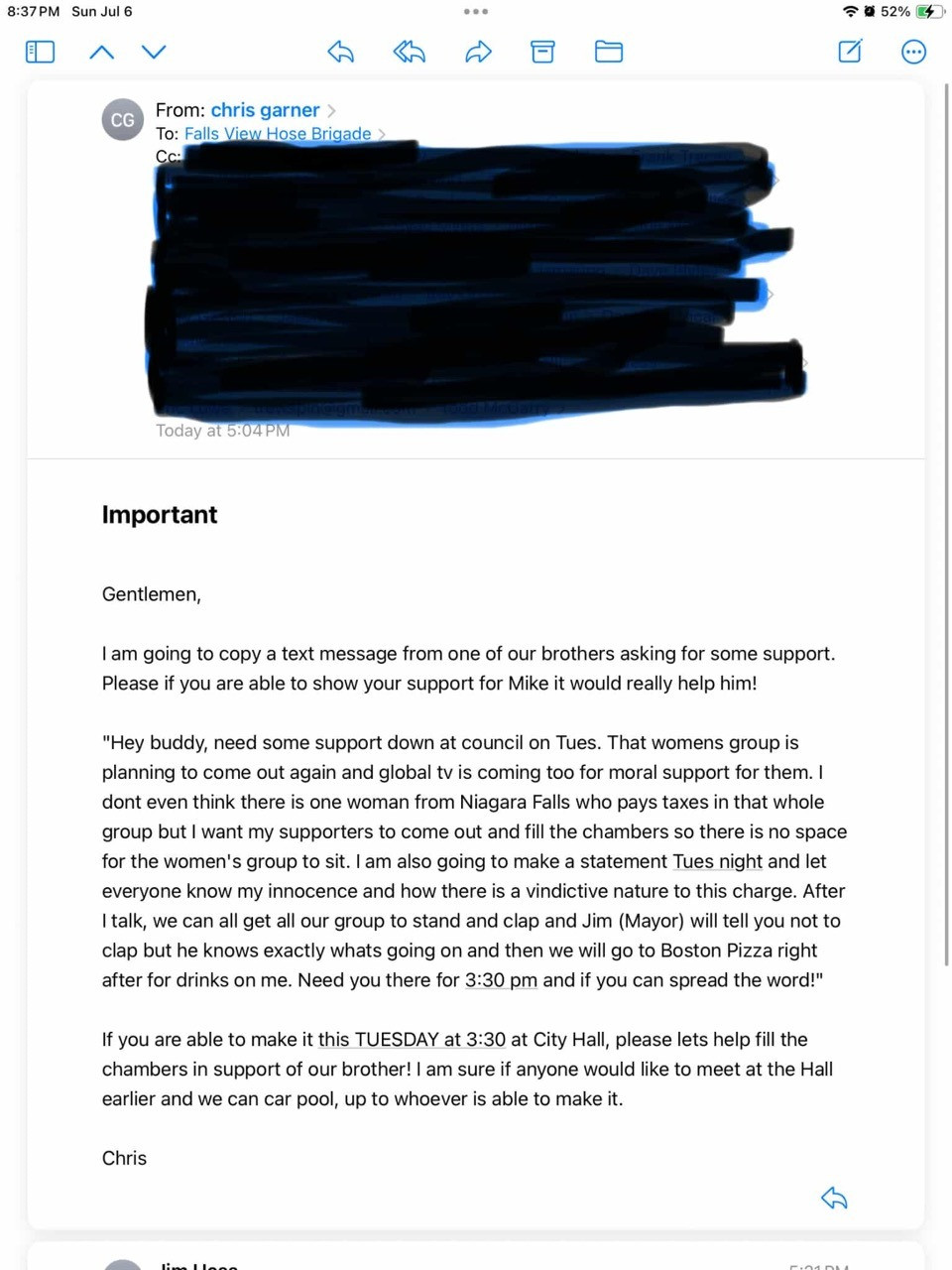
A copy of the message sent by Councillor Mike Strange to members of the Falls View Hose Brigade in July.
On January 20, Niagara Falls Council members briefly addressed the fee paid by Burdett, claiming that because he had requested an investigation into all members of council, he should have to pay for nine separate complaints, even though only one was filed.
The idea was brought up by Councillor Vince Kerrio who appeared fixated on the arithmetic of the $500 filing fee, asserting that because the original complaint named all nine members of council, Burdett should be charged for multiple complaints. Mayor Jim Diodati immediately advanced the idea, concluding that since only $500 had been paid, council should invoice Burdett the remaining $4,000. It was a conclusion reached without policy guidance, legal advice, or broad debate, and voted on just minutes after being suggested.
The brief discussion involved only Councillor Kerrio, Mayor Diodati and CAO Jason Burgess. No staff report was presented, no legal opinion was sought and no bylaw or policy was cited giving permission to council to retroactively bill a resident under such circumstances—when no investigation into the original complaint took place.
As Kerrio and Diodati went back and forth during the brief exchange, Burgess had one contribution.
“If Council passes a motion staff will just issue the bill,” he said.
Burgess offered no caution, legal context, or procedural guidance, signalling staff would carry out whatever decision council made, without review or reservation. Burgess, whose 2024 salary is listed on Ontario’s Sunshine List at $293,821, is described on the City’s website as a key advisor to council members and staff, a role that ordinarily includes providing professional guidance, caution, and context.
Of the nine members of council only Councillor Lori Lococo voted against the decision.
The Pointer reached out to Burgess, Diodati and Kerrio regarding the policies they were relying on to retroactively invoice a resident for a dismissed integrity commissioner complaint, one that was never investigated. Only a single nine-page report and two-page addendum (addressing the City’s mistake with Burdett’s $500 filing fee) was produced. None of them responded.
Legal advocates and municipal experts believe what Niagara Falls Council is trying to do is illegal, and sends a chilling message to other Niagara Falls residents.
“To arbitrarily impose additional costs on a citizen who is just trying to use an accountability process is dangerously undemocratic and I think probably not even authorized under the municipal ethics code system for council,” Duff Conacher, the co-founder of Democracy Watch, an advocacy group formed in 1993, told The Pointer.
Burdett agrees, and says he will be reaching out to the Ontario Ombudsman for assistance in handling the matter.
“I don’t see any basis for billing me for services that were never performed,” he says. “I will defend myself if need be, but I suspect they will see their mistake and correct it and try to move on…I will also be asking the Ombudsman to review whether this billing decision amounts to a reprimand or retaliation against a complainant.”
Rebecca Hines, a Toronto-based lawyer who works as a municipal integrity commissioner, says any fee beyond a nominal cost to cover staff time (to a maximum of $25) can act as a deterrent to holding members of council accountable. Any costs after a complaint has been filed could also dissuade residents from using the integrity commissioner accountability function.
"If someone files a code of conduct complaint, and they pay the fee to do so, regardless of what that amount may be, and then later, as a result of filing that complaint, they are then, without their consent or any notice to them, required to pay a significant additional amount of money, that doesn't sound like a service or administrative fee anymore. It sounds more like a fine or a penalty, or, depending on the circumstances, potentially even retaliation,” she says. “From a principled standpoint, I would say that any attempt to punish or retaliate against a member of the public for filing a code of conduct complaint would be wholly inappropriate and contrary to the legislative framework."
The latest episode highlights an ongoing issue with the current Niagara Falls Council, which has shown a habit of putting barriers in place to filing complaints against elected members.
“Niagara Falls is definitely one of the worst examples across the province of a council trying to undermine an ethics enforcement system in multiple ways and all with the aim of escaping accountability for unethical behaviour,” Conacher says. “I think any kind of evaluation would conclude that.”
The $500 fee to file a complaint has been heavily criticized, by legal experts and the Ontario Ombudsman himself, multiple times.

Mayor Jim Diodati has voted down attempts to review the Code of Conduct complaint system in Niagara Falls.
(Joel Wittnebel/The Pointer files)
Ontario Ombudsman Paul Dubé wrote to Niagara Falls City Council in February 2023 indicating that his office had received complaints, especially regarding the $500 fee.
“[T]here should be no fee or other barrier to make a complaint to the Integrity Commissioner…Charging a fee to complain is entirely inconsistent with the primary intent of the Integrity Commissioner scheme, which is to foster democratic legitimacy and public trust at the local level.”
It’s not the first time Dubé has addressed the issue with fees for complaints generally.
“The Municipal Act, 2001 requires that all municipalities appoint an Integrity Commissioner, or make the services of an Integrity Commission available, to address complaints regarding the ethical conduct of members of council and local boards. This system is premised on a willing public coming forward to assist in ensuring that transparency is maintained at the municipal level… While some municipalities have chosen to implement a complaint fee, my Office has publicly denounced this practice as it penalizes complainants for exercising their statutory rights, and may prevent legitimate complaints from being brought forward due to concerns about financial cost,” he wrote previously.
Along with the $500 fee, Niagara Falls also does not allow any resident who is not a citizen of the city to file complaints. This was recently an issue after Mayor Diodati had a trio of peaceful protestors arrested inside council chambers. Two of them were barred from filing complaints as they did not live in Niagara Falls—despite being directly impacted by the mayor’s actions.
Councillor Lococo attempted to review the complaint process in 2024, including the potential of removing the exorbitant fee. Her efforts were voted down by the majority of Council. During the January 20 meeting, Councillor Kerrio suggested Council is actually considering increasing the $500 fee.
“There shouldn’t be a fee in any case for this because taxpayers are already paying for the integrity commissioner’s time and the commissioner can dismiss complaints that are frivolous or have no valid grounds for the complaint, relatively easily,” Conacher says.
Hines agrees.
“When you’re getting into the hundreds, I think that’s a barrier to access, and I don’t think it’s warranted or appropriate,” she says.
A previous memo from City Clerk Bill Matson attempted to justify the $500 fee: “[E]ven since imposing the $500 fee, taxpayers have spent in excess of $75,000 for investigations conducted by the Integrity Commissioner on complaints that have been filed, none of which have shown any violations. Staff are of the belief that the costs for investigations would be substantially higher should Council decide to do away with the fee required to file a Code of Conduct complaint and that known abusers of the system would no doubt increase their submissions.”
There was no evidence provided to support that staff “belief”.
“If what you’re really trying to do is prevent frivolous and vexatious complaints, the mechanism is through the integrity commissioner and their preliminary review and intake process,” Hines says, adding it does not take long to determine whether complaints have merit.
The Ontario government is currently considering changes to the municipal accountability system in Ontario, particularly as it relates to integrity commissioners, through the proposed bill 9, which passed third reading in October.
The legislative amendments proposed are meant to enhance municipal codes of conduct and create an additional level of accountability through a review process by the provincial integrity commissioner—particularly as it relates to “egregious” conduct by a municipal elected member such as harassment or assault. The provincial IC would then make a recommendation to the local council, determining whether or not a member’s behaviour warrants removal from office. Under the current proposal, a unanimous vote of council would then be required to remove the member, which critics say renders the legislation, as it is currently worded, effectively unworkable. The PCs ignored repeated recommendations that this final decision be left to a judge, not the colleagues of the member in question.
Conacher says the Niagara Falls incident shows further work needs to be done on bill 9 in order to improve municipal accountability in Ontario.
“This is just another example, of many examples, of why allowing local councils to run their own ethics rules and enforcement system is just a big kangaroo court, unethical, undemocratic scheme that results in very little accountability for unethical behaviour,” he says.
Throughout the summer of 2025, during a number of roundtable discussions hosted by the PCs across Ontario, advocates called for numerous upgrades to the integrity commissioner system, including changes that would take the appointment process out of the hands of local council members. Currently, members of council appoint the integrity commissioner tasked with investigating them and can fire them, which Hines agrees can be perceived as a conflict.
“The existing framework is not without its flaws. A council can appoint and dismiss its integrity commissioner at will. This means you really have to trust the council to act in the public interest, in the sense of not dismissing an integrity commissioner simply because the members do not want to have adverse findings made against them, and on the integrity commissioner to perform their statutory mandate in a truly independent and impartial manner, regardless of whether or not any adverse findings might, depending on the council, put their appointment at risk,” she says, adding there is also room to improve the mechanisms for choosing who can perform this crucial accountability function.
Advocates and experts who spoke at the various committee hearings across the province held by the PC government this summer to help inform the proposed municipal government accountability legislation, called for a requirement that all integrity commissioners be lawyers, with experience in municipal law and the various pieces of provincial legislation that govern the sector, such as the Municipal Act and the Municipal Conflict of Interest Act.
“Right now, it’s not a regulated profession like we are as lawyers,” Hines says. “I think having some sort of system whereby integrity commissioners are vetted, either by the Province or some other regulatory body, to confirm their qualifications, experience, and any potential conflicts of interest, would be a positive step and would instill more confidence in members of the public."
For Conacher, the decision by Niagara Falls Council clearly shows one thing: they don’t care about being held accountable.
“If you actually cared about public trust and upholding the public trust you would not do things like this because the whole message you’re sending is you don’t trust the public and you don’t care about ensuring accountability when you violate the public’s trust.”
Email: [email protected]
Email: [email protected]
At a time when vital public information is needed by everyone, The Pointer has taken down our paywall on all stories to ensure every resident of Brampton, Mississauga and Niagara has access to the facts. For those who are able, we encourage you to consider a subscription. This will help us report on important public interest issues the community needs to know about now more than ever. You can register for a 30-day free trial HERE. Thereafter, The Pointer will charge $10 a month and you can cancel any time right on the website. Thank you
Submit a correction about this story

