

Complaint against Councillor Mike Strange dismissed after he rallied supporters to squeeze women out of public meeting
A citizen’s request for a Code of Conduct investigation into the actions of Niagara Falls city councillor Mike Strange has been rejected by the City’s Integrity Commissioner. The complaint was dismissed by Michael Maynard on the grounds of being "frivolous” and “vexatious” and generally without merit.
The complaint was filed by Niagara Falls resident Joedy Burdett in response to Councillor Strange’s conduct at a July council meeting, linked to his efforts to fill council chambers with his supporters and block out an advocacy group looking to speak about municipal accountability. Strange has been at the centre of discussions in Niagara Falls about accountability for local officials after he was charged with assaulting his intimate partner earlier this year. It led to a wave of public scrutiny, including calls for him to take a leave of absence as the court process unfolds. He has consistently denied the allegations.
On May 3 police charged Strange with assault after responding to his home in the early morning hours. Officers found an injured woman at the scene and Strange was apprehended and charged shortly after. His trial is scheduled for April 2026, and Strange has publicly maintained his innocence, stating that he expects to be vindicated in court.
At the same time, independent of Councillor Strange’s case, a provincial committee was gathering public input on Bill 9, a piece of proposed provincial legislation designed to enhance mechanisms to hold local elected officials accountable for wrongdoing, including how municipalities should respond when councillors face criminal charges.
The committee was scheduled to convene a public information meeting in Niagara Falls in early July as part of a province-wide series of consultations to help shape the legislation. In advance of that provincial meeting, The Women of Ontario Say No (WOSN), an advocacy group focused on appropriate accountability measures to protect women from violence and harassment by municipally elected officials, sought permission to address Niagara Falls City Council. The group hoped to provide information ahead of the provincial committee’s public hearing in Niagara Falls. WOSN’s advocacy focused on policy changes that would see elected officials placed on paid leave while charges are before the courts, with automatic removal from office if there is a conviction.
Niagara Falls officials, particularly Mayor Jim Diodati, immediately took a hard-line with the women’s group, claiming they could not be allowed to speak in council due to the criminal charges facing Councillor Strange, which supposedly could not be separated from any advocacy around the proposed provincial legislation (Diodati blatantly contradicted his own position when he later allowed Strange to address the criminal charges against him, claiming his innocence in the middle of a council meeting, after the mayor had just claimed no such discussion was allowed).
The City refused WOSN’s request to speak and effectively barred the organization from being heard in council chambers while Strange’s case remains open.
The conduct of Diodati and senior officials who backed his apparent efforts to shield Strange, a close council ally, sparked public backlash and frustration.
At a mid-June council meeting, tensions escalated.
Three women were arrested, further galvanizing public support ahead of a council meeting on July 8.
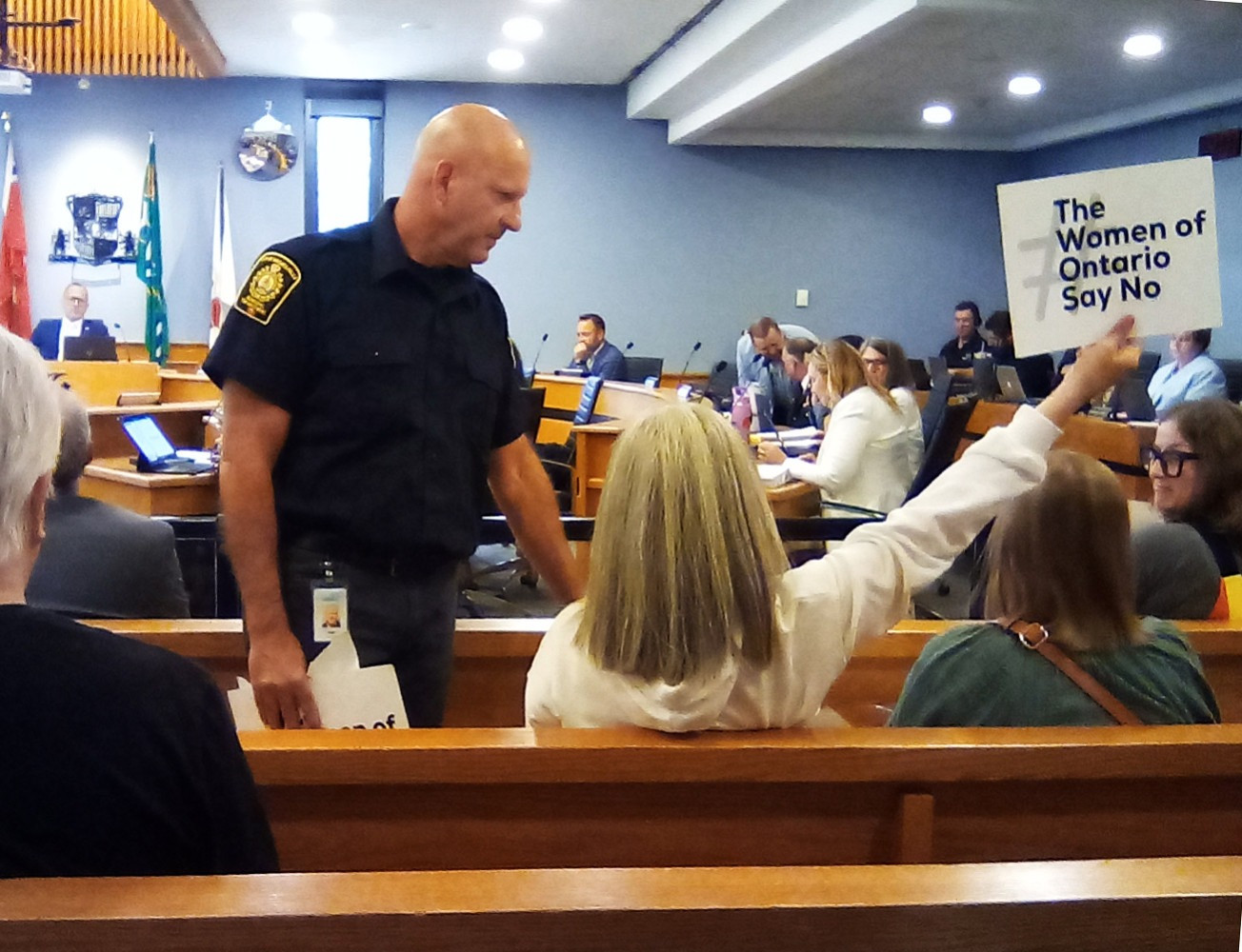
Supporters of Women of Ontario Say No (WOSN) were escorted from council chambers and placed under arrest during a June council meeting.
(Ed Smith/The Pointer files)
In the lead-up to the July meeting, while framing WOSN’s advocacy as a direct challenge, Councillor Strange contacted friends and supporters behind the scenes to block the group from attending council. In written communication to a group known as the Falls View Hose Brigade (many are connected to Niagara area fire departments) he expressed his goal to “fill the chambers, so there is no space for the women’s group,” alongside other remarks that critics felt were derogatory and in breach of City Hall’s code of conduct councillors are sworn to uphold. He promised free pizza and drinks to those who turned up at the meeting to squeeze the women out, preventing them from finding any space inside the council chamber. Strange has publicly confirmed he sent the message.
The communication also directed supporters to engage in conduct during the meeting that would be contrary to council decorum, while assuring them not to worry about shows of public support that are not allowed. Mayor Jim Diodati “knows exactly what’s going on” he wrote. His offer of free pizza and drinks in exchange for public interference to help his cause was also characterized by critics as questionable conduct, amounting to abuse of power.
It was against this backdrop that Burdett filed a complaint with the City’s Integrity Commissioner alleging that Councillor Strange’s actions contravened the Code of Conduct and warranted investigation—which has now been rejected.
In his final report, Maynard cited several reasons why he would not investigate Burdett’s complaint, which raise a series of questions about the integrity framework in Niagara Falls—a system that concentrates discretionary power in the hands of an investigator who lacks clearly defined qualifications (Maynard is not a lawyer, and has been criticized for failing to follow provincial legislation that is supposed to govern his own conduct).
Among the most obvious problems in the report are the following:
- Rather than grounding his decision making in legislation, external legal authority, or the Ontario Ombudsman’s best-practice guidance, Maynard relied heavily on prior decisions made by him, claiming that his own previous rulings justified the latest one. Integrity commissioners are not required to have specialized training or qualifications for the role, despite the legal nature of their work. Their prior decisions are neither binding nor precedent-setting, they are not subject to critical review or appeal by a governing body. In effect IC reports can be based solely on the opinion of the person the City employs to write them.
- Maynard invoked a six-week limitation period to exclude any consideration of conduct occurring before July 7, noting that Burdett’s complaint was received on August 18. Maynard noted in his report: “To be clear, the Complainant provided no evidence that Councillor Strange actually “orchestrated” anything on either July 7th or 8th regarding the “Hose Brigade”. He only noted that some members of the “Hose Brigade” attended the July 8th Council meeting, apparently at Councillor Strange’s request. Any action Councillor Strange might have taken on July 6th – as implied in the Complaint – is beyond the time limitation period.” Ontario’s Ombudsman, who provides guidance to municipal integrity commissioners to help ensure that provincial legislation is followed, has written that: “Municipalities can choose to include a time limit for complaints, but complaint protocols should give integrity commissioners the discretion and flexibility to accept complaints outside of that limit, based on the specific circumstances of the case.” Maynard excluded significant evidence that demonstrated Strange’s troubling conduct because it fell outside his self-imposed timeline by one day.
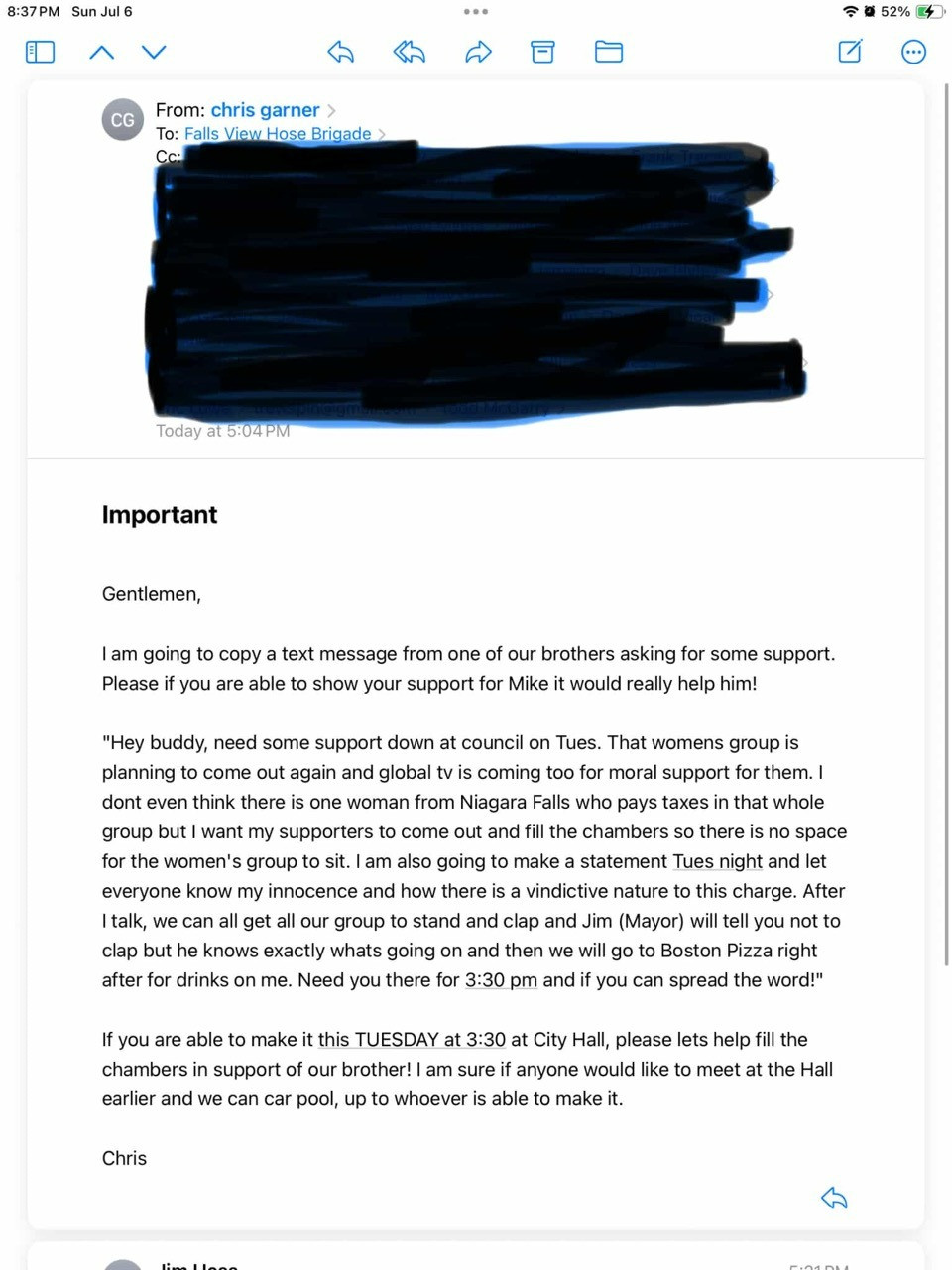
The full July 6 message sent by Councillor Mike Strange to members of the Falls View Hose Brigade.
- Maynard claims a councillor’s conduct during council meetings is governed by the chair. This effectively excuses Strange’s behaviour and fails to contemplate situations where direct evidence suggests the chair may have acted in collaboration with a councillor to allow conduct that contravenes the Code. This was apparently what happened ahead of and during the July 8th meeting. Strange’s message to the Hose Brigade made it clear that Diodati knew about the scheme in advance and, despite any possible breach of decorum rules, would ignore them during the council meeting. In his report, Maynard claims that if Mayor Diodati wished to rule against Councillor Strange and shut down his conduct, he had the tools and authority to do so. The IC failed to address Strange’s July 6 communication which explicitly stated the mayor was aware of and supportive of the plan to drown out women, support Strange’s defence of himself in a criminal matter (Diodati had previously repeatedly claimed no discussion of the case would be allowed during a council meeting) and ignore any of the rules the mayor as chair was supposed to enforce.
- Maynard said his decision to dismiss the complaint against Strange was partly because his conduct was harmless and inconsequential. The IC wrote that the attendance of Hose Brigade members Strange rallied to the meeting that night, was “frankly of no concern” to his office. He described it as nothing more than a councillor “marshalling political support”, and claimed it would be an “absurd waste of taxpayer dollars” to examine what he described as politics “in its most basic form”.
Emily McIntosh, the founder and spokesperson for Women of Ontario Say No, said Maynard’s dismissive claims have “created an environment of discomfort and intimidation.”
She questioned his description of the conduct by Strange, who secretly offered free food and alcohol to drown out “That womens group”, and ensured loyal supporters that any breaking of council rules in their show of loyalty to the criminally charged councillor, would be overlooked by the man chairing the meeting, Mayor Diodati, who knew “exactly whats going on”.

Emily McIntosh of Women of Ontario Say No, described the recent Niagara Falls Integrity Commissioner report as contributing to an “environment of discomfort and intimidation”.
(Jerry Manco for The Pointer)

“That is not political advocacy,” McIntosh said. “It was a call to action that is discriminatory toward 51 per cent of the population, women, and it reflects the very issue legislative reform is meant to address.”
She said Strange’s message to the Hose Brigade “was intended to silence people under the guise of healthy democratic discourse, but becomes something entirely different when it is organized with the explicit intent of physically occupying a public space to exclude a specific segment of the population.”
Maynard dismissed concerns in the complaint that Strange’s actions were “disparaging” or “discriminatory” when he attempted to block out women he described as non-residents of Niagara Falls.
“Councillor Strange made a political argument that non-residents of Niagara Falls ought not to weigh in on Niagara Falls City Council business. Whether his stance is agreeable or not is irrelevant, and I deliberately offer no opinion on point,” he wrote, claiming that further analysis could infringe on Strange’s Charter rights.
In his July 6 message to supporters Strange wrote: “I don’t even think there is one woman from Niagara Falls who pays taxes in that whole group, but I want my supporters to come out and fill the chambers so there is no space for the women’s group to sit.”
Residents concerned with Maynard’s defence of Strange’s actions can contact the Ontario Ombudsman who serves as the authority of last resort for matters involving integrity commissioners. While the Ombudsman does not act as a municipal integrity commissioner and does not function as an appeal body, he can review an integrity commissioner’s conduct to determine whether the commissioner acted in accordance with legislation, followed fair practices, considered relevant information and provided adequate reasons supported by evidence.
Maynard was called out after he dismissed a recent complaint against Mayor Mat Siscoe in St. Catharines, where Maynard also serves as the IC. In that case, while admitting the mayor violated the Code of Conduct when he used City resources for a campaign event to endorse Doug Ford for premier during the provincial election, he refused to recommend any penalty, or find wrongdoing.
Following his decision to toss the complaint against Councillor Strange, The Pointer reached out to Maynard for comment.
He responded: “It is not our practice to publicly comment on Code of Conduct matters beyond what we report to Council in accordance with the Municipal Act, 2001.”
Email: [email protected]
At a time when vital public information is needed by everyone, The Pointer has taken down our paywall on all stories to ensure every resident of Brampton, Mississauga and Niagara has access to the facts. For those who are able, we encourage you to consider a subscription. This will help us report on important public interest issues the community needs to know about now more than ever. You can register for a 30-day free trial HERE. Thereafter, The Pointer will charge $10 a month and you can cancel any time right on the website. Thank you
Submit a correction about this story

