
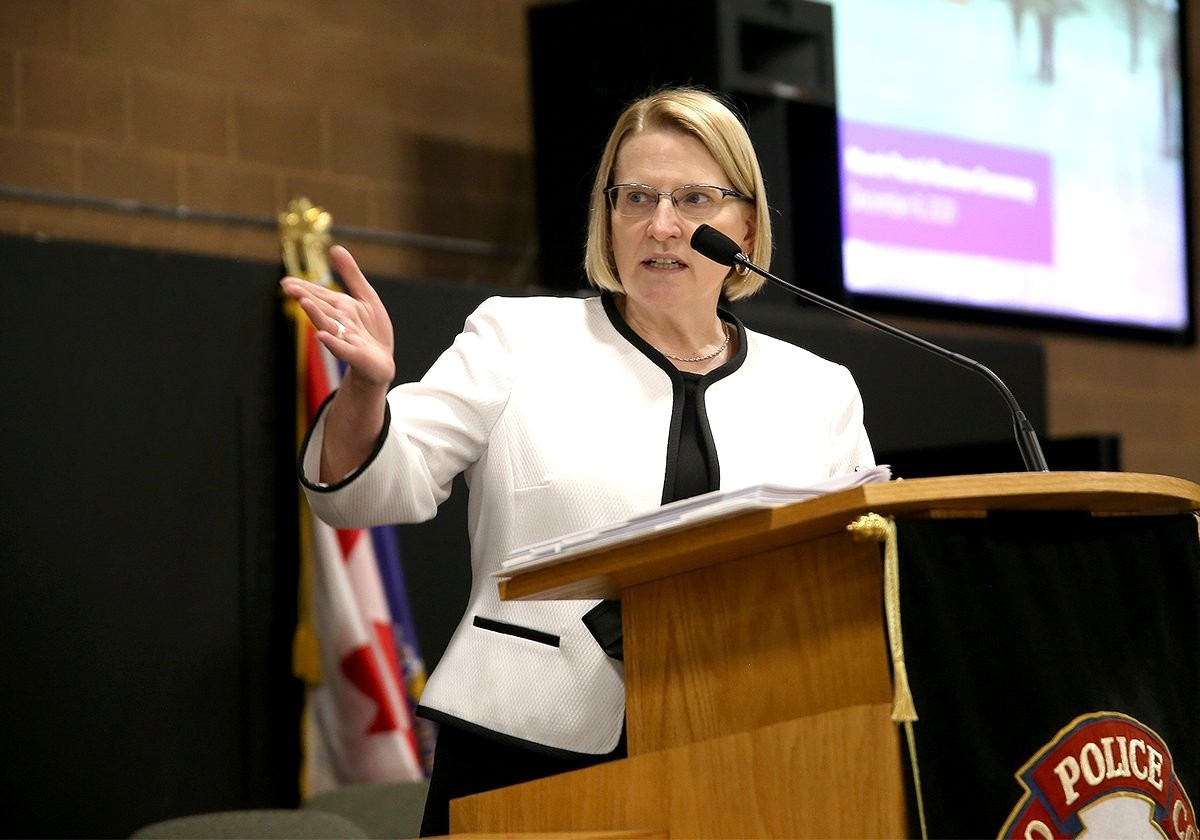
Region left to pick up the slack after PCs closed Peel’s safe consumption site; replacement hub yet to open
In its first year of operation, Peel’s safe consumption site changed the lives of 250 people. Despite being next to a police station on Peel Centre Drive—which could potentially deter those who use drugs and historically have negative interactions with police—these individuals visited the location 960 times.
They were offered a pathway to healing.
Addiction treatment options were provided to help them fight back against a disease that for many had taken over their life.
If they weren’t ready for that, they were offered a safe space to take their drugs in the presence of a professional who could save their life in case the street drugs they consumed were tainted with an unknown substance.
“We had no security incidents, no police incidents, no sharps found in the vicinity of the site, and no complaints from our neighbours. In fact, Bramalea City Centre reported to us that while we were open, they had no more overdoses at the mall along with seeing a drastic reduction in drug related issues which took a significant burden off their own team,” the 2025 annual report from Moyo Community Health Services, the operator of the site, details. “Peel’s first supervised consumption site was able to show that services like this can be successful in not only providing safety to those who use the services, but also be a net benefit to the larger community in which these services are located through collaboration, communication and accountability.”
The PC government did not see it this way.
Following passage of the widely condemned Community Care and Recovery Act in December 2024, the Peel safe consumption site, along with 10 others across Ontario were forced to close. The legislation slammed the door on a service that experts across the globe agree provides benefits not only to those who use drugs, but to stakeholders throughout the communities where these life-saving facilities operate.
Health Minister Sylvia Jones repeatedly attempted to spin the closures as an effort to keep communities safe, but she refused to provide any concrete evidence to support the government’s claim that the sites posed a threat.
The PCs repeatedly used the tragic death of Karolina Huebner-Makurat, who was struck by a stray bullet in the area of the South Riverdale Community Health Centre in Toronto’s East End in 2023, as evidence of the risk the centres posed. The tragedy was used by the PCs not as a catalyst for real change, but as a brush they used to paint all safe consumption sites across Ontario with.
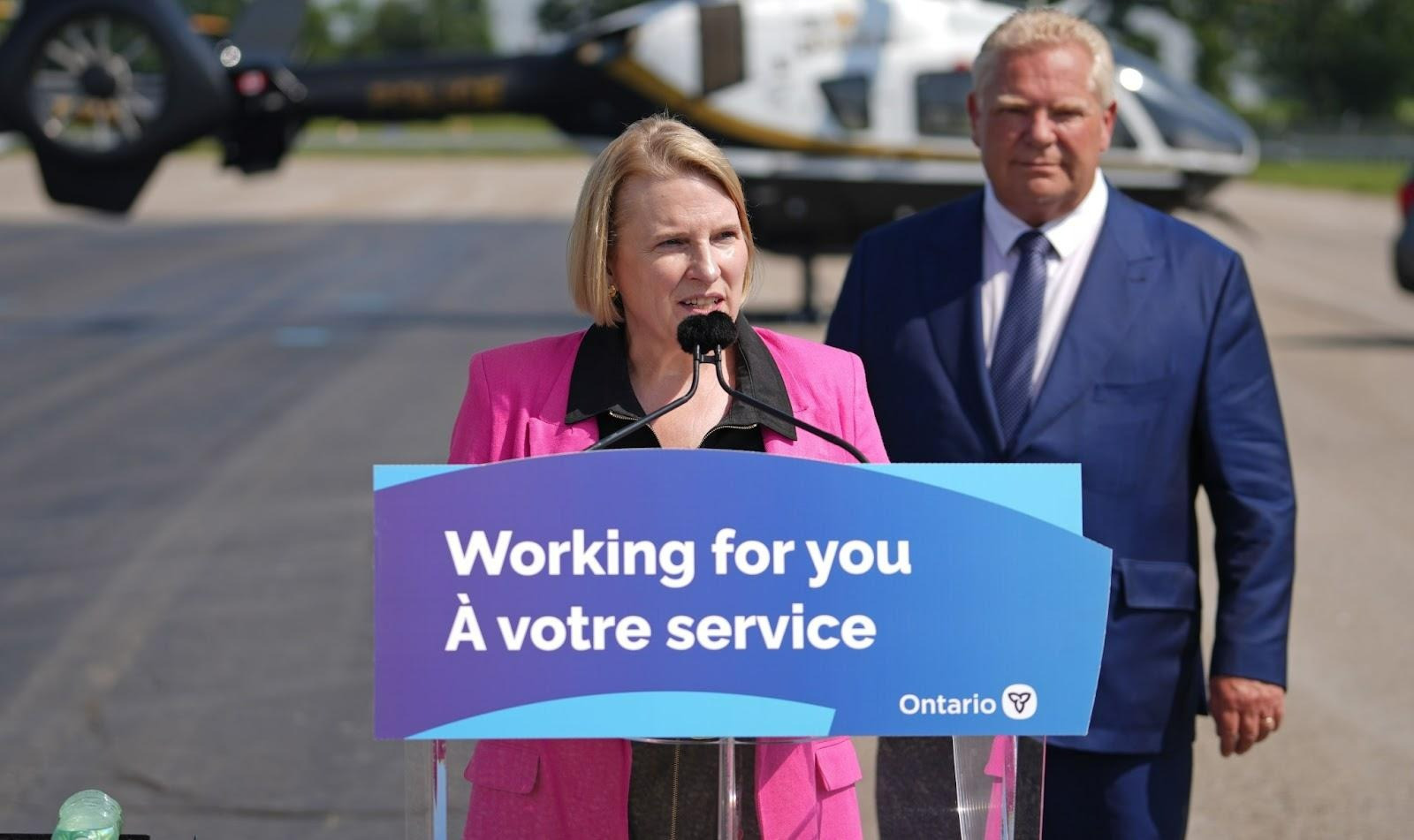
A Freedom of Information request by The Pointer has revealed how staff in the minister's office worked to build a narrative that safe consumption sites were responsible for an uptick in violent crime, relying on loose connections and misleading data.
(Government of Ontario)
Two independent reviews of the South Riverdale Community Health Centre that were completed following the tragic shooting of Huebner-Makurat did not recommend the site be closed. Instead, the conclusion of the report was Ontario should have more safe consumption sites, not less.
One review was completed by Jill Campbell, the former chief nursing executive at Toronto's Centre for Addiction and Mental Health, who said “Recent evidence demonstrates that these health services make a difference in opioid-related death rates based on proximity to the CTS (consumption and treatment sites).”
Both reviews recommended not only keeping existing locations, but expanding them while implementing policies to improve their operations and manage issues. This included increasing funding to retain more staff and hiring permanent security to enhance safety around the sites.
The PCs ignored these findings. Instead, relying on misleading criminal statistics and events to bolster the narrative that these sites were dangerous to the surrounding community.
A Freedom of Information request completed by The Pointer shows how staff in the minister’s office worked to build a narrative that all sites were crime magnets and a threat to residents. They ignored any evidence to the contrary.
Documents obtained by The Pointer include briefing notes provided to Minister Jones by her staff outlining information on each of the sites the government was looking to shutter.
Along with the basic information about location of the sites planned for closure, and any nearby schools or childcare facilities, the briefings include sections like “Crime and Community Safety” which purport to show data highlighting the increasing crime in the neighborhood of each safe consumption site.
For example, in the undated briefing note on Hamilton’s Urban Core Community Health Centre, it claims homicide rates in the surrounding neighbourhood were 450 percent higher than compared to the rest of the city. It’s a figure Minister Jones repeated in her speech at the annual Association of Municipalities of Ontario conference in August 2024, about four months before the legislation to close the site was passed at the Legislature. The figure is blatantly misleading.
A spokesperson for the Province told The Pointer earlier this year the violent crime data used to generate the figure was taken from the Hamilton Police Service for the entire Ward 2 where the site was located, not neighbourhood specific.
Misleading data is not the only issue with these briefing notes.
The page on the Thunder Bay site, claims the neighborhood has seen a “marked increase” in crime, but no data is included to prove this assertion. There is only a highlighted note: “data still to come”. The note on the Kitchener site also claims there has been a “marked increase” in crime in the area, but the section to include supporting data is blank.
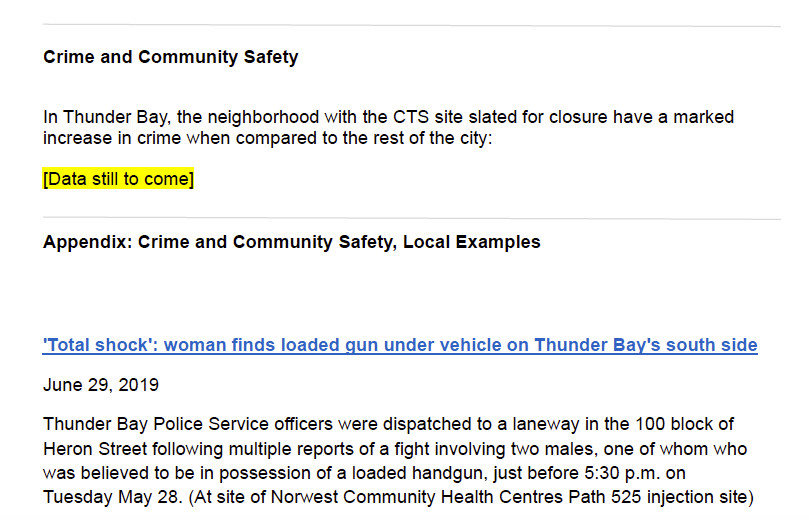
A briefing note to Minister of Health Sylvia Jones claimed the area around Thunder Bay’s safe consumption site had recorded a “marked increase in crime”; the PC government had no data to back up its claim.
A second section in all of the briefing notes is titled “local examples”, which provides links to news stories about criminal activity around the safe consumption sites.
Many of the articles make no mention of the safe consumption services themselves.
For example, the briefing note on the Guelph Community Health Centre has links to a story about a man being arrested for carrying a fake gun. The only connection being that it was “immediately by” the safe consumption site. The note also references a woman charged in connection with an apartment fire that displaced 15 people. It appears to have nothing to do with the safe consumption services.
For the Somerset Community Health Centre in Ottawa, the note includes a story on businesses upset about panhandling in the area of the safe consumption site, which is one of the few articles with direct connections to these sites. It also references an article on a suspicious fire in the area which makes no mention of the Centre.
Even for the Toronto locations it appears provincial staff in Jones’s office needed to stretch in order to make links between reported criminal incidents and these sites. The Toronto briefing note includes incidents that make no mention of safe consumption services, along with a series of articles written in the wake of the shooting death of Huebner-Makurat.
The Ministry of Health did not respond to questions about the contents of the briefing notes, or why it appears irrelevant information was used to inform the decision to close these sites.
Despite the lack of evidence, the PCs were insistent the proximity to schools or daycare facilities was a significant issue and rammed through its legislation barring them from opening within 200 metres of any school or childcare facility.
The reality that this government made the decision to close these sites without evidence or consultation was also highlighted by the Ontario Auditor General.
The audit of Ontario’s Opioid Strategy, confirmed the decision by Premier Ford and Jones to facilitate the closure of ten supervised consumption sites and bar future ones from opening under specific conditions “was made without proper planning, impact analysis or public consultations.”
The report continues: “We found that the Ministry has not performed comprehensive analysis to assess and quantify the impacts on and risks to public health and the health system prior to the finalization of its decision to introduce the new legislation…Our review of the government’s internal documents noted that the Ministry recognized the potential impacts to the health system of closing the 10 supervised consumption services sites, including: an increased risk of deaths from overdoses and emergency department visits; increased distances of public drug use and the public discarding of drug supplies; and no access within a responsible distance to supervised consumption services for Northern Ontarians going forward as a result of the closure of the only remaining site in Thunder Bay.”

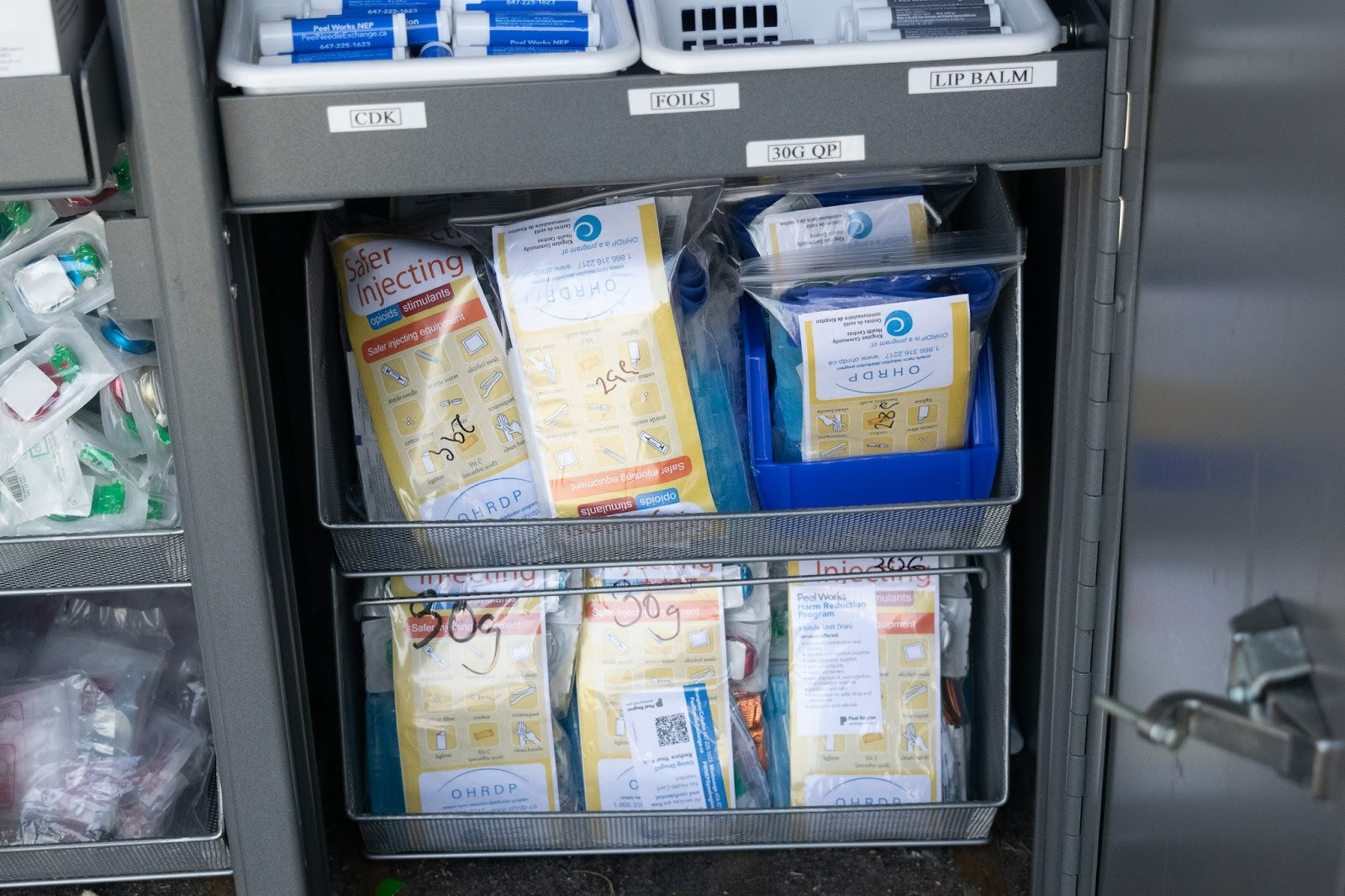
The Region of Peel’s harm reduction efforts include mobile vans that offer a number of services to those who use drugs which help keep them healthy and avoid overdoses.
(Alexis Wright/The Pointer files)
The PC solution has been to transition these former safe consumption sites into Homeless and Addiction Recovery Treatment Hubs, or HART Hubs. Peel has yet to see its HART Hub open, creating a significant gap in the services available to those who use drugs. It’s unclear why there has been such a delay after an announcement was made in January of this year that the Peel Dufferin branch of the Canadian Mental Health Association (CMHA) would be operating the hub.
According to staff with the Regio and CMHA Peel-Dufferin, the HART Hub at 10 Peel Centre Drive in Brampton will open in January.
“We are currently making minor improvements to the space to ensure it is well equipped to meet the needs of our clients,” a spokesperson for the Region of Peel told The Pointer.
Since the site’s closure, Peel has increased its harm reduction efforts elsewhere in an attempt to fill the gap created by the PC government.
“The Peel Public Health Harm Reduction Program offers free, anonymous, and confidential mobile services from 1 p.m. to 11 p.m. on Monday to Saturday. Daily hours of operation were increased in response to the supervised consumption site closure and our harm reduction program strengthened service in the area where the site previously operated,” a regional spokesperson explained.
Moyo also continues to support vulnerable individuals in Peel. The annual report details how the organization continues to operate five satellite programs across Peel. The usage of these programs highlight a dire need for additional services as 45 percent of those they’ve helped since the closure never accessed any services before. More than half of the clients are racialized and 34 percent identify as women.
When Peel’s HART Hub opens, according to information on the Government of Ontario’s website, it will provide services 12 hours a day, seven days a week, and is designed to “help individuals transition safely indoors into shelters, transitional beds, and supportive housing, thereby reducing encampments and stabilizing their circumstances.”
With Peel’s shelter system operating well over capacity, it’s unclear how these connections will be made.
The mental health and addiction services it will provide include “assessment, brief treatment, counselling, structure psychotherapy, Rapid Access Addiction Medicine, detox (and) addictions medicine prescription”.
No safe consumption services will be provided.
Peel Public Health officials admit it has been difficult to gauge the impact the elimination of such services has had on those who relied on it.
“Since the supervised consumption site closed, it has been challenging to identify a clear trend or connection related to overdoses, as fluctuations in overdoses continue to be largely influenced by changes in drug toxicity,” a spokesperson shared, noting that “in the immediate period following the closure, outreach teams did not identify any increased public drug use around the former supervised consumption site.”
In Toronto, according to reporting by Global News in late November, the city is reporting a modest increase in visible drug use and calls to clean up syringes.
Between 2014 and 2022, overdose deaths in the Region of Peel increased 249 percent with 606 lives lost over the period.
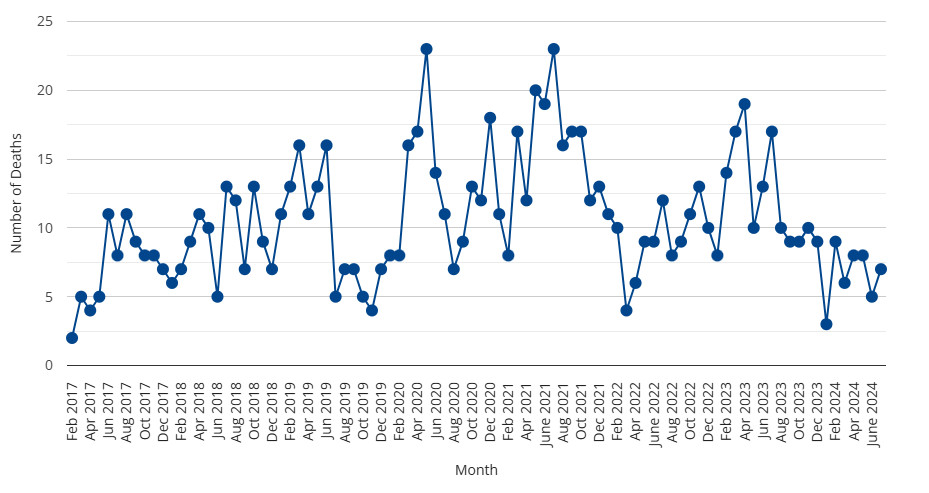
Data from the Region of Peel show that on average, roughly 10 people die every month from opioid overdoses in Peel.
(Region of Peel)
Peel Public Health is one of the lowest funded health units in all of Ontario. Broken funding formulas at the provincial level have failed to keep up with Peel’s rapid growth or the needs of its diverse population. In the 2026 budget, Peel Public Health is requesting an additional full time employee to help them meet the growing need for mental health and addiction services in the region.
“Demand continues to surge for public health services. Proactive upstream interventions, such as addressing risk factors for disease, health promotion and identifying intersections with social determinants of health help to reduce the burden of preventable illness on the healthcare system and improve population health outcomes,” the Peel Public Health 2026 Business Plan explains. “On average, every dollar invested in public health saves eight dollars in avoided health and social service costs.”
Adapting to the new mental health and addiction landscape, which has been significantly altered by the PC government, the Region of Peel is currently at work on a new “Peel Substance Strategy”, expanding on the work initiated with Peel’s 2019 Opioid Strategy.
“(It) is being co-designed with local partners and people with lived/living experience at the centre, including youth,” a regional spokesperson explains. “The strategy will be informed by community feedback, so it reflects local needs and supports people at all stages of life, including youth….The new strategy will be a community-driven response to the ongoing drug toxicity crisis with equity, inclusion, and lived experience at its centre.”
Email: [email protected]
At a time when vital public information is needed by everyone, The Pointer has taken down our paywall on all stories to ensure every resident of Brampton, Mississauga and Niagara has access to the facts. For those who are able, we encourage you to consider a subscription. This will help us report on important public interest issues the community needs to know about now more than ever. You can register for a 30-day free trial HERE. Thereafter, The Pointer will charge $10 a month and you can cancel any time right on the website. Thank you
Submit a correction about this story

