

$7K for killing a dog in Ontario: accused in heinous animal cruelty case avoids jail time
Animal welfare advocates are still waiting for justice for Dakota.
The young German shepherd was found seizing on a Niagara Falls sidewalk in July 2024 with her mouth muzzled shut with a plastic bag shoved inside.
The courts previously heard about how Dakota, in distress, broke a glass table her leash was connected to and ran off down the street—following months of mistreatment detailed to The Pointer by neighbours—the muzzle put her at grave risk.
She eventually collapsed and passed away.
She was forced to live in squalor, rarely let outside, and constantly shoved into the bathroom of the small apartment where she would bark to be let out.
Her owner Carly Young was charged with several provincial offences for causing her death and the Crown was seeking a sentence of six months in jail.
The potential for jail time had many advocates hopeful. Too often, animal abusers in Ontario are let off with weak penalties, often small fines, even after they’ve carried out heinous acts that would make any person cringe.
In late August that hope was snuffed out when Justice Krista Whittard delivered what is being described as “a joke” of a sentencing decision in one of the worst cases of animal abuse in Niagara Region in recent memory.
“It’s a bad day,” Donna Power, the co-founder of animal welfare organization The Humane Initiative, told The Pointer when reached after the August 24 decision. “Dakota has been failed by every imaginable lever of protection promised - the sentencing was the final nail in this betrayal.”
Young was found guilty on three provincial offenses, including causing distress to an animal—considered a major offense under the Provincial Animal Welfare Services Act (PAWS); acknowledging or recklessly causing an animal to be exposed to undue distress; and failing to provide the basic standards of care.
The PAWS Act dictates, for the major offense alone, a mandatory minimum fine of up to $25,000, but the law also allows for, a first offense, the fine to be as high as $130,000 and up to two years imprisonment, or both.
On the other two “minor” offenses, each come with a potential $75,000 fine and up to six months imprisonment, or both according to the Act.
The Crown was seeking six months in jail, the mandatory minimum fine of $25,000, along with a $2,500 fine for the other two charges. Young would also be banned for life from owning animals.
The Crown attorney in the case believed these penalties were “reasonable” given the extreme distress experienced by Dakota.
Justice Whittard fined Young just $7,000
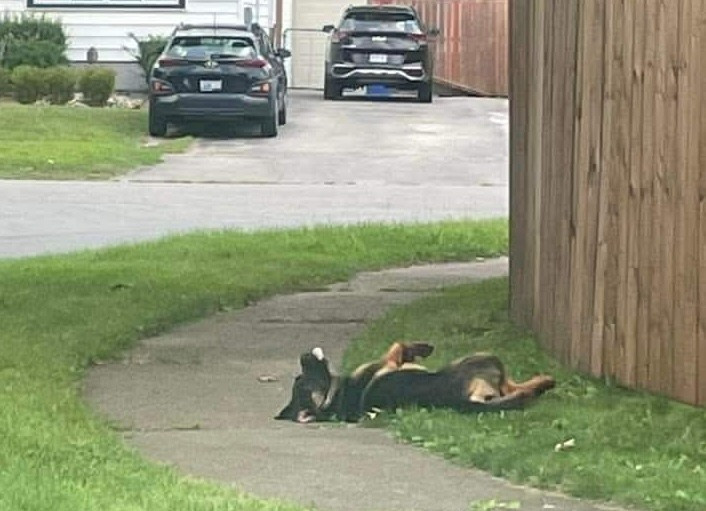
Dakota collapsed on the side of the road in Niagara Falls. Her mouth is muzzled shut, a plastic bag lodged inside is clearly visible. Carly Young, Dakota’s owner, admitted to routinely placing the muzzle on Dakota to keep her from barking. She was fined just $7,000 for causing Dakota’s death. (Facebook)
In reading the decision, Justice Whittard said she had considered the principals of deterrence and proportionality, meaning the sentencing must be harsh enough to deter others from committing similar offences and be proportional to the harm it caused. Under the PAWS Act, causing the death of an animal is the most extreme form of harm an offender can carry out.
Despite this claim, the decision by Justice Whittard is neither proportional to the crime carried out by Young, nor will it do anything to deter others from committing similar acts, advocates say.
“This sentence sends a clear message - abuse and/or kill an animal and nothing of consequence will happen to you,” Power told The Pointer.
Justice Whittard acknowledged an aggravating factor in the sentencing was Dakota’s death.
She did not go into detail of the tragic final moments of Dakota’s life on that hot day in July.
“I don’t want to come across as being too graphic, but I think it would be horrifying,” veterinary pathologist Dr. Ian Welch, testified in January. “In veterinary pathology we generally assign the cause of death as the one thing that if it hadn’t happened, the dog would most likely be still alive. So, in this case, if we follow the dog back to the one thing that led to the heat stroke and complicated by asphyxiation it would be the application of a tight muzzle on a hot day”
During sentencing, Justice Whittard revealed Young still had not taken responsibility for her actions that day, refusing to accept she killed Dakota, despite admitting to the court her and her husband Chris routinely used the muzzle to stop Dakota from barking. The muzzle was not a common cage or “basket”, which covers a dog’s mouth, preventing them from biting, but still allows them to safely pant. What was wrapped around Dakota’s mouth was a nylon “groomer’s muzzle”, a sleeve that keeps the dog’s mouth almost completely shut so they can’t bite when they are being groomed. It is only meant to be used for a short period.
Justice Whittard appeared to place a lot of weight on a pre-sentencing report completed ahead of the August court date
“The pre-sentencing report presents Ms. Young as an individual who is not malicious, but appears to have poor judgement, limited insight, significant mental health challenges, therefore Ms. Young does not appear to have any remorse or insight into the consequences of her actions, given these vulnerabilities, this presents ongoing risk concerns regarding animal care,” Whittard detailed.
According to report, Young was described as "cooperative" throughout the report process. Justice Whittard acknowledged this was a mitigating factor worthy of reducing her sentence.
What Justice Whittard did not explain is why cooperation with a pre-sentencing report would serve as a mitigating factor, but Young’s failure to attend multiple court dates—including her sentencing hearing—despite being ordered to do so, would not serve as an aggravating factor to justify a harsher penalty.
Young was a no-show to the first two scheduled court dates last summer. A bench summons was issued, giving police the power to arrest her and bring her to court. Carly showed up for the first day of trial in September.
Her failure to appear in court, choosing to do so virtually, routinely caused issues for the trial.
On January 29, the proceedings reached an impasse when it came time for Carly to testify.
Crown Attorney Hillary Lowry raised a number of concerns with allowing Carly to deliver her testimony and be cross-examined over Zoom. She pointed to the “cross talk” already occurring with her husband, and said proceeding this way would “interfere with the truth seeking function of the court”.
Lowry suggested rescheduling the hearing which was supposed to conclude that day.
Chris pushed back on the idea, claiming Carly had recent back surgery and was unable to travel long distances. The couple now live in Barrie.
He said in an effort to “clear it up today”—referring to the charges—Carly would not testify.
Lowry recommended against that, sharing that she would be seeking jail time if Carly is found guilty.
Carly immediately broke into tears, forcing a 15-minute recess.
Chris’s behaviour during the trial also repeatedly caused Justice Whittard to intervene, her frustration evident.
“Sir, again, listen sir, it’s really distracting for the court and I think for Carly, for you to be coaching her,” Justice Whittard said in one of several exchanges with Chris who frequently moved in and out of the camera frame visible to the courtroom.
“Well I’m trying to help my wife, your worship,” he claimed, adding he needed to assist her because she had a learning disability.
“Another question Carly has for the doctor-”...
Justice Whittard stopped him. “Okay, Carly can ask, Carly needs to ask the question, not you asking on her behalf or coaching her to ask.”
Justice Whittard was forced to intervene multiple times when Chris continued to ignore the instruction.
“Sir, please stop, it's very distracting, which is why we don’t often have defendants by Zoom.”
These previous issues, and Young’s failure to appear before the courts when directed—including at the August sentencing hearing—were not addressed by Whittard when making her sentencing decision.
“There is no consequence for giving the court a full fledged middle finger,” Power said.
The Justice also appeared to take into account Young’s self-diagnosed mental health issues, despite having no medical records before the court to support them.
The pre-sentencing report referenced long-standing learning challenges and “limited comprehension abilities”.
“No diagnosis of a learning disability was submitted,” Justice Whittard said.
Young self-diagnosed as schizophrenic, bipolar, and claimed she suffered from auditory hallucinations.
“No medical records in support of these diagnoses were submitted for the purposes of the pre-sentencing report to the court,” Justice Whittard said.
The limited documentation Young provided was insufficient to indicate the treatment, if any she received. Young filed a Form 42 form with the court, which is drafted when someone visits a hospital for mental health reasons. The doctor’s name on the document was illegible.
“It’s unclear if Carly was admitted to a psychiatric facility or assessed and released on this date,” Justice Whittard detailed.
Despite this, Justice Whittard said: “Although no medical documentation has been provided to the court, I am satisfied that there are significant mental health issues at play.”
She did not reveal how she came to this conclusion.
In explaining her reasoning for not imposing the mandatory minimum fine, Justice Whittard said there was simply no way Young would be able to pay it. Her and Chris live on approximately $2,300 a month from ODSP.
Justice Whittard said fines “are not intended to be crushing.”
“If the minimum fine was imposed it is far beyond Ms. Young’s ability to pay,” she said. “Therefore it would be an overhanging burden to rehabilitation, therefore significantly impairing rehabilitation.”
It’s unclear what rehabilitation Justice Whittard is referencing. Her sentencing decision did not order Young to take part in any rehabilitation programs, and there is limited evidence before her that Young would comply with the court’s requests, given the disdain she had previously shown for the Justice’s requests for her to simply show up in court.
Along with the $7,000 fine, Young will have a lifetime ban on owning animals—enforced through random inspections by Animal Welfare Service officers—and two years probation.
Justice Whittard claims the sentence addresses the principals of sentencing “providing both deterrence and impact on Ms. Young in conjunction with other orders.”
For the major offense of causing distress to an animal—muzzling Dakota, a decision that ultimately killed her—Justice Whittard could have imposed a fine of $135,000 and two years imprisonment.
She fined Young just $5,000.
For the minor offense of causing an animal to be exposed to undue distress, Justice Whittard could have imposed a $75,000 fine and six months imprisonment.
She fined Young just $1,000.
For the minor offense of failing to provide the basic standards of care, Justice Whittard could have imposed a $75,000 fine and six months imprisonment.
She fined Young just $1,000.
Justice Whittard summed it all up with:
“This is a situation of very unfortunate circumstances and choices by Ms. Young that resulted in the death of a dog.”
This is a gross trivialization of what Dakota experienced that day.
“Imagine a plastic bag over your head where you’re running out of oxygen and unable to resolve the source of the problem and until the heat stroke takes over and the dog becomes unconscious I think the level of distress would be extreme,” Dr. Welch testified in January.
Niagara Falls resident Melynda Banks sat with Dakota as she took her last breaths. The seizures caused her legs to twitch so forcefully, Dakota’s paw pads were left bleeding on the sidewalk. The muzzle was so tight around her mouth it would cause visible bruising observed days later during an autopsy.
“She just had so much blood on her. She had what looked like a bubble of plastic in her mouth, and then like hard plastic melted on the muzzle, it looked like to me,” Banks previously told The Pointer. Another person who joined Banks on the sidewalk left when Dakota began to seize, unable to watch.
Banks stayed with her.
“It wasn’t easy. I’m constantly thinking, what could I have done differently?”
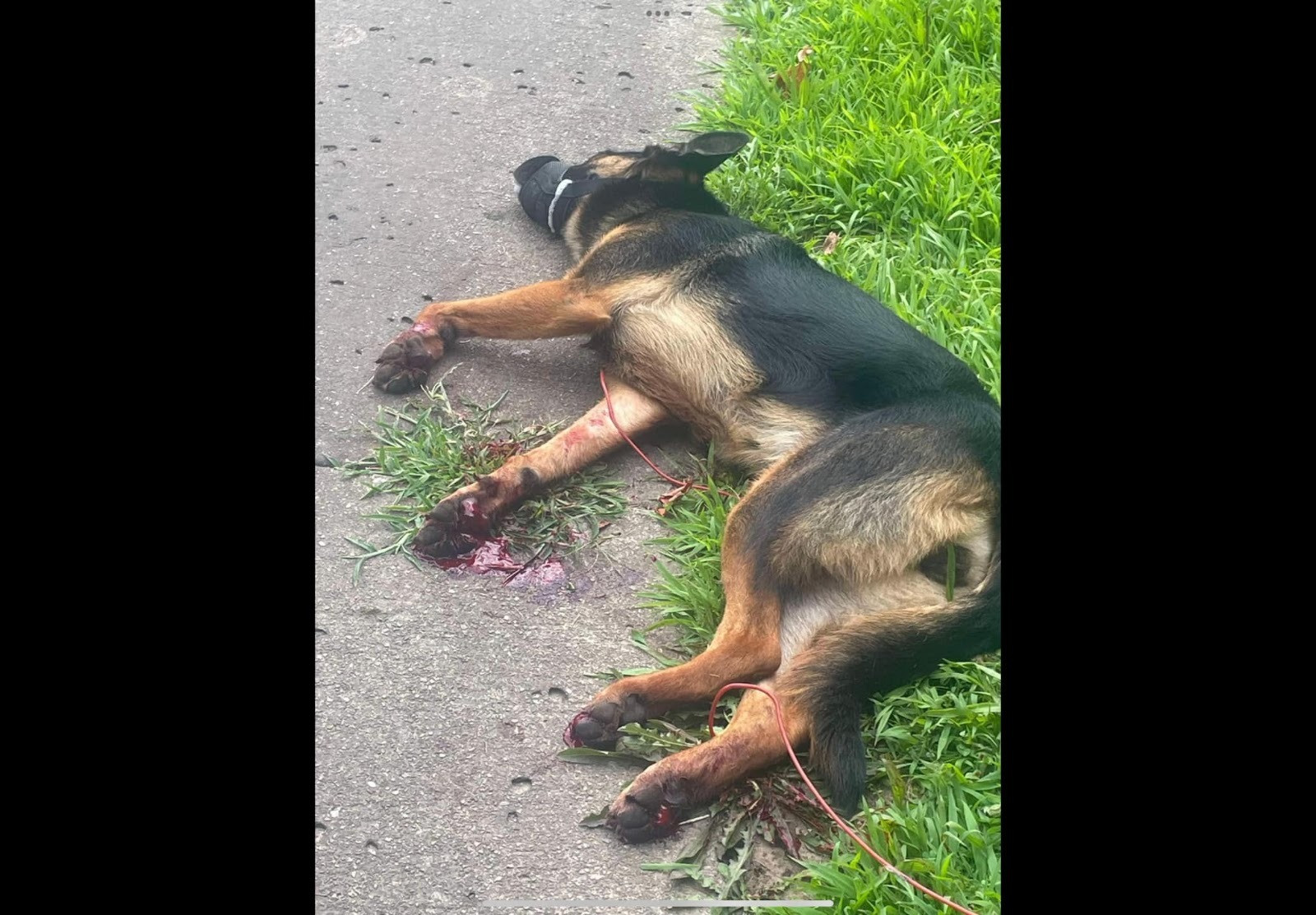
The end result of what Justice Krista Whittard described as an “unfortunate circumstances and choices”. Dakota died on a Niagara Falls sidewalk in July 2024 after owner Carly Young muzzled her mouth shut to keep her from barking. The muzzle was so tight it left bruising on Dakota’s nose and kept her from panting, triggering a fatal heat stroke. (Facebook)
Banks witnessed Dakota’s final moments, yet investigators with the Niagara Regional Police ruled she wasn’t important enough to the investigation to speak with.
It’s one of the many questionable decisions from a police force that waited nearly two years to launch a criminal investigation into Dakota’s death–despite glaring evidence of criminality–and only did so after immense public pressure from local advocates and organizations like The Humane Initiative.
The NRPS launched its investigation in March. It was closed by May with no charges being laid.
In an email sent to Power and shared with The Pointer, Detective Constable Rachel Flynn explained she had reviewed the evidence before the courts in Young’s provincial offenses case and determined “reasonable and probable grounds” for Criminal Code charges.
Despite this, the Crown decided not to move forward.
“I have consulted with the Criminal Crown on this case; as the defendant has been tried and convicted already, the Criminal Courts will not proceed with Criminal charges against the defendant over the same matter. The duplication is a risk of abuse of process, particularly with the defendant's conviction and forthcoming sentencing, wherein the POA Crown is seeking high punishment.”
In her email, Power expressed concern to Flynn that historically, animal abusers often receive small penalties for their crimes and worried a similar situation was about to play out with Young.
“While I understand this concern, I'd like to reassure you that this is not necessarily the case. The POA charges hold high fines, jail time, and post-jail probation time as well; the POA Courts are punitive, rather than rehabilitative, meaning full completion of jail sentencing has to be completed,” Flynn replied. “I am in agreement with you on the seriousness of this matter, as is my team, and understand the passion that you and your team feel in this regard. That being said, I am bound by the parameters of the Courts.”
Both the provincial offense and the criminal courts are the latest systems to have failed Dakota.
As The Pointer previously reported, bylaw officers and animal welfare services were repeatedly called about Dakota prior to her death in 2024. The Pointer learned from neighbours that AWS had been called multiple times about the living conditions Dakota was subjected to.
The police and AWS were well aware of the alleged mistreatment of Dakota by her owners through multiple complaints from residents who lived in the same building.
Neighbour Jennifer Sparaga told The Pointer the smell of dog excrement emanating from the apartment rented by Carly and Chris Young was overbearing. More than once tenants living on the same floor drafted a petition to management, demanding something be done about the odour.
Sparaga said both AWS and the SPCA were called to the apartment about the living conditions Dakota was being subjected to. Several complaints were filed about the dog using the balcony to go to the bathroom, with urine leaking down onto the balcony below.
There was constant screaming, arguing and barking.
No action was taken.
It remains unclear why none of this critical background was included as part of the evidence against Young in the trial. The Crown did not answer questions from The Pointer.
Dakota’s case is indicative of all the problems within Ontario’s animal welfare regime which places little significance on the death of an animal, and allows abusers to avoid real punishment.
Changes are necessary across the board, but one glaring issue Dakota’s case exposes is the breakdown between police and Animal Welfare Service officers.
Investigations by The Humane Initiative has revealed that AWS has no set protocol for guiding AWS officers on when to contact the police. It is an entirely subjective decision of the officer when they arrive on scene.
This is at best a recipe for miscommunication and at worst will cause a significant miscarriage of justice.
In the Dakota case, it is much closer to the latter.
It remains unclear why when AWS officers arrived on scene and found Dakota with her mouth muzzled shut, a plastic bag stuffed inside, they did not immediately suspect criminality.
The plastic bag, for some reason, never formed part of the official evidence at trial. It has never been explained why.
If strict protocols existed that if AWS officers even have an inkling of criminal behaviour when arriving on scene, this could go a long way to preserve could effectively be a crime scene.
In Dakota’s case, NRPS was not notified about her death, despite what investigators would determine years later to be “reasonable” grounds for Criminal Charges being laid against Young. This is without key witnesses and neighbours like Sparaga ever having been interviewed. It’s unclear why AWS did not speak with neighbours.
If a murder investigation was handled in the same manner it would trigger public outrage and an independent inquiry.
It appears now Young simply skates away on a technicality.
Changes to Ontario’s animal welfare regime would require provincial intervention. The PC government has shown it is less than open to making impactful changes to animal welfare in Ontario.
The animal welfare service is a disjointed and under-resourced system—Ontario, a province with a population of 15.8 million people, has fewer animal welfare inspectors than Manitoba, which has a population of 1.5 million. This explains why only 10 percent of serious animal cruelty cases result in charges.
The Ontario PC government routinely claims the province has some of the strictest animal welfare laws in the country.
“It’s all song and dance,” Power previously told The Pointer. “This is why we’re so vocal, people really need to know what’s going on.”
Nowhere was this more clear than the 2024 rollout of Ontario’s new legislation which the PC government claimed would put an end to puppy mills in the province.
The appropriately named PUPS Act (Preventing Unethical Puppy Sales) was marketed as the battering ram that would knock down the barriers to identifying puppy mills in Ontario and enforcing standards of cleanliness and safety upon all breeders.
It was anything but.
The government has little understanding of the true scale of the problem in the province as there are no reliable statistics on the number of puppy mills currently operating, and there is nothing in the legislation that will help identify them. While the new penalties the law creates could certainly act as a deterrent, the standards they apply to are vague, superficial and completely inadequate, advocates have complained, making them nearly impossible to enforce.
The government is attempting to close puppy mills by increasing fines on standards that are difficult to enforce, for puppy mill operations they do not know the locations of.
The vague, disjointed legislation mirrors the animal welfare system at large.
“It’s a puzzle and the pieces needed to come together, but they’re all floating all over, and no one is talking to each other and no one knows what their role is,” Power told The Pointer last year.
Closing these gaps would be a crucial first step. AWS are not trained investigators and allowing the system to remain disjointed means the risk of criminal charges being missed continues.
If there can be any justice for Dakota, it must come in the form of fixing the fractured system that allowed her pain to go unnoticed for so long, her death to be trivialized and the person responsible to go unpunished.
Email: [email protected]
At a time when vital public information is needed by everyone, The Pointer has taken down our paywall on all stories to ensure every resident of Brampton, Mississauga and Niagara has access to the facts. For those who are able, we encourage you to consider a subscription. This will help us report on important public interest issues the community needs to know about now more than ever. You can register for a 30-day free trial HERE. Thereafter, The Pointer will charge $10 a month and you can cancel any time right on the website. Thank you
Submit a correction about this story

