
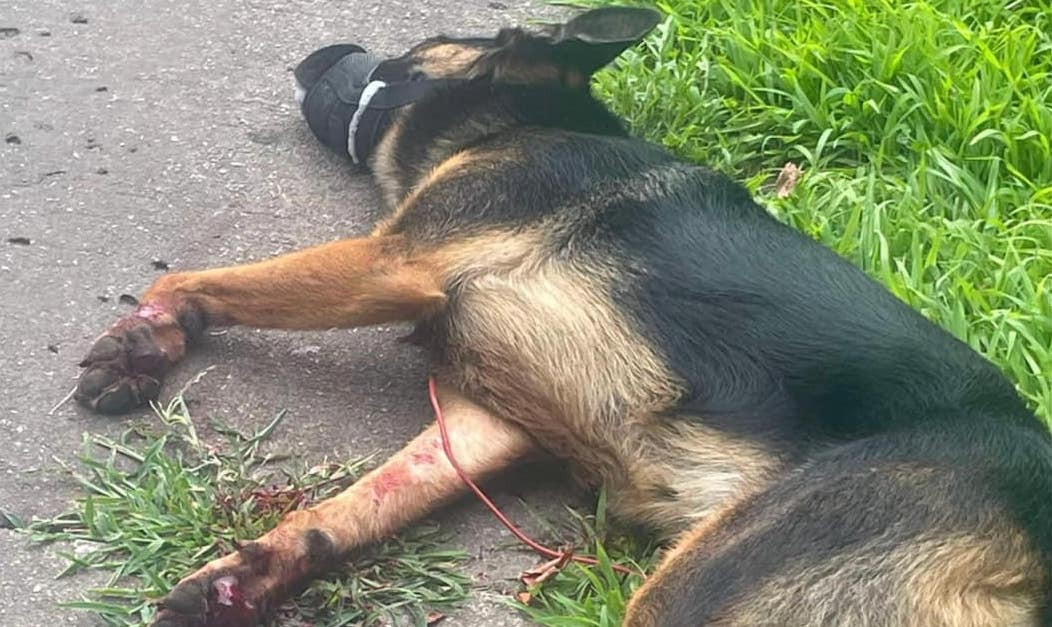
Owner inflicted ‘extreme’ distress to Dakota before her death, court hears; Crown seeking 6 month jail sentence
“I don’t want to come across as being too graphic, but I think it would be horrifying.”
The testimony from veterinary pathologist Dr. Ian Welch, delivered inside a Welland courtroom on January 29, had many in the public gallery solemnly nodding their head.
Welch was describing the final moments of Dakota’s life.
The young German Shepherd died muzzled and bleeding on a Niagara Falls sidewalk in July 2024. Her owner, Carly Young, is currently facing four charges under the Provincial Animal Welfare Services Act (PAWS) for her alleged mistreatment of Dakota that led to her tragic death on that blisteringly hot July day. The charges include not providing the basic standards of care, permitting distress to an animal, and “exposure to undue risk of distress”.
Welch, brought into the case to determine the level of distress experienced by Dakota prior to her death, made his conclusion abundantly clear, describing it as “extreme”.
Dakota died of heat stroke, brought on by a muzzle cinched so tight around her jaw it was cutting off bloodflow, Welch concluded.
The muzzle was not a common cage or “basket”, which covers a dog’s mouth, preventing them from biting, but still allows them to safely pant. What was wrapped around Dakota’s mouth was a nylon “groomer’s muzzle”, a sleeve that keeps the dog’s mouth almost completely shut so they can’t bite when they are being groomed. It is only meant to be used for a short period.
When Dakota, in distress, broke a glass table her leash was connected to and ran off down the street—following months of mistreatment detailed to The Pointer by neighbours—the muzzle put her at grave risk.
Niagara Police, and local bylaw officials were well aware of the issues Dakota had faced inside the small apartment which was infested with cockroaches. She was rarely let outside and was locked in a bathroom for long stretches when she would bark and cry incessantly.
Young has pleaded not guilty to the charges and is defending herself in the case.
“Dogs are exceptionally sensitive to heat stroke because they have limited ways of controlling their temperature,” Welch said, sharing what any responsible dog owner would already know, that one of the main ways dogs cool off is through evaporation when they pant.
“In veterinary pathology we generally assign the cause of death as the one thing that if it hadn’t happened, the dog would most likely be still alive. So, in this case, if we follow the dog back to the one thing that led to the heat stroke and complicated by asphyxiation it would be the application of a tight muzzle on a hot day,” Welch explained. “Imagine a plastic bag over your head where you’re running out of oxygen and unable to resolve the source of the problem and until the heat stroke takes over and the dog becomes unconscious I think the level of distress would be extreme.”

Dakota photoed running down the street in Niagara Falls, dragging the metal legs of a broken table.
(Facebook)
The case has garnered widespread attention among animal rights activists demanding “Justice for Dakota”. Advocates want her death to be a catalyst for change, to help fix glaring issues within Ontario’s Animal Welfare Service.
Young does not deny putting the muzzle on Dakota that day, but in her cross examination of Welch, she claimed it was loose when Dakota ran away.
“When the dog left, she was spooked and the muzzle was loose. So I don’t know how it could have gotten tightened,” she said.
Welch, through his review of the necropsy report conducted after Dakota’s death, detailed that when the muzzle was taken off “there were obvious indentations of the soft tissue”, along with pallour on the skin (meaning it was white or pale) due to constricted blood flow.
“This dog did experience a significant amount of distress and I think it's reasonable to believe that any reasonable person would understand that a tight muzzle on a hot day is an extremely bad idea and presents a high risk of death to a dog,” Welch said. “If you replayed that scenario in a dog without a muzzle, I think it’s very hard to imagine the dog falling over and paddling and seizuring if it was able to ventilate properly.”
It was a detail Justice of the Peace Krista Whittard focused on.
“I can infer without the muzzle, death may not have taken place?”
Dr. Welch responded: “Correct.”
At least two witnesses observed a plastic bag stuck into Dakota’s mouth, which the muzzle was keeping jammed in place. Carly herself, in Facebook posts made after Dakota’s death, acknowledged the bag, claiming Dakota “picked it up on her way to where she was running”.
According to Welch’s analysis of the report, no plastic bag was found in the dog’s mouth. It’s unclear why this evidence was excluded, or why it did not form part of any post-mortem report. The Pointer is continuing to investigate the matter.
While the January court date was meant to be the final day of the trial, Young was a no-show in the courtroom at the start of the hearing.
Court staff discovered Young and her husband Chris were logged into the virtual courtroom, despite being directed to attend in person.
While the proceedings were allowed to continue, her physical absence clearly frustrated Justice Whittard, who was repeatedly required to jump in to stop Chris from trying to coach Carly on how to cross-examine Welch.
“Sir, again, listen sir, it’s really distracting for the court and I think for Carly, for you to be coaching her,” Justice Whittard said in one of several exchanges with Chris who frequently moved in and out of the camera frame visible to the courtroom.
“Well I’m trying to help my wife, your worship,” he claimed, adding he needed to assist her because she had a learning disability.
“Another question Carly has for the doctor-”...
Justice Whittard stopped him. “Okay, Carly can ask, Carly needs to ask the question, not you asking on her behalf or coaching her to ask.”
Justice Whittard was forced to intervene multiple times when Chris continued to ignore the instruction.
“Sir, please stop, it's very distracting, which is why we don’t often have defendants by Zoom.”
It was not the first time Carly failed to show up in person to answer to the charges. She was a no-show to the first two scheduled court dates last summer. A bench summons was issued, giving police the power to arrest her and bring her to court. Carly showed up for the first day of trial in September.
On January 29, the proceedings reached an impasse when it came time for Carly to testify.
Crown Attorney Hillary Lowry raised a number of concerns with allowing Carly to deliver her testimony and be cross-examined over Zoom. She pointed to the “cross talk” already occurring with her husband, and said proceeding this way would “interfere with the truth seeking function of the court”.
Lowry suggested rescheduling the hearing which was supposed to conclude that day.
Chris pushed back on the idea, claiming Carly had recent back surgery and was unable to travel long distances. The couple now live in Barrie.
He said in an effort to “clear it up today”—referring to the charges—Carly would not testify.
Lowry recommended against that, sharing that she would be seeking jail time if Carly is found guilty.
The revelation stunned those in attendance. Advocates turned to one another wide-eyed with surprise.
Carly immediately broke into tears, forcing a 15-minute recess.
While seeking jail time for PAWS Act offences is allowed under the law—the maximum for the charges Carly is facing is two years—it is rarely considered. Animal advocates routinely complain that those who abuse animals in Ontario often get away with a slap on the wrist. Lowry told The Pointer she will be asking for a sentence of six months in jail, along with a lifetime ban on owning animals.
When court resumed, the couple’s demeanor changed, and they were willing to push the trial to a later day.
Chris asked for a delay until April, but Justice Whittard said that was too long, instead setting the final trial date on March 2.
Chris continued to claim they were unable to attend in person due to Carly’s health issues following back surgery. Justice Whittard dismissed these claims, pointing out that Carly was able to attend the September court date—after her surgery in July—so she should be able to appear in person.
Email: [email protected]
At a time when vital public information is needed by everyone, The Pointer has taken down our paywall on all stories to ensure every resident of Brampton, Mississauga and Niagara has access to the facts. For those who are able, we encourage you to consider a subscription. This will help us report on important public interest issues the community needs to know about now more than ever. You can register for a 30-day free trial HERE. Thereafter, The Pointer will charge $10 a month and you can cancel any time right on the website. Thank you
Submit a correction about this story

