
Debunking PC claims about Ontario’s animal welfare crisis—it’s time offenders face criminal charges
Content Warning: This story details graphic examples of alleged animal abuse, including images, that some readers may find upsetting.
For over 100 years, the Ontario Society for the Prevention of Cruelty to Animals was the animal welfare enforcement agency in this province.
Sadly, its work has always been desperately needed. Animals have suffered profoundly from so-called human civilization: beyond the industrial-scale slaughter of creatures harvested for our consumption, domesticated animals often suffer neglect, daily harm and even torture at the hands of owners. Many are randomly abandoned. Cases of such neglect and harm became even more prominent since the pandemic, when, ironically, many of the beings used by people for companionship and support to help ease their own troubles, were soon discarded—nothing more than an inconvenience once life returned to normal.
The OSPCA is a private charity. It was granted limited policing powers, but was not open to public scrutiny like taxpayer-funded police services. This led to rising concerns around transparency and public accountability.
The OSPCA received some financial support from the provincial government which covered approximately one-third of its budget (approximately $5.75 million - $6 million annually). Public donations accounted for the remaining two-thirds of the operating requirements.
A scathing 2016 report by Kendra Coulter, a labour studies professor at Brock University, found that the majority of the OSPCA officers were poorly paid, worked in the field alone often facing dangerous circumstances, and were responsible for extremely large geographic regions. Coulter said there are many reasons a government should fund and operate animal welfare law enforcement, including transparency and accountability.
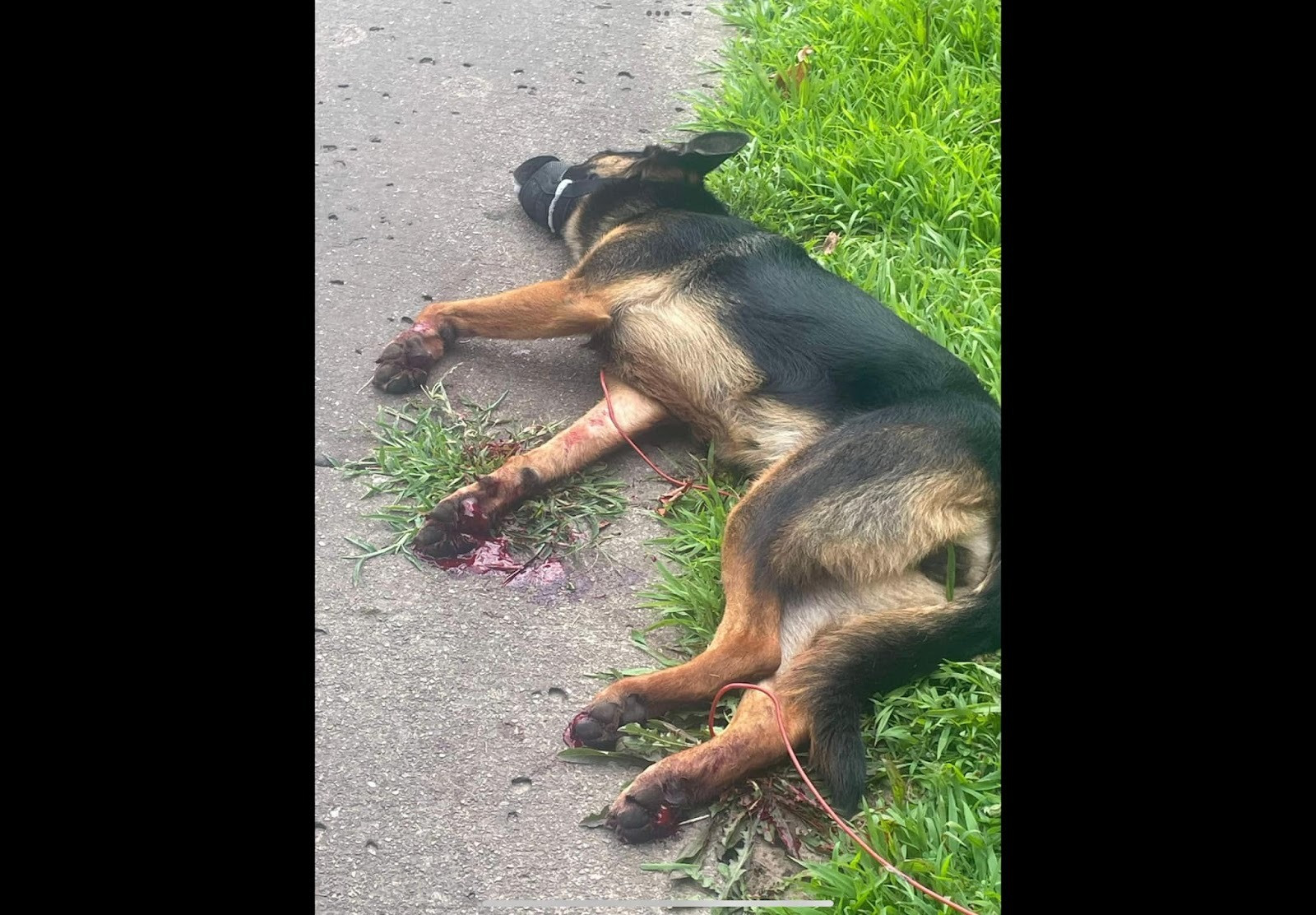
Dakota was a young German shepherd who died in Niagara Falls in the summer of 2024 after suffering horrific abuse. Fleeing from her owner, she collapsed on the sidewalk, bloodied. A muzzle kept her mouth clamped shut with a plastic bag stuffed inside.
(Facebook)
“But the government has not yet shown any leadership on this issue,” she said. “We are in a time of troubling uncertainty. We need clarity from the government, promptly.”
In 2019, three years after the scathing report, with no changes made by the provincial government, OSPCA CEO Kate MacDonald put it bluntly: “The current model is just simply not working”.
The tipping point came from a landmark legal ruling. In January 2019, the Ontario Superior Court ruled in Bogaerts v. Attorney General of Ontario that the Province’s system of delegating animal policing to the OSPCA was unconstitutional. The court found it was improper to grant sweeping police powers to a private organization without any public oversight or accountability measures. This strongly worded decision gave the Ontario government one year to “fix” the situation.
In response to the court's decision, the OSPCA sent a letter to Community Safety Minister Sylvia Jones, outlining how it would not sign a new contract with the Province for enforcement responsibilities after the current one expired at the end of March 2019. The OSPCA offered a three-month transition phase in lieu of a signed contract until June 28 of the same year. Moving forward, the organization would shift away from overseeing enforcement responsibilities into a support role in animal cruelty investigations, providing animal shelter, forensic evidence collection and veterinary services.
Because of the court’s decision, and alongside the growing public push for animal welfare reforms, the government commissioned a survey in 2019 to gauge public sentiment. It found overwhelming support for having police or a public agency take the lead on animal welfare enforcement rather than a private entity.
The province went into scramble mode. To fill the void, the Ontario legislature passed a temporary law enacted in June of 2019 which allowed the Solicitor General to appoint a provincial Chief Inspector and recruit qualified inspectors from local humane societies and other agencies to continue enforcing animal welfare laws after the OSPCA’s exit. Essentially, many local humane societies and police services stepped in on an interim basis to handle animal cruelty investigations for the remainder of 2019.
In October of that year, the Ontario government unveiled proposed legislation—the Provincial Animal Welfare Services Act (nicknamed the “PAWS Act”)—to create a permanent public enforcement system. Government officials promised a stronger, transparent enforcement model with province-wide coverage and specialized officers for different types of animals. They promised “a new approach to enforcement is coming”.
So far, the government of Ontario has refused to recognize animals as sentient. Sentient being the ability for an animal to experience positive emotions (joy, pleasure) and negative ones (pain, fear and distress). Overwhelmingly, the public—and science—does not agree with this position.
The Ontario legislature passed the PAWS Act in December of 2019. The new law includes significantly tougher penalties for animal cruelty (the highest in Canada) and formalizes the creation of a fully public enforcement regime. The PAWS Act came into effect in January, 2020 with Paula Milne transitioning from Interim Chief to being the first Chief Animal Welfare Inspector.
It was a promising start on a path to desperately needed animal welfare reform in Ontario.
But it was a lie.
The government continues to pander to special interest groups placing preservation of the status quo over humane animal protections. They rebuke calls for transparency and accountability. The operating budget of the Animal Welfare Service (AWS) is more than double that of the OSPCA with the majority of the budget going to salaries. Enforcement has not improved, animals continue to suffer and the provincial government is turning a blind eye to rampant animal cruelty playing out across Ontario.
In a sense, Ontario is right back where it started before the OSPCA handed the reins to AWS.
So, why does our animal welfare system continue to fail? Why are more animals left to suffer and the guilty allowed to go unpunished?
The PAWS Act was pretty much thrown together using much of the contents of the now repealed OSPCA Act. There was very little time to pull it together during the rush to ensure there was no gap in animal welfare enforcement.
We are now entering the seventh year under the PAWS Act and there are many gaps and loopholes still unaddressed and a government exhibiting very little appetite to improve animal protections—all the while working overtime to ensure the wall obstructing transparency and accountability stays firmly in place.
The foundational cornerstone of any animal welfare legislation—Basic Standards of Care—remain woefully weak under the PAWS Act. Solicitor General Michael Kerzner admitted this shortcoming to the Humane Initiative more than two years ago. He has continued to resist calls for a major overhaul of the Act from many in the animal welfare community.
Minister Kerzner also admitted to Humane Initiative that there remains a lack of consistency in how police services across the province respond to calls regarding suspected animal cruelty.
Under the Canadian Criminal Code 445.1 it is an offence to wilfully cause or permit (if a person is the owner) unnecessary pain, suffering or injury to an animal.
In my experience as co-founder of Humane Initiative, an organization that advocates for the welfare of animals in Ontario, we have heard many police services claim they have no responsibility for animal welfare. People are directed to a provincial hotline, despite language in the PAWS Act that outlines the responsibility of police.
Under the new system, enforcement is conducted by a team of provincial inspectors who are directly accountable to the government (through the Ministry of the Solicitor General). A Chief Animal Welfare Inspector leads this unit, and many former OSPCA officers were hired on as provincial animal welfare inspectors to provide continuity.
The inspector ranks are under-resourced. The total number of field inspectors has hovered around 100, to cover all of Ontario and its 15 million residents. Manitoba, which is roughly one-tenth the size, has about the same number of inspectors doing similar work.
The PC government touts its inspectors as “specialists designated for areas like livestock, zoos/aquariums, and equine cases”.
Our experience, which is shared among many in the animal welfare community, is that the “expertise” is severely lacking. Along with poor response times in many parts of the province, the Act is often not enforced, or inspectors apply arbitrary reasoning for making decisions.
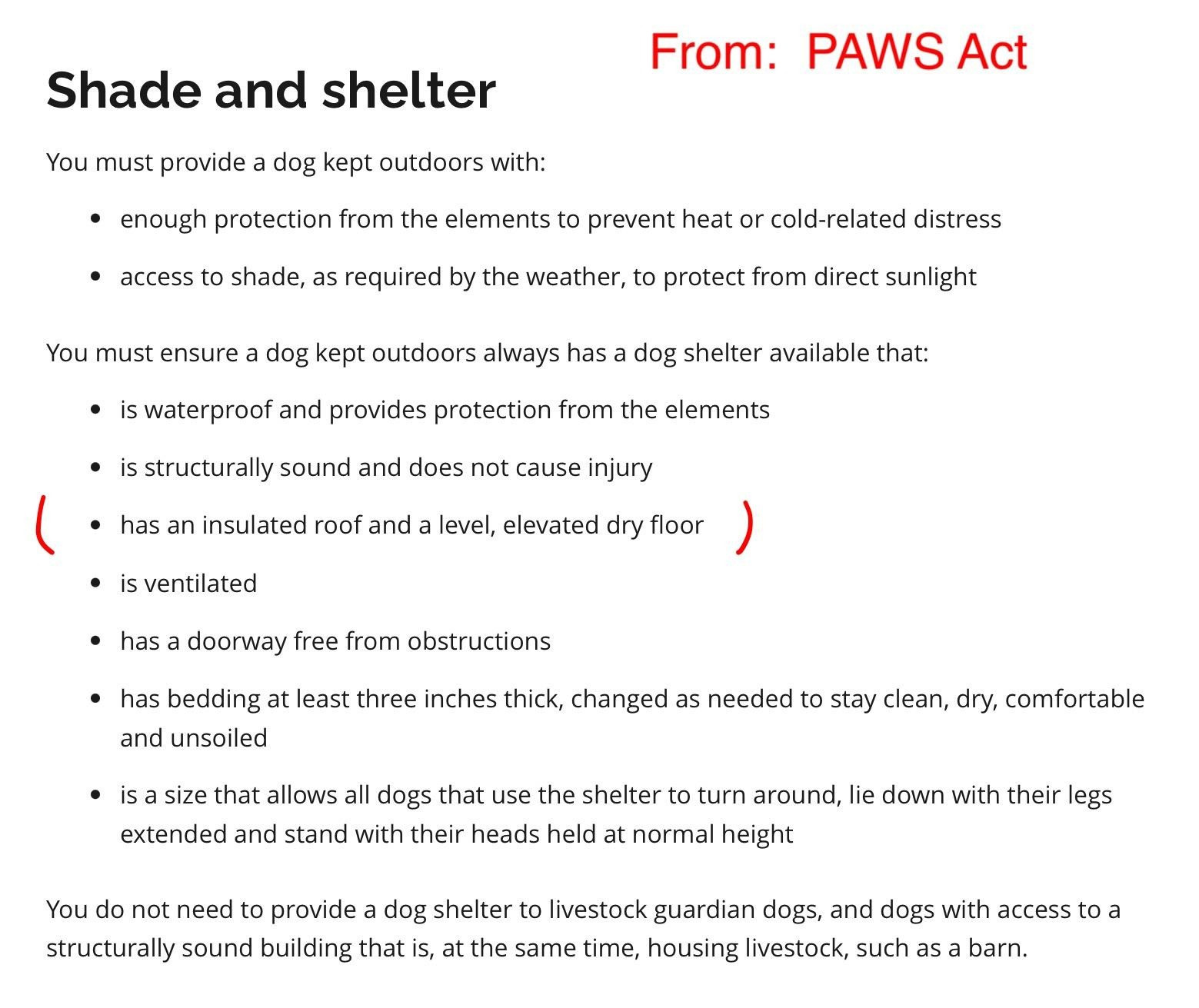
For example, in January last year the AWS was called to a residence in Guelph for reports of owners leaving their dogs outdoors for long periods of time without adequate shelter from the elements. In response to the initial visit by AWS, the owners installed insulation in the shelter. When AWS revisited the property, inspectors ordered the insulation removed, saying “How do you expect the dog to breathe?” This is a direct contradiction from what is outlined in the PAWS Act, which details how shelters for outdoor dogs must have “an insulated roof and a level, elevated dry floor”.
Here is an example of a government talking point: The PAWS Act introduced several improvements and stricter provisions. Penalties for animal abuse were sharply increased – for example, individual offenders can face fines up to $130,000 and up to 2 years in jail for a first major offence (doubled for subsequent offences), while corporations can be fined up to $1,000,000 for repeat animal welfare violations.
The reality: under the PAWS Act the approach is “re-education” as opposed to protection and enforcement. The backbone of the PAWS Act is focused on re-educating abusive and neglectful owners to try and change their behaviour as opposed to removal of the animal or enforcement using the ability to punish owners. This allows those who break the law to do so with impunity. According to government data, 38 percent of all animal welfare charges laid are withdrawn by the Crown and only 12 percent result in a guilty plea or conviction.
And this is just provincial offences. Despite obvious evidence of criminality, in many cases there is a reluctance by police and Crown Attorneys to pursue Criminal Code charges.
Why are animal welfare offences not being taken seriously by provincial Crown Attorneys? Why does the PAWS Act, the keystone animal welfare legislation in the province, not include stricter provisions and guidelines to assist the police and Crown on when they should pursue criminal charges? These questions have gone unaddressed by the PC government.
Another government talking point: The system now has built-in oversight and accountability. Inspectors are subject to public-sector transparency rules, and a new one-stop public complaints mechanism was created to handle any concerns about animal law enforcement. The public has the ability to submit Freedom of Information requests for AWS documents and reports.
The reality: Humane Initiative, along with many other advocacy groups and the public at large, has faced stonewalling by the government when asking for more details surrounding its enforcement strategy. Responses to Freedom of Information requests are faced with delays upon delays and the results are often so heavily redacted or incomplete the underlying content is unclear.
(Editor’s Note: The Pointer has experienced similar treatment with FOI requests related to animal welfare under the PC government. Several requests have simply gone unaddressed, which is a violation of provincial law.)
We have also faced a closed door when using the appointed inspector complaint mechanism. We have seen first-hand, complaints with clear evidence submitted to the AWS that have been ignored. In every case, the Chief Animal Welfare Inspector would reply with a dismissive note saying the inquiry proved groundless and the issue was now considered closed.
This is a matter that needs to be investigated by Ontario’s Auditor General or the Ontario Ombudsman. When complaints about AWS inspectors are made, they should be reviewed by an independent body and results should be available to the public.
Government talking point: Puppy mills are now prohibited in Ontario and those found to be operating one will face the strongest penalties in all of Canada.
The reality: The Preventing Unethical Puppy Sales Act (PUPS Act) became law in 2024 and stipulates that “no person shall operate a puppy mill”. Similar to the PAWS Act, this piece of legislation is hollowed out, with standards that are either too vague to enforce, or leave the decision-making up to inspectors, which creates an arbitrary enforcement regime based on opinion instead of applicable rules and regulations.
When drafting the regulations to support the PUPS Act, policy advisors within the Ministry of the Solicitor General created “task forces” to bring in expert advice. Humane Initiative was a member of one of these task forces.
Across the board, each member made it very clear that a breeder licensing mechanism was required if any sort of legitimate oversight of commercial dog breeding was to be done. The lack of any licensing or true enforcement has allowed puppymills, backyard breeders, unregulated selling platforms like Kijiji and Facebook Marketplace to flourish completely unencumbered. Allowing breeders to remain hidden and unlicensed makes any enforcement basically impossible. This allows breeding factories with horrendous “living” conditions to continue. This allows breeder dogs who never see the light of day until they are no longer required to continue to suffer. This allows the selling of sick puppies to unsuspecting members of the public.
The lack of oversight and licensing has allowed puppy breeding to surge out of control in Ontario. Animal rescues and municipal shelters across the province are recording disturbing increases in the number of dogs being dumped when they can not be sold for profit.
A license system could fix all of this. Doug Ford made it very clear the PC government had no interest in introducing such a system.
The PCs claim they are the leaders in Canada when it comes to fighting puppy mills, despite their weak position on oversight and enforcement.
What makes the government’s unwillingness for such a system even more puzzling is the financial benefit it could provide the Province. For Premier Ford, who styles himself as fiscally responsible, leaving potential revenue on the table seems like a contradiction. The potential licensing fees and tax revenue from these businesses could provide millions of dollars to support AWS and further enforcement efforts.
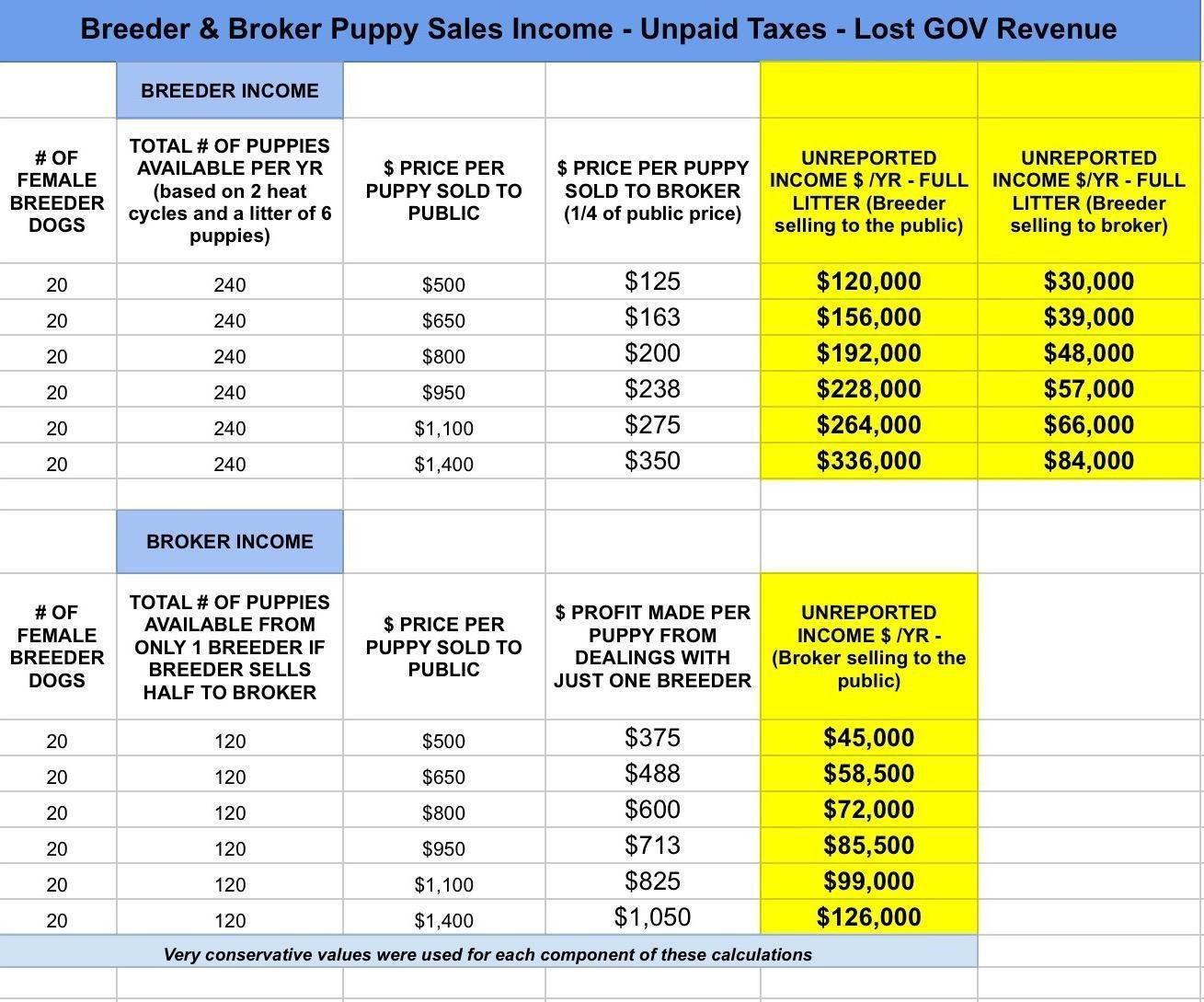
Estimates of puppy mill revenue in Ontario.
(Humane Initiative)
Government talking point: The government committed to bolstering enforcement, reviewing the PAWS Act to modernize standards to ensure better protection for animals, and clarify ambiguous language and close loopholes.
The reality: Significant gaps remain in the PAWS Act that have gone unaddressed. Key terms in the legislation, such as requirements to provide “adequate and appropriate” food, water, medical care, ventilation, and sanitary conditions, are not precisely defined. The Act and its regulations mandate that an animal’s living area be kept “sufficiently clean” and cleaned “as frequently as necessary,” but again, these phrases are open to interpretation.
Broad, ambiguous wording makes compliance difficult for both owners and inspectors. This vagueness increases the risk of substandard conditions being deemed technically compliant.
This grey area creates loopholes and puts the issuance of orders and the laying of charges (and successful prosecution) at risk.
Similar vague language is seen in the government’s recently introduced Animals for Research Act. The proposed legislation does not address key deficiencies. As written, it would allow the continuation of questionable inhumane experiments, other treatment of animals from municipal shelters, and some humane societies would still be mandated to sell to laboratories for experiments when requested.
It’s time for change. We need a government that will make the bold decision to pass legislation recognizing animals as sentient beings; we need a government that will create specific, measurable amendments to existing legislation, not just vague empty promises. We need to ensure police services across the province are responding in a consistent manner to animal cruelty concerns. Dog breeders need to be licensed, with the requirement for annual inspections and taxes in place for animal sales.
The government needs to create a communication channel between AWS and local police so that when it is clear to AWS (based on set criteria) that an offence meets the bar under Criminal Code 445.1, that the case is escalated to local police to investigate and lay charges if warranted. To enhance punishments and deter future offences the government should also increase the penalties for animal cruelty charges laid under the Provincial Offences Act.
Ontario’s animal welfare system is broken. It is not delivering what was promised in 2019, not even close.
The government is blocking the public’s access to information—information that as taxpayers we have every right to see and question our elected officials about.
Decisions were intentionally made by the government to have individuals accused of animal cruelty face a lesser degree of justice.
This is being conveyed by having offences prosecuted under the Provincial Offences Act, not the Criminal Code.
This is the hardest part to share with you. As an animal advocate, I am so disheartened by what we allow our “leaders” to do to defenceless animals, “leaders” who refuse to recognize what animals feel. As a human being, my heart is crushed.
We are better than this. Ontario’s animal welfare policy does not reflect who we are.
Animals must be protected from the evil that is inflicted upon them.
Those found responsible should face meaningful consequences that send a clear message that illegal conduct will not be tolerated in Ontario.
So what can be done?
First, and most important, vote, and let your local Member of Provincial Parliament and candidates know that animal welfare is an issue that will determine your ballot decision. Create groups of like-minded individuals. Increase public awareness of the plight of animals in Ontario. Try to encourage your MPP to bring forward a private members bill in the Ontario legislature to push for the changes outlined above. Publicize politicians’ voting records on important animal related legislation. Be vocal on social media. And turn out to municipal and provincial assembly chambers, in full force, to show decision makers that there will be a consequence if they continue to allow the suffering of animals in Ontario.
Donna Power is the co-founder of Humane Initiative, a prominent animal advocacy organization in Ontario.
At a time when vital public information is needed by everyone, The Pointer has taken down our paywall on all stories to ensure every resident of Brampton, Mississauga and Niagara has access to the facts. For those who are able, we encourage you to consider a subscription. This will help us report on important public interest issues the community needs to know about now more than ever. You can register for a 30-day free trial HERE. Thereafter, The Pointer will charge $10 a month and you can cancel any time right on the website. Thank you
Submit a correction about this story

