
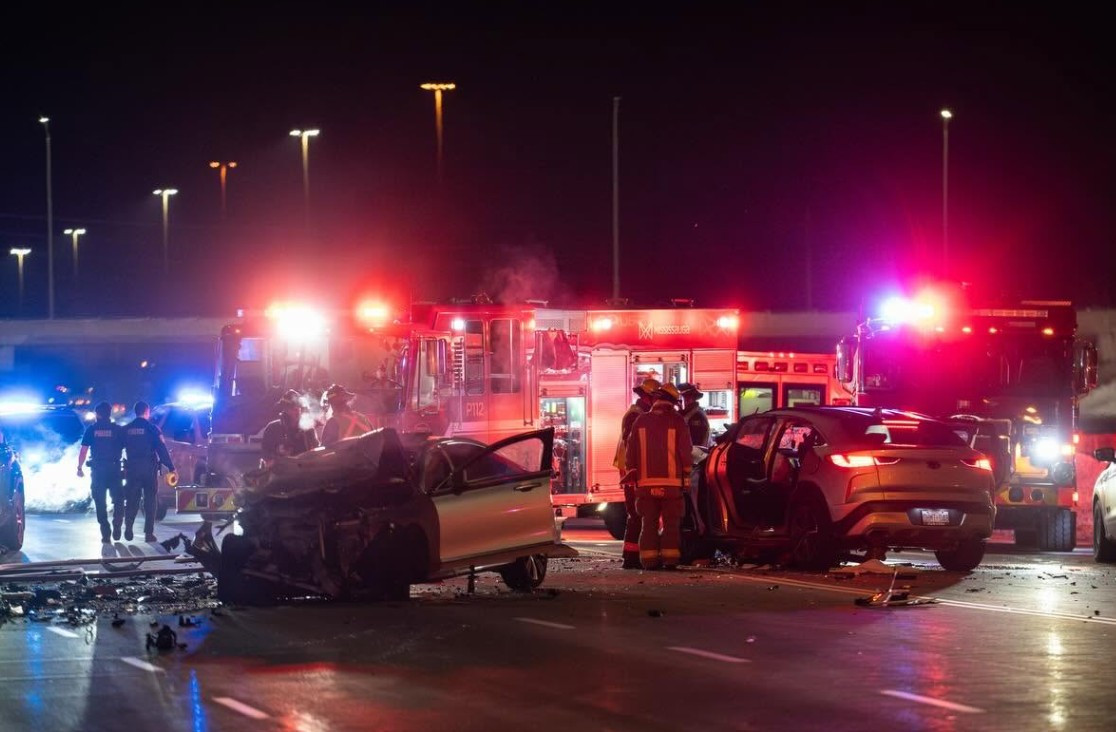
New report finds accidents in Peel are already on the rise, a year after PCs banned speed cameras
One year after the provincial government ended automated speed enforcement, new research points to rising accident rates among drivers in Brampton and Mississauga, raising questions about whether the removal of cameras has left communities without sufficient protection against speeding.
“Brampton had the biggest number of speed cameras before they were shut down in the whole of Ontario. It was 185 speed cameras stationed around Brampton. That's a bit more than in Toronto, which tells you that if you remove all of [them] at once, obviously that might have some impact on how people are behaving on the roads,” Vitalii Starov, vice-president of product growth at mychoice, an Ontario based insurance company, told The Pointer.
For Starov, the removal of the automated speed enforcement cameras across Ontario was a decision by the PC government that warranted a closer examination of what would happen to driver behaviour once the technology was no longer being used to enforce speed limits.
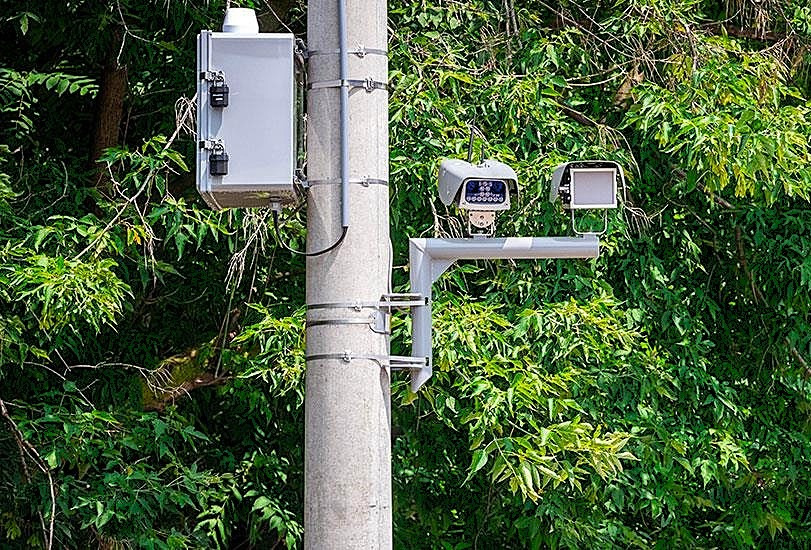
Automated speed enforcement cameras are no longer allowed in Ontario. (Alexis Wright/The Pointer)
A year after the provincial government prohibited municipalities from issuing speeding tickets through automated speed enforcement cameras, new research from mychoice published on November 11, suggests drivers in Peel are reporting more accidents, with Brampton experiencing a particularly notable increase.
The findings come from a follow-up study conducted by the insurance company, which compares insurance across the province and collects data that informs the industry. It examined reporting by drivers seeking insurance quotes before and after the provincial ban. The research found the percentage of Brampton drivers reporting an accident increased from 9.74 percent before the ban to 11.33 percent after. Mississauga also experienced an increase, rising from 11.05 percent to 11.49 percent.
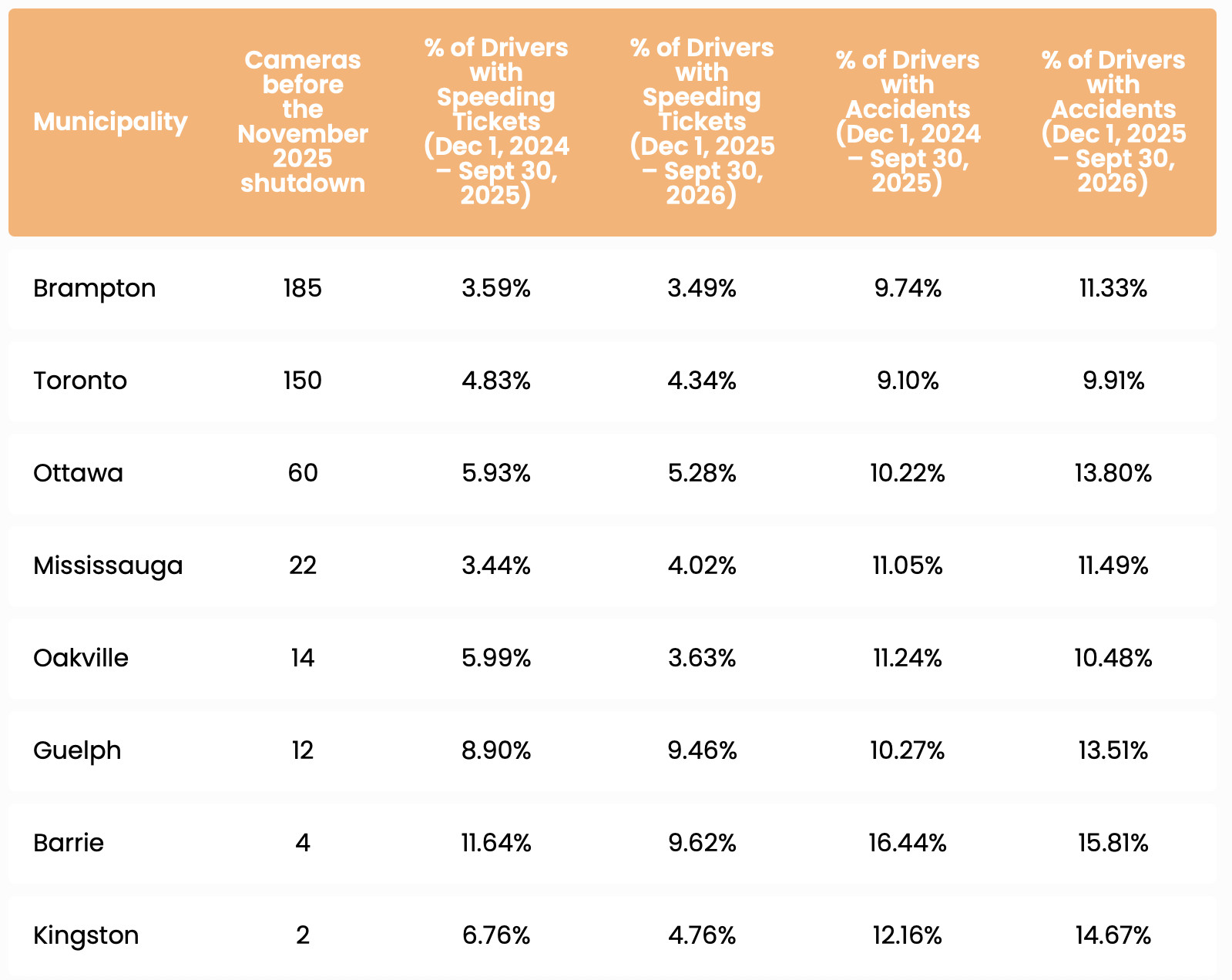
Mychoice’s recent speeding study.
While the research does not establish that speeding was the direct cause of the increase in reported accidents, the data raise questions about whether the removal of automated speed enforcement has affected road safety in communities that previously relied on the cameras to discourage drivers from exceeding posted speed limits.
The findings are particularly significant for Peel given the number of cameras that had been installed throughout Brampton, in particular, and the efforts made to replace the technology.
Ontario's decision to eliminate automated speed enforcement came into effect on November 14, 2025, following the passage of Bill 56, the Building a More Competitive Economy Act. The legislation pushed by Premier Doug Ford and his government prohibited municipalities from issuing speed camera tickets or administrative penalty orders for speeding violations captured through automated speed enforcement systems that Ford referred to as “cash grabs”, claiming they did not actually reduce speeding, which was widely refuted by law enforcement officials.
The provincial government argued the cameras had become a source of revenue for municipalities that charged excessive fines at a time when the ongoing affordability crisis was making life exceedingly difficult for residents. Rather than an effective road safety measure, it was described as a costly cash grab and the PCs announced they would instead provide funding for physical traffic-calming infrastructure and increased police enforcement.
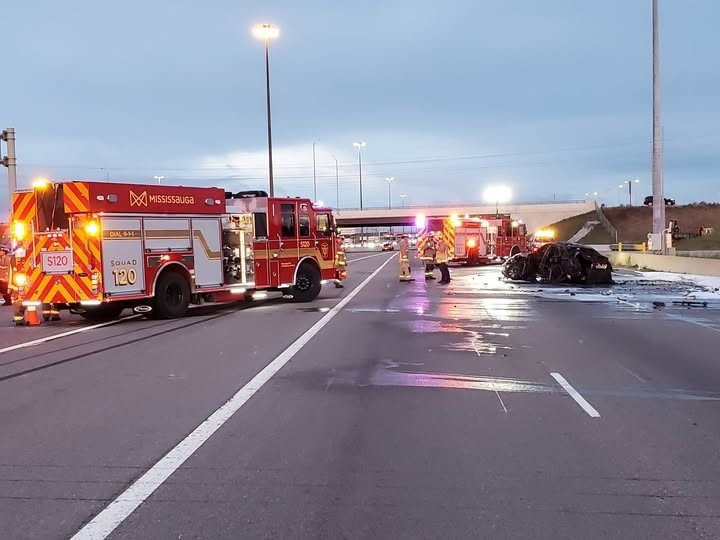
Mississauga’s highways and interior roads with higher speed limits make it a haven for speeding. (Facebook/Canadian Fire and EMS)
According to the Ontario government's announcement, more than 700 automated speed enforcement cameras had been installed across more than 40 municipalities since 2019. Brampton had one of the largest programs in the province, with 185 cameras operating before the ban. Mississauga had 22.
For Starov, the number of cameras previously operating in Brampton helps explain why the city deserves particular attention when examining the consequences of their removal.
“Brampton was not a city that saw the highest increase in terms of accidents, it was actually Ottawa, but there was a significant increase in accident rates and it was worth pointing out,” he said.
While Ottawa recorded the largest increase among the municipalities included in the study, Brampton followed closely behind, with its reported accident rate increasing by 1.59 percent. The study also identified increases in Mississauga, which saw a more modest bump of 0.44 percent.
Mychoice's research examined 68,720 auto insurance quote records collected between November 13, 2024, and October 30, 2026. For its before-and-after comparison, the company narrowed its analysis to 42,518 Ontario records across two equal 304-day periods.
The first was from December 1, 2024, to September 30, 2025, before the cameras were removed. The second covered December 1, 2025, to September 30, 2026, after the provincial ban had taken effect. The company then examined whether applicants reported having at least one police-issued speeding ticket or having been involved in an accident when completing an insurance quote, and the information was then aggregated to examine trends across municipalities and specific postal-code areas.
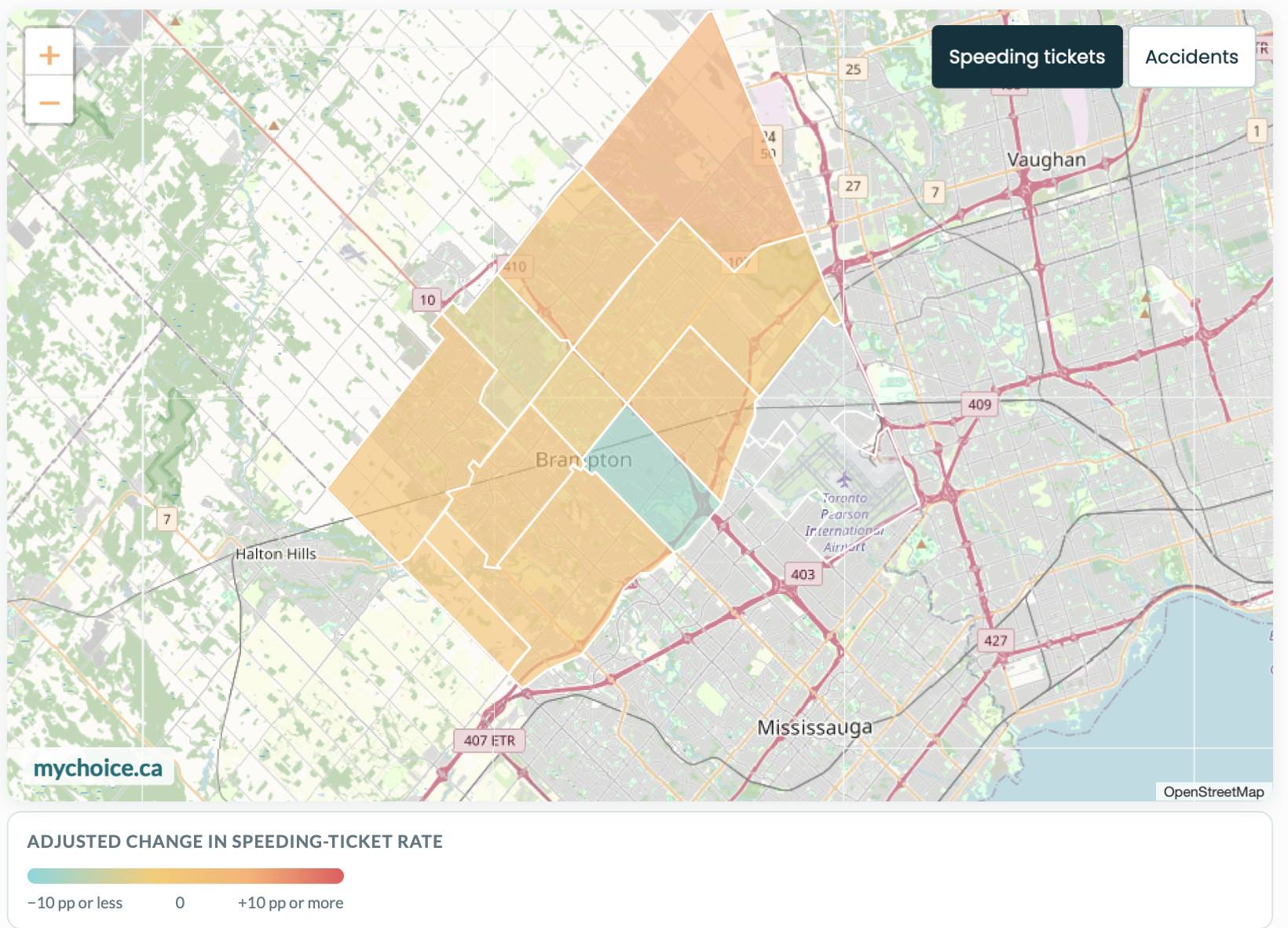
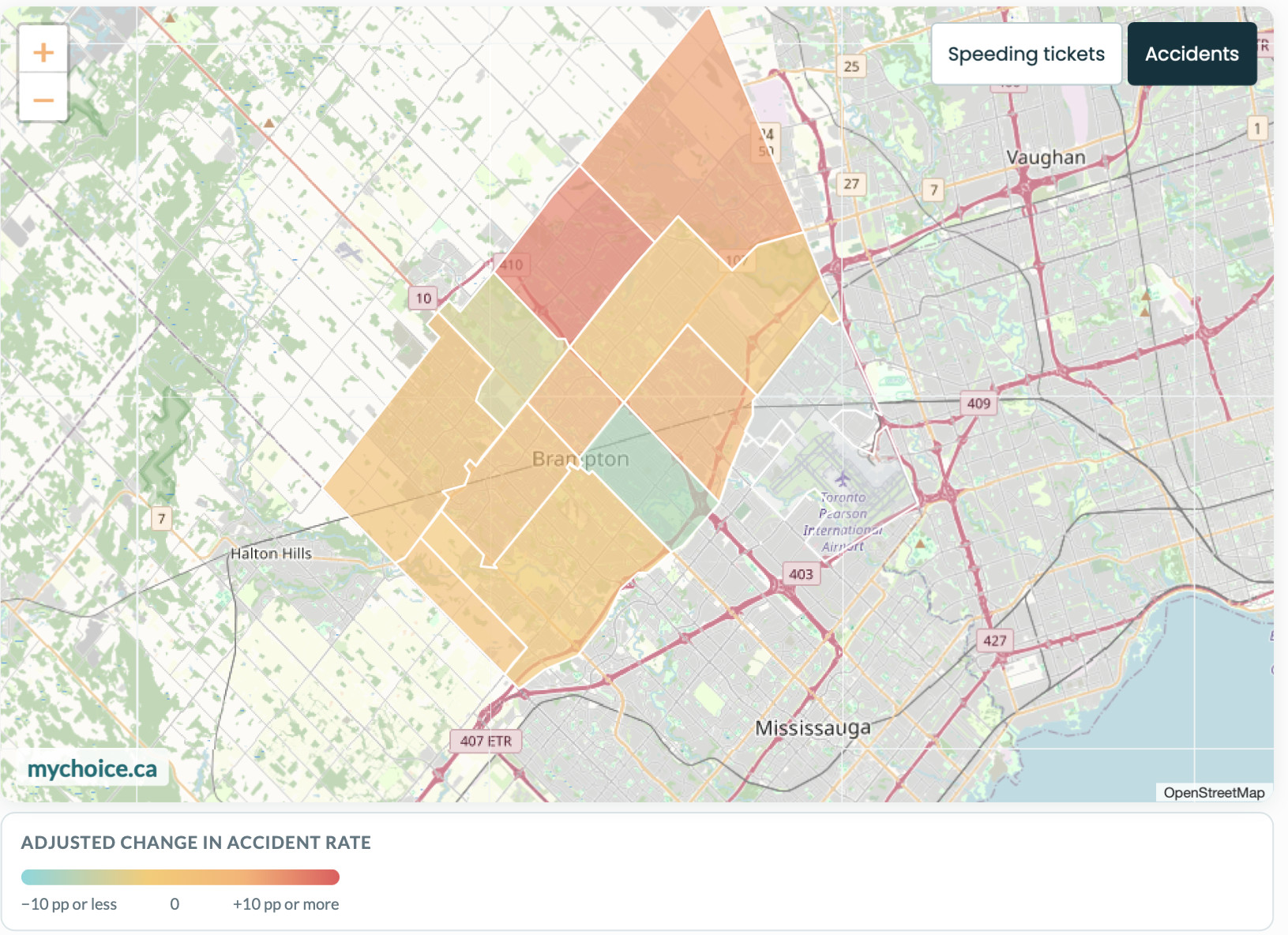
Top photo: Insurance company mychoice examined speeding-related ticket increases based on postal code area, noting the starkest increases in Brampton. Bottom photo: mychoice broke down its study further to examine accident increases in Brampton by postal code areas following the province’s speed camera ban in November last year. (Screengrab from mychoice’s recent study)
In Brampton, the percentage of insurance claimants reporting an accident increased from 9.74 percent to 11.33 percent and in Mississauga it rose from 11.05 percent to 11.49 percent.
Starov said the company initially expected to see more speeding tickets issued by police following the removal of automated enforcement. Instead, the research showed that the proportion of insurance claimants reporting police-issued speeding tickets had declined in several municipalities.
“That means that the enforcement is actually down. So that leads us to the conclusion that enforcement [is] down, [and] the amount of accidents is up. Maybe there's not enough enforcement being done in those areas,” Starov said.
Peel Police did not answer questions about any operational changes since the speed camera ban.
Among the areas examined, the postal code area L6P, which includes Castlemore and surrounding neighbourhoods in Brampton, experienced one of the most significant changes. The percentage of those reporting an accident increased from 7.58 percent before the ban to 13.14 percent after.
The area had 28 mapped former speed-camera locations, the largest number identified within any Brampton postal-code area in the study.
Another area, L6R, which includes Springdale, experienced a substantial increase in reported accident involvement, rising from 3.17 percent to 10.81 percent.
Starov said the company mapped former speed camera locations against postal-code areas to identify where changes were occurring, allowing municipalities to examine which communities might warrant additional attention.
He also cautioned that the company's findings should be treated as an indication of changing trends rather than proof that the removal of speed cameras has led directly to more accidents. When asked whether the company could determine how many of the reported accidents were specifically caused by speeding, Starov acknowledged that its data did not provide that level of detail.
“We just saw that the person was involved in an accident. That's kind of as much as we can collect.”
The distinction is important because an increase in reported accidents does not automatically mean those collisions were caused by speeding or occurred at the former speed camera locations themselves.
Nevertheless, the research provides municipalities with an additional tool to determine where road safety concerns may be emerging and where more detailed traffic monitoring could be useful.
The removal of speed cameras has also raised questions about what measures can effectively replace the technology.
Shortly after the removal of the speed cameras, the Ontario government announced on November 13, 2025, a $210-million Road Safety Initiatives Fund to help municipalities transition away from automated speed enforcement; the money was intended to support alternatives including speed bumps, raised crosswalks, roundabouts, curb extensions, improved signage and increased police enforcement.
The province's position is that physical traffic-calming measures can prevent speeding rather than simply penalizing drivers after an offence has occurred.
In research conducted by Toronto Metropolitan University and The Hospital for Sick Children, published in July 2025, the two institutions examined the effectiveness of automated speed enforcement in Toronto school zones.
The study examined 250 school-zone locations between July 2020 and December 2022, with researchers finding that the presence of automated speed enforcement cameras reduced the proportion of speeding vehicles by 45 percent, while the number of vehicles travelling more than 20 kilometres an hour above the posted speed limit decreased by 87 percent.
The research found that speeding rates returned to previous levels after the cameras were removed.
Mississauga for years has struggled to keep its drivers within its posted speed limits, with several residents being repeat offenders.
Both Brampton and Mississauga have begun pursuing alternative road safety measures following the provincial ban.
In Mississauga, the city received $2,242,888 in immediate provincial funding through the Road Safety Initiatives Fund, with another $8,934,513 available for eligible road safety improvements through reimbursement.
According to the City's March 11, 2026, council update, the funding will support physical traffic-calming measures and other safety improvements in school zones and community safety zones where automated speed enforcement had previously operated. The City said the funding would be distributed equally across its 11 wards, with staff working alongside ward councillors to identify locations and determine appropriate improvements.
Brampton has also indicated that it intends to continue investing in road safety following the end of its automated speed enforcement program.
The City's road safety initiatives include traffic-calming measures, speed display boards, school-zone safety initiatives, intersection camera enforcement and police enforcement.
Brampton officials also said City Hall is exploring opportunities to repurpose existing automated speed enforcement equipment and staff for other community safety initiatives.
Peel Region itself has existing road safety initiatives that include radar speed signs, radar speed trailers, traffic-calming signage and an expanded red-light camera program, however, red-light cameras and automated speed enforcement serve different purposes. Red-light cameras target vehicles entering intersections after a traffic signal has turned red, while speed cameras specifically flagged drivers who exceeded posted speed limits.
For Starov, the issue is not necessarily that speed cameras must return, but that municipalities need to ensure some form of effective enforcement is taking place in the communities where speeding remains a concern.
He acknowledged that the provincial government's decision was controversial, with some drivers viewing automated speed enforcement as a way for municipalities to generate revenue rather than improve road safety, but he argued that removing the cameras without sufficiently replacing their enforcement function could create additional problems.
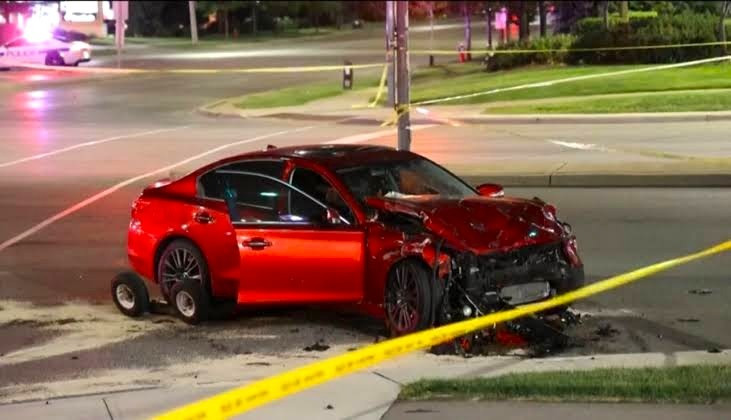
Car crashes in some Mississauga and Brampton neighbourhoods have been on the rise since automated speed enforcement cameras were banned by the PC government last year. (Facebook/Canadian Fire and EMS)
He also pointed to a potential financial consequence for drivers who believed eliminating speed cameras would reduce their insurance costs.
Camera-issued penalties did not appear on a driver's insurance record in the same way as police-issued speeding convictions. Police-issued tickets that result in convictions, along with at-fault accidents, can affect insurance premiums.
Starov said that if insurers begin identifying higher accident rates in particular communities, they may have to reconsider the risk associated with those areas when determining insurance prices. This could lead to significantly higher costs for all drivers in those postal-code areas.
Starov said municipalities should examine their own traffic and collision data to determine whether the trends identified by mychoice are reflected in official municipal records.
Rather than relying on broad enforcement measures across entire municipalities, he believes police resources should be directed toward the neighbourhoods where speeding and road safety concerns are most pronounced.
“I'd say there needs to be a targeted approach to this” and relying just on police “probably means saying you need to take the money out of somewhere else”.
He emphasized that at the end of the day drivers still “need to be afraid of getting tickets, and not to speed.”
Email: [email protected]
At a time when vital public information is needed by everyone, The Pointer has taken down our paywall on all stories to ensure every resident of Brampton, Mississauga and Niagara has access to the facts. For those who are able, we encourage you to consider a subscription. This will help us report on important public interest issues the community needs to know about now more than ever. You can register for a 30-day free trial HERE. Thereafter, The Pointer will charge $10 a month and you can cancel any time right on the website. Thank you
Submit a correction about this story

