
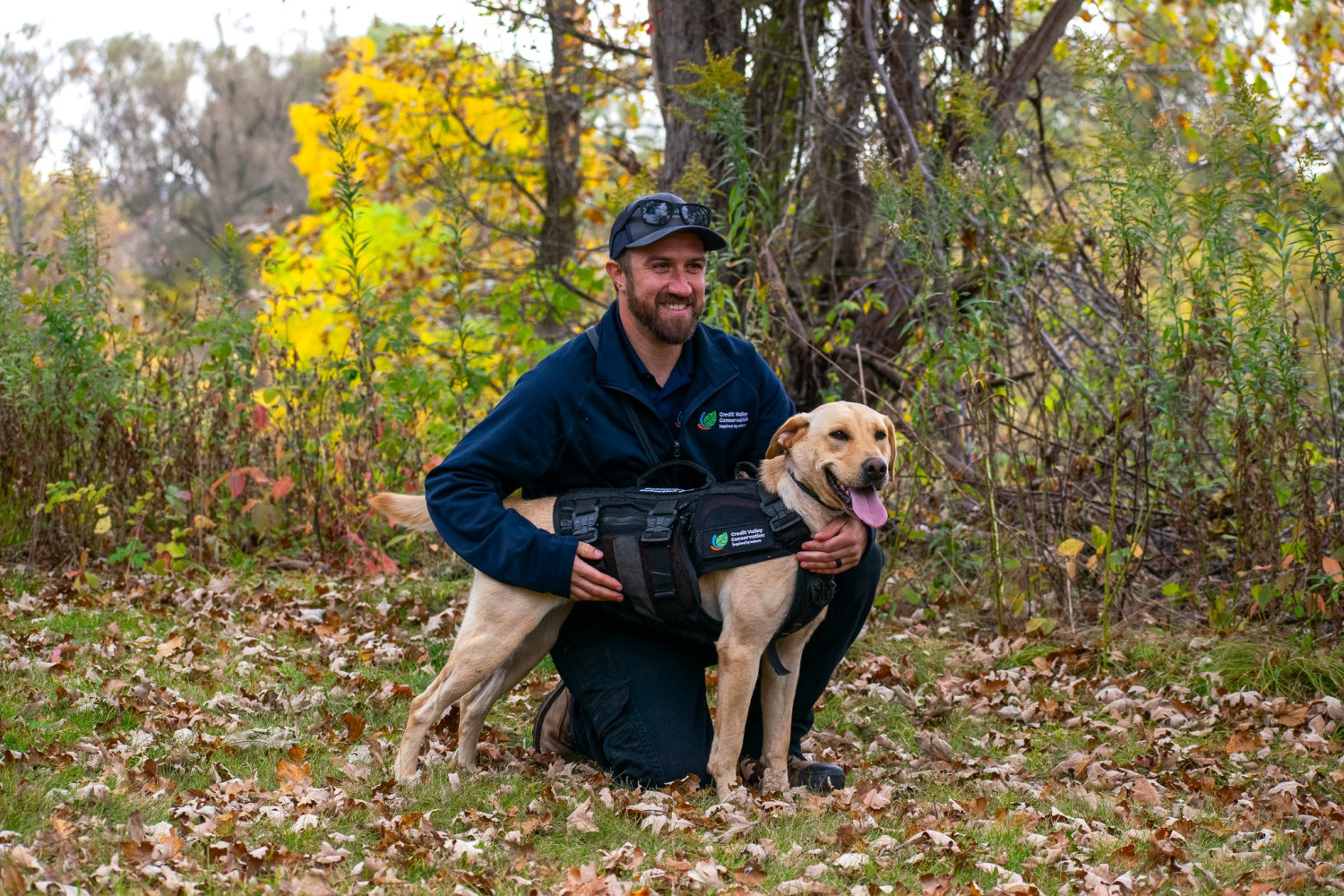
Four months on the job, CVC’s newest recruit is sniffing out invasive species ‘remarkably’
“How would you like to have a dog to work with, and take home at the end of the day?”
More than two years ago, that was the unexpected question put to Lee Merrill, Credit Valley Conservation’s (CVC) Coordinator of Terrestrial Restoration and Terrestrial Invasive Species Specialist.
Until then, Merrill had largely relied on conventional methods to track down invasive species, the unwelcome outsiders that can quietly take root in an ecosystem and, in time, disrupt its delicate balance, threatening native species and the biome they depend on.
One of those methods involved a specialized slingshot loaded with Velcro-covered balls, which Merrill would stretch and fire high into the canopy of tall evergreen conifers — Eastern Hemlock trees.
As the balls brushed against the branches, twigs and needles, their Velcro surfaces snagged the tiny, white, woolly egg sacs or insect bodies left behind by the hemlock woolly adelgid (HWA), which can gradually weaken the tree, triggering needle loss and canopy thinning.
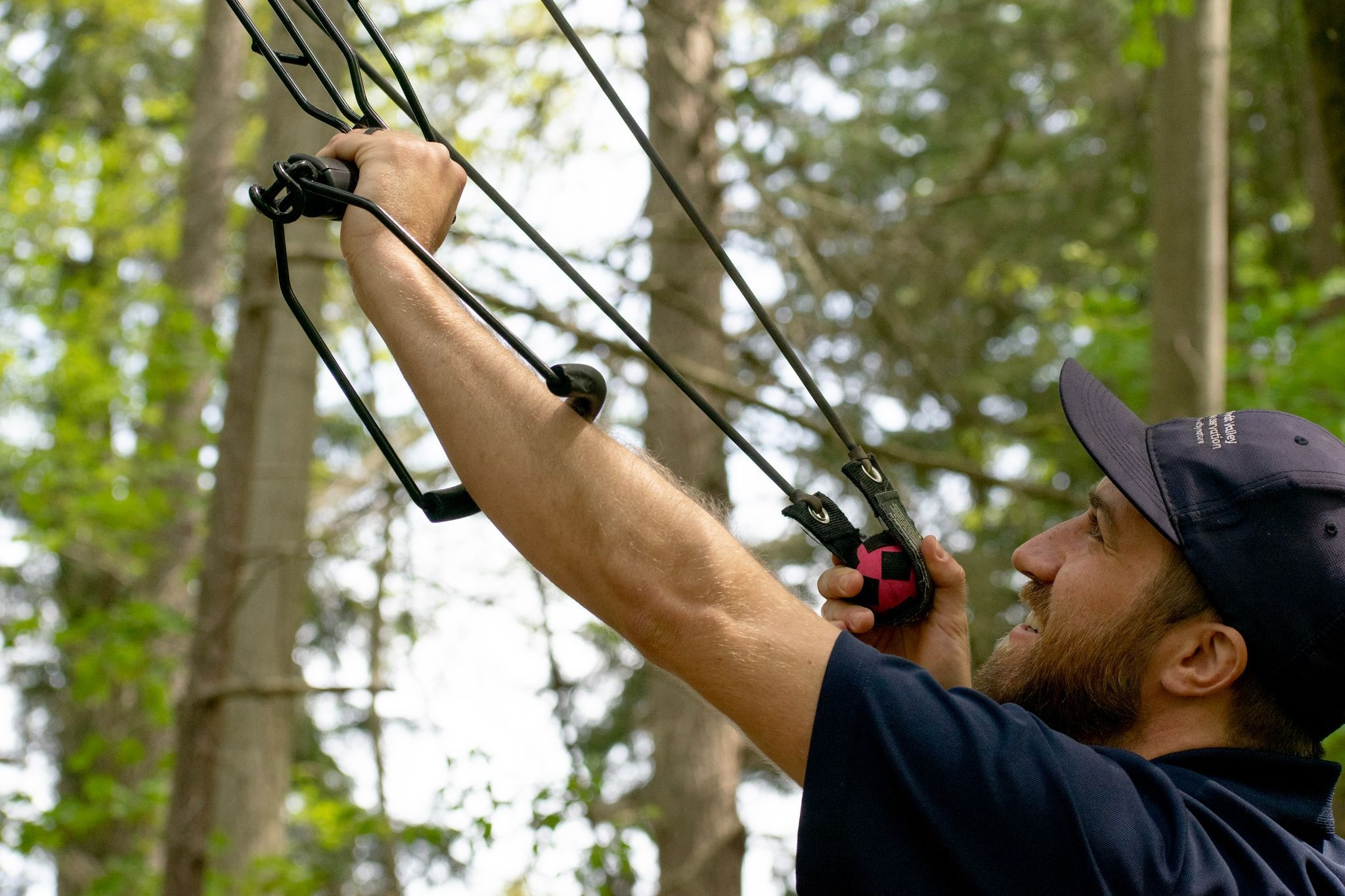
At CVC’s invasive species fair in May 2023, Lee Merrill was demonstrating one of the methods researchers use to detect invasive insects hiding high in the forest canopy: a specialized slingshot loaded with Velcro-covered balls. (Alexis Wright/The Pointer)
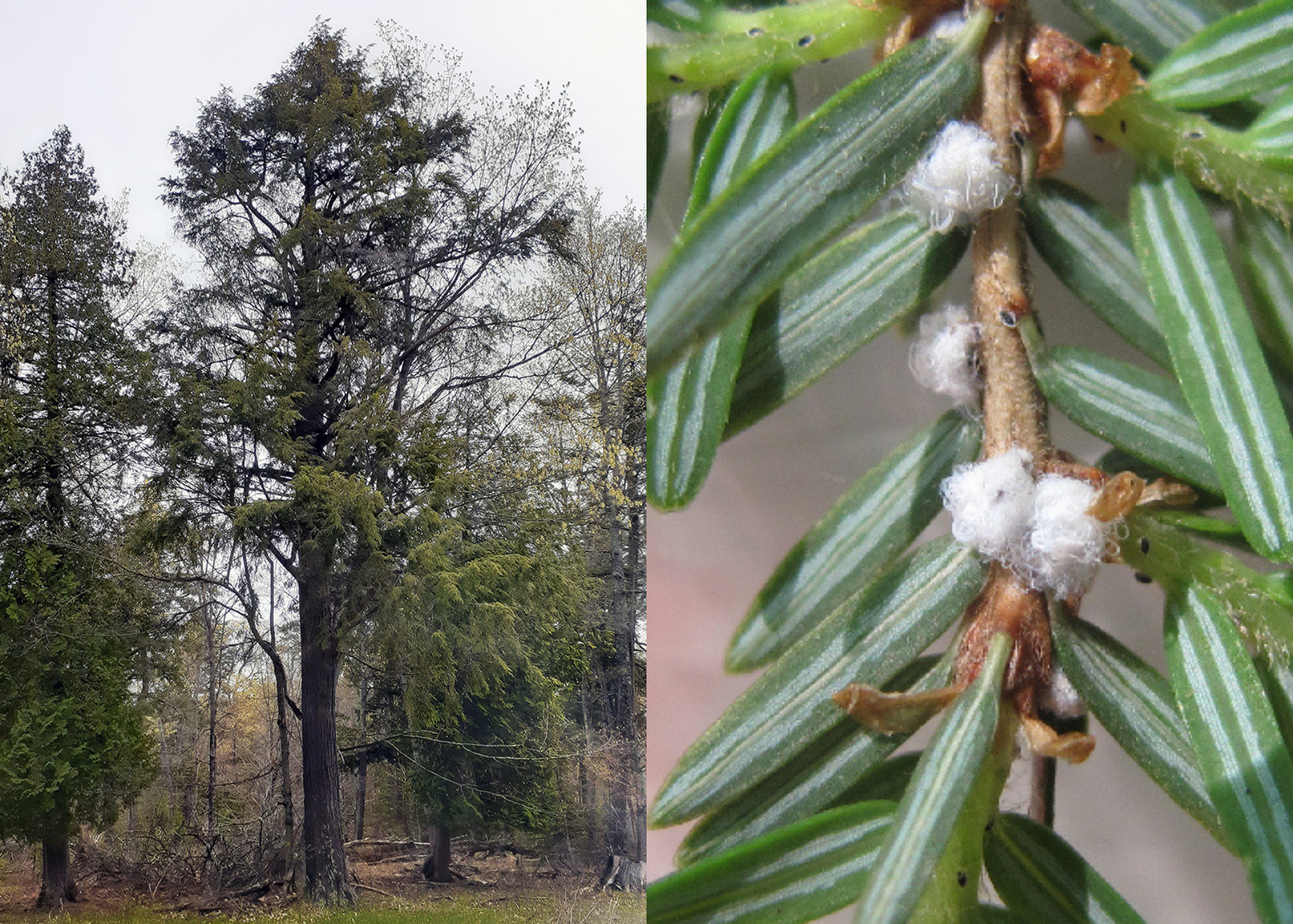
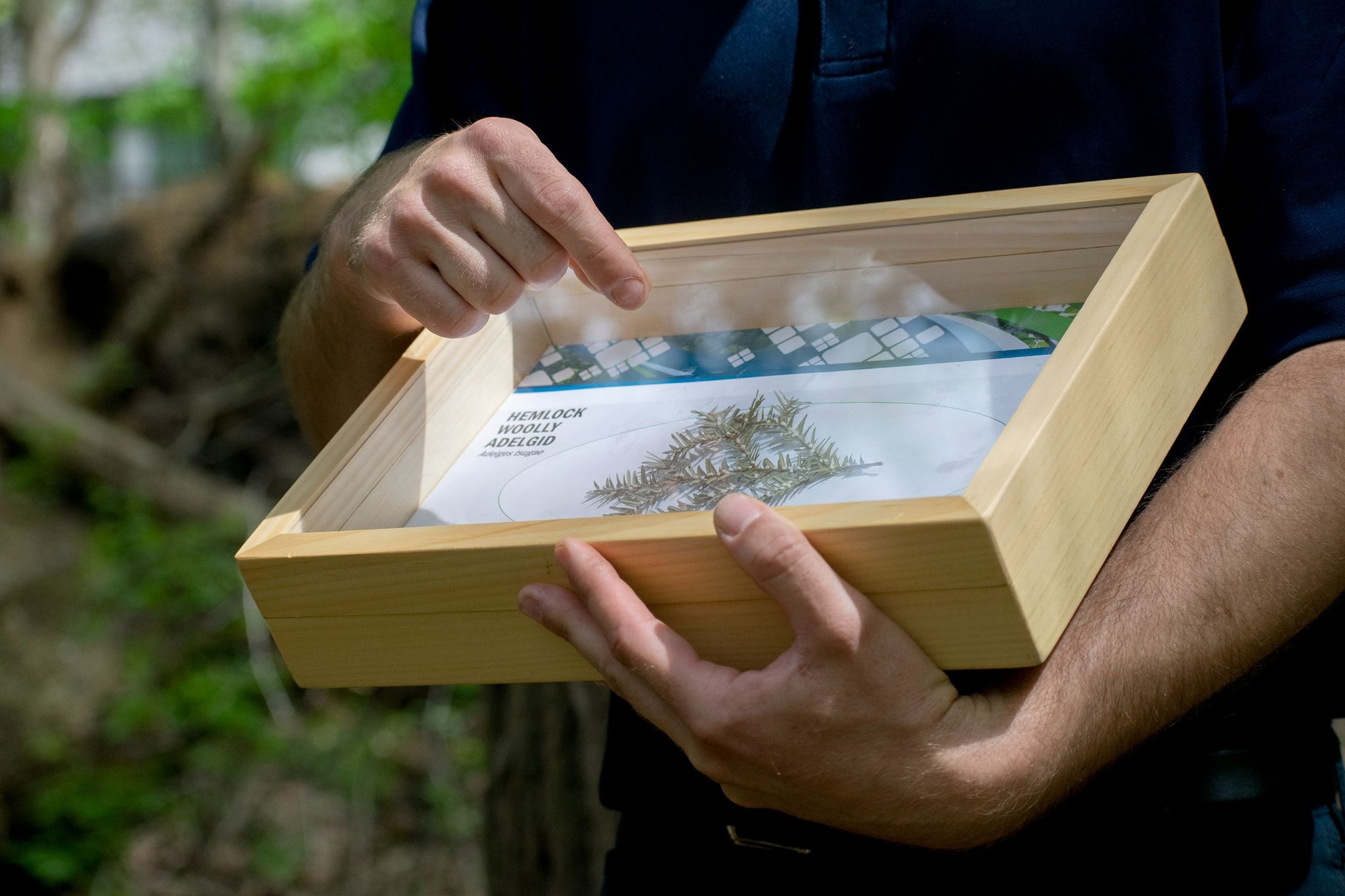
The hemlock woolly adelgid (HWA) is identifiable by the distinctive white, cotton-like masses it leaves behind, beneath which the tiny adult insects, measuring just 0.8 to 1.5 millimetres and dark brown to black in colour, remain largely hidden. (First Image: Government of Ontario, Second Image: Alexis Wright/The Pointer)
Left unchecked, an HWA infestation can kill an Eastern Hemlock within four to 10 years—making it urgent to find the invasive species before it spreads.
Because when a hemlock dies, it takes with it the deep root systems that help absorb rainfall, prevent erosion and stabilize stream banks, as well as the protective canopy that shades nearby waterways and keeps temperatures cool enough for cold-water species such as brook trout who live and breathe in the Credit River.
Putting his slingshot down, Merrill would then carefully collect those samples, detect the pest and work towards restoration with his team.
CVC has recorded 195 invasive species across the Credit River watershed, threatening its forests, wetlands, waterways and communities so far. But another 71, already found elsewhere in Ontario, Canada or the nearby United States, have yet to be detected in the watershed.
Catching them early matters. Economic damage caused by biological invasions exceeds management costs by more than 10 times, according to the global InvaCost database. In Ontario alone, municipalities and conservation authorities are estimated to spend $50.8 million every year on invasive species.
Unfortunately, a warming climate is only adding to the challenges.
In 2024, however, an idea germinated within the CVC team to maybe look beyond the slingshot.
CVC Senior Manager of Ecosystem Restoration and Stewardship Kate Hayes approached a dog trainer whose expertise included preparing police canines for narcotics, explosives and cadaver searches, as well as enforcement work, to see whether he would be interested in taking on a new challenge.
The answer was yes. What followed was months of research and consultation.
CVC brought in experts from the Canadian Food Inspection Agency (CFIA) and other specialists to assess whether scent detection was viable, which invasive species could be targeted and whether a dog could be trained to detect them reliably.
The team also knew they wanted to tackle Hemlock Woolly Adelgid and White River crayfish.
In August 2025, another name was added to the list after a curious Mississauga teen visited Lake Aquataine and spotted a red swamp crayfish, an invasive species native to the southern United States and northern Mexico that has spread to freshwater habitats worldwide. Highly adaptable, they tolerate a wide range of habitats and can migrate, burrow and spread rapidly while altering ecosystems by feeding on aquatic vegetation, insects, fish eggs and amphibians.
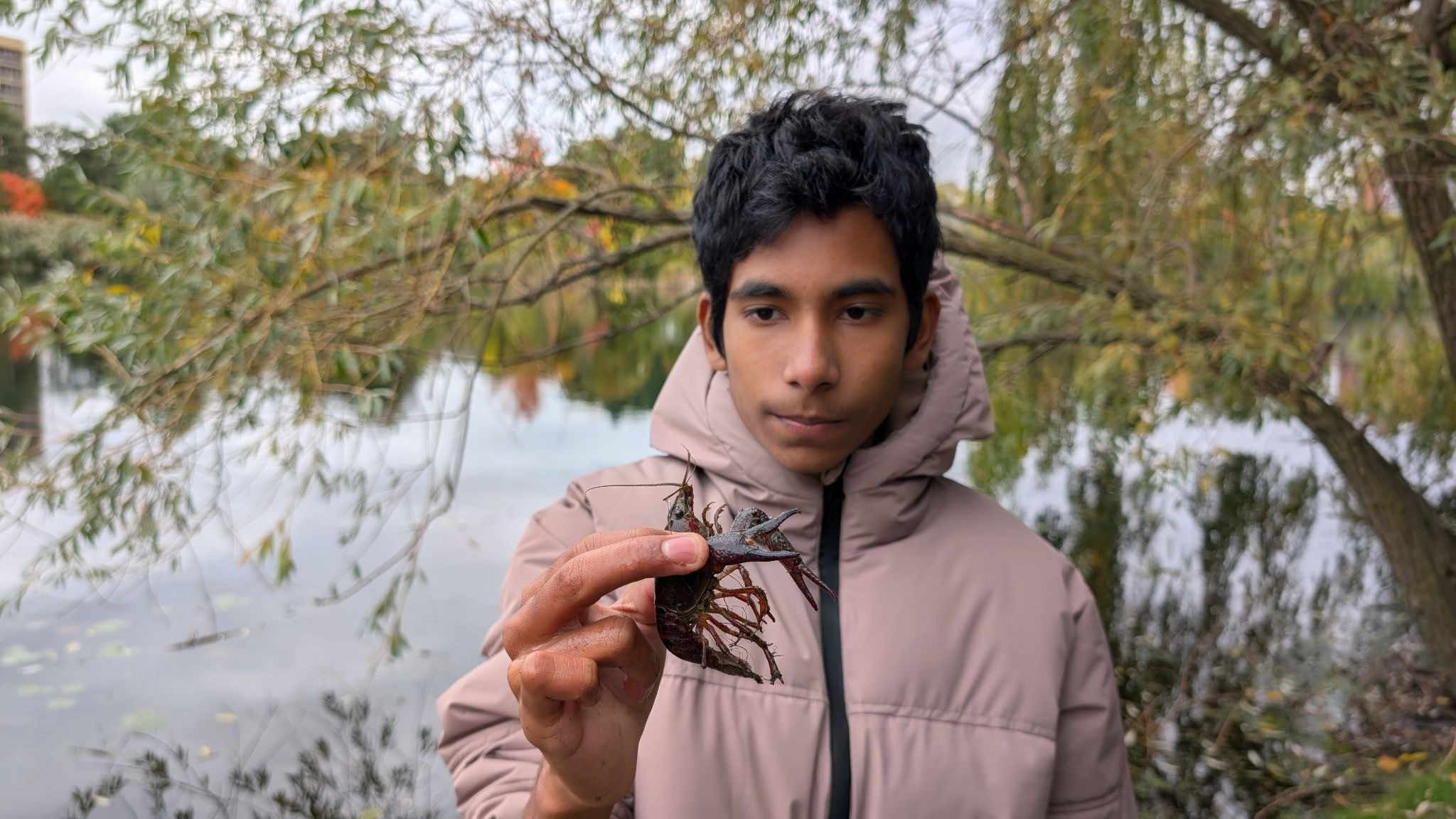
Grade 10 student Santhosh Durga Thyagarajan detected the red swamp crayfish in 2025 during his visits to Lake Aquataine in Mississauga. (Submitted/Durgadevi Ramasamy)
After six months of rigorous discussion and planning, the Conservation Detection Dog Program was born, and the candidate chosen to be on the team was a Yellow Labrador Retriever named Tilly.
Merrill recalls visiting Tilly with her future secondary handler — Freyja Whitten, CVC’s Program Manager of Terrestrial Restoration — when the Labrador was still a “cute little” puppy.
“She was a bundle of energy and joy,” he told The Pointer.
Merrill’s eyes lit up as he smiled and continued, “I definitely remember that day.”
After more than a year of training, Tilly and Merrill reunited in June this year to officially become coworkers and roommates.
It was time to get to work and protect the Credit River watershed from invasive species together!
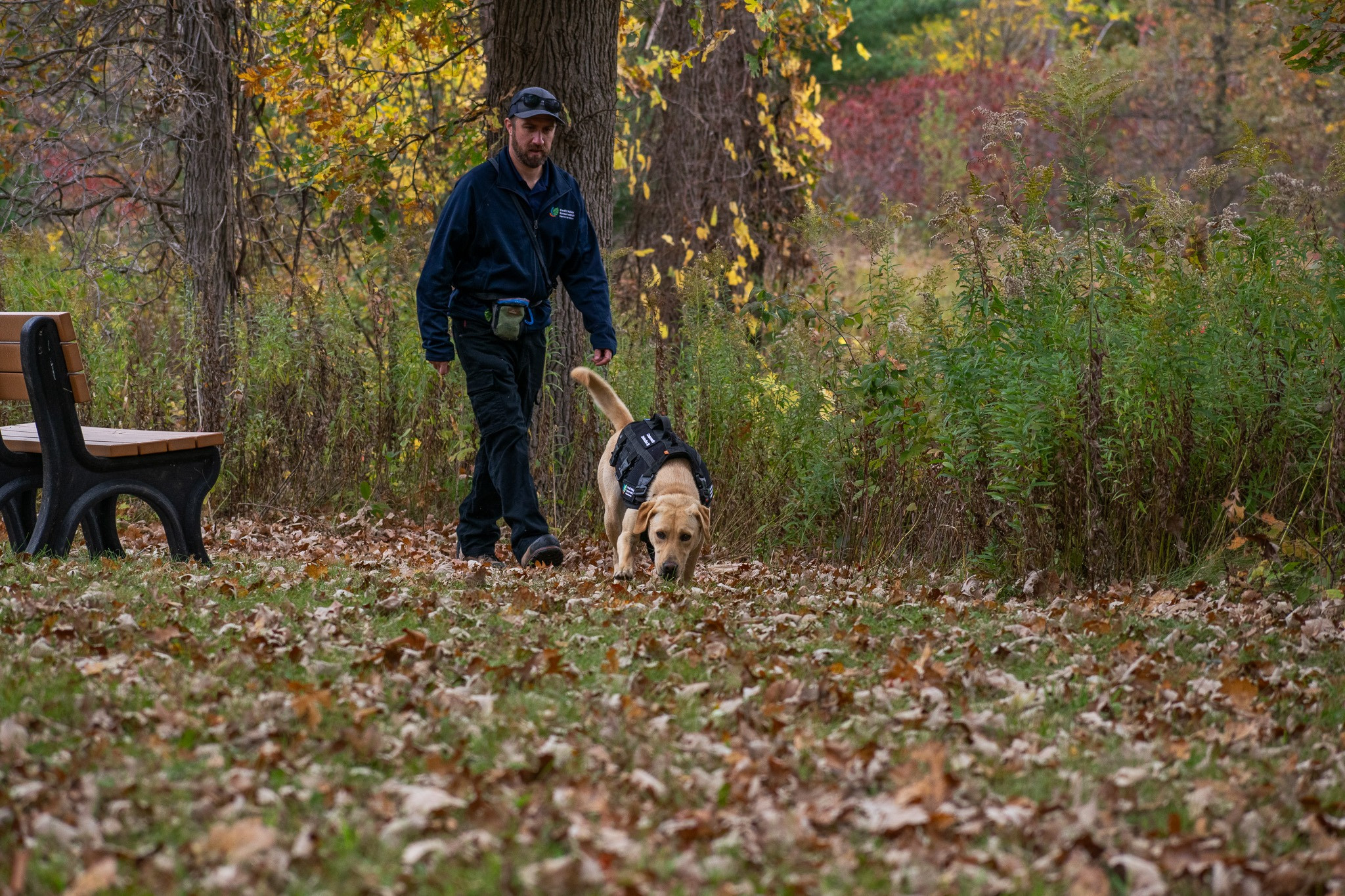
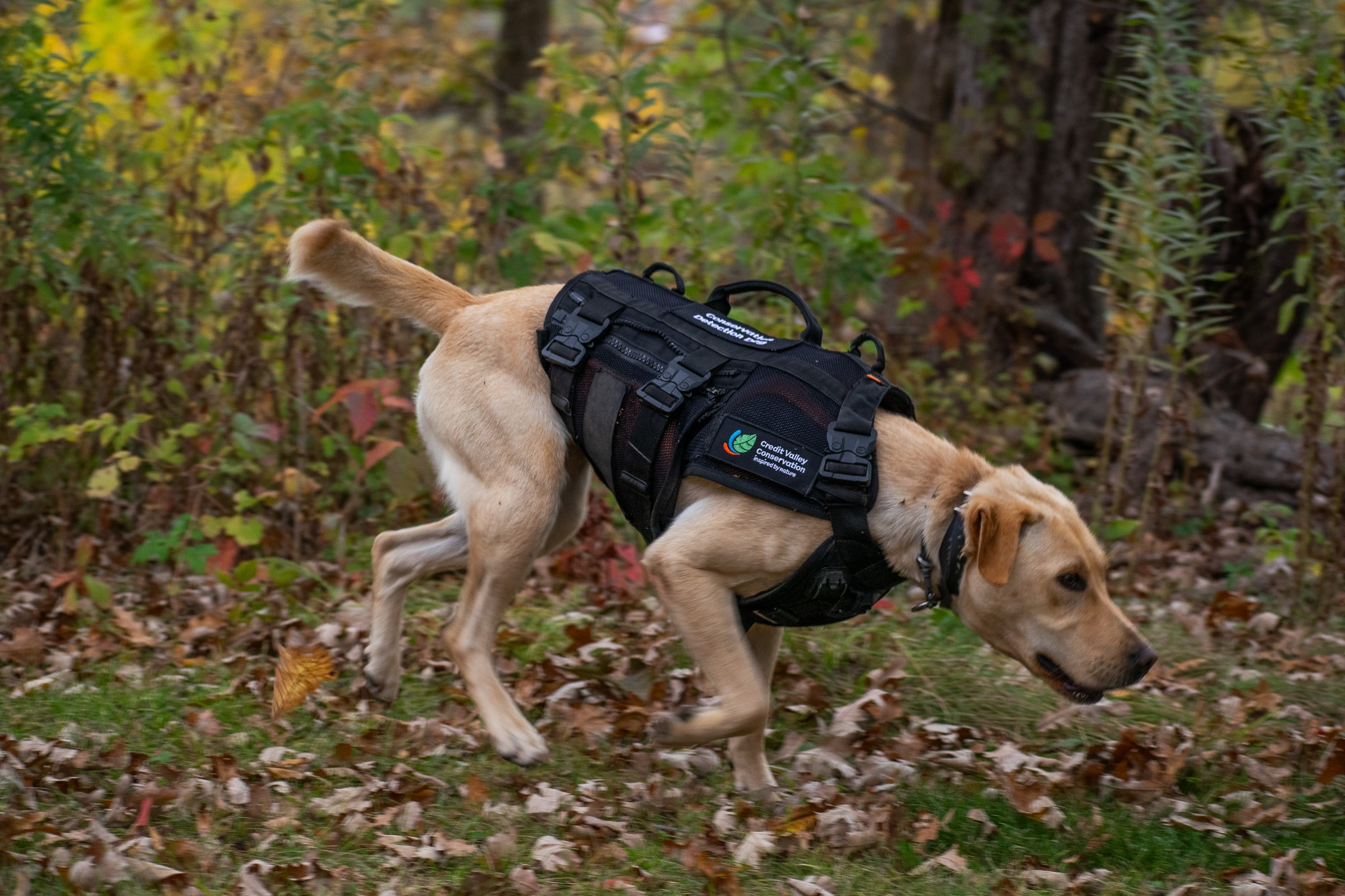
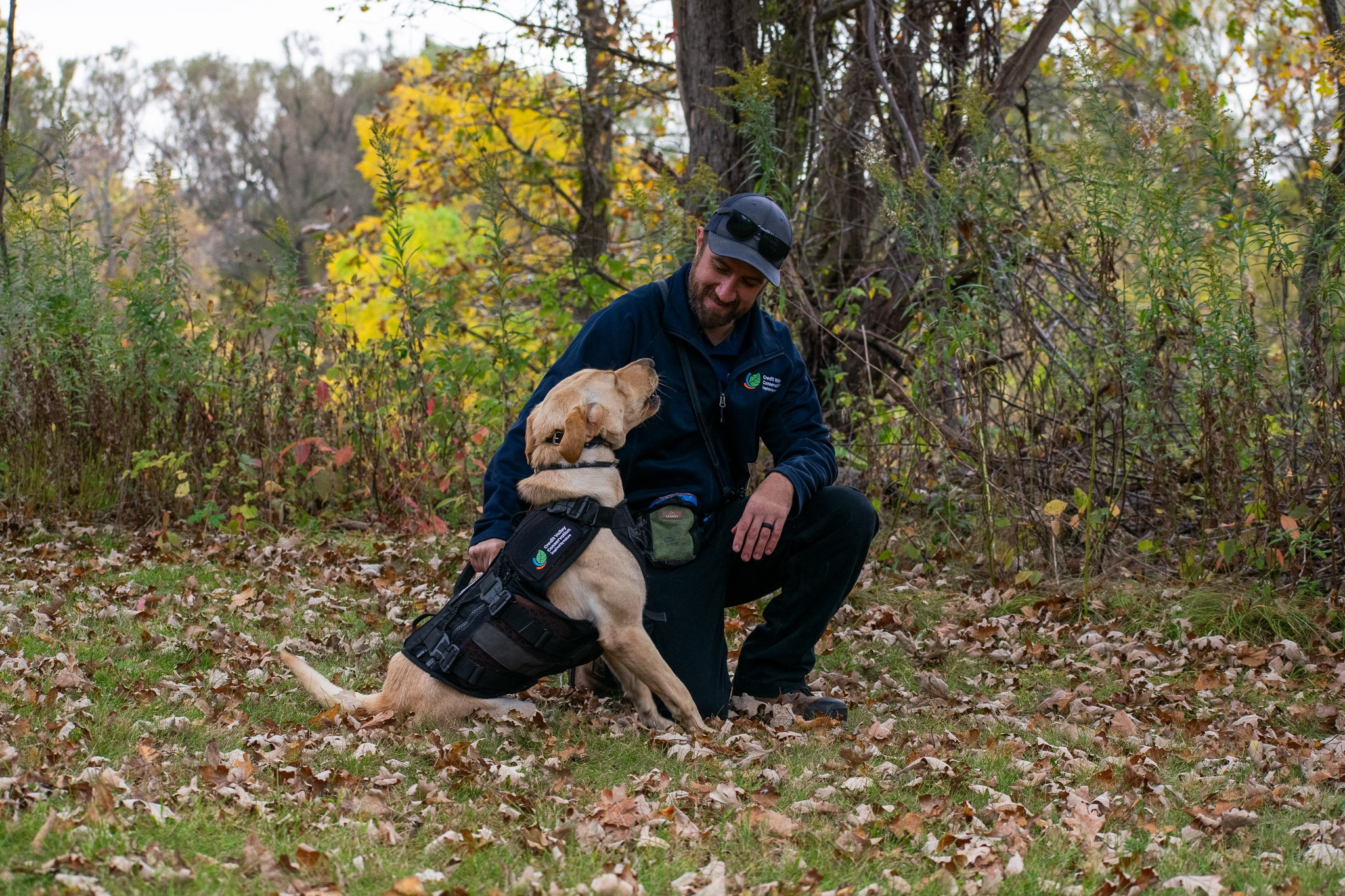
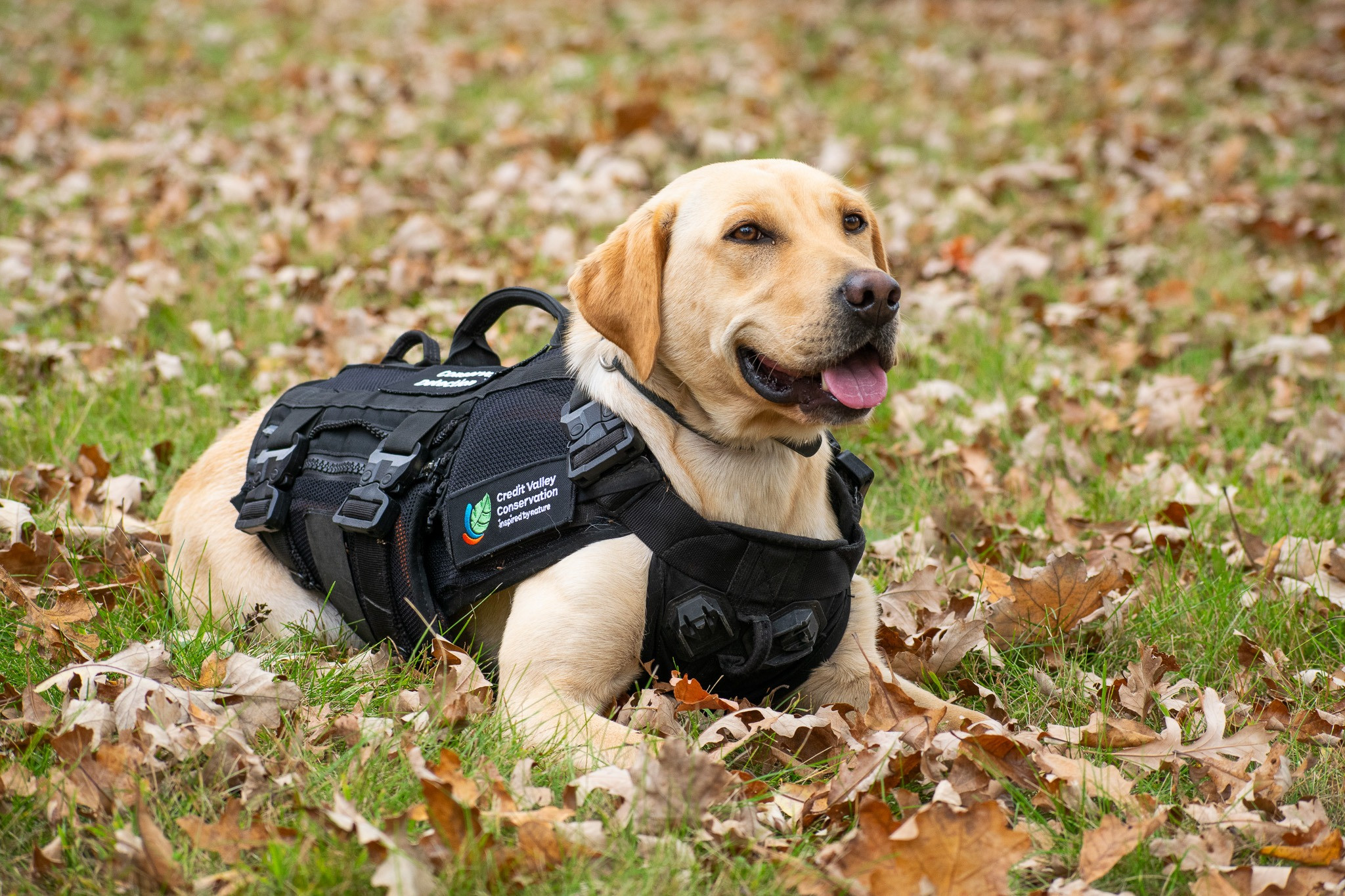
Tilly (full name is Tilia) is a two-year-old Labrador retriever trained to detect four priority invasive species by scent: two forest pests, the hemlock woolly adelgid and spotted lanternfly, and two crayfish species, the red swamp crayfish and white river crayfish. (Alexis Wright/The Pointer)
On October 15, Merrill and Tilly set off towards a cluster of trees behind CVC’s Mississauga headquarters where, somewhere among the branches, Whitten had hidden a sample of hemlock woolly adelgid, waiting to see whether the Labrador’s nose could pick up what the human eye might easily miss.
The autumn air had turned colder, and Tilly stood alert, her eyes fixed on Merrill as he prepared to give the command.
“Search,” he said.
In an instant, Tilly was off, nose close to the ground as she began weaving between the trees, following an invisible trail of scent.
She immediately began to sniff something.
She circled the first tree, briefly lifting her front paws against its trunk as she tried to trace where the odour was strongest and moved towards the next.
Finding the source is not as simple as following a straight line.
Whitten says wind direction plays a crucial role in how scent travels. Working upwind allows Tilly to follow the scent as it moves through the air, gradually narrowing down where it is strongest. By detecting which direction the odour is coming from, sometimes even distinguishing which nostril picks it up, she can work her way towards its source.
On windier days, however, the scent can drift further away or become trapped against neighbouring trees, making it harder to pinpoint the exact location.
That is why Whitten and Merrill repeat searches, assess Tilly’s indications and use their ecological knowledge to determine which tree is actually harbouring the pest. When necessary, they return another day to confirm the finding.
“We’ve noticed her behaviour changes start to lock in as far as 70 to 100 feet away from the samples, where she’ll do a head whip, like something interesting is that way,” Merrill said.
Just as he finished speaking, Tilly placed her front paws against one of the trees, sniffing along its base before suddenly freezing, her body stiff and nose fixed on the spot as she signalled that she had picked up the scent she had been trained to find.
“Break! Bring it in, show me,” Merrill called, breaking the tension with a high-pitched, playful cheer — “whoo-whoo-whoo” — before showering Tilly with praise for finding the hidden sample and giving her a treat.
“Good girl, good girl.”
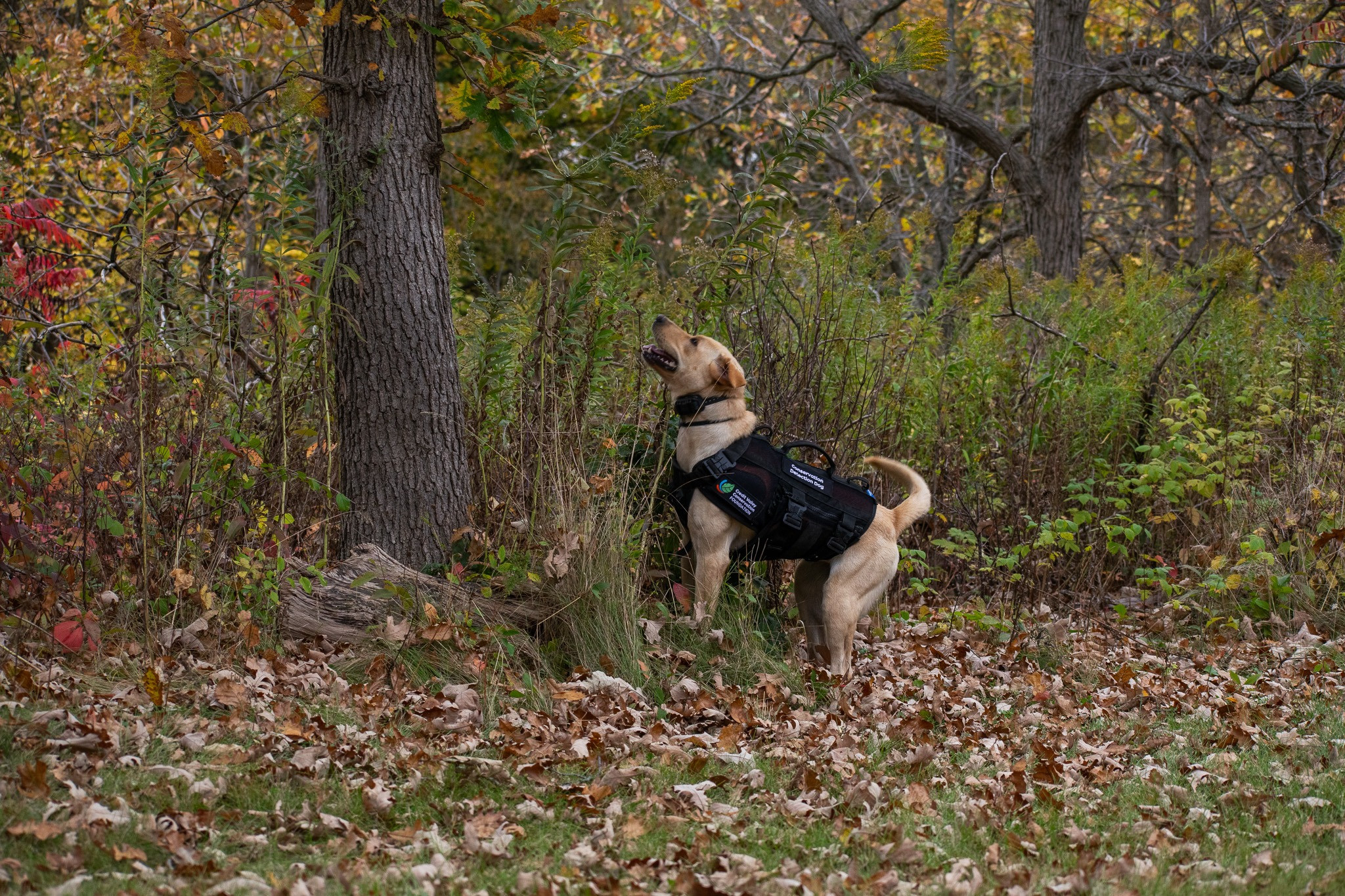
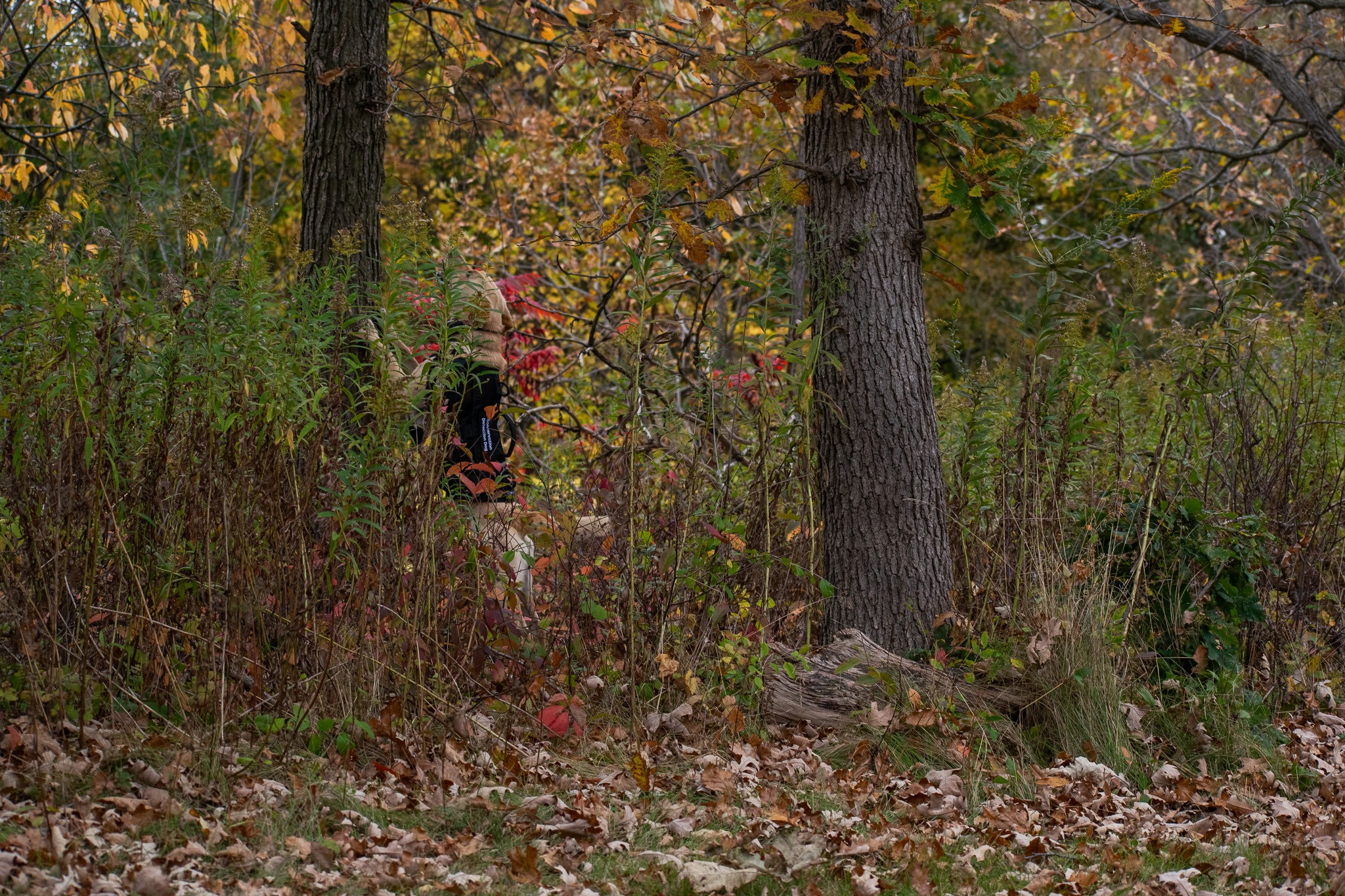
Tilly at work sniffing for invasive species. (Alexis Wright/The Pointer)
Tilly is not replacing field staff or CVC’s ecological expertise but helping expand existing capabilities.
“We are currently only serving about 44 percent of our hemlock trees across our conservation areas and with Tilly we’ll be able to do 100 percent,” Whitten said.
Tilly’s “scent library” can be expanded to include new species as conservation priorities evolve and suitable training samples become available.
Her flexibility was already put to the test in September, when the non-native Spotted Lanternfly was added to Tilly’s training following its first confirmed detection in Canada in Windsor, Ontario.
Native to Asia, the Spotted Lanternfly is a sap-feeding insect that poses a threat to more than 100 plant species including grapevines, apple trees, stone fruits and several forest species.
Whitten prepared a scent “cocktail” of spotted lanternfly and hemlock woolly adelgid samples and hid it inside one of five wooden boxes arranged in a small search area.
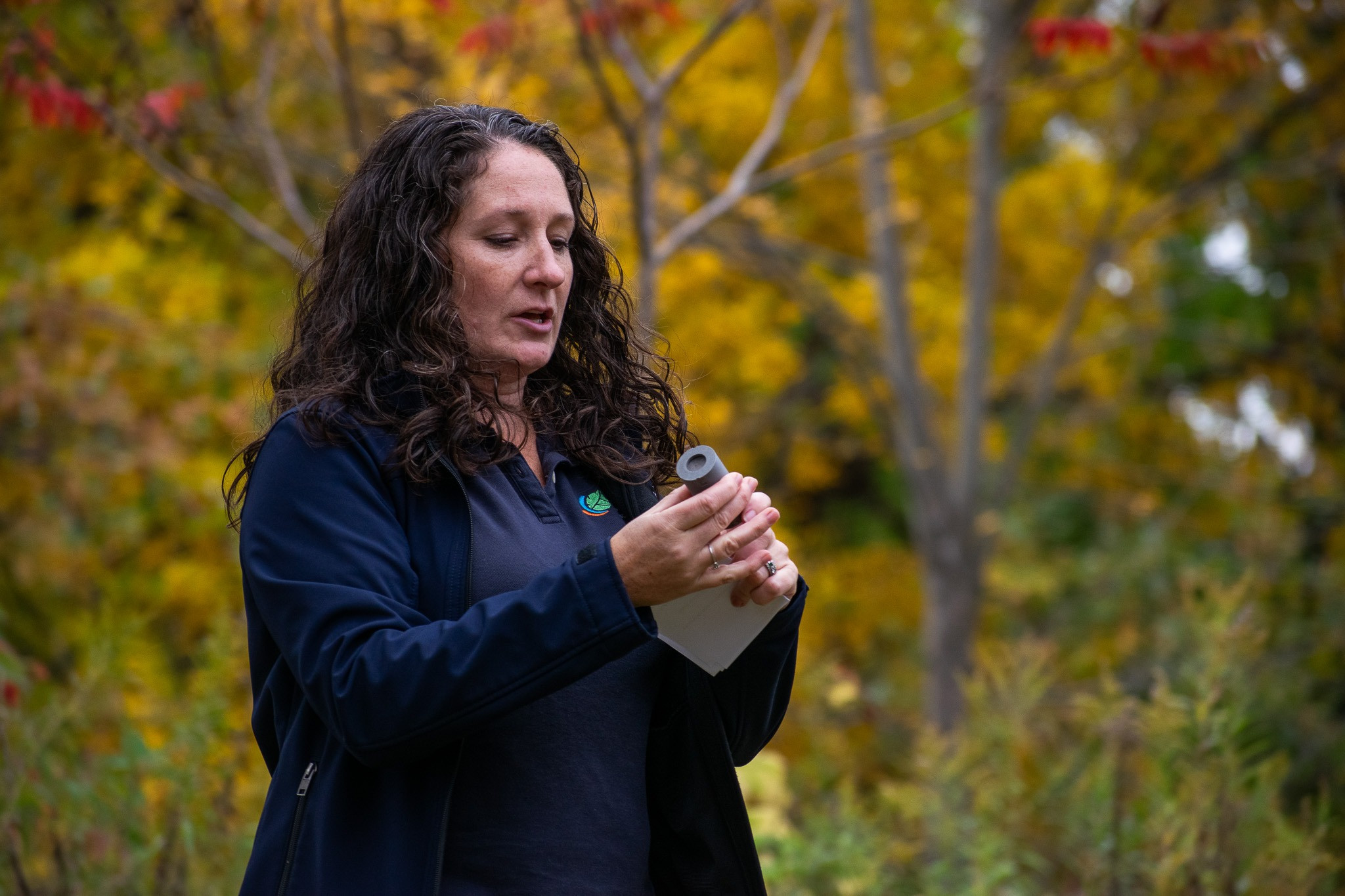
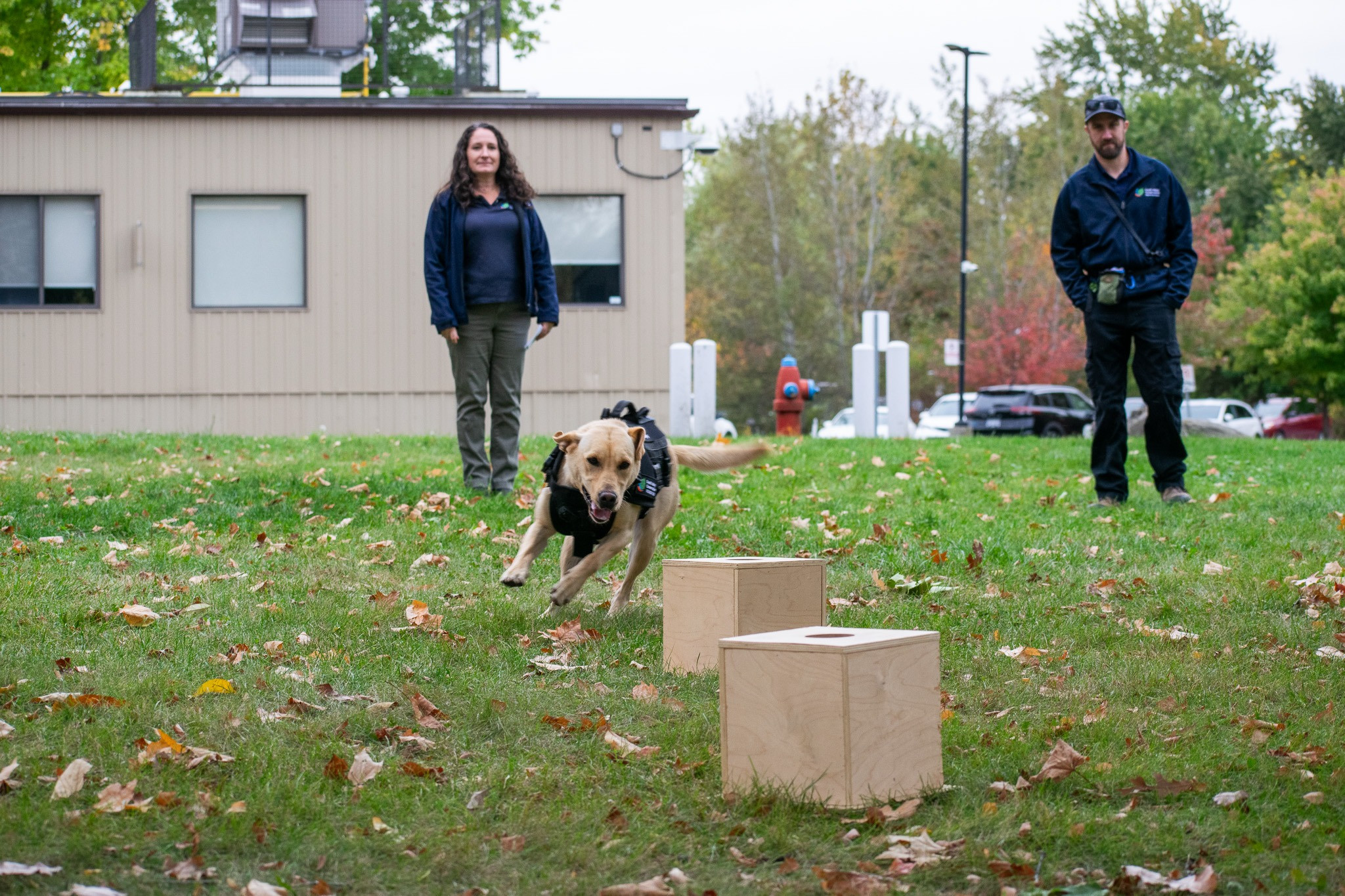
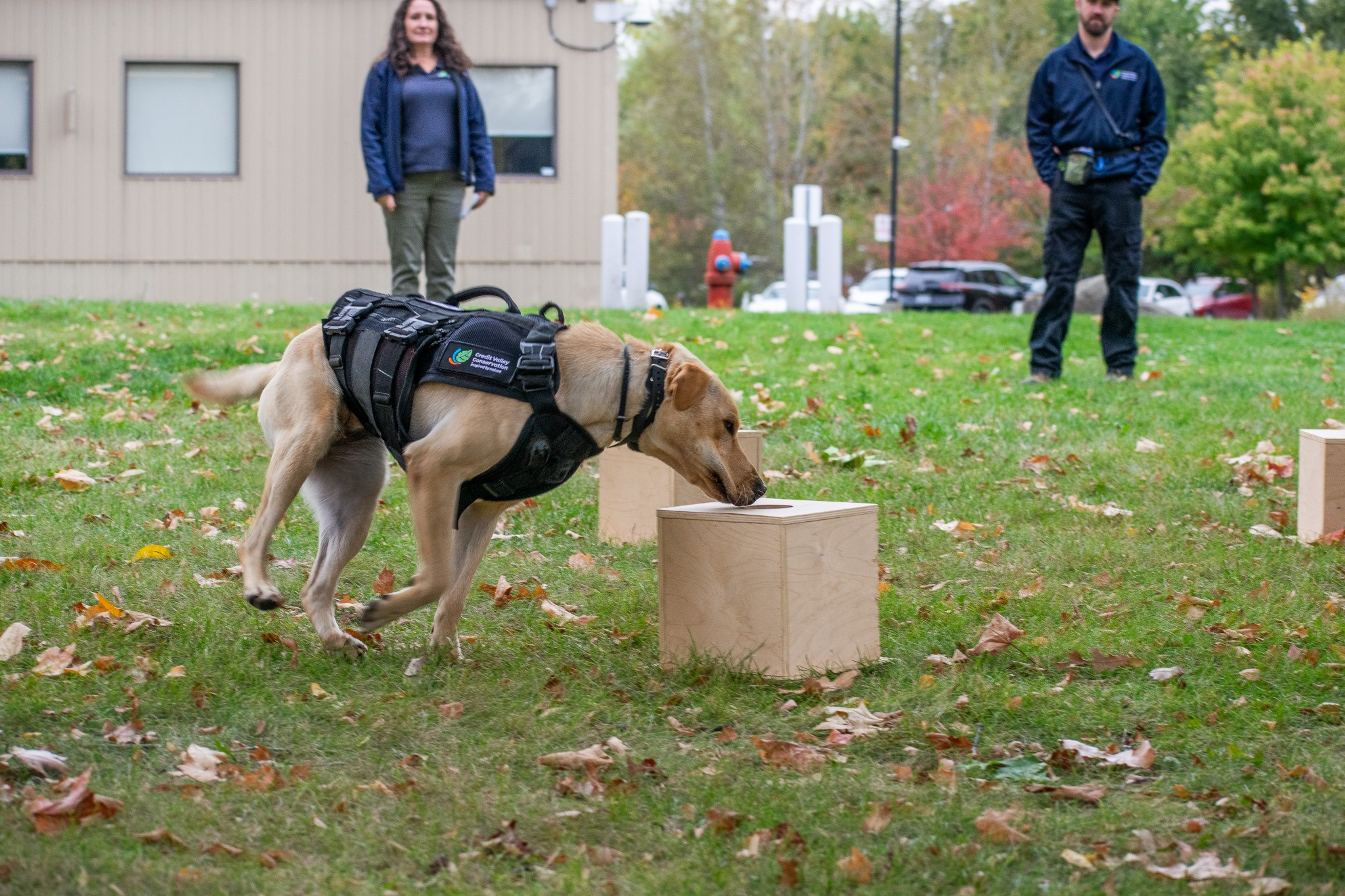
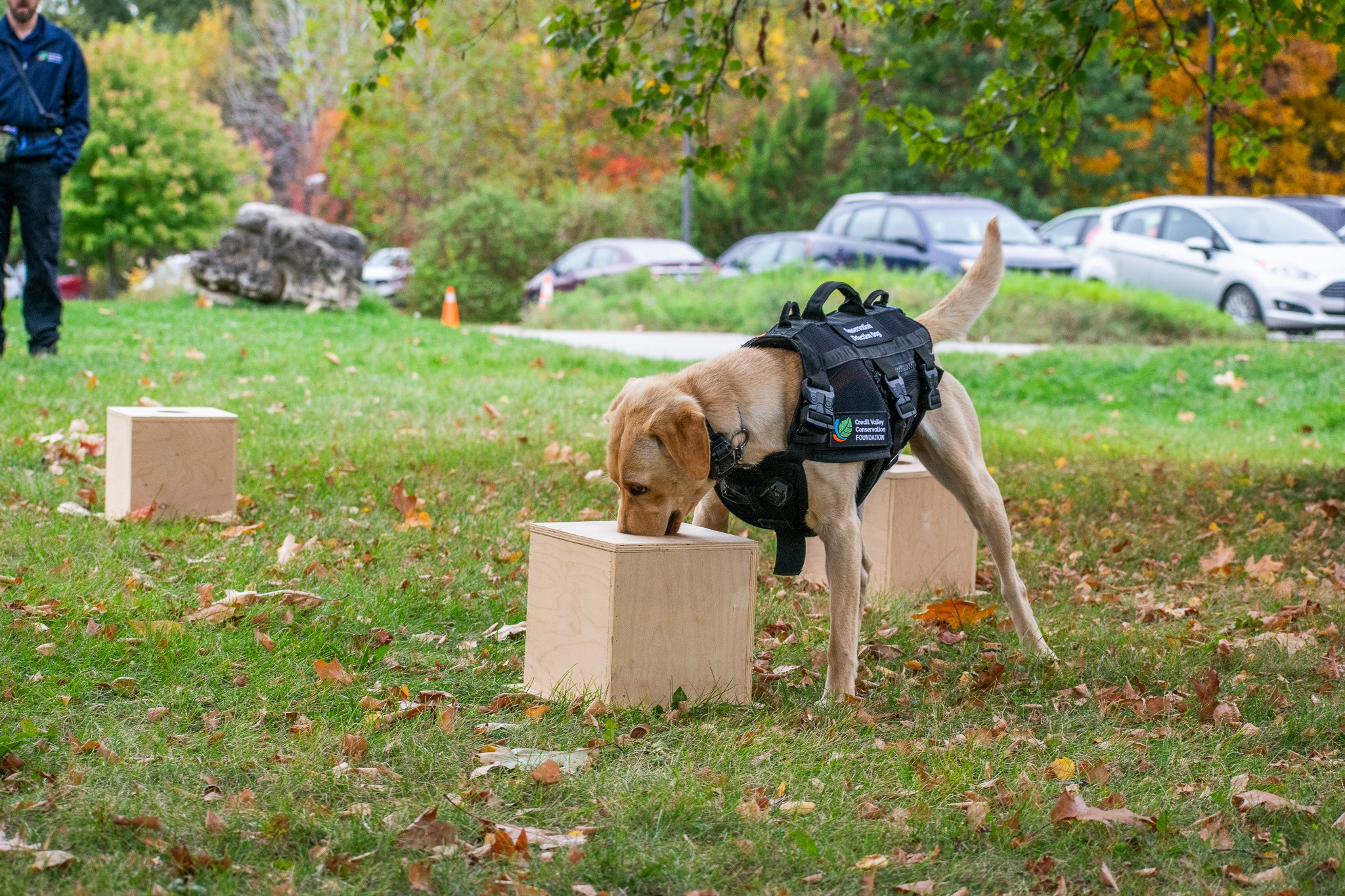
Freyja Whitten, CVC’s Program Manager of Terrestrial Restoration, with the sample of invasive species that she hid in the box. (Alexis Wright/The Pointer)
At Merrill’s command, once again Tilly darted between the boxes while wagging her tail, sniffing each one until she reached the hidden samples and froze, fixing her gaze on Merrill to signal she had found the scent.
“Break!” he called, tossing her yellow toy into the air as Tilly bounded towards him and the toy.
“Good girl, good girl.”
As much as Whitten and Merrill have been impressed by Tilly’s “remarkable sniff detection abilities”, the 2-year-old Labrador has added laughs to the four days that Tilly is on duty.
“She is definitely still a puppy. Doesn’t seem to know her whole body yet, so a little bit gangly and awkward sometimes. She’s come a long way,” Whitten chuckled.
“It’s just been a really fun learning opportunity. We’ve had experience with dogs, but never doing this. Who can complain when you get to go to work with a dog!”
While the trio continue to detect invasive species as a team, it doesn’t take much to detect the special bond that Merrill and Tilly have already formed.
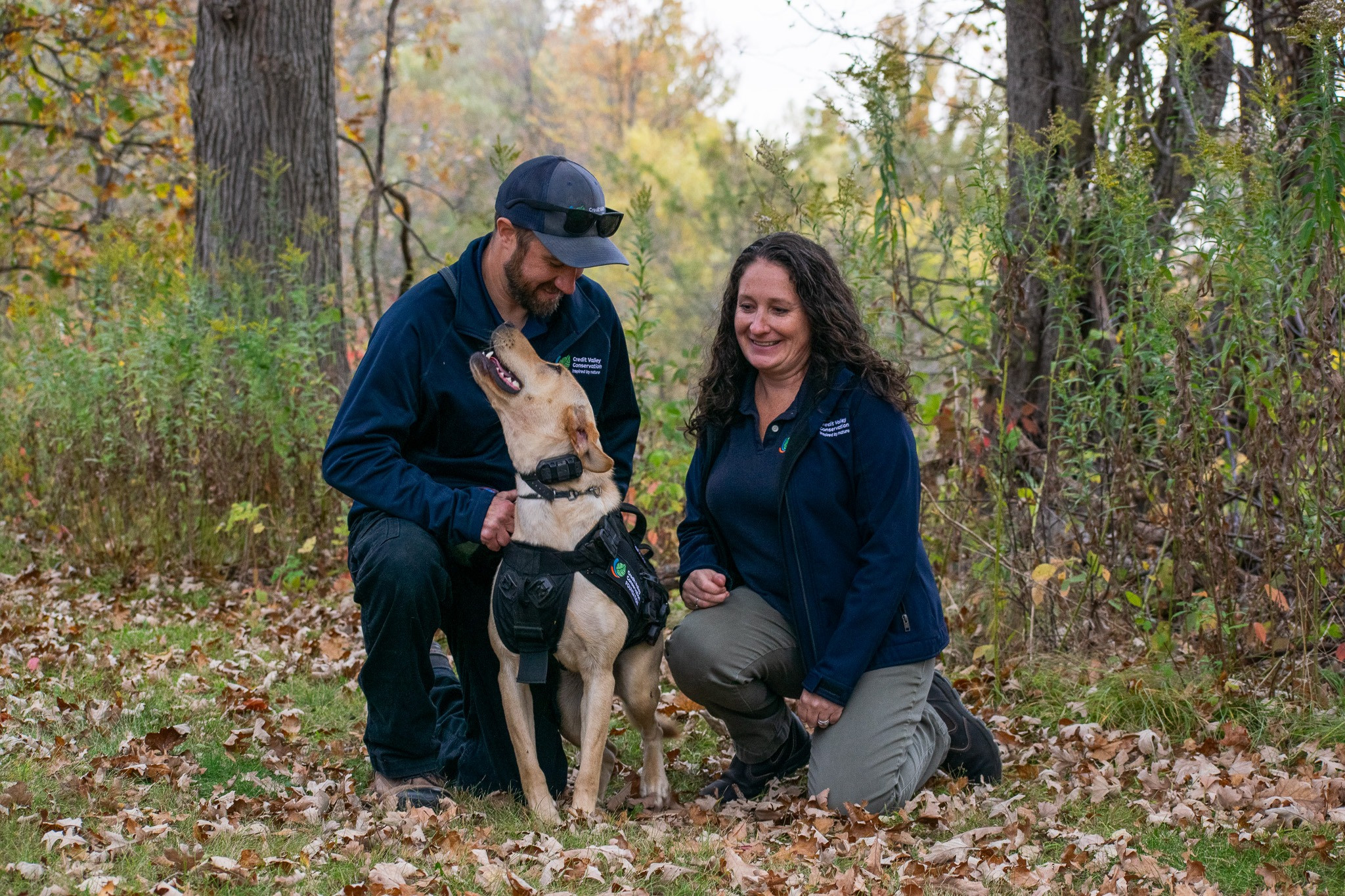
Lee Merrill, Credit Valley Conservation’s (CVC) Coordinator of Terrestrial Restoration and Terrestrial Invasive Species Specialist and Freyja Whitten, CVC’s Program Manager of Terrestrial Restoration with Tilly. (Alexis Wright/The Pointer)
“Lee [Merrill] is definitely her favourite,” Whitten said.
At home, the 2-year-old Labrador’s favourite pastime is “perhaps having the freedom to unwind in the backyard and simply be a dog”.
“She still wants to work because that’s her fun time. She’d probably choose working over free time,” he said.
“She also loves people and squirrels.”
CVC is already working with the Ontario Federation of Anglers and Hunters’ Invading Species Awareness Program and Fisheries and Oceans Canada to obtain samples of marbled crayfish, an invasive species found in Burlington, with plans to add it to Tilly’s scent profile in the spring so she can help detect all three priority invasive crayfish species before they become established in the Credit River watershed. The team has also considered training Tilly to detect oak wilt, but has been unable to secure samples of the disease for training.
For Merrill, being part of a new initiative that serves a larger purpose of protecting natural areas has been especially rewarding: “I think just being part of something new that has such a great purpose, protecting our green spaces, is really fun and cool.”
Email: [email protected]
At a time when vital public information is needed by everyone, The Pointer has taken down our paywall on all stories to ensure every resident of Brampton, Mississauga and Niagara has access to the facts. For those who are able, we encourage you to consider a subscription. This will help us report on important public interest issues the community needs to know about now more than ever. You can register for a 30-day free trial HERE. Thereafter, The Pointer will charge $10 a month and you can cancel any time right on the website. Thank you
Submit a correction about this story

