
Ontario schools welcome students back with allowable lead limit twice as high as Ottawa’s guideline
This year, Ottawa parents Crystal Mask and Garrett Hansen had to have an unsettling conversation with their two kids as they went back to school: “do not drink from the water fountains”.
“It was hard,” Mask told The Pointer.
“They're four and five, they see their friends doing it, they think it’s okay.”
In March, Mask found out about the Canadian Environmental Law Association (CELA)’s report that uncovered two Ottawa school boards ranked among the ten worst in Ontario for lead exceedances in school drinking water—Ottawa Carleton District School Board recording the highest levels in the province.
Peel’s schools fared no better.
The Dufferin-Peel Catholic District School Board ranked second-worst in the province for lead exceedances: 40 schools reported levels over the provincial limit while 95 schools exceeded the federal guideline of five parts per billion (ppb).
Peel District School Board ranked fourth-worst with 23 schools reporting water tests over 10 ppb and 46 schools exceeding five ppb.
“So, there was a lot of hesitation sending our kids to school this year,” she shared candidly.
“I send my kids with two water bottles. We have a filter system at home that filters out the lead…I did get my water tested and we’re good.”
Musk took a deep breath before continuing, “But with everything that I found out, there’s a need to be extra cautious with what it can do to my children, especially at their age, it’s very scary.”
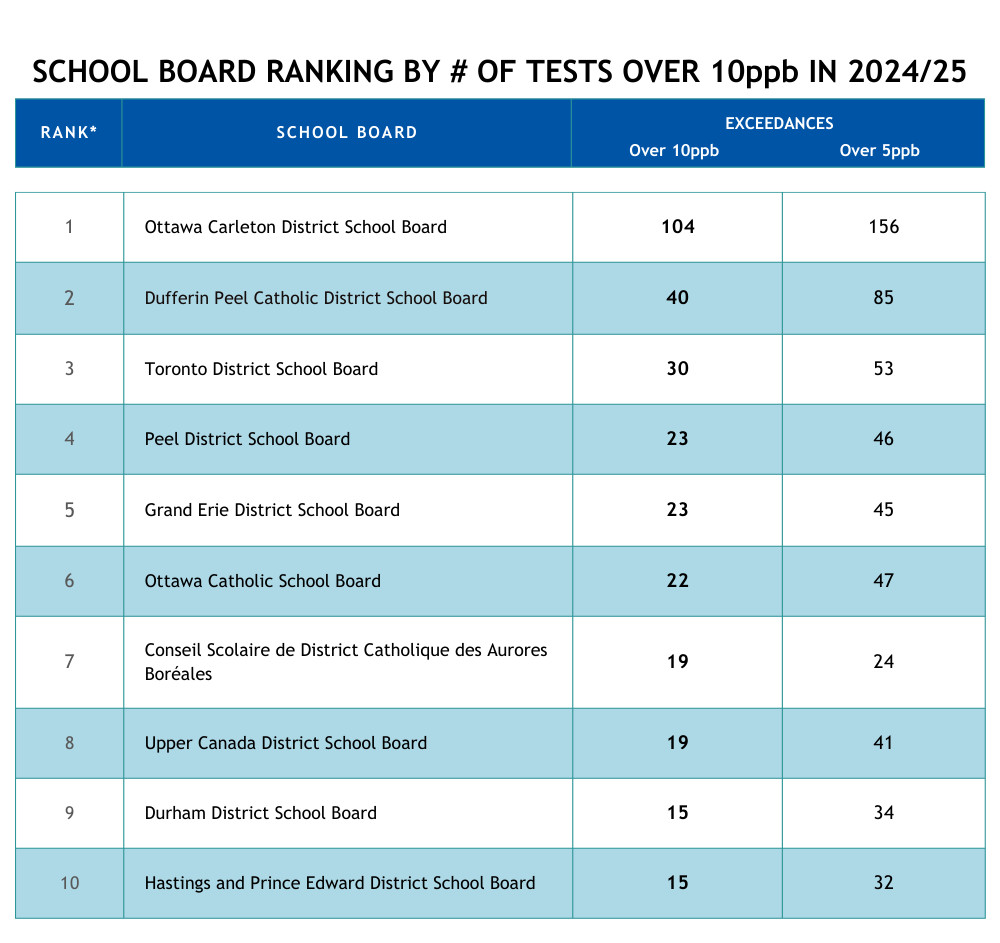
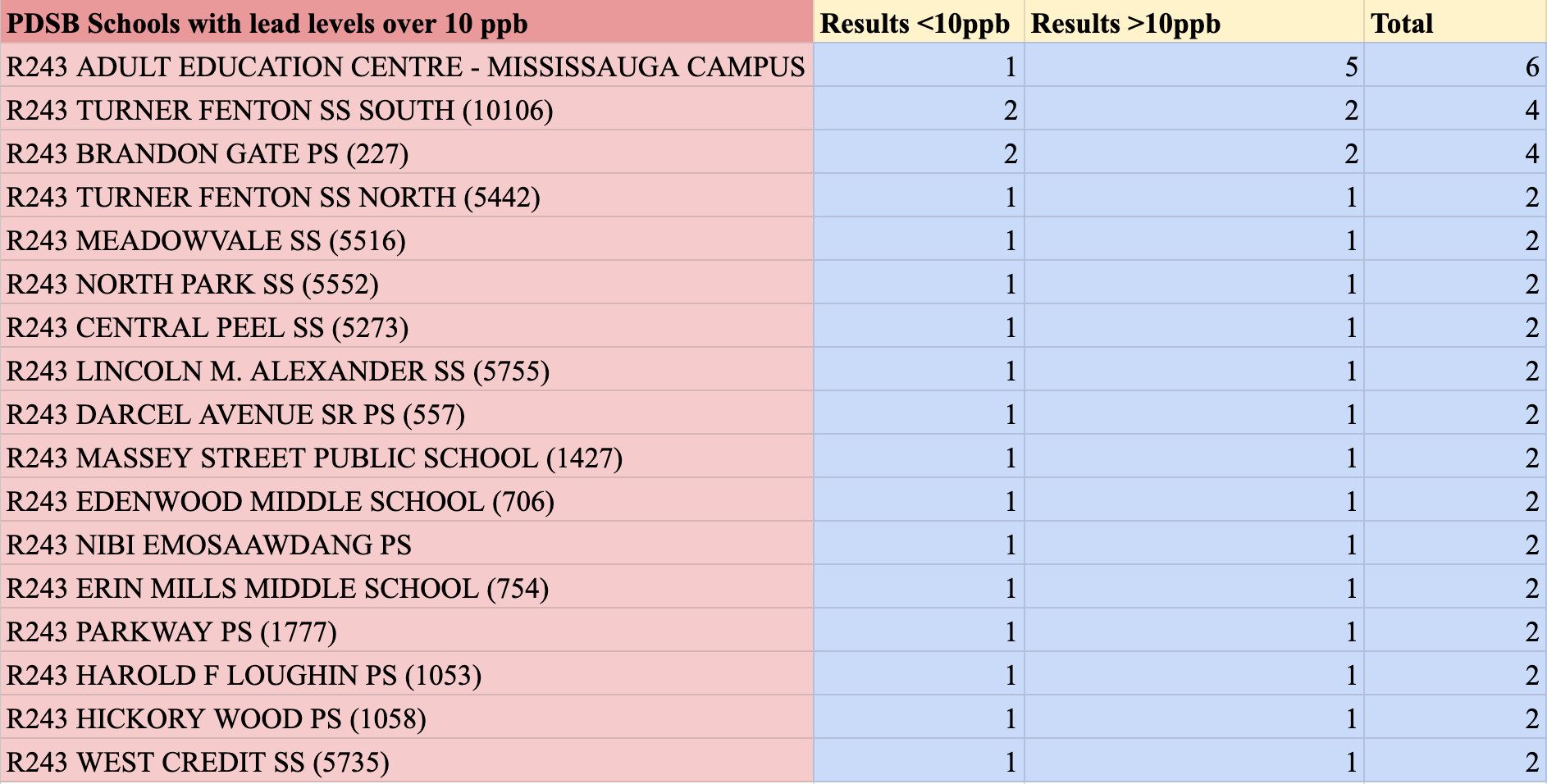
The ten worst school boards identified by the Canadian Environmental Law Association (CELA) as having the highest toxic lead levels in drinking water in Ontario, followed by the Peel District School Board (PDSB) institutions identified with lead levels over 10 ppb. (TOP: CELA; Table: The Pointer/Data provided: CELA)
Ontario is one of only two provinces (Saskatchewan is the other) in Canada that continues to follow a 10 parts per billion lead guideline for school drinking water, twice Health Canada’s stricter 2019 recommendation of five ppb.
The World Health Organization has clearly stated that there is no safe level of exposure to lead—“a toxic heavy metal” linked to decreased Intelligence Quotient (IQ), attention deficits, behavioural issues including antisocial behaviour and impaired motor skills in children, even at low levels of exposure.
“Ontario’s Chief Medical Officer of Health has not received any reports of lead toxicity in children in Ontario that have been linked to drinking water in the last 10 years,” a Government of Ontario report noted.
“Lead is a naturally occurring element that has many industrial uses. Exposure to lead can occur by inhalation of lead-containing particulates in air (especially smoke from cigarettes), contact with soil that contains lead, certain diets relying on imported canned food, some consumer products and from drinking water in homes served by lead service lines and/or piping containing lead components including the solder.
“However, drinking water generally accounts for a small fraction of total lead exposure for most people.”
Mask says a lack of lead toxicity report does not give her reassurance as a parent because she wants “zero lead in the water at schools—no matter what school board” in order for all kids to have a healthy body and mind.
“I’m putting my trust in the school board to take my precious child and teach them,” she added.
“I’m trusting that this is going to be a safe place for my child, and the lead in the water is just one of the many things that I can’t wrap my head around. How is this not a bigger problem? How are more people, more parents, not talking about it?”

(Alexis Wright/The Pointer)
Dr. Anna Gunz, chair of the Environmental Health Working Group at the Canadian Paediatric Society, cautions young children, especially those below age three, are uniquely vulnerable to environmental toxins as their bodies are still developing.
“They drink more water, eat more food and breathe more air per body mass than anyone at any other stage,” Gunz told The Pointer.
“While their organs and systems are still forming, it’s a perfect time to disrupt it and then, you can have really long term impacts.”
After learning about lead in the school’s water, Mask and her husband began supplying bottled water to the kindergarten classrooms, along with other parents.
“I don’t want any of these children drinking any of the water,” she said.
Internal documents obtained by CELA under the Freedom of Information and Protection of Privacy Act revealed that although the province has internally acknowledged that no level of lead exposure is safe, it has not eliminated exemptions based on thresholds now recognized as harmful to children.
“The [provincial] government hasn’t really, to the best of my knowledge, engaged with anyone about this issue,” CELA Community Outreach worker Julie Mutis told The Pointer.

Lincoln M. Alexander Secondary School was among the Mississauga schools where the water students have been drinking contained lead levels more than the federally recommended amount. (Alexis Wright/The Pointer)
The province’s standard response is to claim that Ontario has the best and most stringent school drinking water testing program in Canada.
“That might have been true back in 2005 but it is definitely not true today,” Mutis emphasized.
In 2007, Ontario introduced a new regulation under the Safe Drinking Water Act, 2002, mandating schools and childcare centres to test, report and respond to lead levels in drinking water through regular flushing of plumbing fixtures (running water through pipes to clear out stagnant water that may have absorbed lead) with frequency determined by factors such as system age, previous lead test results, fixture location and National Sanitation Foundation certification status.
All fixtures in new facilities needed to be tested within five years of opening, followed by annual testing or every three years for sites eligible for reduced sampling.
“For future sampling, we recommend that you rotate where you take your sample. We suggest you start with the fixture that has gone the longest without being sampled or take a sample from a fixture where lead issues have been identified,” the province recommended.
But when the regulations were introduced, Ontario considered lead concentrations at or below 10 ppb unlikely to pose an “undue risk to health”. As a direct result, schools that consistently tested below that threshold could be exempt from annual testing and rotating sampling locations was not mandatory.
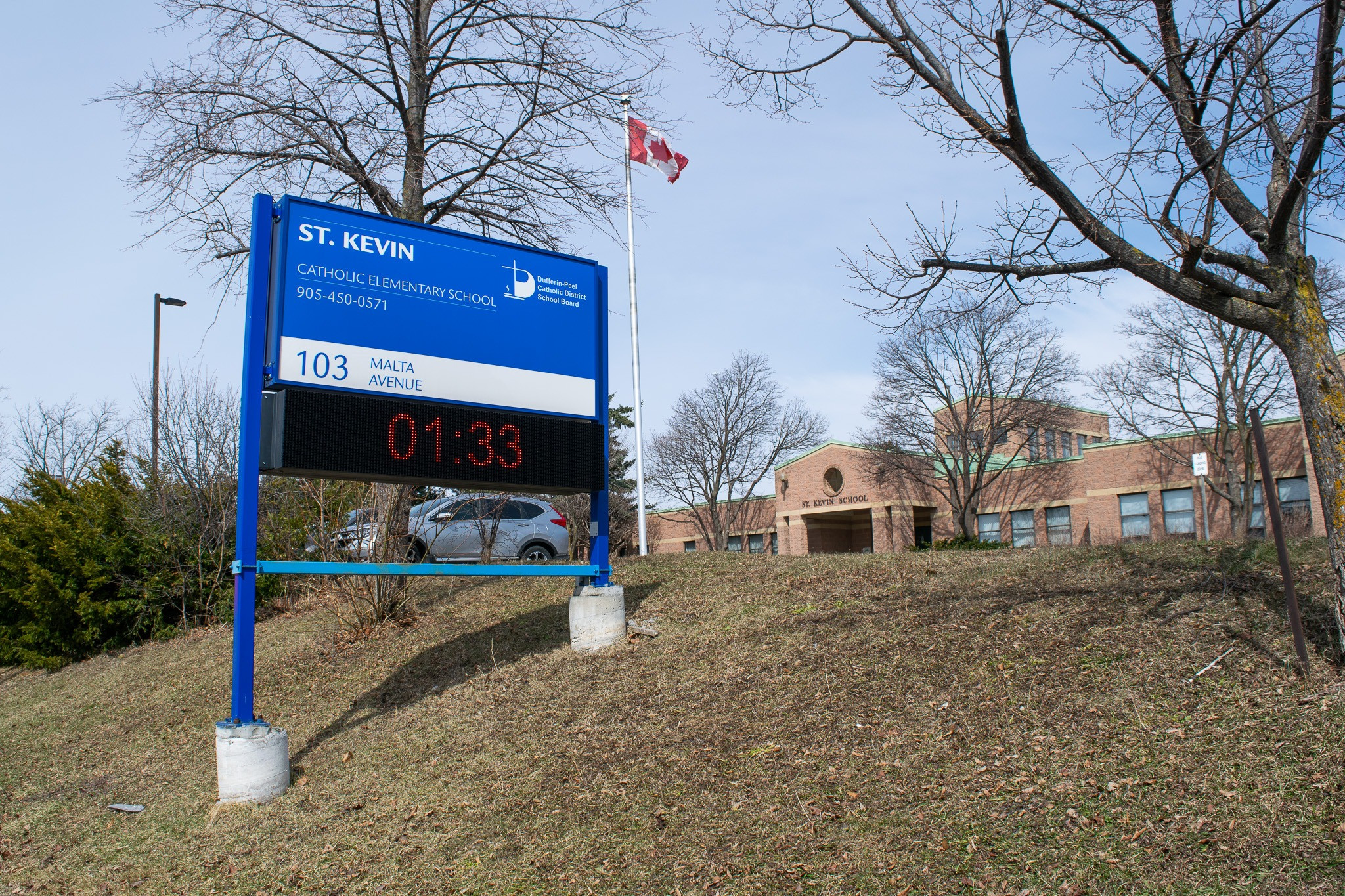
Lead levels above 10 ppb were found in drinking water at St. Kevin Catholic Elementary School in Mississauga. (Alexis Wright/The Pointer)
Even when testing does take place, the lack of accessible information makes it difficult for parents and communities to determine whether their child’s school has been impacted, as Ontario still releases school water testing results as large, raw datasets.
Mask and Hansen began searching for the most recent water-testing results on the Ottawa-Carleton District School Board’s (OCDSB) website but were unable to do so.
“When the water gets tested, I want to see that report,” Mask shared with “frustration”.
“The only report or the last report, that’s online right now is from 2024, and that’s the one that was shocking and the one that got us to investigate.”
She was puzzled; why hasn’t the province intervened to ensure records are being maintained and made available.
“According to the regulations, records must be kept for a minimum of six years, and they don’t even have that,” she added.
“Why has the province not requested records already to deal with this ongoing issue?...the trustees and the board need to do better.”
The Pointer reached out to OCDSB, PDSB, DPCDSB and Ontario’s ministries of Infrastructure and Education for a statement on what actions were being taken to eliminate lead in drinking water but did not receive a response by the time of publication.
“It's important that parents have access to this information,” Mutis noted.
“Right now, the only way to get that information is for a parent or caregiver to go out of their way to specifically go to the office and ask.”
She recommends adopting Quebec’s approach in tackling lead contamination in school drinking water.
In October 2019, Quebec became the first province in Canada to match Health Canada’s updated guideline. Former Premier François Legault gave schools a deadline to test all water fixtures; elementary schools were required to complete testing and corrective measures by June 23, 2020 while all other educational institutions had until November 1, 2020.
By summer 2021, screening was finally complete and 61 percent of non-compliant taps in public schools had been removed, replaced, or made safe to use. Flushing was treated as a last resort—a temporary measure that can return lead levels to unsafe concentrations within hours.
In 2020, a newly installed water bottle filling station at an Ottawa elementary school tested at 136 ppb in a standing-water test (more than 25 times the federal guideline).
Instead of replacing the fixture, the school increased flushing to once a day, even as repeated tests continued to show elevated lead levels. After two subsequent tests came back at eight ppb, the fountain was returned to service.
But months later, lead levels spiked again while the system remained broken: the fixture remained the same, ongoing testing was not required while the school was not obligated to notify parents about the exceedances.
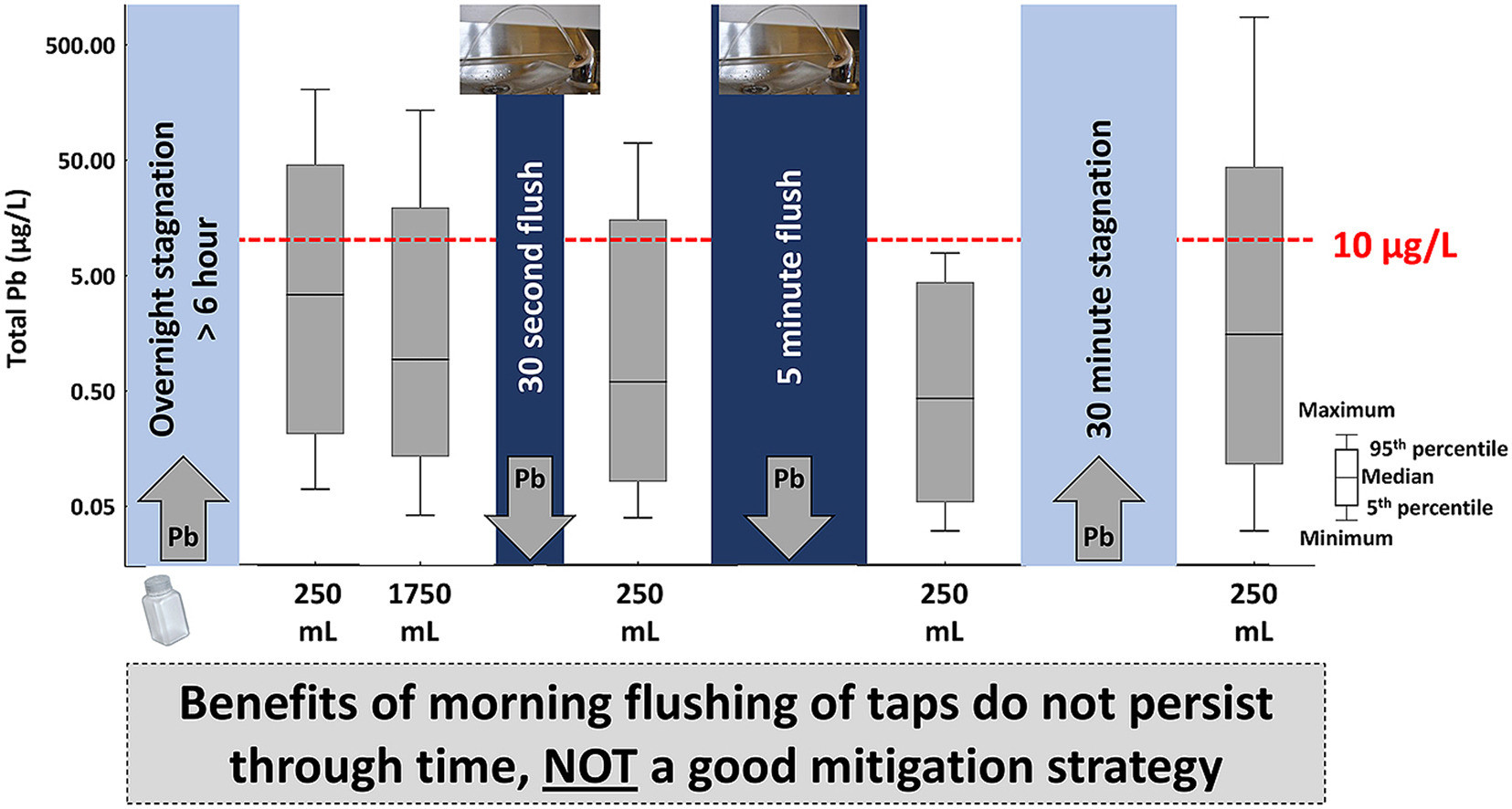
A 2018 study found particulate lead, which is often released from brass fixtures or solder, can cause extreme spikes in water with concentrations that can vary up to a thousand times between taps within the same building. (Sampling in schools and large institutional buildings)
“It's unacceptable that Ontario is continuing to use not only an outdated limit on lead that’s twice as high as what’s allowed in almost every other province and territory,” Mutis warned, “but that the ways that we respond to it are also outdated.”
In Quebec, now considered a “national leader” in treating lead in school drinking water, communities are informed when lead is found and educational institutions are required to identify the affected fixtures.
Adding another layer of protection, the province has built an inventory of taps and fountains used for drinking water, which means officials can track and regularly report how many fixtures are known to be lead-free and how many are not—giving parents a clear, honest picture of whether schools are safer.
“Ontario just can’t say the same,” Mutis criticized.
“If we’re going to spend 20 years putting money and resources and so much time into a policy about lead in schools, the goal should be to get lead out. And for some reason, that’s not the goal at the moment…the first order of business should be to stop children from being exposed altogether.”
Both her and Mask acknowledge that making these changes will require stronger provincial action at a time when school boards are under mounting financial pressure as demands for special education, mental health supports and technology infrastructure continue to grow.
In its latest $2.16 billion budget that was filed without public consultation, PDSB’s Special Education Fund fell by $7.5 million year over year including a $5.4-million reduction in per-pupil special education funding and an $828,000 reduction in funding for specialized equipment for students with disabilities.
The cuts followed the provincial takeover of PDSB in January this year following allegations of financial mismanagement by the school board—claims critics have argued were a pretext for the Ford government to expand its control over the school board.
While Ontario-appointed supervisor and consultant Heather Watt was able to reduce the PDSB’s projected 2026-27 deficit from $35 million to $10.9 million, much of the reduction came through $24.1 million in “Supervisor Savings” by eliminating 25 central-office positions identified as surplus and reducing school management and facilities staffing through vacancies and attrition.
Despite Ontario education minister Paul Calandra’s claims that the takeover was to avoid teacher layoffs, by March, 331 permanent teachers at PDSB received notices of layoffs.
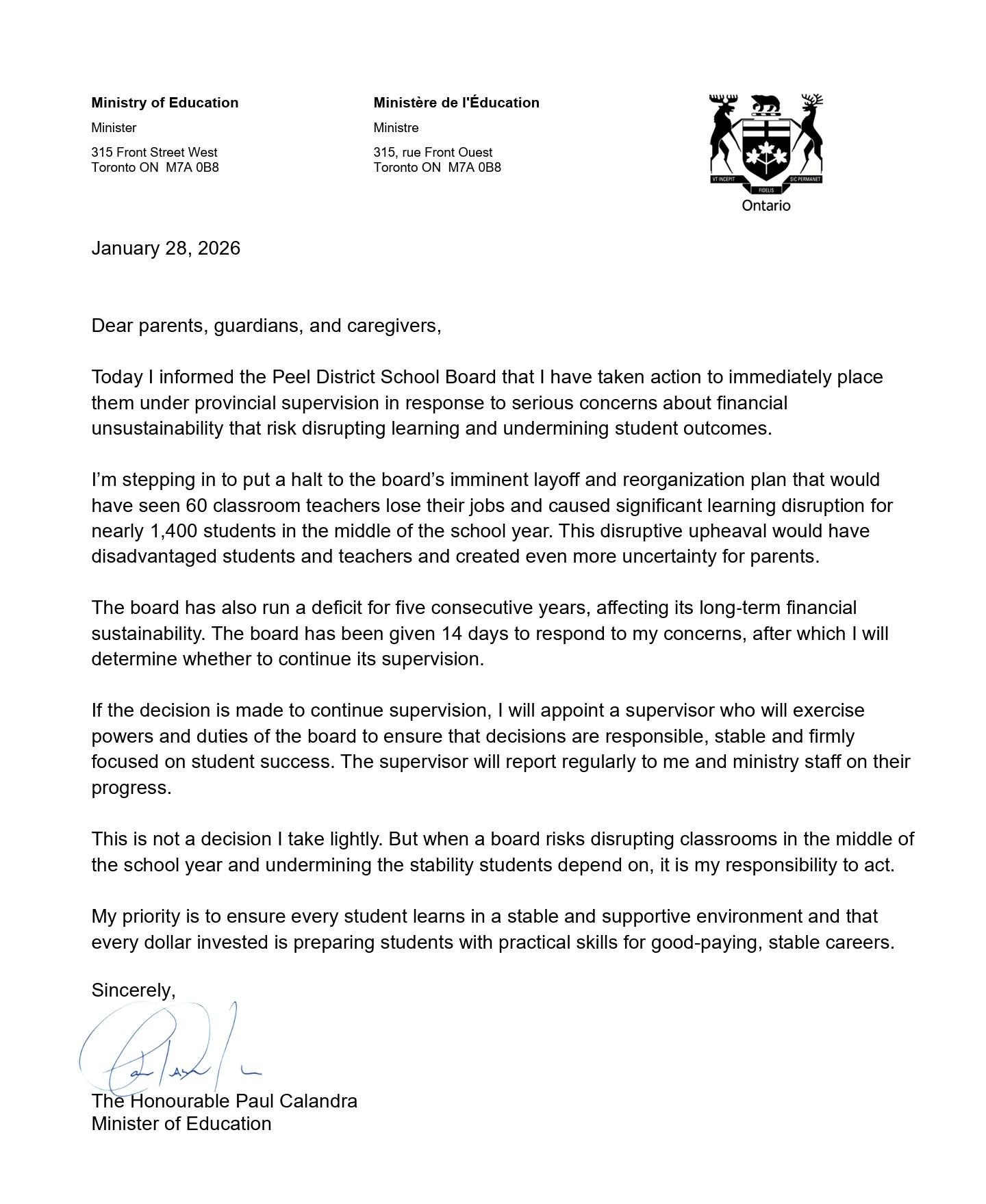

On January 28, Ontario Education Minister Paul Calandra announced the immediate provincial takeover of the Peel District School Board (PDSB), which he justified as intervening to halt PDSB’s imminent mid-year staffing plan that would have seen 60 classroom teachers laid off, a move Calandra claimed would have caused severe disruption for over 1,400 students. In March, many PDSB teachers announced they had received layoff notices. (Government of Ontario)
Can the province then finally find money to replace corroding copper and lead pipes and fittings in its aging infrastructure?
The answer may not be as simple as one would expect. Not only has the Ford government deprived OCDSB of $358 million, PDSB of $237 million and DPCDSB of $196 million since 2018, but the province also ties school board funding to enrolment numbers, meaning fewer students result in lower funding.
Mask says the underfunding issue has been “thrown” in parents’ faces every year but that does not eliminate the concern parents like her have: “these are my children, and you want to protect them”.
She has been doing her part, working with teachers who are working as efficiently as possible within an underfunded system while the Ford government hands them a $750 Staples gift card for classroom supplied, by buying supplies such as tissues and crayons, as well as toys for their classrooms.
“I will continue to do my part because I don’t want anything coming out of these teachers’ pockets if it doesn’t have to; they’re already struggling,” Mask added.
“The school board is just failing our kids.”
School boards in Ontario have been trying to balance their budgets after facing years of declining enrolment: over 156,000 students in 2018-19 to 146,605 students in 2024-25 in PDSB, and 79,813 in 2018-19 and 68,859 in 2026-27 in DPCDSB. Even OCDSB expects enrolment to drop by 1,824 students for the 2026-27 school year, bringing total projected attendance down to 74,846.
“I would definitely hope that in all school boards, including ones where the province has taken over a supervisory role, that not only are we putting funds and resources towards responding to lead in a way that actually works,” Mutis said.
In the past, provincial representatives have contended that school boards can use their existing resources to address concerns such as lead in drinking water. But when the province places a school board under supervision, “that just really removes the middleman”.
“While the responsibility for all of this lies with the province because they’re the ones who are in charge of education in Ontario, that is just even more true in school boards where the province has put in a supervisor,” she added.
“It’s more directly their responsibility to not just continue with [the] status quo there but to do as much as they can.”
But a simple start can be lowering the provincial lenient threshold for lead from 10 ppb to five ppb in line with the national guidance and eliminating exemptions that allow some institutions to test less frequently; instead, every tap and fountain needs to be retested under stricter standards.
“We're not really sure why the province hasn’t taken the action to reduce the limit for lead or to change how we respond to and test for lead in schools,” Mutis said.
“But what we do know is that the more noise people make about it, the harder it remains to do the same thing, and the more reason there is to change.”
Mask pledges to continue making “noise” because “in the end, it’s for the children, and that’s all I care about”.
Email: [email protected]
At a time when vital public information is needed by everyone, The Pointer has taken down our paywall on all stories to ensure every resident of Brampton, Mississauga and Niagara has access to the facts. For those who are able, we encourage you to consider a subscription. This will help us report on important public interest issues the community needs to know about now more than ever. You can register for a 30-day free trial HERE. Thereafter, The Pointer will charge $10 a month and you can cancel any time right on the website. Thank you
Submit a correction about this story

