
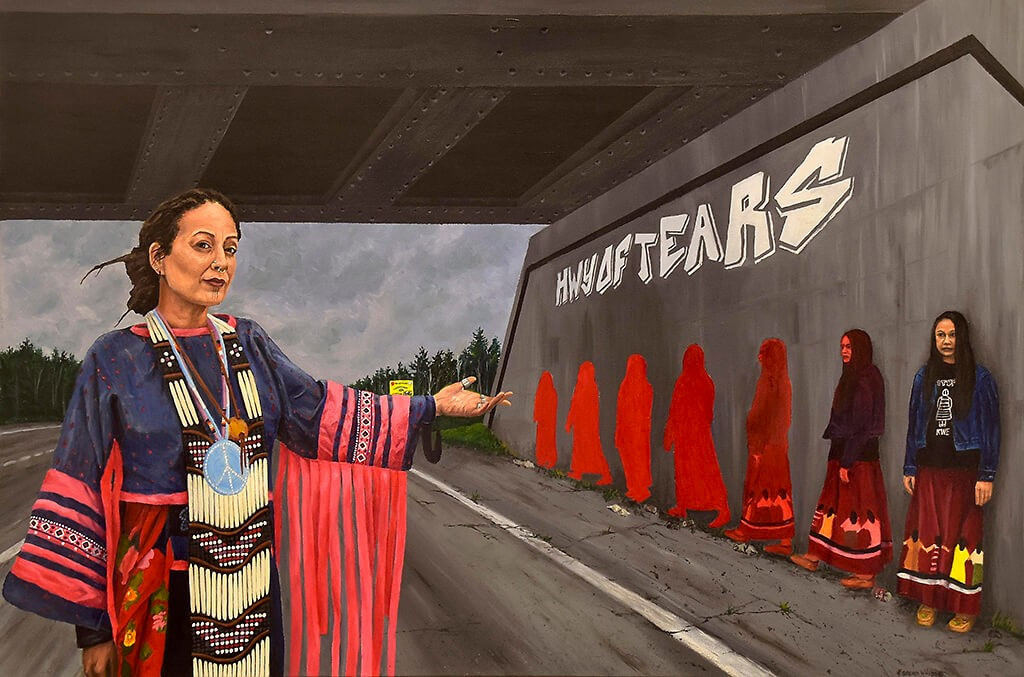
Has Ottawa’s Ring of Fire road decision set the stage for a Highway of Tears 2.0?
Content warning: This story discusses missing and murdered Indigenous women and girls, systemic violence, and the ongoing grief experienced by their families and communities. Some details may be distressing or difficult to read.
“the bread far from the hunger the apology
the confusion the broken road
these things we gather in this blanket
bone and sand and sage
we wash the world, between us
hold this blanket, fill it with our tears
and when we have cried
from one dawn to the next
then we will rise, and we will dance
until they're home, until they all are home”
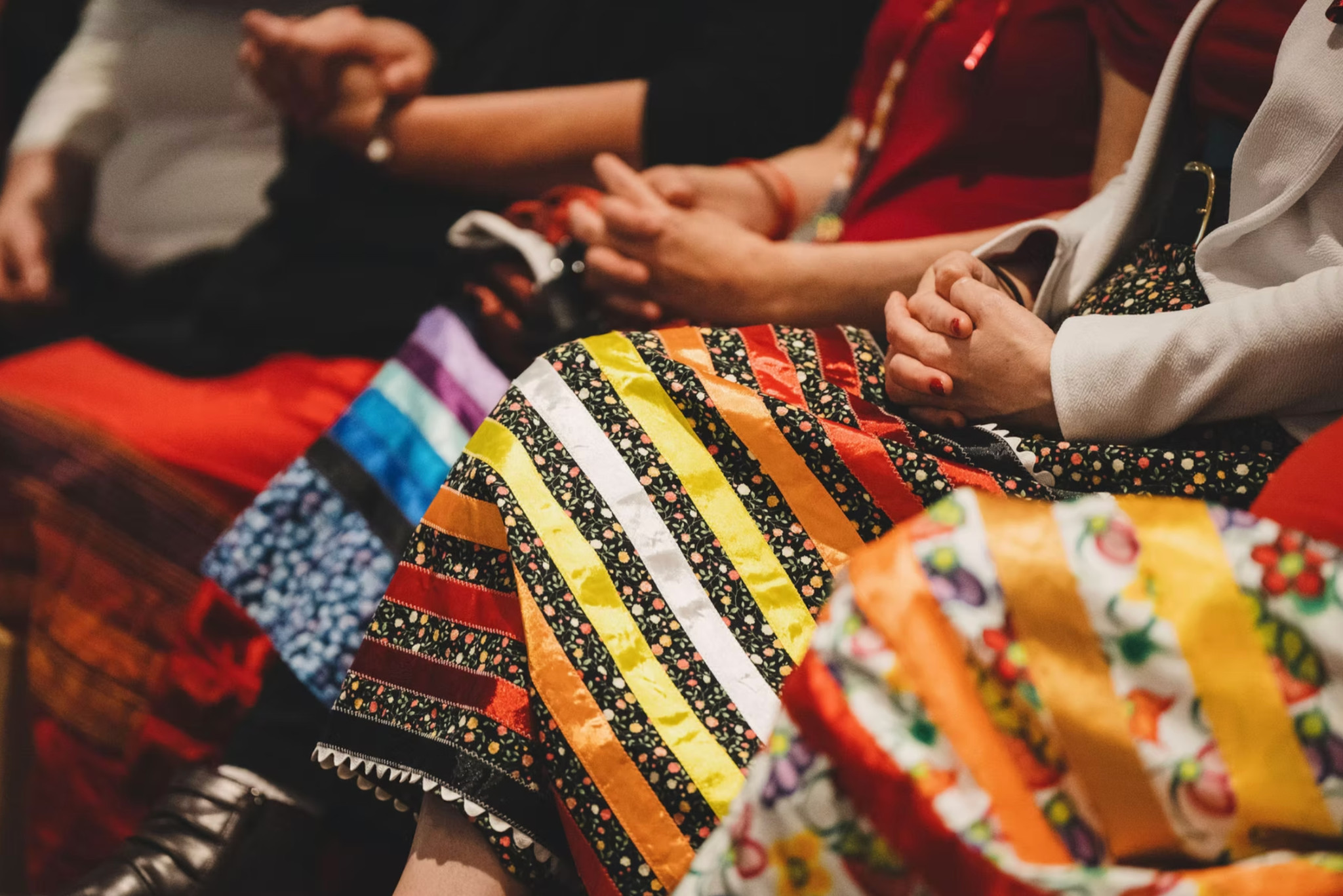
In Anna Marie Sewell’s ‘Washing the World’, grief is not left to be carried alone. Fragments of loss are gathered one by one into a shared blanket woven from sorrow, memory and the enduring hope that those who are missing will one day return home.
But where does that preventable grief germinate from?
In 2025, 33,584 people were reported missing across Canada—Indigenous people accounted for 13 percent of missing adults and 21 percent of missing children while Indigenous women and girls made up 58 percent and 69 percent of those cases respectively, according to the latest government records.
For generations, many Indigenous families have lived with the onerous weight of grief, close to their heart, of women and children who never made it home — as they continued to demand answers, accountability and safety for those still here.
As major development projects move deeper into Indigenous territories, advocates are now wondering if the lessons of the past are being carried into the future or left behind.
On June 19, as the final Impact Assessment Report for the first road to Ring of Fire identified “positive effects on employment and the economy as well as community well-being, economic reconciliation”, it also warned the project may “increase physical and sexual violence towards Indigenous women and girls, and raise the risk of human trafficking” due to the influx of workers, “increased risk of illegal or prohibited substances entering the community, concerns regarding public and road safety”.
Six days later, the 107-kilometre all-season Webequie Supply Road proposal for mineral exploration and potential future mining development in the Ring of Fire was greenlit by federal environment minister Julie Dabrusin. She determined the project's “public interest” benefits outweighed its “potential adverse effects”, after considering the statutory factors and mitigation conditions.
“The Government of Canada is committed to ensuring proposals like this move forward in a way that is sustainable and protects the environment and Indigenous rights,” a statement by the minister noted.
“[It] is committed to working with Indigenous communities in a manner that advances reconciliation, respects the rights and cultures of Indigenous Peoples, and ensures the inclusion of Indigenous Knowledge in assessments.”
While the decision has since prompted critics to question who gets to define “public interest” and sparked a Federal Court challenge seeking to overturn Dabrusin’s approval, an uncomfortable question haunts: is Ontario at risk of building a Highway of Tears 2.0?
Nearly three decades after Highway 16 was completed, its 719-kilometre stretch between Prince George and Prince Rupert, British Columbia had become a landscape marked by the disappearances and killings of women and girls—earning the name “Highway of Tears” during a 1998 vigil in Terrace, when a Wet'suwet'en matriarch and Indigenous advocate, Florence Naziel, coined the term as she witnessed the tears of families who had lost their loved ones.
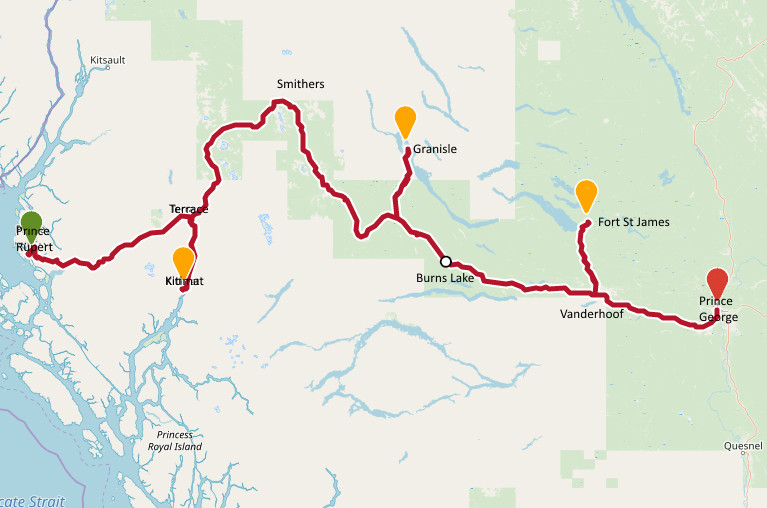
The Highway of Tears is a 725-kilometre stretch of Highway 16 between Prince George and Prince Rupert in British Columbia.
(Open Street Map)
Seven years later, Naziel would lose someone she was related to, Tamara Chipman, a young mother who disappeared along the highway on September 21, 2005—leading her to organize the first official walk from Prince Rupert to Smithers in 2006 and support the Missing and Murdered Indigenous Women and Girls (MMIWG) movement while calling for a national inquiry.
It would take Ottawa a decade to launch a Canada-wide inquiry despite the numbers speaking louder than ever.
A 2004 Amnesty International report documented more than 500 missing or murdered Indigenous women, exposing a pattern of systemic violence that disproportionately affected young and impoverished women. It brought to light that Canadian authorities could—and should—have done more to protect them and address the social and economic conditions that placed them in harm’s way.
Between 1980 and 2012, 1,181 police-recorded cases involving Indigenous women and girls were documented in the RCMP’s Missing and Murdered Aboriginal Women: National Operational Overview—1,017 homicide victims and 164 missing persons with 225 cases still unsolved at the time.
In 2005, the RCMP launched provincially funded Project E-Pana to investigate unsolved murders and disappearances of women and girls along the Highway of Tears. The investigation expanded over the years, growing from three cases in its first year to 18 by 2007 and eventually spanning highways across much of the province. But its resources declined sharply, with the task force shrinking from 70 officers in 2010 to just 12 by 2014 despite a 2006 Highway of Tears Symposium Recommendations Report urging RCMP to be “provided the resources to increase their highway patrols during the hitchhiking season, more specifically increase these patrols along the sections of Highway 16 near First Nation communities, towns and cities”.
Among the 33 recommendations that the report made, the last one called on the RCMP to “continue its official investigation or inquiry into the aboriginal community’s assertions on the actual number of missing women”.
“Each individual number from nine to possibly 32 missing victims is in fact a valued family member’s life that deserves the same respect and attention presented at the Highway of Tears symposium”.
Critics and Indigenous advocates have long argued that systemic racism and unequal media attention have contributed to the lack of progress in solving cases along the Highway of Tears.
“If it weren't for [Nicole] Hoar, the police would have invested less effort in investigating cases, and the media would have done little, if anything, to inform the public about the tragedies along the road,” Tamara Chapman’s aunty Gladys Radek said at the time.
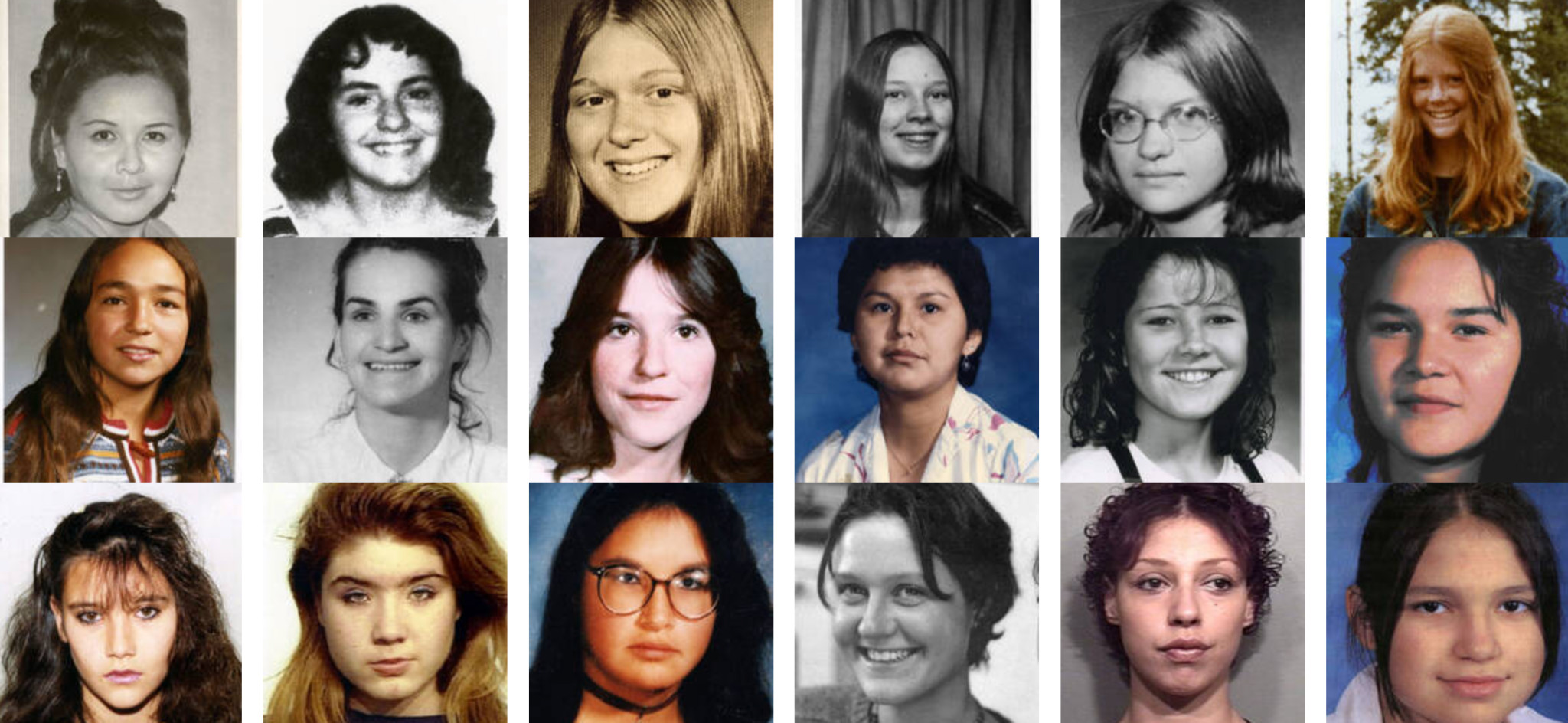
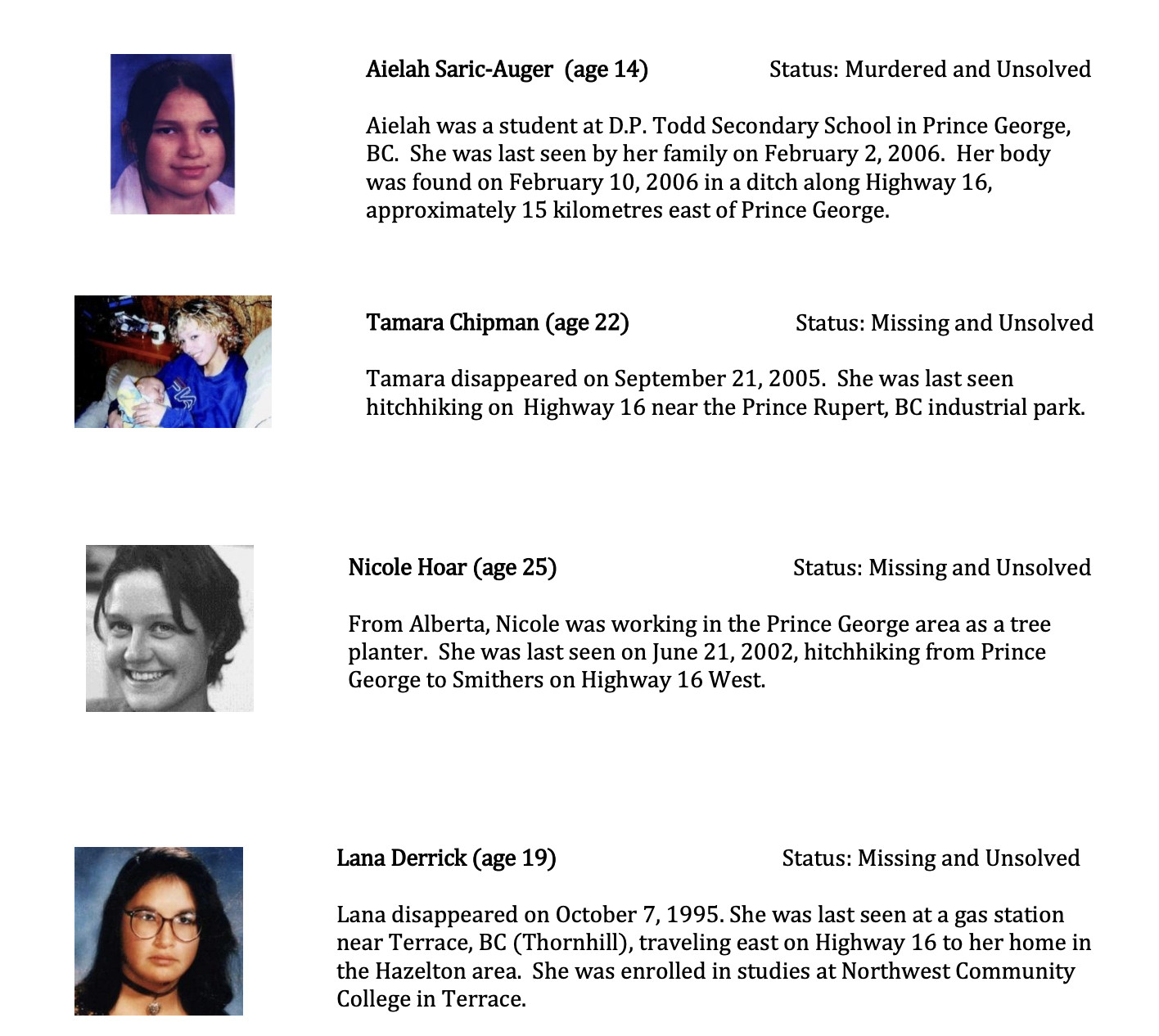
The 2006 Highway of Tears Symposium Recommendations Report outlined 33 specific actions to address the crisis of missing and murdered Indigenous women, girls and 2SLGBTQQIA+ people along British Columbia’s Highway 16 but it would take decades for some of the recommendations to be applied on ground.
(Top Photo: RCMP, Bottom Photo: Highway of Tears Symposium Recommendations Report)
In 2015, the United Nations Committee on the Elimination of Discrimination against Women (CEDAW) condemned Canada’s failure to protect Indigenous women and girls, calling it a “grave human rights violation”: “the Canadian police and justice system have failed to effectively protect Aboriginal women, hold offenders to account, and ensure that victims get redress”.
“The violence inflicted on Aboriginal women is often rooted in the deep socio-economic inequalities and discrimination their communities face and which can be traced back to the period of colonisation,” CEDAW members Niklas Bruun and Barbara Bailey noted.
“During the inquiry, NGOs indicated to us that young Aboriginal women are five times more likely than other Canadian women of the same age to die of violence. Aboriginal women and girls also experience high levels of sexual abuse and violence in their own families and communities, as well as within wider society.”
The following year, the federal government launched the National Inquiry into Missing and Murdered Indigenous Women and Girls.
When the inquiry released its final report in June 2019, decades of disappearances along the Highway of Tears were found to be rooted in systemic racism, poverty and a lack of safe transportation — and industrial activity compounding those existing vulnerabilities.
First person accounts pointed to a clear connection between major resource-extraction, infrastructure and construction projects and the temporary worker camps (also called man camps) who have “high salaries and little to no stake in the host Indigenous community” that accompany them and heightened risks of violence against Indigenous women and girls.
“The industrial system of resource extraction in Canada is predicated on systems of power and domination. This system is based on the raping and pillaging of Mother Earth as well as violence against women. The two are inextricably linked,” Melina Laboucan-Massimo, a woman from the Lubicon Cree First Nation, said.
“With the expansion of extractive industries, not only do we see desecration of the land, we see an increase in violence against women. Rampant sexual violence against women and a variety of social ills result from the influx of transient workers in and around workers’ camps.”
T. J. Lightfoot, a Two-Spirit Mi’kmaw person from Elsipogtog First Nation, told the inquiry there are two types of mancamps associated with resource extraction: camps operated by industry, typically made up of portable housing units brought in to accommodate workers, and informal camps including privately rented homes, trailers or mobile homes where workers live outside the company-run sites.
In both cases, the influx of predominantly male workers into small Indigenous communities can place additional pressure on local services and increase risks of sexual assault, harassment, sexually transmitted infections and women entering the “sex trade” while rampant drug and alcohol abuse increases not only in the community but also among workers.
The Native Women’s Association of Canada (NWAC) President Josie Nepinak, explained in a community of 200 or 300 people, the arrival of a camp housing 500 predominantly male workers can stretch policing, health care, social services and family support considerably, possibly beyond their limits.
“Indigenous women and girls experience poverty, lower educational attainment and addictions are particularly vulnerable in the communities, so this raises a good question about whether or not there'll be enough,” Nepinak told The Pointer.
Former United Nations Special Rapporteur on the Rights of Indigenous Peoples James Anaya’s work also revealed Indigenous women living near oil, gas and mining operations had reported increased sexual harassment and violence including rape and assault following the arrival of extractive workers.
“There is substantial evidence of a serious problem that requires focused attention on the relationship between resource extraction projects and violence against Indigenous women,” the final report reiterated.
Five months after the inquiry, the Impact Assessment Agency of Canada (IAAC) decided that an impact assessment was required for the Webequie Supply Road, officially commencing shortly after on February 24, 2020.
In the recent report, IAAC recorded concerns raised by at least five First Nation communities regarding “concern for health and safety, and potential human trafficking of Indigenous women, girls, and LGBTQ2+ populations”. The First Nations called for the project’s conditions and the Community Readiness Plan to include stronger measures to address the risks of missing and murdered Indigenous women and girls associated with worker camps and the cumulative effects of development.
The agency said it had considered the potential impact of an influx of workers on Indigenous women and girls, including the possibility of increased violence.
“IAAC understands that the proponent made commitments to provide training programs that focus on the safety of Indigenous women and girls, and that as part of the Community Readiness Plan, there would be mechanisms for local women and girls to bring forward grievances, including issues related to sexism and gender-based violence,” the report noted.
“[The Plan] would track and monitor the safety and security of vulnerable community members as part of community well-being monitoring.”
But for advocates, the question is whether those measures are enough.
NWAC’s Nepinak is “very concerned” about the safety to Indigenous women since the IAAC’s findings. She argues the risks associated with temporary worker camps need to be considered long before a woman has to make a complaint.
“Major projects like the Ring of Fire roads must be more than economic opportunity,” Nepinak said.
“Any project in any community should only proceed where governments and proponents can demonstrate that Indigenous women's rights, their community safety, environmental stewardship and equitable economic participation will be protected throughout the life of any project.”
Advocates have stressed that the mechanism to make complaints will need to be efficient given past failures of the system.
Indigenous women working around resource projects have often been reluctant to report harassment or violence because they feared losing their jobs, damaging their reputations or having their complaints ignored.
“One woman said that she did not report harassment to her supervisors because she was new to her job and did not want to jeopardize her reputation and future employment prospects. Of her male colleagues who witnessed her harassment, she said, “nobody stood up for me”,” the 2019 inquiry noted.
Advocates say for a grievance system to work women must be able to trust that their concerns will be heard, understood and acted on without putting their safety or livelihoods at risk because systemic challenges have left them untrusting of police forces.
Based on interviews with Indigenous Peoples and Elders living along Highway 16, a 2024 study by University of Alberta’s researchers found that cases involving Indigenous women were not pursued with the same urgency as those involving white women while they were often blamed for their own disappearances.
“I feel like there’s a blame that goes on… ‘she shouldn’t have been there’ and you know, ‘it was her lifestyle.’,” one woman told researchers.
(Ontario Native Women’s Association)
The Missing Women Commission of Inquiry also reported the “initiation and conduct of the missing and murdered women investigations were a blatant failure,” citing poor report-taking and follow-up, failures to pursue investigative strategies and inadequate accountability.
“We truly believe that economic prosperity should be for everyone, absolutely. But what we don't agree with is whether or not major extracting industries have provided the safety and the necessary resources that will impact Indigenous women,” Nepinak said.
She believes protecting communities, particularly those along the Ring of Fire, from such vulnerabilities must be the first priority of any major project and “Indigenous leaders must be involved from the outset” to identify the services needed to ensure community safety.
Communities may need more emergency housing, victim services, sexual health care, mental health and addictions support, child and family services, culturally appropriate trauma care and transportation for women seeking help—recommendations that were also made in the 2006 Highway of Tears Symposium Recommendations Report and are yet to be applied in its entirety.
A recent NWAC annual score card found the federal implementation of the MMIWG2S+ National Action Plan remains “fragmented”, “delayed” and largely reliant on existing or short-term programs rather than transformative, sustained action.
While Ottawa has continued funding initiatives such as the Red Dress Alert, survivor and family supports, Indigenous housing, policing and community safety programs, NWAC found major gaps in long-term funding, independent accountability, Indigenous-led data systems and systemic reforms.
The federal government has yet to establish the Indigenous Human Rights Ombudsperson and Tribunal or an oversight body for the National Action Plan while a national Indigenous data system grounded in data sovereignty remains unrealized and promised Indigenous health legislation has stalled.
“Economic development and community safety must advance together, not behind,” Nepinak added.
“And Indigenous women must have a meaningful role in project design, decision-making, and ongoing monitoring of major projects.”
If you are affected by the issue of missing and murdered Indigenous women, girls and 2SLGBTQI+ people and need immediate emotional assistance, the national helpline is 1-844-413-6649.
Email: [email protected]
At a time when vital public information is needed by everyone, The Pointer has taken down our paywall on all stories to ensure every resident of Brampton, Mississauga and Niagara has access to the facts. For those who are able, we encourage you to consider a subscription. This will help us report on important public interest issues the community needs to know about now more than ever. You can register for a 30-day free trial HERE. Thereafter, The Pointer will charge $10 a month and you can cancel any time right on the website. Thank you
Submit a correction about this story

