

Niagara Police launch criminal investigation into Dakota’s death
Content Warning: This story contains graphic descriptions and images of alleged animal abuse that some readers may find disturbing.
There was a plastic bag stuck in Dakota’s mouth.
There was a muzzle clamped so tightly around her jaw, she could barely breath.
This was how the young German shepherd was found on July 30, 2024 on a Niagara Falls sidewalk. Video of Dakota running down the street, a long leash dragging metal poles behind her, spread quickly on social media. It immediately ignited anger.
It was a barbaric scene. A helpless animal put to a horrific death.
After she collapsed, blood draining from her onto the sidewalk, heat stroke shut down her organs before any emergency vet services could reach her.
Nearly two years later, following persistent calls, petitions and advocacy from dedicated animal rights groups, the Niagara Police confirmed last week that a criminal probe has finally been opened into Dakota’s death.
The news is a victory for the animal rights advocates who have long questioned why, despite clear evidence that the circumstances leading to Dakota’s death could have been criminal, the Niagara Police were never called to investigate.
Notification is the responsibility of the Ontario Animal Welfare Service (AWS). They’ve also been left to wonder why an investigation was not launched after online petitions demanding “Justice for Dakota” outlined the disturbing circumstances, and why no action was taken after at least two residents expressed dire concern to the police about Dakota’s treatment before her death.
According to Jessica Martin, a spokesperson for Niagara police, the force were notified of the incident this month. She would not say who contacted the police.
“We were notified of this incident in March, however it is currently under investigation, and we won’t be releasing any information on it at this time,” she said.
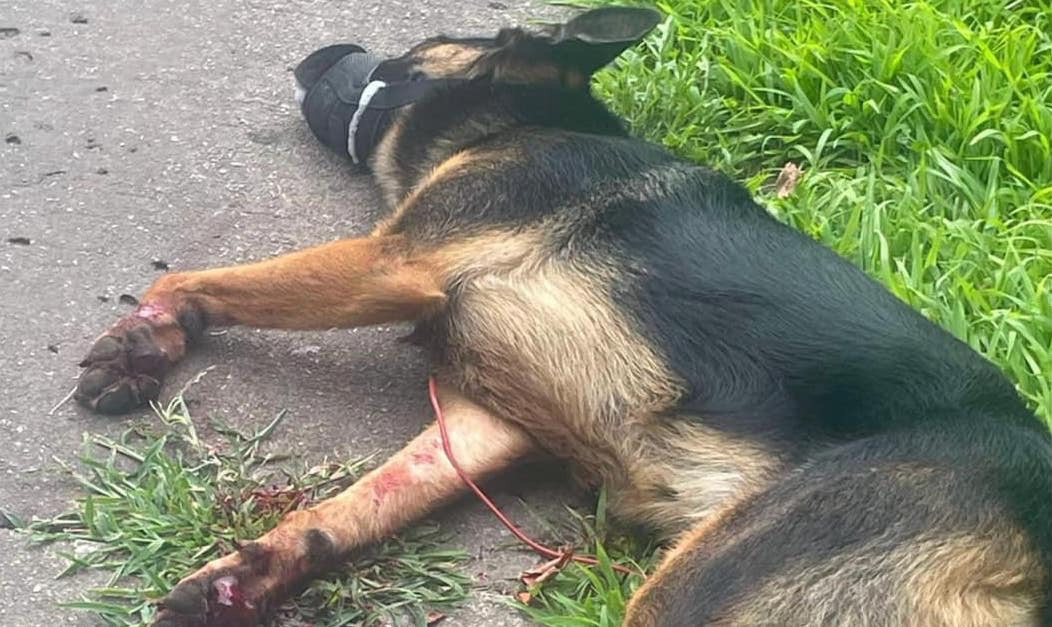
Dakota, after she collapsed on the sidewalk. A tight muzzle is clearly visible. Expert testimony pointed to the muzzle as the main cause of death as it prevented the young dog from panting to cool off, triggering a fatal heat stroke during the summer of 2024.
(Submitted)
When The Pointer first detailed the horrific circumstances of Dakota’s death after speaking with witnesses and neighbours, and the gaps it exposed within Ontario’s animal welfare system, Niagara Police officials said they were unable to find any record of calls related to the July incident.
In January last year, two Niagara Police constables searched for evidence of the call and were unable to locate it. This was confirmed in February this year when Martin told The Pointer she could find no calls to police regarding Dakota’s death in 2024.
“Generally, incidents involving animals are under the jurisdiction of Provincial Animal Welfare Officers, and it would be the decision of the investigating PAWS officer on whether to contact police,” Martin said.
When contacted for an interview, the responding AWS officer directed questions to the Solicitor General’s Office, which has jurisdiction over AWS. She did not respond to a follow-up request to speak about her investigation.
Dakota’s owner, Carly Young, is currently on trial for four provincial offence charges stemming from Dakota’s death, including two counts of permitting distressing to an animal, exposing an animal to undue risk of distress and failure to provide basic standards of care. That trial is expected to conclude on April 27. She has denied any wrongdoing.
The damning evidence already heard at the trial makes it clear the muzzle placed on Dakota by Young was the likely cause of death.
“In veterinary pathology we generally assign the cause of death as the one thing that if it hadn’t happened, the dog would most likely be still alive. So, in this case, if we follow the dog back to the one thing that led to the heat stroke and complicated by asphyxiation it would be the application of a tight muzzle on a hot day,” veterinary pathologist Dr. Ian Welch, told a Welland courtroom on January 29. “Imagine a plastic bag over your head where you’re running out of oxygen and unable to resolve the source of the problem and until the heat stroke takes over and the dog becomes unconscious I think the level of distress would be extreme.”
Young and her husband Chris have repeatedly delayed the proceedings, failing to show for numerous pre-trial dates, and refusing to attend a trial date in-person despite an order from the Justice of the Peace. Young’s failure to attend the trial date in January forced the court to delay the conclusion until March 2. On that date, Young again failed to show up. According to her husband Chris, who appeared via Zoom from their Barrie home, Carly was in hospital. He said she had been admitted the night before for psychiatric assessment.
A further trial date has now been set for April 27.
The Crown is seeking a six-month jail sentence for the provincial offences. The maximum penalty for criminal animal cruelty charges is five years in prison.
The Criminal Code of Canada definition of animal cruelty includes anyone who “wilfully causes” or, “wilfully permits to be caused unnecessary pain, suffering or injury” to an animal.
Advocates believe this case far surpasses that threshold.
Donna Power, the co-founder of the Humane Initiative, the organization that has led the “Justice for Dakota” movement, is pleased the Niagara Police are finally investigating, but is dismayed it took this long.
“It is only through public advocacy that Niagara Police have agreed to investigate this,” she said.
Power says this is just another example of how badly Ontario needs to reform the systems meant to protect animals.
“I am very disappointed to see how badly this case has been handled and actually botched by AWS. The three main witnesses were never interviewed,” she said. “Based on the findings of Dr. Welch, the threshold of Criminal Code statute 445.1 (animal cruelty) was met and this should have, according to PAWS Act Regulation, prompted the investigating AWS inspector to reach out to Niagara Regional Police to commence a criminal investigation. She did not do this.”
A key shortcoming of the Provincial Animal Welfare Service (PAWS) Regulations is the lack of prescribed criteria for when an AWS inspector should notify the police. Guidance given to inspectors says they should notify the police when circumstances appear to meet the threshold of criminal prosecution. But this decision is left to the discretion of the individual officers and handled on a case-by-case basis.
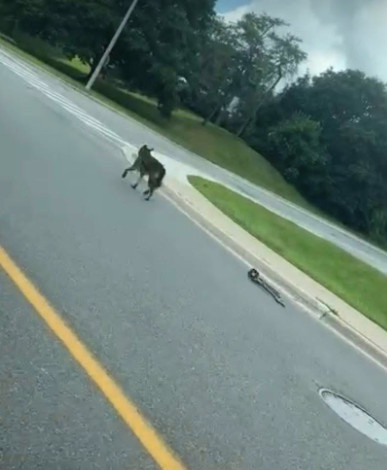
A screengrab from a video posted to Facebook showing Dakota running down the street dragging metal poles behind her.
(Facebook)
With such a long delay, any investigation into the circumstances surrounding Dakota’s death will be incredibly difficult for officers to gather evidence.
For example, any evidence at the scene of Dakota’s death is now gone; the home where Carly and Chris previously lived—which was pest-infested—has been cleaned after the two moved out. Any evidence of abuse to Dakota, like scratch marks on the walls and door from her being routinely locked in the bathroom, could have been repaired.
Questions have already been raised about the plastic bag in Dakota’s mouth when she collapsed which was reported by at least two witnesses. According to the post-mortem report analyzed by Welch, there was no mention of the plastic bag. This potentially means a key piece of physical evidence pointing to criminality could now be gone.
Carly recognized the presence of the plastic bag, but denied having placed it in Dakota’s mouth. In a Facebook post after the incident, she claimed Dakota picked it up herself while running down the street.
According to Welch’s testimony, the muzzle was so tight around Dakota’s mouth it was cutting off bloodflow. It’s difficult to determine how, with such a tight muzzle around her jaw that did not allow her to open her mouth enough to pant, Dakota could have nearly swallowed a plastic bag. Unfortunately, that critical piece of physical evidence could now be lost.
Another worry of animal advocates is that should criminal charges eventually be laid by the police, there will be no appetite from the Crown Attorney’s Office to pursue the charges if Carly has already faced consequences under the Provincial Offences Act.
“The public interest is not being served if only the Provincial Offences proceedings continue,” Power says. “If found guilty, Ms. Young will have no criminal record and fines will be minimal and jail time very doubtful. This does not send a clear message of deterrence to the public. Only a criminal charge would send this message that cruelty truly will not be tolerated.”
Email: [email protected]
At a time when vital public information is needed by everyone, The Pointer has taken down our paywall on all stories to ensure every resident of Brampton, Mississauga and Niagara has access to the facts. For those who are able, we encourage you to consider a subscription. This will help us report on important public interest issues the community needs to know about now more than ever. You can register for a 30-day free trial HERE. Thereafter, The Pointer will charge $10 a month and you can cancel any time right on the website. Thank you
Submit a correction about this story

