
From ban to bargain: Mark Carney welcomes Chinese EVs under new world order
“Boycott Chinese EVs,” Ontario Premier Doug Ford exclaimed at a press conference on January 21. Days later, his defence of one of the most critical industries in the province would take a dramatic turn, after a snap emergency meeting over pizza with Prime Minister Mark Carney.
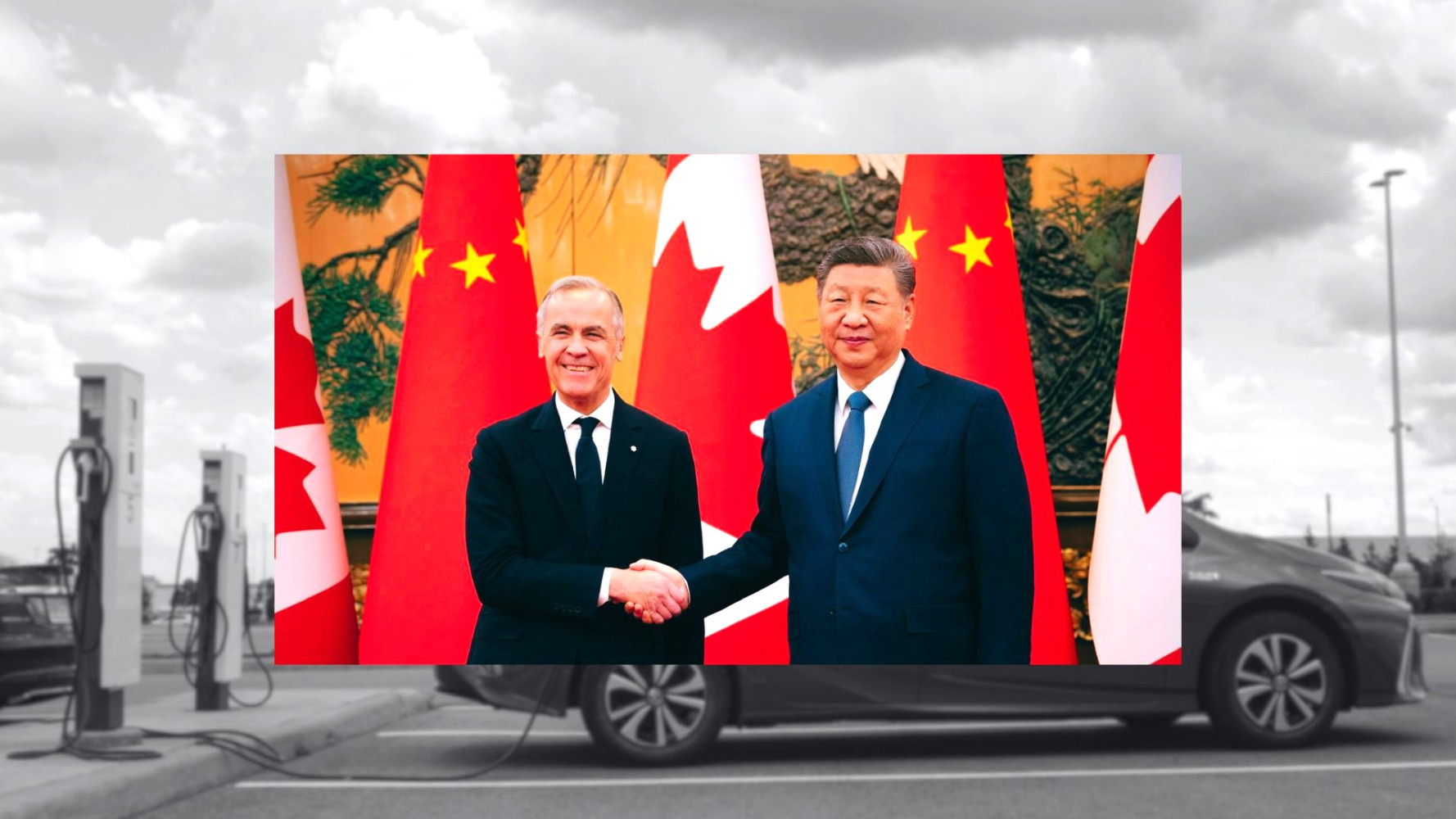
Ford’s initial reaction came just five days after the PM signed a deal under a “new strategic partnership” with China that allows an annual import quota of up to 49,000 EVs at a 6.1 percent tariff, with 50 percent of these vehicles required to have an import price under $35,000 by 2030. In exchange, China agreed to reduce its tariffs on Canadian canola, with the potential for future tariff relief that would further benefit the Canadian agricultural and fisheries sectors.
“Canada and China are both energy superpowers focused on expanding two-way energy cooperation – reducing emissions and scaling up investments in batteries, solar, wind, and energy storage,” a press release from Carney’s office detailed.
While the deal locks in specific terms, it is already being viewed by experts as the beginning of what could be significant changes in the Canadian EV market. The future remains largely uncertain, with market trends set to dictate how the agreement will impact Canada.
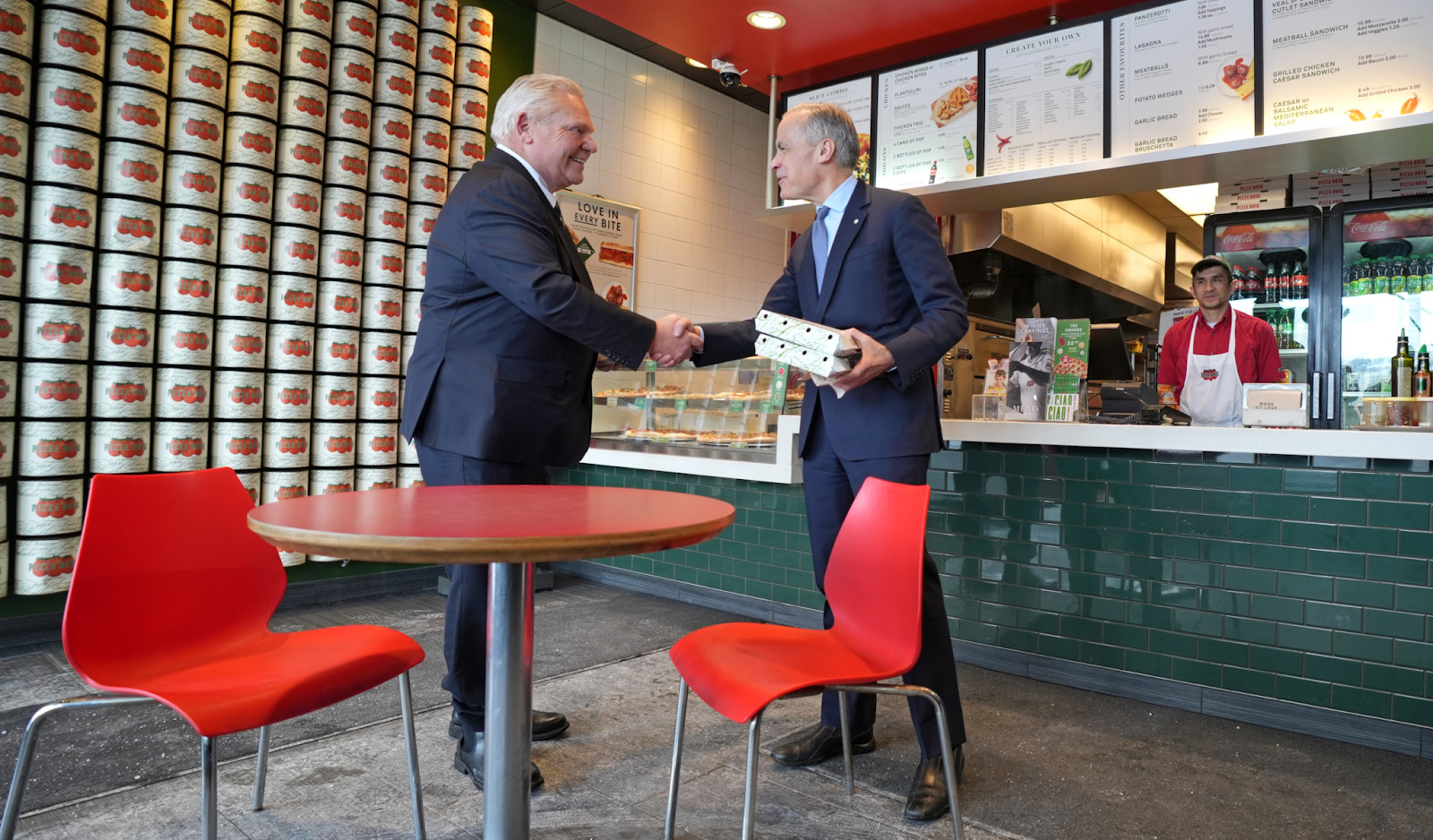
On January 26, Ontario Premier Doug Ford struck a conciliatory tone after a highly publicized pizza meeting with Prime Minister Mark Carney, hailing Ottawa’s “great auto strategy” as the two leaders moved past tensions over changes to Chinese EV tariffs.
Former environment minister Steven Guilbeault views the partnership as “encouraging”.
“It reaffirms the importance of the implementation of the historic Kunming World Framework Agreement in Montreal on nature and cooperation on climate change through the joint initiative between the European Union, China and Canada through the Ministerial Meeting on Climate,” Guilbeault said.
Canadian Climate Institute’s Principal Economist and Head of 440 Megatonnes, Dave Sawyer, said the prime minister’s trip to China, which opens the Canadian market to up to 70,000 Chinese EVs within five years, means Canadians “can expect higher EV sales, some redistribution of market share among producers and a modest improvement in emissions outcomes.”
It marked a sharp reversal from Canada’s previous stance when the government announced a 100 percent tariff on Chinese EVs on August 26, 2024, which came into effect on October 1. This matched a U.S. policy put in place due to “unfair trade practices” including “weak standards across EV supply chains, including poor labour standards, a lack of environmental protections, and trade policies supporting oversupply.”
For Ford and manufacturing and labour groups, including the Canadian Vehicle Manufacturers’ Association (CVMA) and Unifor, the trouble lies in the potential impact on jobs and existing supply chains in the province’s auto manufacturing sector. Carney has tried to assuage these concerns by framing the agreement as “an opportunity for Ontario” done in a “controlled way with a modest start”.
Clean Energy Canada’s clean transportation policy advisor Denise Lee says the agreement largely restores conditions that existed before the 2024 tariffs were imposed under the Trudeau government, when Canada was already importing roughly the same volume of EVs from China, about 40,000 vehicles annually in 2023.
Lee says there seems to be “a lot of anxiety” around the announcement because “a lot of people don’t actually know that we already have a lot of Chinese EVs and they are Teslas”.
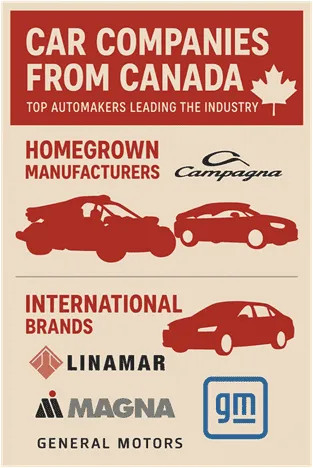
Canada only has small niche or specialized EV manufacturers such as Campagna and Edison Motors exist with no large-scale, domestically owned passenger car brand currently operating in the country. Every major company operating here is foreign-owned, primarily from the U.S., Japan or South Korea with the industry dominated by firms like Ford, GM, Stellantis, Toyota and Honda, which maintain assembly plants in Ontario.
(Canadian Car Shipping)
“This quota is also not a mandate of how many EVs come in, it will still be based on how many Canadians want to buy one,” she said, noting that the new number of EVs only represents 2.5 percent of all vehicle sales in Canada.
While the new deal does not guarantee investment in Canadian auto manufacturing, Ottawa said it is “expected” that the agreement will spur new Chinese joint-venture investments in Canada within three years.
“The way you want to welcome manufacturing into Canada is to allow in foreign EV models, let them establish a base here, show that Canada has an appetite and an ability to produce EVs and want them, and that is a really strong signal to foreign manufacturers to set up bases in Canada,” Lee explained.
“It is a little bit presumptuous of people like Doug Ford to say we really want Chinese manufacturing here but we also hate Chinese EVs.”
Even before the latest announcement, the province’s manufacturing sector was struggling. Its employment share has fallen to its lowest level since 1976, dropping below 10 percent of total jobs, according to a November 2025 report by the Financial Accountability Officer (FAO).
“Ontario lives and dies by its manufacturing base. So one would think more investment in Ontario would be helpful,” Sawyer added, noting that Chinese companies have already invested in Ontario.
In 2019, BYD opened a 45,000-square-foot electric bus assembly plant in Newmarket, supplying buses to the Toronto Transit Commission.
The company also overtook Tesla as the world’s largest seller of electric cars with 2.26 million units compared to Tesla's 1.63 million in 2025 with sights to open a third European assembly plant in Spain.
To further understand Canada’s sudden pivot, it might be helpful to turn to Carney’s January 20 speech at the World Economic Forum in Davos. He spoke of a new world order where “hegemons cannot continually monetize their relationships.”
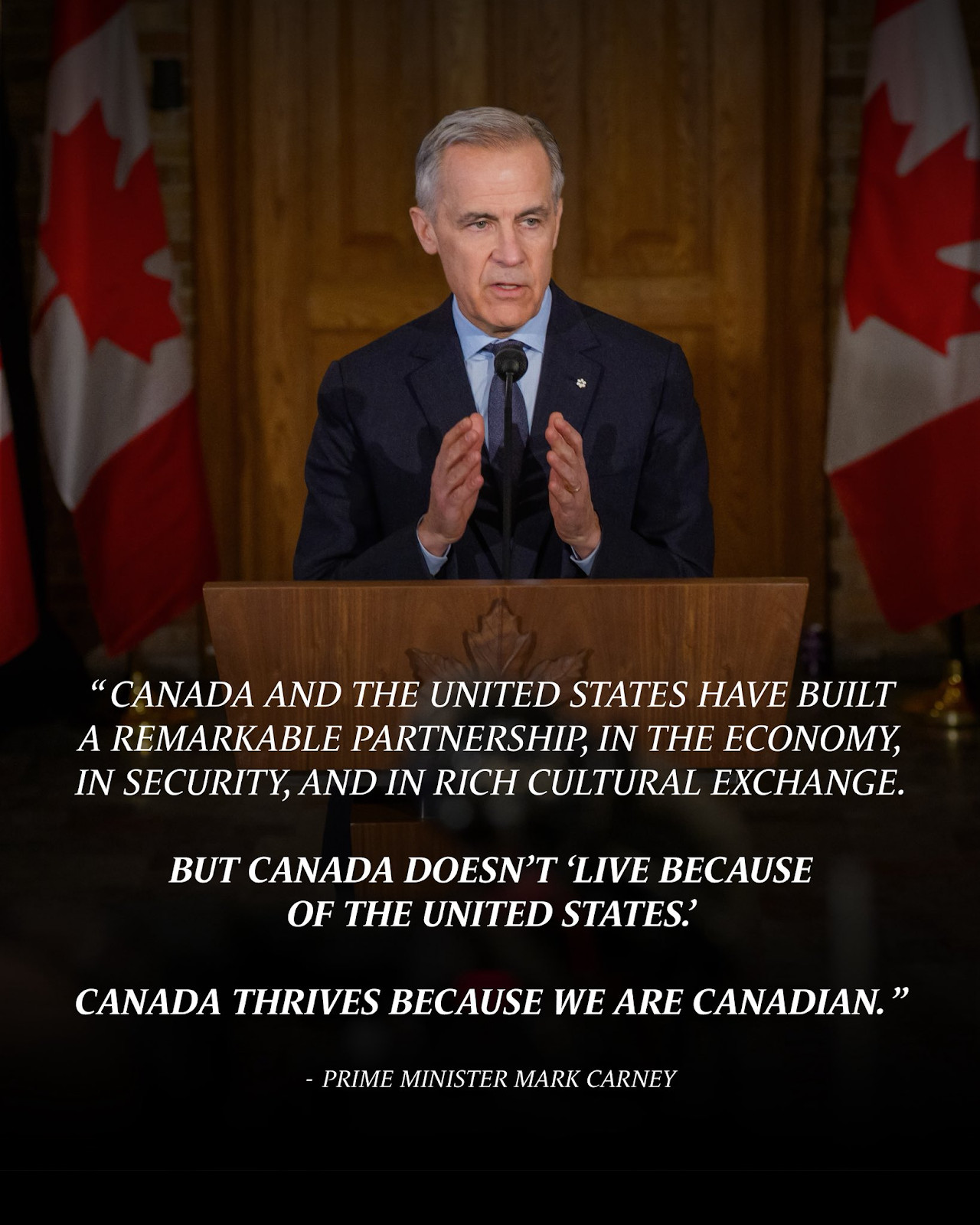
“We aim to be principled and pragmatic,” Canada Prime Minister Mark Carney said at the World Economic Forum. “Canada is calibrating our relationships so their depth reflects our values. We are prioritising broad engagement to maximise our influence, given the fluidity of the world order, the risks that this poses, and the stakes for what comes next.”
(Mark Carney/Facebook)
“Canada was amongst the first to hear the wake-up call, leading us to fundamentally shift our strategic posture,” Carney said in his speech that has since garnered international recognition.
“Allies will diversify to hedge against uncertainty. Buy insurance. Increase options…The question for middle powers, like Canada, is not whether to adapt to this new reality. We must. The question is whether we adapt by simply building higher walls – or whether we can do something more ambitious.”
U.S. President Donald Trump’s tariff whiplash has already left bruises on the world economy, with the International Monetary Fund (IMF) warning 2025 tariffs will be a major factor in slowing global economic growth, projecting 3.1 percent in 2026, down from previous projections of 3.3 percent.
Canada is not immune to these downturns. Analysis from the Canadian Chamber of Commerce’s Business Data Lab projected a hit to Canada’s Gross Domestic Product (GDP) by 2.6 percent, equating to approximately $78 billion and costing Canadians approximately $1,900 per person annually.
Even the Bank of Canada projected GDP to be 1.5 percent lower by the end of 2026 due to trade pressures.
“US tariffs have already hurt employment in the sectors most dependent on trade. Canadian businesses that are subject to tariffs knew demand for their products would be lower, so they cut jobs,” Bank of Canada Governor Tiff Macklem said in a speech on June 18 last year.
“If the current tariffs remain in place, more jobs will be lost. Over the longer term, employment will depend on how well Canadian businesses pivot to new markets.”
The Bank of Canada expected China’s economic outlook to grow faster than before, despite policy uncertainty, supported in part by “robust” government spending — much of which was in its electric vehicle industry.
Between 2009 and 2023, the country spent $230.9 billion to build its EV industry, analysis by the U.S.-based Center for Strategic and International Studies noted. It led to China marking its place as a dominant leader in the global EV market, producing over 70 percent of the world’s EVs as of 2025, according to the International Energy Agency (IEA).
“Sales were up 35 percent year-on-year in the first three months of 2025, with record first-quarter sales in all major markets,” the IEA reported.
Lee, who travelled to China last year, recalled standing on city streets surrounded almost entirely by electric vehicles, a moment she found striking.
“It was somewhat entertaining to me. If most Canadians saw how other countries are doing right now in their EV uptake, they would realize how behind we are,” Lee told The Pointer.
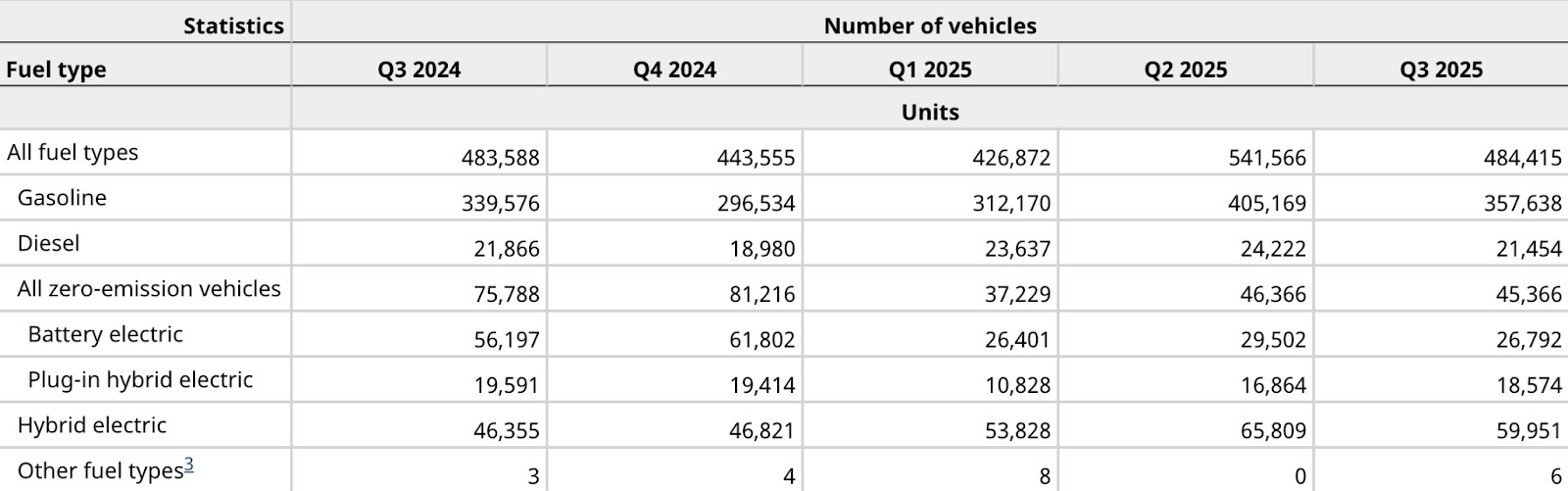
After the ban on Chinese EVs and the end of federal EV subsidies, EV adoption struggled to keep pace with the broader automotive market. While total vehicle sales in Canada remained relatively steady, ranging from 426,872 in Q1 2025 to 541,566 in Q2 2025, zero-emission vehicle registrations fell sharply from 81,216 in Q4 2024 to just 45,366 in Q3 2025.
On the contrary, Canada was among the only countries in the world in 2025 with declining EV sales, as zero-emission vehicle registrations fell from 81,216 in Q4 2024 to just 45,366 in Q3 2025, even as overall vehicle sales remained relatively stable.
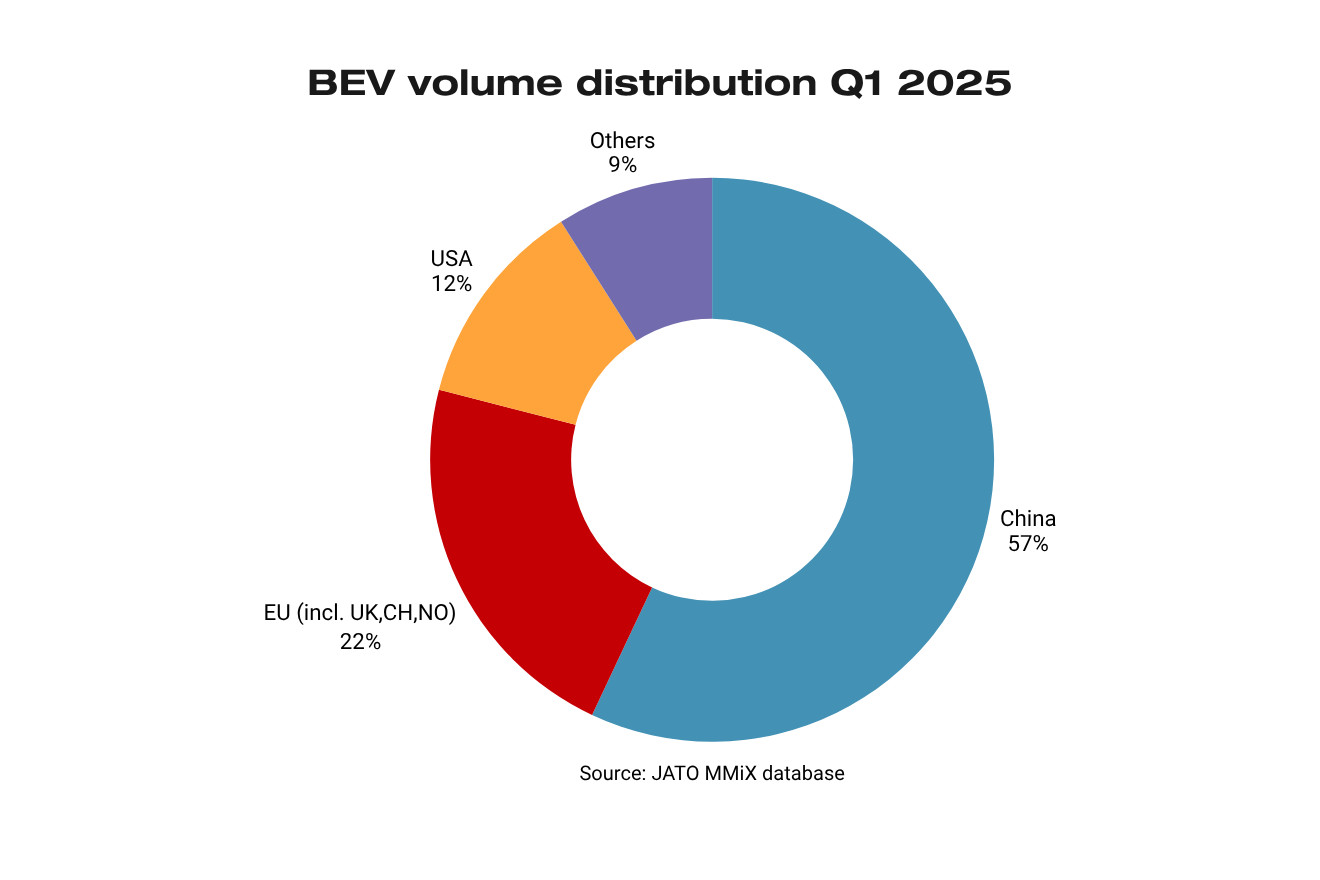
“China leads the BEV [battery electric vehicle] market with 57 percent of global registrations, followed by Europe (22 percent) and the U.S. (12 percent), while other countries remain below two percent”, a July report by market research firm JATO noted.
(JATO)
Despite massive investment in clean energy, China remains a major contributor to global emissions, with five Chinese companies ranking among the world’s ten largest oil, gas, coal and cement producers, a new Carbon Majors report highlighted. Collectively, the world’s top ten emitting companies, all fully or majority state-owned, were responsible for 27.6 percent of global emissions in 2024, with China accounting for 11.6 percent of that total.
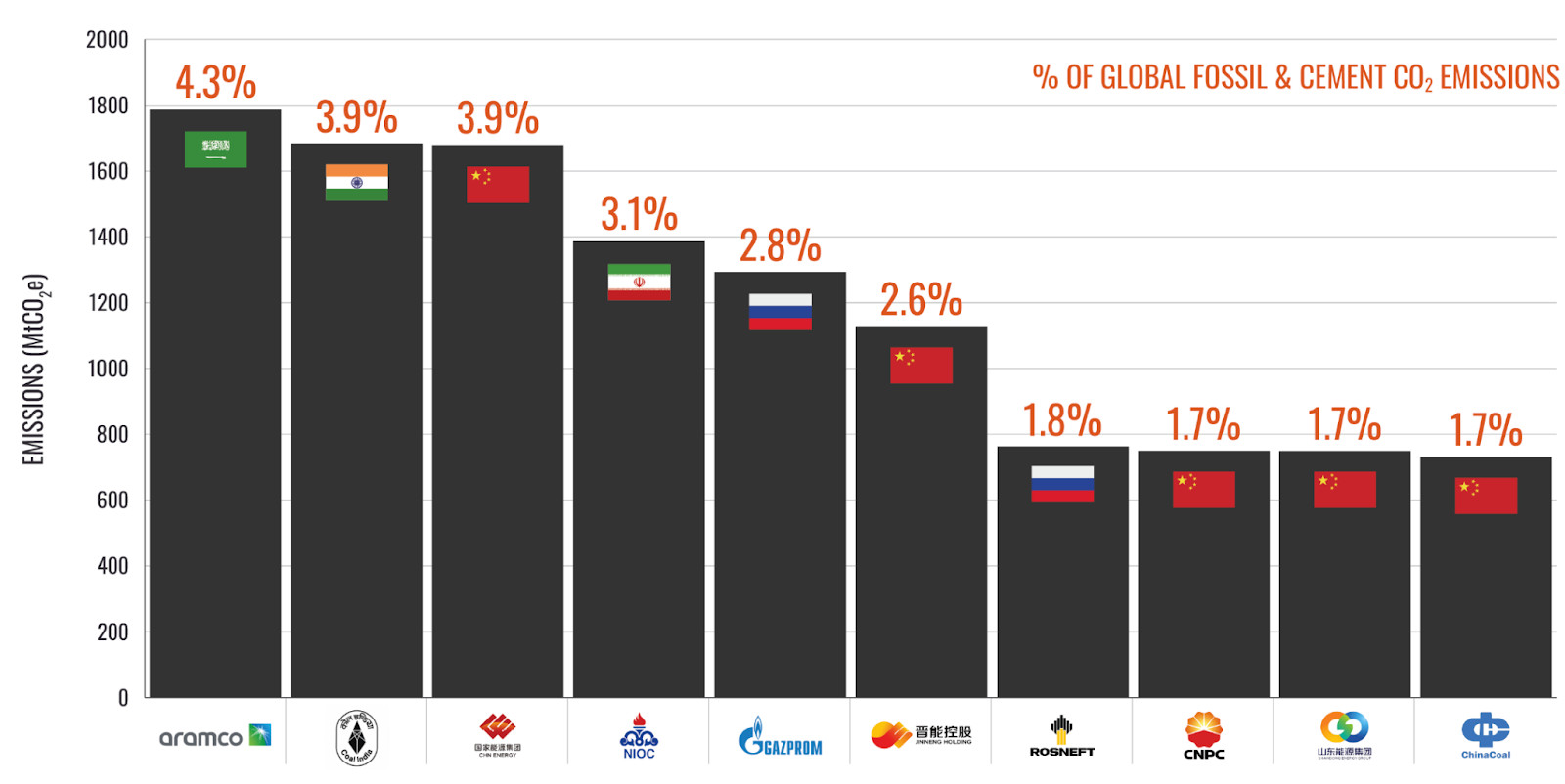
A recent Carbon Majors update showed global emissions remain heavily concentrated among state-owned fossil fuel producers, with Saudi Arabia ranking as the largest source, followed by China, whose state-owned firms accounted for about 11.6 percent of global emissions. Canada also appeared among the top emitters, largely due to oilsands production by Canadian Natural Resources, accounting for 0.48 percent of global emissions in 2024 and 0.15 percent historically between 1854 and 2024.
(Carbon Majors)
China’s influence has also been reshaping EV markets beyond its borders, with its imports driving 75 percent of the increase in 2024 EV sales in emerging economies like Asia and Latin America.
Lee sees Canada’s latest EV deal with China as “a really big opportunity for Canadians to finally have access to a technology that is affordable and good for the planet.”
A July 2025 study by the International Council on Clean Transportation (ICCT) found that battery electric cars sold today produce 73 percent less greenhouse gas emissions over their full life cycle than gasoline cars, nearly four times lower, even when accounting for emissions from production.
While the Canada-China EV deal is expected to bring emissions down, it won’t be a “big impact,” Sawyer told The Pointer.
The environmental economist projects the net increase in Chinese electric vehicle sales could reduce greenhouse gas emissions by approximately 113,000 tonnes per year, amounting to about 1.7 million tonnes of carbon dioxide equivalent over the fifteen-year lifetime of the vehicles.
Investors for Paris Compliance senior analyst Michael Sambasivam said the deal also represents another signal of “disruption” for Canada’s oil and gas sector, which remains “heavily exposed” to transportation demand.
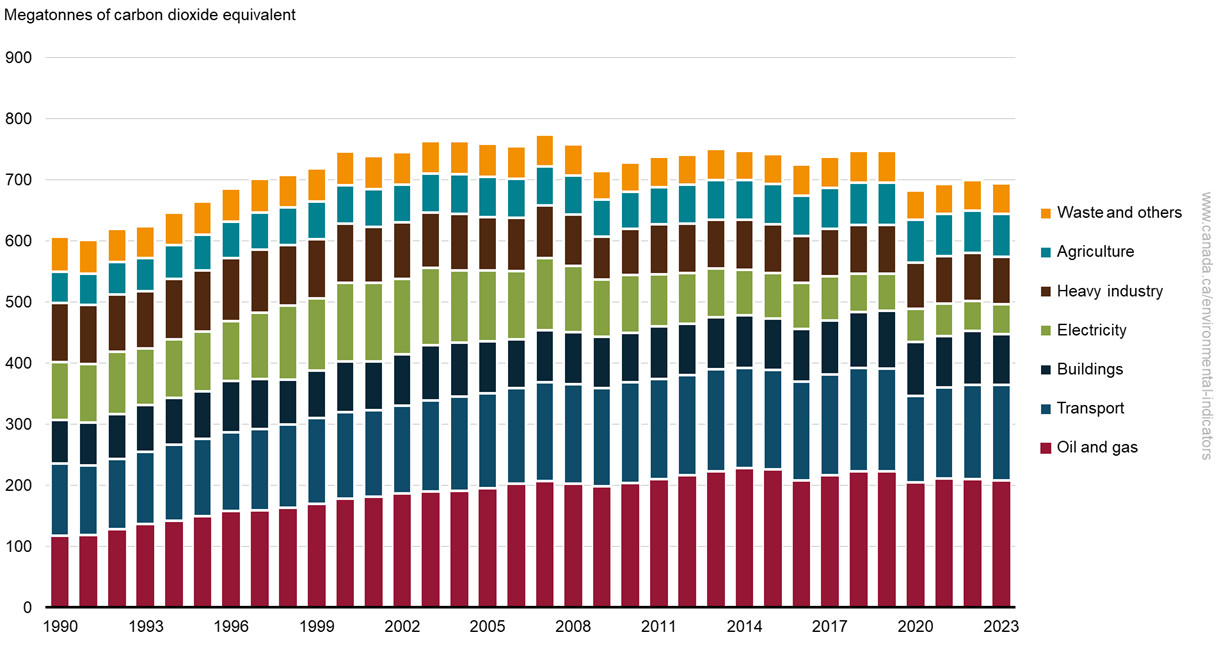
Canada's oil and gas sector and transportation sector are the largest greenhouse gas emitters, together accounting for more than half of national emissions.
“About half of North American oil consumption goes to transportation…As EVs become cheaper and more widely available, that demand is increasingly at risk.”
Sambasivam noted that China’s electric vehicle industry has faced criticism for heavy subsidization but that strategy should be understood as long-term economic planning rather than market distortion.
“China has been really prudent on emerging sectors,” he added, pointing to the country’s dominance in affordable solar manufacturing and its growing lead in electric vehicles.
He added that falling battery costs, improving charging infrastructure and expanding access to critical minerals are rapidly narrowing the price gap between electric and gas-powered vehicles. “When that tipping point is hit, the ability of Canada to sell its oil is going to be risky,” Sambasivam said.
He described the Canada-China EV agreement as incremental but consequential. “This is a baby step,” he said, adding that making electric vehicles more affordable would help accelerate Canada’s energy transition while putting pressure on North American automakers to adapt.
“The bigger impact is on affordability,” which has been a hindrance to EV adoption in the country, Sawyer noted.
Polling conducted by Abacus Data on behalf of Clean Energy Canada revealed approximately 45 percent of Canadians were inclined to purchase an EV as their next car with stronger support for EVs among younger, urban residents.
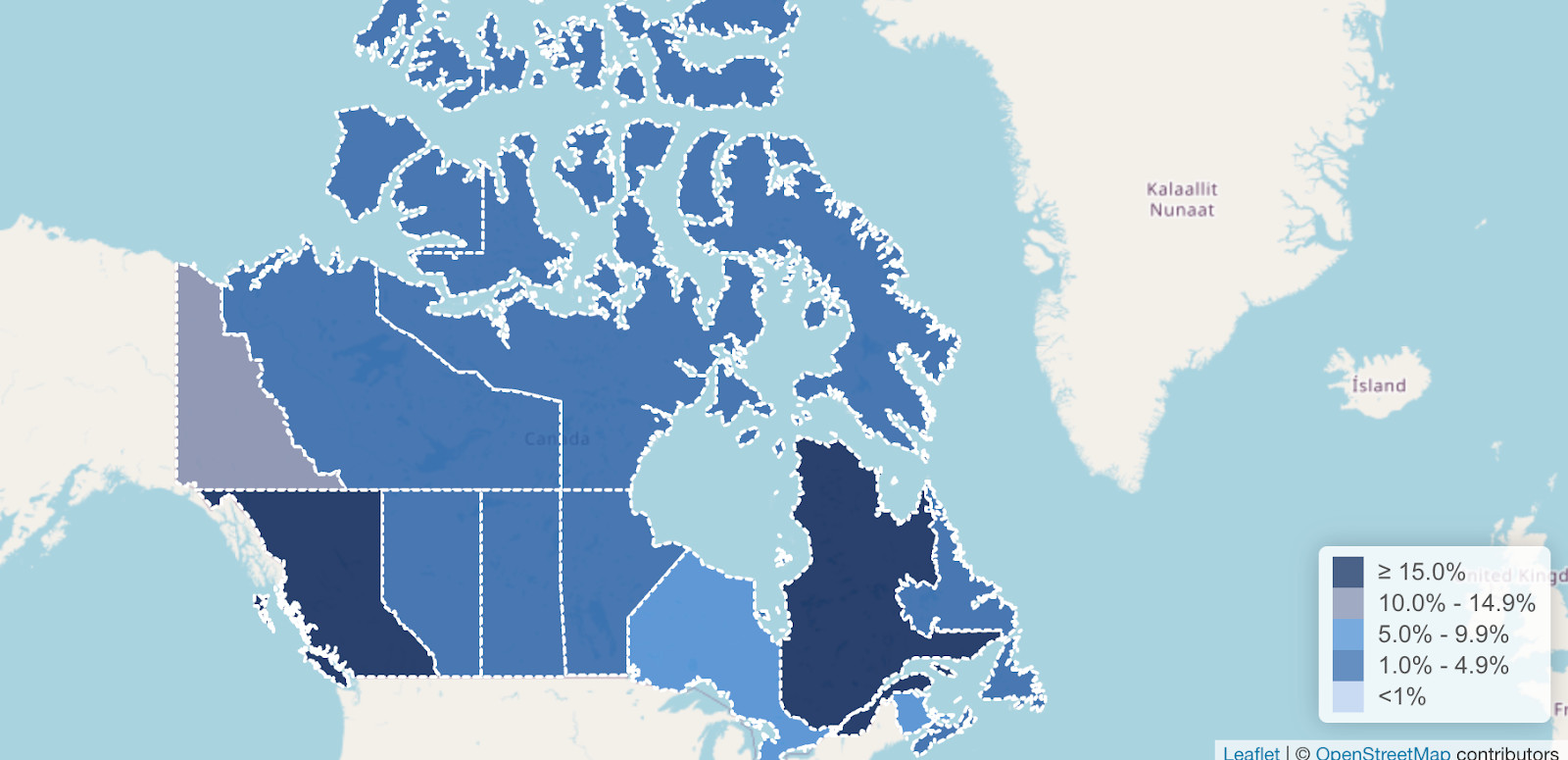
Quebec, British Columbia, Yukon and Ontario are among the leading provinces in EV adoption with market shares of 14.8 percent, 19.2 percent, 10.9 percent and 7.3 percent, respectively in Q1 2025, well above the national average of 9.7 percent.
In surveys of the Greater Toronto and Hamilton Area and Metro Vancouver, conducted between November 2024 and January 2025, nearly seven in ten respondents in Metro Vancouver (69 percent) said they favoured electric vehicles.
In the GTHA, where EV adoption lags significantly behind Metro Vancouver, 55 percent of respondents said they preferred an EV over a gas-powered vehicle. That share rose to 62 percent when respondents were presented with additional information about EVs, suggesting many consumers remain open to persuasion when concerns are addressed.
But what were those concerns? High costs (58 percent), limited range (52 percent) and poor infrastructure (41 percent).
There is no doubt that there is demand.
The federal Canadian Incentives for Zero-Emission Vehicles (iZEV) program, which offered rebates of up to $5,000 for EV purchases and was scheduled to end in March 2025, was paused early on January 12 due to high demand and depletion of funds.
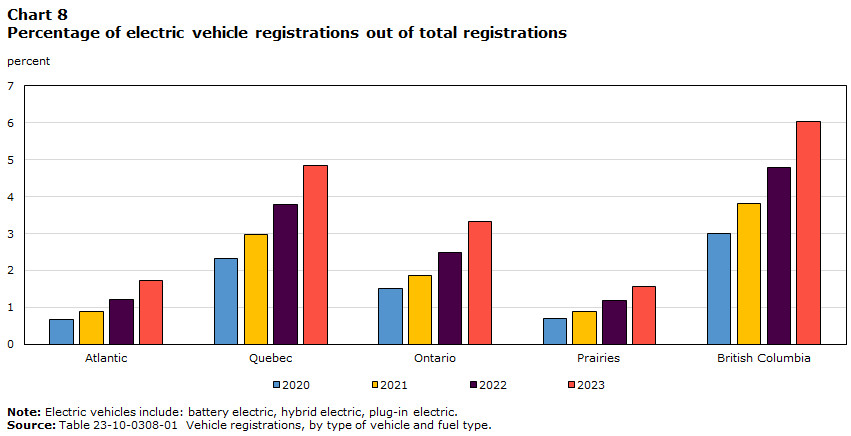
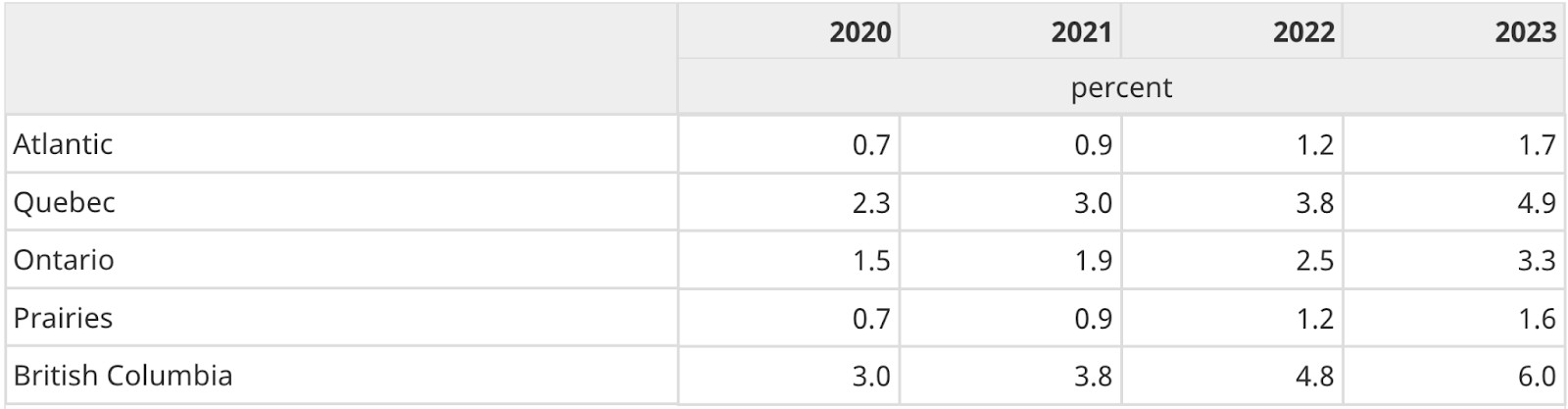
Demand for electric vehicles in Ontario has risen steadily, with EVs accounting for more than double the share of vehicle registrations over four years from 1.5 percent in 2020 to 3.3 percent in 2023.
(Statistics Canada)
On September 5, Carney also announced a one-year pause on Canada's EV sales mandate, which is also being threatened under the Conservative Party’s motion for the Canadian Sovereignty Act, specifically the 2026 target of 20 percent zero-emission vehicle sales, while calling for a 60-day review of the policy to address economic pressures, including U.S. tariffs on Canadian goods.
While Ford has signalled he wants Ottawa to reconsider the mandate requiring 60 percent of new vehicle sales to be electric by 2030, rising to 100 percent by 2035, industry minister Mélanie Joly said those conversations are still ongoing and the federal government will have “more to say in the coming weeks”.
“We can’t just have an auto strategy in a bubble in Ottawa. We need to work with the premier. We need to work with everyone to roll out the strategy and basically have their input,” she said after a meeting with Ford on January 26, emphasizing that Ottawa understands the “pain that the autoworkers are going through” because of U.S. tariffs.
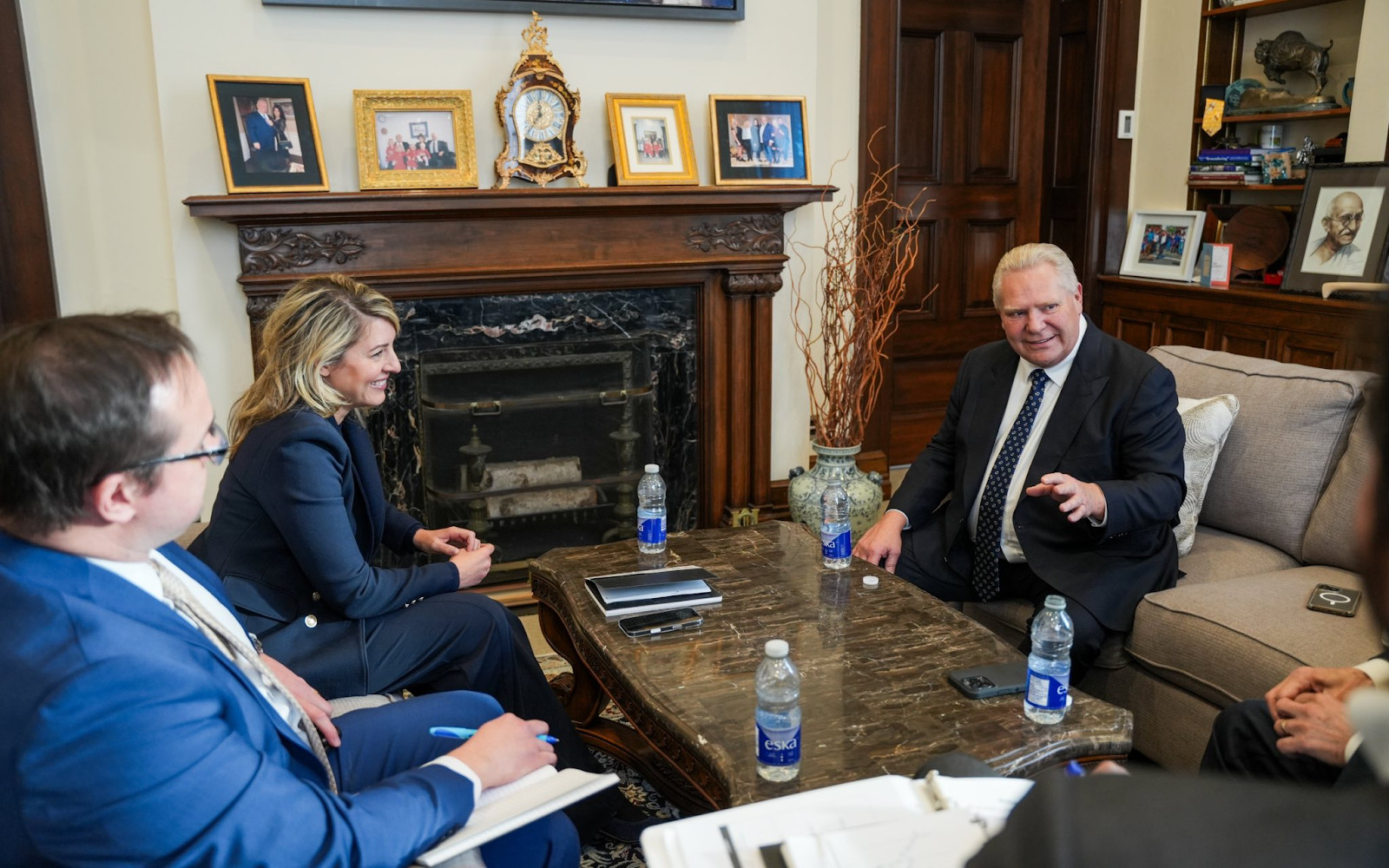
On January 26, industry minister Mélanie Joly said a new federal auto task force will be created, following a closed-door meeting with Ontario Premier Doug Ford, aiming to coordinate Ottawa and Queen’s Park’s efforts as the auto sector navigates trade tensions and electrification.
(Doug Ford/Facebook)
Environmental Defence Clean Transportation Manager Sam Hersh, who has been in talks with federal officials, was informed that an announcement on the EV sales mandate was expected in January.
Hersh warned that weakening the standard would stall Canada’s domestic EV industry, allow automakers to continue prioritizing gas-powered SUVs and leave the country increasingly reliant on imported vehicles.
After the meeting with Ford, Joly said Ontario and the federal government have agreed to launch an auto manufacturing task force to protect the existing workforce by focusing on “future strategic” investments. In February, Ottawa is expected to unveil a new auto strategy that will center on domestic EV production and offer more favourable Canadian market access to foreign automakers that manufacture vehicles in Canada.
Later that afternoon, the Premier also met with Carney over a pizza break in Etobicoke, changing his tone and calling Ottawa’s approach the “great auto strategy”.
Calling for a “balanced approach,” Hersh said the agreement with Beijing is welcome news, as increased competition and lower prices would be beneficial as long as they are supported by “strong domestic policy”.
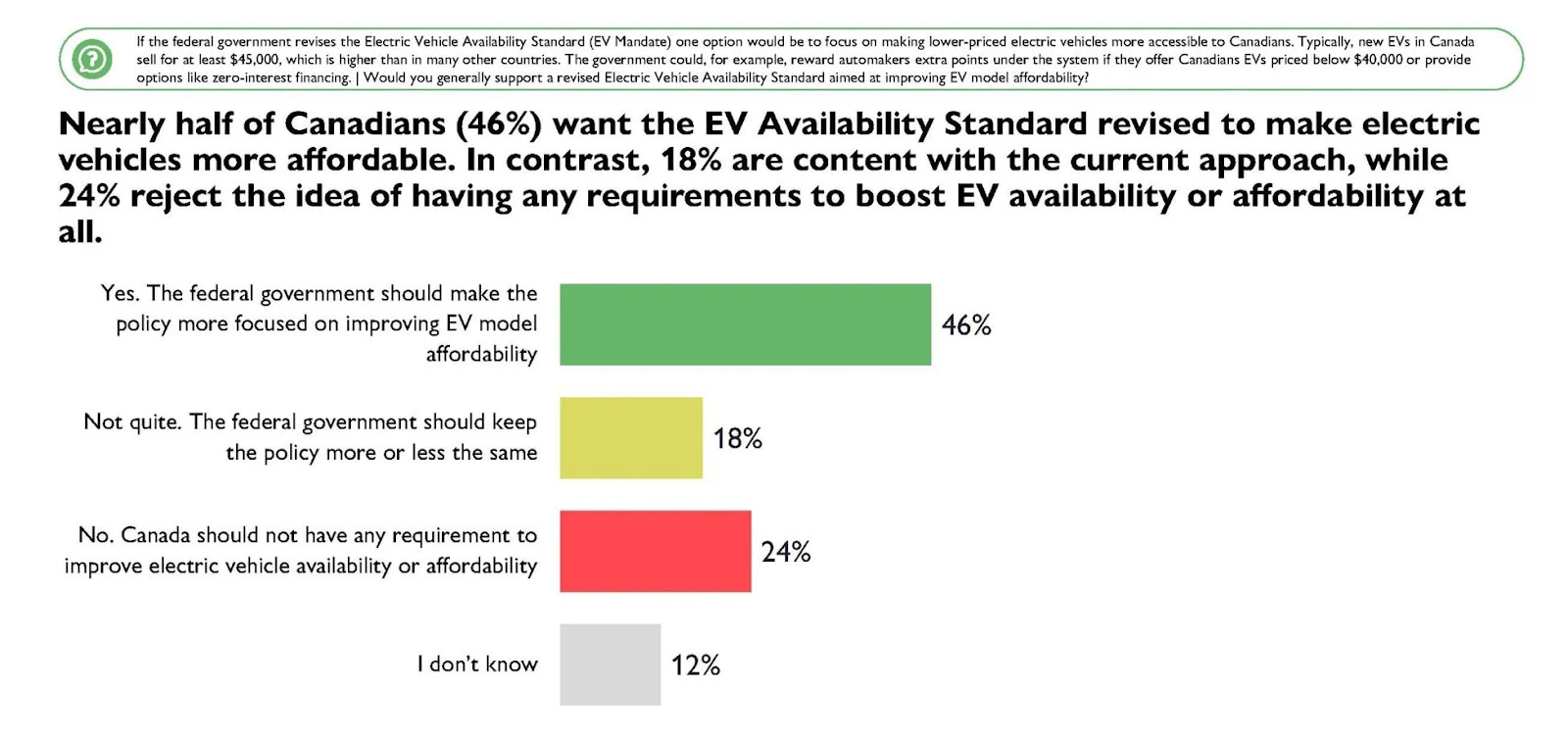
A September 2025 poll conducted by Abacus Data and Clean Energy Canada highlighted that 46 percent of Canadians supported revising the federal Electric Vehicle (EV) Availability Standard to specifically make electric vehicles more affordable.
(Abacus Data/Clean Energy Canada)
In April last year, Statistics Canada reported that a new battery EV costs about $70,682 while a used EV costs $42,045 — this will change under the agreement with Beijing.
Modelling by Sawyer estimates the Canadian EV market would settle at about 211,000 EV sales in the first year, an increase of about 31,000 vehicles as prices decline. Chinese EVs would account for 49,000 sales, capturing approximately 23 percent of the market and displacing about 18,300 sales from other brands. Overall, EVs would rise from roughly ten percent to 11.7 percent of total vehicle sales.
Total consumer cost savings are estimated at $330 million, averaging $6,700 per Chinese EV buyer, with lower-cost models priced around $35,000 generating savings of $7,000 to $12,000 per vehicle.

The 2025 Fiat 500e is known as one of Canada’s cheapest EVs with models starting around $39,995 for the base model.
Whether these gains will result in the resumption of Ottawa’s EV sales mandate remains “unclear”, Sawyer says it would be reasonable to expect the Carney government to reintroduce consumer EV incentives under an affordability framework in the coming months but not the zero-emission vehicles availability standard.
But mandates alone are not enough. “Vehicles on the lot, reliable charging infrastructure and affordability — those three together are what drive EV adoption,” he added.
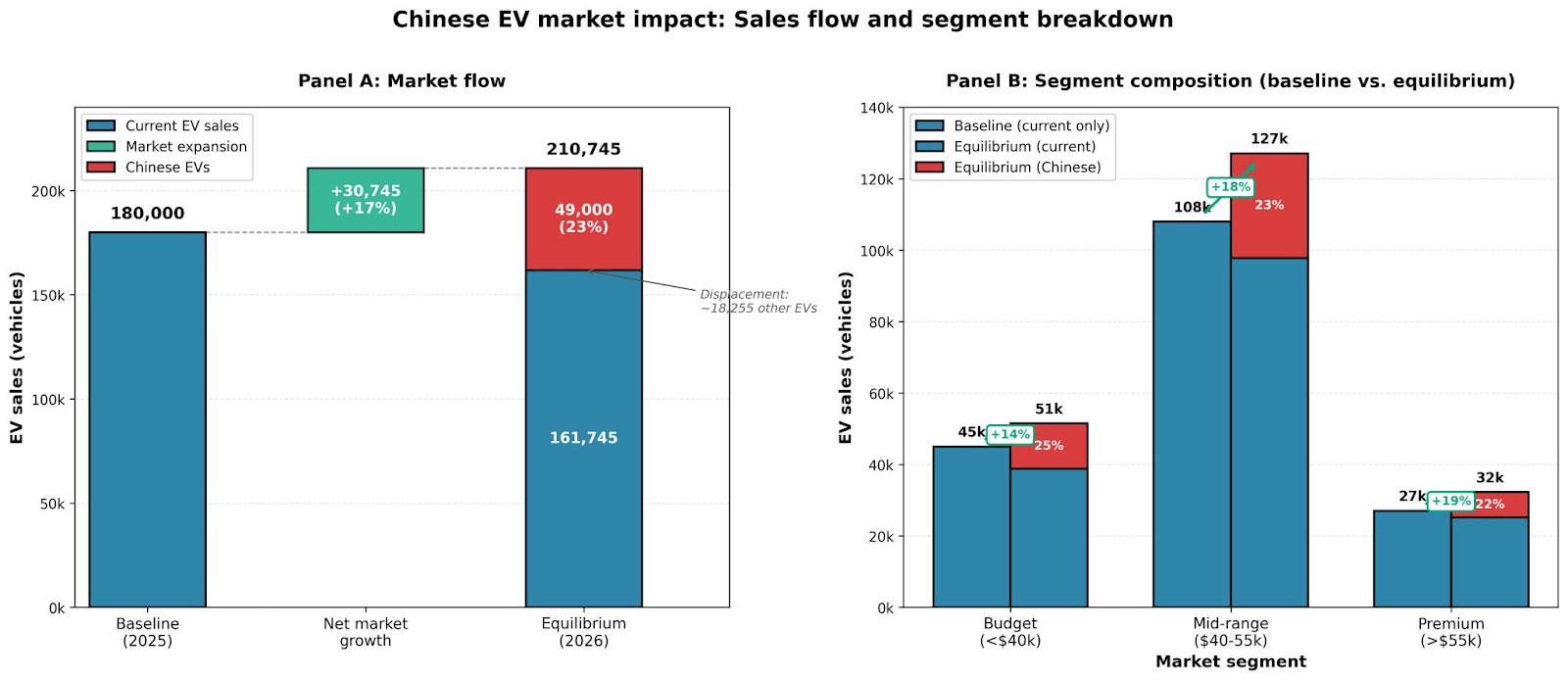
Canadian Climate Institute Principal Economist Dave Sawyer expects “Chinese imports will improve affordability by both expanding the EV market and redistributing market share but deliver only modest decarbonization gains. There will be costs to Canadian and foreign producers to the extent they are unable to compete.”
(Dave Sawyer)
EV adoption and charging infrastructure are also deeply interdependent.
“Most charging happens at home but a robust public network is essential for longer trips or for those without home access and expanding that network depends on growing EV demand,” Lee explained.
“More vehicles on the road attract investment to build chargers, which in turn supports further adoption.”
The City of Mississauga said, “the federal government’s announcement will not change or impact” the City’s “efforts to install public EV chargers” which is guided by the Zero Emission Vehicle Strategy.
“EV charging network will continue to be an important amenity for our residents and with increases in market share of EVs, we expect charging usage to increase,” the City stated in a statement shared with The Pointer.
In March last year, the City introduced a new EV charging fee policy, which took effect on April 2, 2025, prior to which it was free, charging users of City-owned public EV stations $0.30 per kilowatt-hour based on actual energy use to recover operating and maintenance costs.
The federal government has not provided details on which companies might benefit from the deal. But looking back at 2023, most Chinese-made EVs entering Canada were Tesla Model 3s. So, Canada could potentially allow any vehicle made in China to enter the market including Teslas but there’s an important condition: at least half of these vehicles must be priced under $35,000.
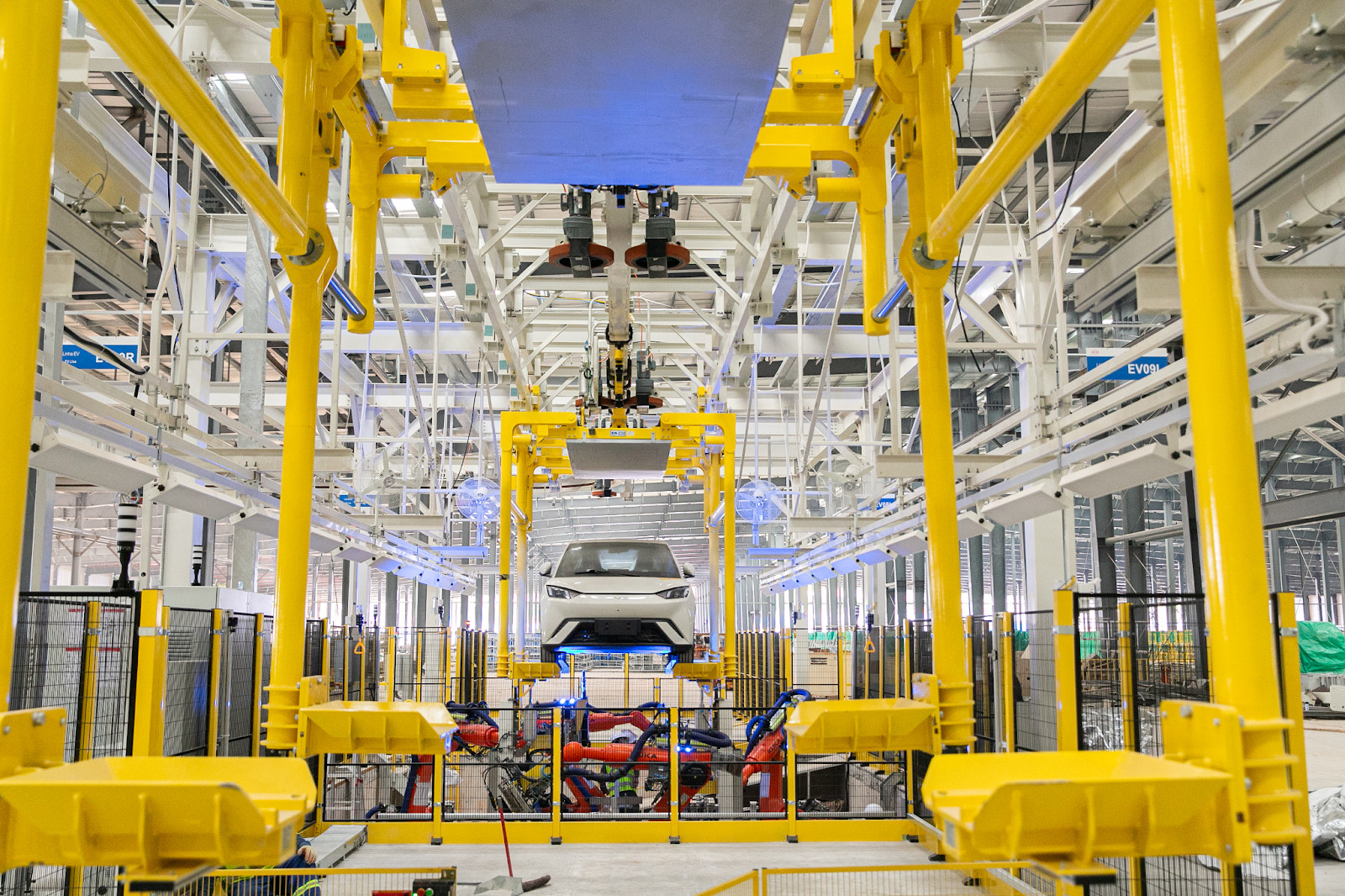
In 2024, BYD acquired the former Ford plant in Camaçari, Bahia, Brazil, for R$300 million, transforming it into a major EV hub. During construction, the plant faced scrutiny for “slavery-like” labour conditions, which BYD has since addressed. By July 2025, it rolled out its first fully electric vehicle in Brazil, the BYD Dolphin Mini (Seagull in China, Dolphin Surf in Europe). Under the Canada-China EV trade deal, lower-cost BYD models like the Seagull ($20,000–$30,000), Dolphin ($25,000–$30,000), Atto 1 ($22,000–$30,000), Atto 2 ($31,000–$35,990), and base Sealion 06 ($34,000–$35,000) could qualify for reduced tariffs and entry into the Canadian market.
(BYD)
Since Tesla currently does not offer a model at that price point, other Chinese automakers like Chery and Nio or those willing to meet this pricing threshold as well as adapt their vehicles to meet Canadian safety and technical standards, are more likely to enter the market.
“Many people are unaware of the fact that Chinese automakers are already in Canada, producing vehicles, just not the light-duty vehicles that we're used to buying,” Lee said.
“It would not be surprising to me, considering BYD is both the largest EV producer and already active in Canada, and also has a massive manufacturing base in Mexico that it could be a strong contender to enter the Canadian market.”
She explained that when discussing Chinese EVs, it’s important to clarify that this includes EVs made in China, even by American automakers with factories in cities like Shanghai, which can then export those vehicles to Canada.
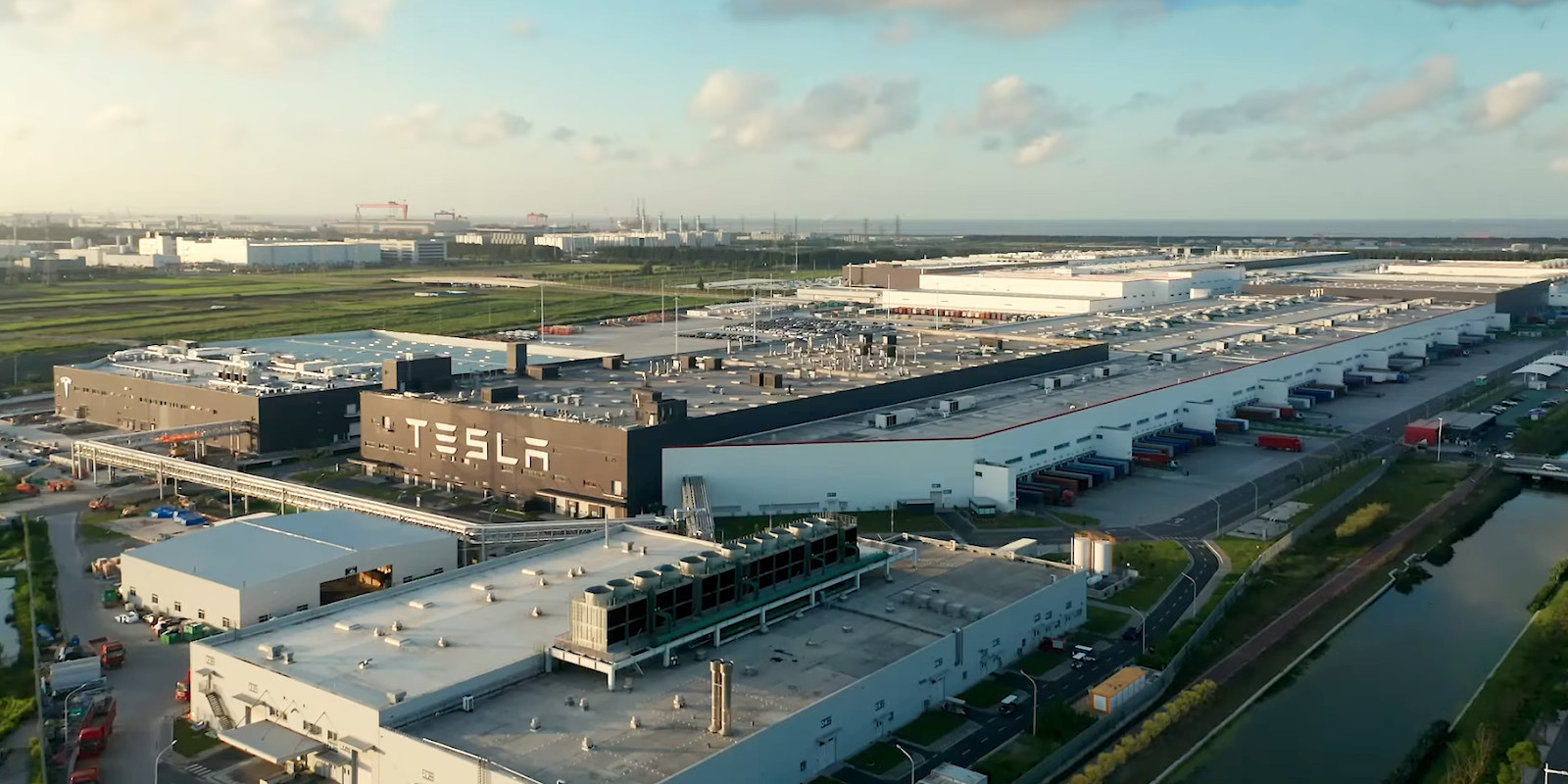
Tesla manufactures vehicles in China at its Gigafactory Shanghai, which produces a significant portion of the world's Tesla Model 3s and Model Ys, serving both the Chinese market and for export globally.
Beyond Chinese brands, non-Chinese automakers like Tesla, Volvo and Polestar could also qualify under the rules.
Even though Ford, who has since taking office eliminated key policies supporting EV adoption, asked Canadian to “support companies that are building vehicles here”, Sambasivam believes ultimately consumer behaviour will be driven less by political messaging and more by affordability.
“The driving factor, for most consumers in determining what cars they’re going to buy, is largely cost,” he said.
From a broader perspective, Sambasivam sees the deal as “just one more step in terms of the disruption to the Canadian oil and gas sector”, warning that continued resistance to transition is economically risky as “EVs coming to scale is appearing more and more like an inevitability.”
Email: [email protected]
At a time when vital public information is needed by everyone, The Pointer has taken down our paywall on all stories to ensure every resident of Brampton, Mississauga and Niagara has access to the facts. For those who are able, we encourage you to consider a subscription. This will help us report on important public interest issues the community needs to know about now more than ever. You can register for a 30-day free trial HERE. Thereafter, The Pointer will charge $10 a month and you can cancel any time right on the website. Thank you
Submit a correction about this story

