
Trial for accused in horrific animal abuse case resumes Thursday
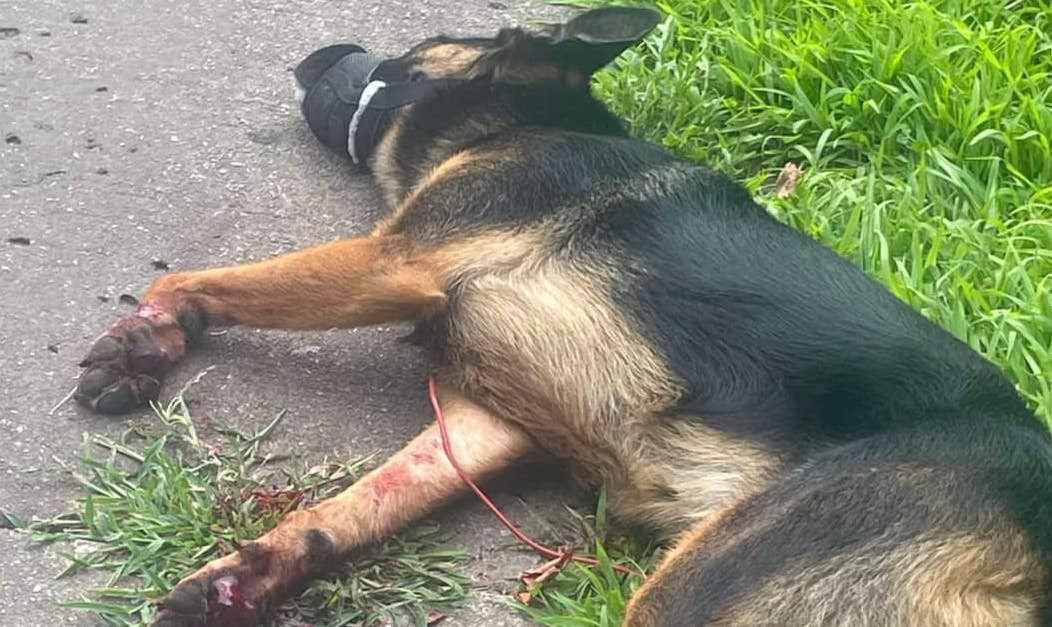
The woman accused in an animal abuse case that shocked residents of Niagara Region will return to a Welland courtroom this week to continue the trial stemming from the 2024 death of her German shepherd, Dakota.
Last year, Carly Young was charged with four offences under the Provincial Animal Welfare Services Act (PAWS) for permitting distress to an animal, “exposure to undue risk of distress”; and not providing basic standards of care following Dakota’s death in the summer of 2024.
The charges have not been proven in court.
Young, through posts on Facebook, has denied any wrongdoing.
The second and final day planned for the trial will be held on January 29 at the Welland Courthouse. During a September court date, the trial heard from Provincial Animal Welfare Service (PAWS) Officers and a representative from the Welland SPCA. Veterinary experts are expected to be called to testify on Thursday.
The trial comes more than a year after Dakota died on the side of the road in Niagara Falls. Videos of Dakota running down the street captured her dragging several metal poles attached to a long leash. A muzzle was cinched tightly around her mouth with a plastic bag stuck inside her throat.
She eventually collapsed, bleeding and seizing on the sidewalk.
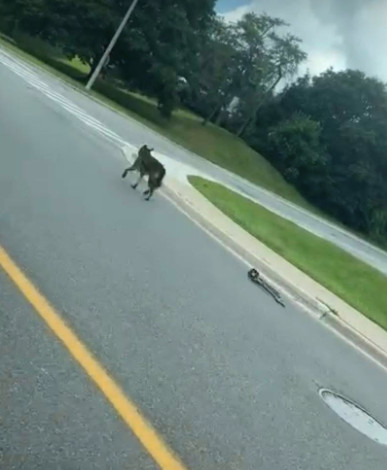
Dakota is seen in a video posted to Facebook. She is dragging metal poles attached to her leash. The poles were part of a table she had been tied to before breaking free.
(Facebook)
The Pointer previously detailed how the case has become a symbol of the dire need for major reform to Ontario’s broken animal welfare system.
The police and AWS were aware of the alleged mistreatment of Dakota by her owners through multiple complaints from residents who lived in the same building.
Jennifer Sparaga, a previous neighbour of Young’s, told The Pointer there was constant screaming, arguing and barking. Dakota was often locked in the apartment’s bathroom, she said. Sparaga could tell when Dakota was locked in the bathroom as their units had a shared wall. She would often sit against that wall, speaking to Dakota in an attempt to soothe the clearly distressed animal.
The unit was infested with bugs. To keep cockroaches and bed bugs from migrating out of the unit into her own, Sparaga would run packing tape along the edges of her apartment door.
Management and other services often showed up at Young’s door, but multiple locks prevented them from getting inside.
“I can’t exaggerate it enough, almost every single day, some sort of service was here,” Sparaga says, describing ambulances, the fire department and police that were routinely called to the unit but would not be let in. “It was just non-stop chaos.”
Despite animal welfare agencies being well aware of concerns surrounding Dakota’s treatment, no action was taken.
“AWS actually went to the property twice, and did nothing. The health department went, did nothing; bylaw went, did nothing; the police, same thing. Everybody was passing the buck,” Donna Power, a co-founder of the Humane Initiative previously told The Pointer. The Humane Initiative is a prominent animal welfare organization in Ontario, and immediately began advocating for justice in Dakota’s case in the summer of 2024.
“It wasn’t until we were screaming and making these posts that they did anything,” Power told The Pointer at the time.
Power recently wrote an op-ed for The Pointer detailing the myriad of problems currently plaguing Ontario’s animal welfare system. Many of these issues are exposed by Dakota’s troubling case and could have directly contributed to her death.
Public awareness efforts by Power and the Humane Initiative created widespread knowledge of Dakota’s case in Niagara and led to the eventual AWS investigation and charges.
“Dakota’s soul cannot rest until there is justice,” one commenter wrote on Facebook at the time.
In several posts written in the days after Dakota’s death, Young and someone writing on her behalf claim what happened that July day was a terrible accident.
“I was sitting at the table with her; she didn’t like loud noises. The cable guy moved his ladder, and it made a loud noise and spoked (sic) her and she bolted,” a post from Young explained. “I was sitting with her, and I went after her, and she is very fast.”
She claimed both her and her husband were looking for Dakota. As for the plastic bag in her mouth, “she picked it up on her way to where she was running.”
Carly was meant to make her first appearance at the Welland courthouse on February 25th last year. She was a no-show. The matter was pushed to July 22, where she failed to show up again. On that date, a bench summons was issued to force Young to attend and answer to the charges. A bench summons gives police the power to arrest the individual to ensure they show up in court.
Power with the Humane Initiative says this is the reason why the police and Crown Attorneys need to consider criminal charges of animal cruelty instead of the provincial offences, which she says carry little weight.
“There needs to be an appropriate consequence for committing this. Right now, the message is very clear…you can do pretty much anything to animals and face little to no true justice,” Power previously told The Pointer. “There is no deterrent. Under the Provincial Offences Act…there is no criminal record for a conviction, and a conviction is meaningless outside the province of Ontario.”
Rarely do even the most awful acts of animal cruelty result in Criminal Code charges, even provincial offences are a rarity.
According to the limited data provided by AWS for 2023, of the 2,893 cases where the abuse was so egregious the animal had to be removed from the owner’s care, only 10 percent of those (296) resulted in charges being laid. Of the nearly 40,000 calls received at the Ontario Animal Protection Call Centre, 57 percent of them are closed without any inspection, follow-up, or investigation being completed.
The PC government has taken little interest in putting forward real solutions to addressing the significant gaps in Ontario’s animal welfare system. The government’s legislation to end puppy mills has few mechanisms to actually accomplish that goal; the failure to create a license system for breeders is allowing the proliferation of online puppy sales that further harm animals; and the ongoing unwillingness to adequately resource the AWS department.
Ontario, a province with a population of 15.8 million people, has fewer animal welfare inspectors than Manitoba, which has a population of 1.5 million.
Email: [email protected]
At a time when vital public information is needed by everyone, The Pointer has taken down our paywall on all stories to ensure every resident of Brampton, Mississauga and Niagara has access to the facts. For those who are able, we encourage you to consider a subscription. This will help us report on important public interest issues the community needs to know about now more than ever. You can register for a 30-day free trial HERE. Thereafter, The Pointer will charge $10 a month and you can cancel any time right on the website. Thank you
Submit a correction about this story

