
New report shows Peel’s carbon emissions rose 9% in 2025 as Ford leans into gas-powered electricity
Around the world environmentalists have shuddered at the rollback of hard-fought gains made over the previous two decades in the fight to curb carbon emissions and stave off catastrophic planet-wide climate devastation.
Peel has not been immune to the recent worrying trends, as governments cancel emission reduction policies while many Canadians despair over the backsliding. In Peel, gas-powered electricity is a big culprit, as the provincial government continues its push to use dirty fuel to meet increased energy demand. Immediately after becoming Premier in 2018 Doug Ford cancelled hundreds of clean energy projects and other green initiatives across the province, and instead began to implement his gas plan to expand the electricity grid.
Ontario’s Auditor General has released damning reports showing how the PCs under Ford have destroyed emission reduction strategies and driven up pollution levels.
According to a new report released by The Atmospheric Fund, Peel’s carbon emissions increased 9 percent in 2025. The report describes this increase as “significant,” after the region saw its “highest level in over 10 years.”
Per person emissions in Peel increased, from 7.1t for each resident, on average, in 2024 to 7.9t in 2025. Because they account for such an outsized portion of overall emissions, buildings were the biggest contributor to the dramatic increase in pollution. According to the report, emissions by buildings rose by 14 percent due to cold temperatures that increased demand for gas heating. The second biggest contributor to the increase was due to electricity-related consumption, with a 24 percent increase in emissions, driven by the spike in gas-fired power across Ontario’s grid under the energy policy of the Ford PC government. A one percent rise in electricity use in 2025 did not help, as more and more power in the province is now being generated from gas.
A policy tracker at the end of the TAF report says Peel Region is making some progress in implementing policies to reduce emissions, and transportation, the second biggest overall polluting category after buildings, is making good progress. However, where the region falls behind is in the way electrification is being managed, which the report says is putting meaningful emission reductions overall “at risk”.
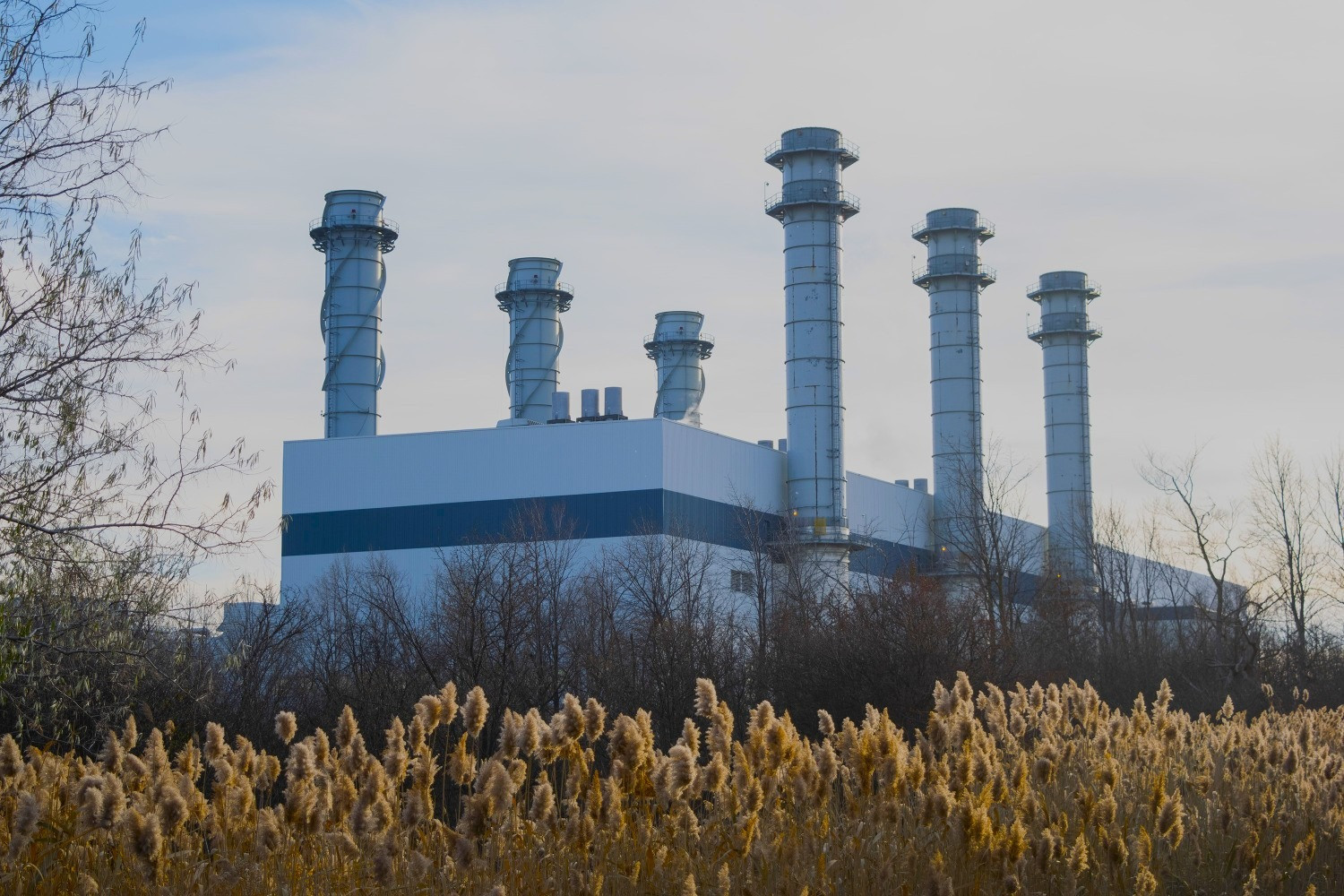
The gas-fired Goreway power plant in Brampton was recently expanded. (Alexis Wright/The Pointer)
The Goreway power plant in Brampton was expanded in 2025 to produce 915 megawatts of electricity from gas, part of the PC government’s highly criticized strategy of meeting higher demand for power through gas-fired electricity production, instead of investing in proven alternative energy technologies that are rapidly powering more and more electricity grids around the world as populations and governments are encouraged to get away from the burning of carbon.
Burning gas to create electricity can be even more damaging to the environment.
Christine Tu, Director of the Office of Climate Change and Energy Management at Peel Region responded to The Pointer in a written statement. Tu cautioned that Peel Region is experiencing an increase in emissions due to “growing dependence on fossil fuels.”
She says switching away from carbon-based fuel has become “increasingly difficult due to limited clean electricity available for electrification.” Due to the lack of clean grid capacity, Tu wrote, projects can be more costly and not have an optimal impact when capacity needs to be increased as we collectively move toward more electrification of the economy and day-to-day life.
Tu said Peel Region is continuing to move toward “Net Zero Emissions” policies through efforts like the “Building Retrofit standards for Peel-owned buildings.”
The regional government is also “expanding EV charging infrastructure to enable the further electrification of our fleet.” She said Peel is working with Brampton, Mississauga and Caledon, “through community focused actions” within the frameworks of the Peel Climate Change and Biodiversity Strategy and Climate Change Master Plan Refresh, but she did not detail what specific actions are being taken that might turn around the concerning nine percent increase in pollution across Peel last year.
The Atmospheric Fund says there were two main reasons behind the dramatic increase: a colder 2025 season, as temperatures “drove up the demand for gas heating”; and the increasing use of gas to expand Ontario’s electricity grid to meet higher demand.
Ekaterina Tzekova, Director of Research and Innovation with TAF, says the cold weather was a real factor but it does not reveal the whole story. She called 2025 “significantly colder than previous years,” though not the coldest in 20 years. Total emissions in Peel “reached 12.4 million tonnes (Mt) in 2025, an increase of almost 9 percent compared to 2024.” This was largely in part due to buildings, whose emissions were 5.6 Mt in 2025.
Emily Hunter of Environmental Defence Canada who works as a Senior Program Manager on Ontario climate, said blaming the cold weather for the emissions “is letting governments off the hook.” Instead, she named three drivers: a dirtier electricity grid, more gas burned in buildings during volatile weather and a continued dependence on gasoline vehicles, which she said is especially true in Peel.
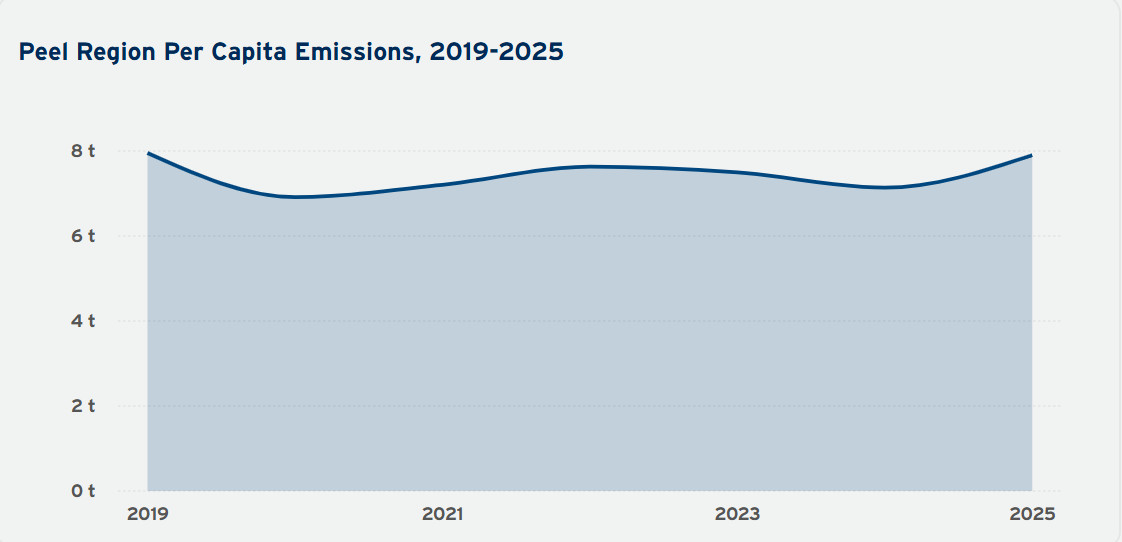
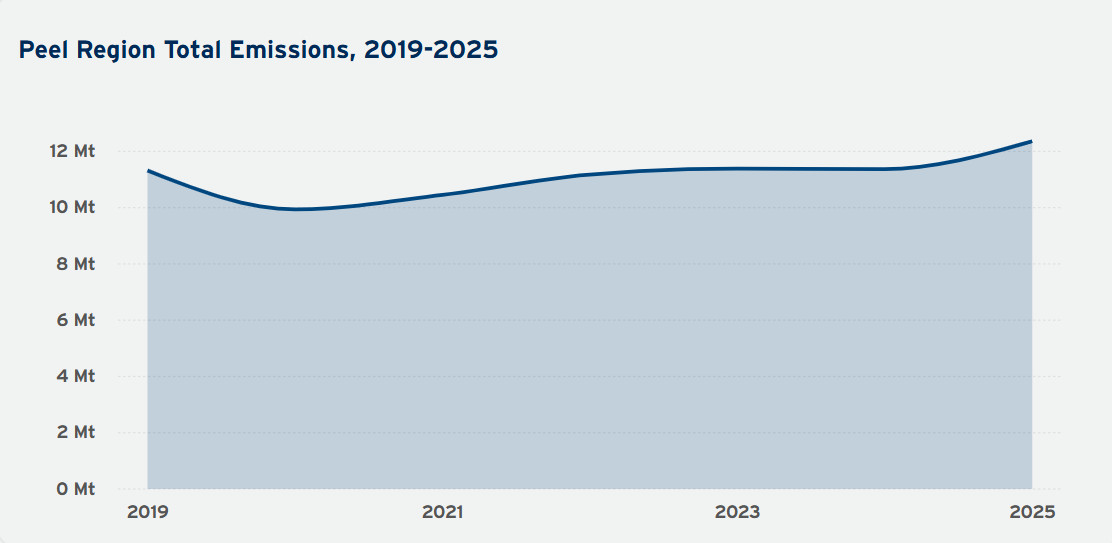
Peel’s emissions increased nine percent in 2025 compared to the prior year. (The Atmospheric Fund)
Removing weather from the equation, and comparing 2025 to 2024, Tzekova says the total emissions “would have increased by about 5 percent rather than 9 percent.” The rest of the increase was due to more gas being burnt to produce electricity.
The whole story is “bigger than weather alone, because we still see emissions increasing from natural gas when we remove the weather.”
She put the regional increase in context: 9 percent "is actually a bigger increase than all the other increases and changes that we've seen year to year since we started doing the emissions over 10 years ago,” she said. “So it's quite significant.”
According to Environment Canada’s Climate Trends and Variations Bulletin for Winter 2024/2025, the national average temperature for the winter of 2024/2025, which goes from December 2024 - February 2025, was 3.7 degrees above the baseline average, and was the 5th warmest winter since records were first kept. This skewed the overall difference in heating requirements the following winter, with much colder comparative temperatures from the previous season, resulting in more gas consumption.
Environment Canada also says 2025 was a memorable year for snowstorms, described as “remarkable and disruptive” with three back-to-back snowstorms blanketing much of Central and Eastern Canada in 2025.
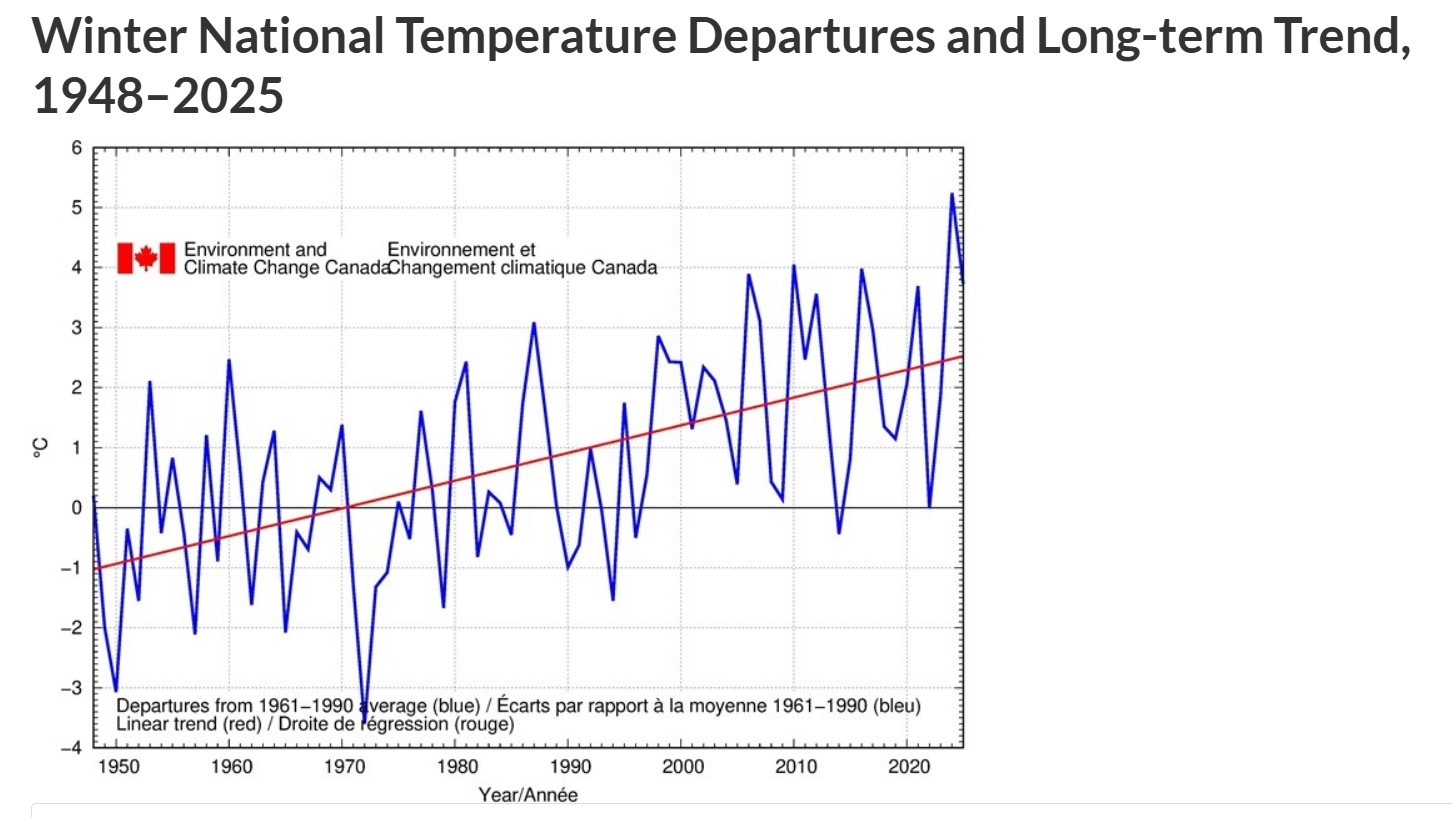
Environment Canada’s temperature chart shows Winter 2024-2025 was 3.7 degrees above the baseline average, leading to a much colder comparative winter the following season. (Environment Canada)
Buildings are inefficient, Tzekova said, because they rely primarily on natural gas. Although she did say retrofits like heat pumps and electrification are happening, it is not to the desired scale and pace “needed to offset that continued fossil fuel dependence.”
The other big driver of these emissions is the electricity grid. Electricity use rose only slightly, but according to Tzekova, “the electricity is becoming dirtier,” because Ontario is continuing to burn more gas while nuclear reactors have gone offline for refurbishment. She said “electricity emissions have tripled since 2019.”
In 2017, Ontario, under the Kathleen Wynne Liberal government, proudly announced it had nearly eliminated carbon emissions from its electricity infrastructure, with a grid that was 96 percent non-emitting.
Then came the Doug Ford-led Progressive Conservative government in 2018, which immediately cancelled 758 renewable energy projects at a cost of more than $230 million.
"If we had the chance to get rid of all the windmills, we would," Ford said in 2019.
The PCs scrapped the $3-billion cap-and-trade program with Quebec and California, which was designed to cut emissions, and ripped apart plans for electric vehicle charging stations across the province.
Tzekova highlighted transportation as another factor behind last year’s concerning numbers, with emissions up 1 to 3 percent in the sector across Peel. She said the suspension of federal EV rebates in 2025 contributed to the backslide. “We saw electric vehicle registration slow down”. She also pointed to return-to-office trips, as Brampton Transit ridership was down about 13 percent and Mississauga’s MiWay figures down about 8 percent, suggesting more people using cars.
Peel, she said, is a fifth of the GTHA’s (Greater Toronto and Hamilton Area) emissions and a fifth of its population. Its rise of about 9 percent in 2025 puts it in the middle, along with York. Toronto was higher, and Hamilton was lower.

Buildings accounted for the largest percentage of emissions in Peel in 2025. (The Atmospheric Fund)
Tzekova said activities in Peel not impacted by weather or population increase contributed to increased emissions in 2025, for example pollution from Mississauga’s Ash Grove cement plant.
In 2024, The Pointer reported how Ontario’s growing reliance on gas for electricity is undermining greenhouse gas reduction efforts across Peel which was identified as the province’s second-largest regional emitter, with buildings and transportation accounting for more than 83 percent of its emissions.
Ash Grove Cement Plant was developing a plan to transition toward alternative low-carbon fuels. The proposed initiative would have diverted non-recyclable materials from other industrial and commercial processes away from landfills, potentially reducing waste and supporting lower-carbon cement production. However, provincial energy policies undermined such municipal environmental initiatives.
Tzekova said avoidable emissions from the Ash Grove Cement plant are not a “one-off”.
In December of 2024, the City of Mississauga made progress in implementing its 2019 Climate Change Action Plan, which aims to reduce greenhouse gas emissions by 40 percent by 2030 and 80 percent by 2050, compared with 1990 levels. This included a 40 percent reduction promised by the Ash Grove Cement Plant. Buildings and transportation remained the biggest contributors of greenhouse gas emissions.
Mississauga was pursuing additional environmental initiatives, including energy-efficient building standards, renewable energy, electrified transit and cycling infrastructure. However, the new TAF report indicates emissions levels went the opposite way in 2025, despite almost a decade of municipal and federal initiatives to drive pollution down, not up.
Per capita emissions look even worse in comparison because Statistics Canada projected a slight population decline for Peel in 2025, which the 2026 Census could confirm when it’s released.
Tzekova said Peel Region’s emissions targets mirror those across the GTHA. Emissions need to fall by about 16 percent a year to hit 2030 targets, and “Peel is not…further ahead or further behind than the rest of the region.” Buildings account for about 45 percent of Peel’s emissions and transportation about 39 percent, so the same strategies apply compared to other municipalities, especially outside Toronto: building retrofits, electrification of fleets and transit systems, new green development standards, energy efficient practices and an end to urban sprawl that drives up emissions from heating and cooling, and extended car trips.
Regarding the PC government’s claims that gas use for electricity grid expansion will taper once the nuclear refurbishments are completed, Hunter of Environmental Defence rejected the narrative. “It’s a specific policy choice the provincial government has chosen to sort of backfill our energy system with gas-fired generation,” she said. She blamed the Ford government for cancelling renewable contracts and cuts to conservation funding.
Hunter also said the emissions will outlast the refurbishments because gas plants also emit methane which “stays in our atmosphere for far, far longer” which risks warming up Earth’s atmosphere for decades. The adverse effects to the sustainability of ecosystems and on the health and well-being of humans will be felt most acutely by younger generations.
She said so-called low-carbon fuels like hydrogen have no real role in buildings. “Natural gas isn’t really low carbon. It's got emissions and it's got a footprint that we can see across our atmosphere.” She also rejected Hydrogen being a viable solution because it “is not at the scale that we would need it to really be a scalable solution.” Adding insulation to basements and sealing leaks are the cheapest fixes. She said the PCs are choosing expensive, polluting energy technologies over cheap, effective solutions.
“We used to have a green building standard. That was removed by the Ford government earlier this year. And those standards help make homes and buildings more energy efficient.”
Hunter said EV registrations are rebounding and were up 46 percent in Ontario in the second quarter of 2026, which she attributed to higher fuel prices. The cancelled federal rebate had slowed purchases, as public transit needs more investment, she emphasized.
Tzekova said it will take all levels of governments acting together to reverse the 2025 emissions levels in Peel.
Municipalities, she said, should make zoning changes to speed up installation of heat pumps and solar panels, financing for retrofits should be provided, EV charging bylaws need to be expanded and rules that accommodate parking for cars in buildings and on streets should be curbed to encourage public transit use.
“Different levels (of government) don’t need to wait for one another,” she said. “That would be the worst thing to happen.”
Hunter echoed the suggestions: remove bylaw and fee barriers to rooftop solar panels, balcony solar, battery storage and heat pumps; set local building performance and insulation standards; write a clean energy strategy with local utilities; and phase out gas plants, just like Toronto did with the Portlands plant.
“By removing some of those barriers and costs, homes can actually now create that energy efficiency because they're generating some of the power and storage at home.”
Hunter is critical of the Ford government’s actions in cutting back on Ontario’s environmental protections. She referenced Bill 140, the Building Ontario Faster Act, which makes it easier for developers to proceed with major infrastructure projects. The Bill targets three key laws, particularly the Environmental Bill of Rights (EBR). Its proposed changes would eliminate citizens’ ability to request environmental investigations, seek reviews of existing environmental laws and bring civil actions over damage to public resources.
Environmental lawyers and advocates warn these changes could undermine public accountability, transparency and community participation, and potentially expose vulnerable communities to greater pollution and environmental harm. Hunter called the new legislation “another huge step back for the province.” The Bill could remove elected officials from utility boards, cutting public oversight of utilities required to meet climate targets, while fast-tracking of waste incineration could be done without local council input.
Hunter said “Queens Park does not need to choose between affordability and climate action. We can lower electricity bills, lower emissions, and have a stronger economy, but we need to prioritize affordable clean power and give our municipalities the tools to deliver on that.”
Email: [email protected]
At a time when vital public information is needed by everyone, The Pointer has taken down our paywall on all stories to ensure every resident of Brampton, Mississauga and Niagara has access to the facts. For those who are able, we encourage you to consider a subscription. This will help us report on important public interest issues the community needs to know about now more than ever. You can register for a 30-day free trial HERE. Thereafter, The Pointer will charge $10 a month and you can cancel any time right on the website. Thank you
Submit a correction about this story

