

Strong mayor powers create tension in Fort Erie with controversial hiring of questionable CAO
Within 48 hours of being sworn in on November 16, Fort Erie Mayor Tom Insinna used strong mayor powers to end the employment of Chief Administrative Officer Chris McQueen, who had held the position since 2022. Two days later, the Town announced that Krystle Caputo, who played a role in one of the darkest chapters of Niagara’s political history, would take over as CAO, effective November 23.
Although the decisions fall within the mayor’s statutory authority, their speed, the lack of consultation alleged by councillors and the unanswered questions surrounding the process have created an immediate test of trust, not only between the mayor and the elected representatives expected to work alongside him, but also with Fort Erie residents. The controversy erupted before the new council had even held its first meeting.
Insinna had served as a Niagara regional councillor since 2018, after a three-decade career with the RCMP. He defeated incumbent Wayne Redekop in October’s municipal election, using a platform that highlighted the need for more transparency to the public in local government and decision making that would give power back to residents who elect those trusted to represent their priorities.
During his campaign, Insinna said Strong Mayor powers should be used “only as a last resort after attempting to build Council consensus.” In a post-election interview on November 1, he spoke of going forward “as a united council, as a united team.”
Then, on November 20 the Town released a statement announcing the hiring of Caputo to replace McQueen. In that statement Insinna claimed, “I believe we make our strongest decisions by building consensus and bringing people together around shared priorities.” Residents were immediately frustrated by the obvious contradiction, trumpeting collaboration then celebrating the Mayor’s unilateral appointment of the individual who would be entrusted with managing and overseeing all affairs of the Town, a decision that until now has involved the consent and participation of the entire Council.

Krystle Caputo played a role in controversial decisions by the Niagara Peninsula Conservation Authority about a decade ago. (YouTube screengrab)
The backlash resulted in another official announcement yesterday, Friday, November 27, with Insinna quickly backtracking: “Mayor Tom Insinna today announced that the Town of Fort Erie will return key administrative strong-mayor authorities to Town Council and municipal administration. The mayor will delegate authority to appoint staff, hire department heads, set organizational structure, and establish municipal committees to Council and senior staff, where permitted under provincial legislation,” the press release by the Town communicated.
Insinna added his own commitment in the announcement.
“Fort Erie is strongest when its Mayor, Council, staff, and residents work together. I am committed to a collaborative, transparent approach and to returning decision-making authority to Council wherever the law allows,” he pledged.
“Ontario law does not allow certain strong-mayor authorities to be relinquished, including the mayor’s role in the municipal budget and certain legislative powers. The mayor will, however, seek Council input throughout the budget process and is committed to line-by-line review.”
Despite his assurances, the decision to fire McQueen and hire someone connected to one of the most tumultuous periods in Niagara’s political history might be difficult to revisit. Caputo has already started her new role, but with the new commitment to hand control over key hiring decisions to all of council, it’s possible her questionable qualifications could be reviewed and, if there are grounds to terminate the contract, her future with the Town could be in jeopardy now that a proper public hiring process is being called for.
Before the Mayor walked back from the unilateral direction he was clearly moving in, councillors in Niagara’s 4th most populous municipality did not wait for a council meeting to challenge what they saw as broken promises and broken trust in the way Caputo was hired.
Councillor Nick Dubanow has been particularly direct in his criticism. In a November 18 statement following McQueen’s departure, Dubanow made his position on the controversial decision clear.
“Let me be clear: neither I nor any of my council colleagues were consulted before this decision was made. Any claim otherwise is false,” he wrote.
Dubanow acknowledged that the mayor has the authority to make the decision, but argued that the potential financial, operational and organizational consequences warranted consultation with council.
He also questioned the pace of the process to find a replacement for the well-liked CAO, saying councillors had not been provided with any evidence of a competitive recruitment process or a competency matrix used to assess candidates.
Councillor Tom Lewis raised similar concerns, questioning the manner in which McQueen’s departure was handled and what it suggested about the new council’s working relationship. Lewis subsequently launched a petition calling on Insinna to voluntarily relinquish the use of strong mayor powers and restore a more collaborative approach to decision-making.
Challenging the mayor’s use of strong mayor powers and calling on him to change his approach to governing, the petition urges Insinna to halt the CAO appointment process and instead allow for a transparent, fair and open recruitment. It also calls on the mayor to involve all elected members of council in meaningful discussions and restore the transparency, communication and collaboration that petitioners say should guide municipal decision-making.
Dubanow has publicly supported the petition, arguing that residents in all six wards deserve to have their elected representatives meaningfully involved in major municipal decisions.
Within 24 hours of the petition’s publication, the Town announced the appointment of a new CAO, a decision councillors say was made without their involvement.
Insinna’s supporters point out that he was elected by Fort Erie residents and that the strong mayor framework gives him authority that previous mayors did not have, or chose not to exercise.
While the law gives the mayor the power to appoint and dismiss a CAO, critics point out that Insinna campaigned on collaboration. He publicly described consensus as the preferred way to make decisions.
The dismissal of McQueen, followed almost immediately by the appointment of Krystle Caputo as his replacement, has added another layer to the controversy.
Fort Erie residents may already be familiar with Caputo’s background, particularly her time at the Niagara Peninsula Conservation Authority (NPCA). She was initially hired in a communications role in 2018 with no municipal administration experience, amid a period of intense controversy surrounding both Niagara Region and the conservation authority that led to a disturbing investigation report by Ontario’s Ombudsman titled Inside Job, detailing the controversy that had engulfed the region due to a rigged hiring process for the Niagara CAO.
On December 17, 2018, in the midst of the turmoil and with information directly connecting her to the regional elected officials aligned with conservative politics in Niagara, Caputo was promoted to Director of Communications and Administration for the local conservation authority, a senior position that had not previously existed within the organization. The promotion was authorized and signed by David Barrick, who was then serving as the NPCA’s interim CAO, as the agency grappled with a contentious leadership and governance struggle. Caputo’s move from communications into a senior administrative role, despite her glaring lack of experience, came during one of the most turbulent periods in the NPCA’s history.
At the time, Barrick and other senior NPCA officials were engaged in a very public struggle for control of the agency. Against that backdrop, Barrick was assembling a leadership team, with Caputo and others appointed to director-level positions. These positions were created and filled without what would ordinarily be expected of a competitive recruitment process. The contracts offered to some of those appointed included significant benefits, including monthly vehicle allowances of $1,000. The circumstances surrounding the appointments and compensation packages raised questions about the process that was followed, who authorized the arrangements and how they were justified.
Ontario’s Auditor General, meanwhile, would release a damning 2018 audit investigation report of the NPCA, which exposed that Barrick himself was handed his initial job with the conservation authority through a process that was deeply flawed, lacked accountability and amounted to insider influence by the board members who gave their own board colleague a senior role.
Caputo’s tenure in the position was short-lived. In January 2019, she became involved in a dispute over access to NPCA records and computer systems by investigators from the Ontario Ombudsman’s office while they were conducting the Inside Job investigation. She initially refused to provide investigators with access to requested files and computers until board Chairman Dave Bylsma overruled her decision and authorized the investigators to proceed.
In February 2019, Caputo contacted Niagara Regional Police to file a complaint concerning members of A Better Niagara (ABN), a citizens’ advocacy group that had been highly critical of the NPCA and had helped bring concerns about the authority’s governance and practices into the public spotlight. The group had also played a prominent accountability role in the 2018 municipal election, when many elected officials associated with the controversy surrounding the NPCA and the Region lost their seats. (Editor’s Note: Reporter Ed Smith was a director with ABN at the time and would later serve on the NPCA board in 2019, before he joined The Pointer.)
Caputo told police she was concerned for her family’s safety and alleged that ABN members were involved in a “plot” to take control of the NPCA. Police met with her at the NPCA offices and reviewed the social media posts on which her complaint was based. The police quickly determined the posts contained no threats, and after finding no other evidence of unlawful activity they provided Caputo with general safety advice before closing the matter.
By the end of February 2019 David Barrick was gone from the NPCA and Krystle Caputo was on stress leave from which she never returned; she left the agency for good in August 2019.
Tom Insinna was serving as a regional councillor at the time and, in that capacity, had been appointed to the NPCA board, a role that gave him direct exposure to the agency’s leadership and governance issues.
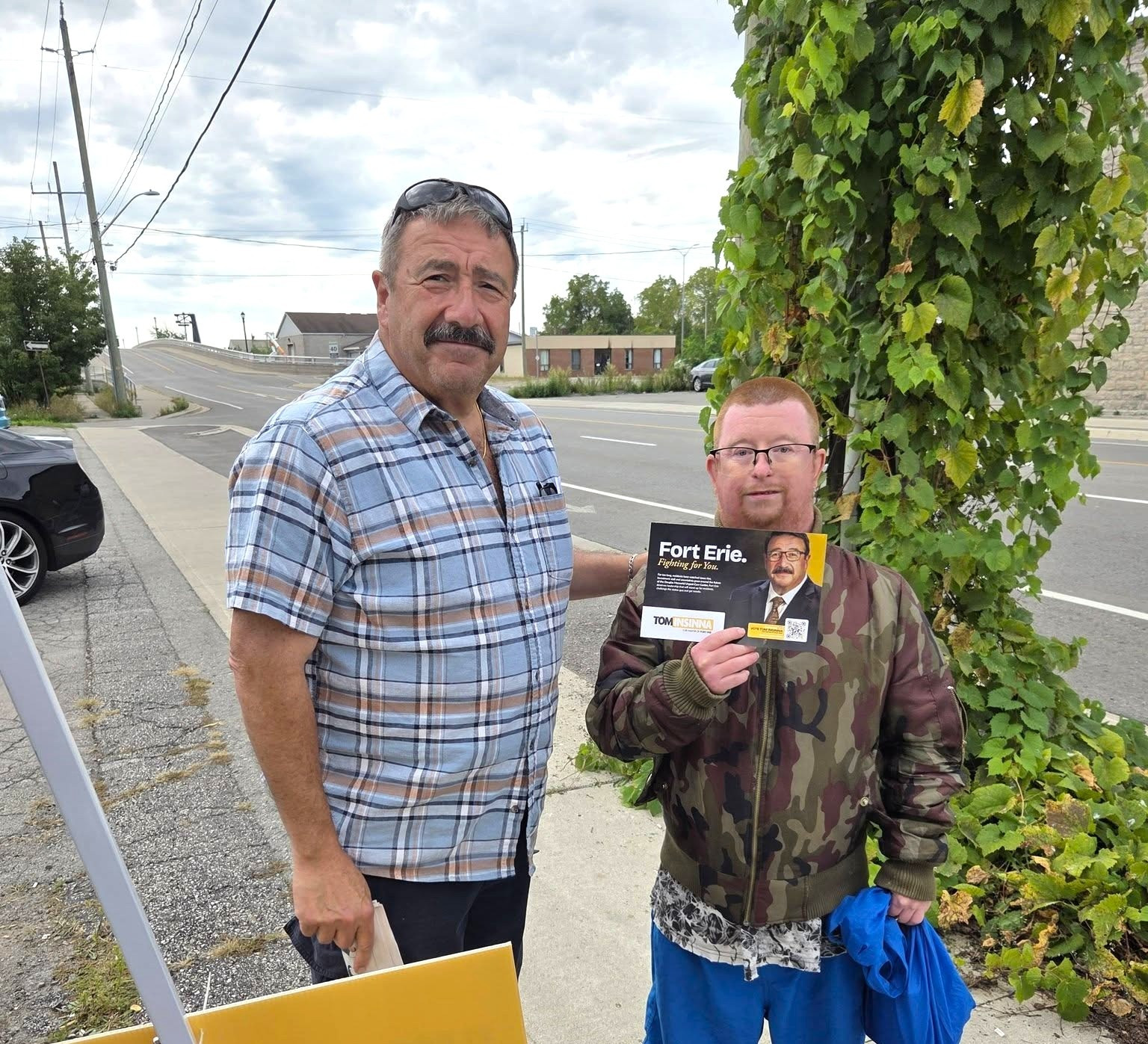
Fort Erie Mayor Tom Insinna appears to be walking back his initial direction relying on strong mayor powers to cut out councillors from key decision making. (Facebook)
In its announcement of Caputo’s appointment, the Town describes her as bringing extensive public and private-sector experience in government, organizational management and strategic communications. It places particular emphasis on her tenure as chief of staff in Ontario’s PC government, stating that she oversaw a ministry with a $20-billion budget and helped advance policy and budget priorities.
That description, however, is not reflected in the employment history set out on Caputo’s LinkedIn profile. According to her profile, she served as chief of staff from July 2022 to June 2023, a period of less than a year, before leaving government for a position at ONpoint Strategy Group, a private consulting and lobbying firm whose leadership and staff have strong ties to Premier Doug Ford’s Progressive Conservative Party. She remained there until January 2026, when she returned to the provincial government as a special adviser in the Ministry of Municipal Affairs and Housing, a role she held for 11 months before being appointed as Fort Erie’s CAO.
Her LinkedIn profile makes no claim that she oversaw a ministry budget of $20 billion, nor do her job titles suggest she was employed in such a role. The Town’s announcement offers no further explanation of the claim or detail about the extent of her direct responsibility for the ministry’s budget, operations or staff.
Liz Benneian, a former director of A Better Niagara, the citizen-led organization that played a prominent role in challenging the NPCA's leadership and governance during the 2018 controversy, has considerable knowledge of Caputo's role during her brief employment with the NPCA.
In comments provided to The Pointer, Benneian said she and others involved in A Better Niagara were "horrified" to learn that Insinna had used his strong mayor powers to install Caputo as Fort Erie's CAO.
Benneian described Caputo as closely aligned with the group of regional politicians she accused of exercising improper influence over the NPCA, and particularly with David Barrick, the former Port Colborne regional councillor who became the authority's interim CAO in December 2018, after his initial hiring with the NPCA was described as deeply flawed by Ontario’s Auditor General.
She recounts how Caputo was involved in efforts to discredit or intimidate critics of the NPCA, pointing to the police complaint involving members of A Better Niagara and Caputo’s role in the court proceedings that followed the group’s efforts to secure proper public control of the agency for a newly appointed board.
At the time, NPCA leadership, that included Caputo, was refusing to allow the newly appointed regional representatives to take their seats and assume control of the authority. With the Region delaying a decision on how to proceed, A Better Niagara took matters into its own hands and filed a motion with the courts to force the issue.
Caputo and Barrick represented the NPCA in those court proceedings, telling the judge that they had not been able to find a lawyer to represent them. Benneian recounts how “Caputo arrived with a substantial volume of documents” and attempted to begin a presentation for which the judge showed little inclination to allow and swiftly ordered her to “sit down”. Benneian describes it as a moment she says remains “particularly vivid.”
Ultimately, Justice James Ramsay gave little weight to the affidavit sworn by Caputo and issued a court order requiring the NPCA to convene its inaugural board meeting on January 7, 2019. Tom Insinna was then serving as Fort Erie’s regional councillor and was also a member of the NPCA board.
"If I was a citizen of Fort Erie, I would be keeping a very close watch on City Hall," Benneian warned, urging residents to scrutinize the qualifications and backgrounds of new hires, monitor development proposals and pay attention to financial and political relationships.
Benneian also states that Insinna’s intimate familiarity with the problems at the NPCA in 2018-19 should have made him aware of the controversies surrounding its leadership and Caputo's involvement.
Her criticism culminated in two pointed questions: If Insinna knew about Caputo's role during the NPCA controversy, why did he choose her for Fort Erie's top administrative position? If he did not know, why had he not examined her background more thoroughly before making such an important appointment?
Benneian went further, suggesting that the speed of McQueen's dismissal and Caputo's appointment raised the possibility that the change had been arranged well in advance. She questioned who might have been involved and what purpose such an arrangement would have served.
Now, more than seven years after the NPCA controversy, Caputo has been appointed to lead Fort Erie’s entire municipal administration. The Town has highlighted her provincial government and advisory experience, including her work as a chief of staff and special adviser. However, its announcement has provided little detail about her direct experience managing municipal operations, municipal departments, local government budgets or the delivery of municipal services.
Insinna’s appointment document raises further questions about the process. Mayoral Decision 03-2026, dated November 20, confirms that Caputo was appointed before the terms of her employment had been finalized. The decision directs Town staff to negotiate a written employment agreement with Caputo and submit the proposed terms to Insinna for review and approval. It also states that her appointment would take effect upon her written acceptance. In other words, the Town announced its new CAO before her employment agreement had even been negotiated, leaving residents without information about the compensation, benefits and other terms attached to the appointment.
Insinna has sparked a controversy that seems certain to overshadow and perhaps define his first term, almost before it gets started, critics have said. Residents and councillors want to know why he moved so quickly to dismiss McQueen without consulting council, despite his stated commitment to consensus, what process led to Caputo’s appointment, and what evidence supports the mayor’s confidence that she is the right person to lead Fort Erie’s municipal administration?
The first meeting of the new council takes place on November 30 at 6 p.m.
Email: [email protected]
At a time when vital public information is needed by everyone, The Pointer has taken down our paywall on all stories to ensure every resident of Brampton, Mississauga and Niagara has access to the facts. For those who are able, we encourage you to consider a subscription. This will help us report on important public interest issues the community needs to know about now more than ever. You can register for a 30-day free trial HERE. Thereafter, The Pointer will charge $10 a month and you can cancel any time right on the website. Thank you
Submit a correction about this story

