
St. Catharines residents kept their mayor…but clearly want change
When Ann-Marie Zammit introduced herself to voters across St. Catharines months and weeks and days before October’s municipal election, she suddenly promoted a platform that resonated with thousands.
From complete political obscurity, a woman who has never held public office and was virtually unknown to everyone but her family and friends mounted a serious challenge against incumbent, and now mayor-elect, Mat Siscoe.
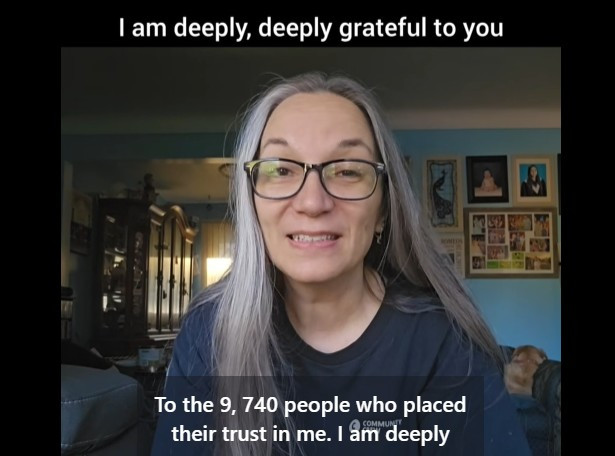
While Siscoe won with 16,763 votes, Zammit finished a clear second with 9,740 ballots cast for her, establishing the political neophyte as the only serious challenger by a substantial margin. The other candidates, Jimmy Jackson, Anthony A. Adeoye and Henry Bosch, received 2,395, 1,910 and 1,169 votes respectively.
While overall voter participation increased slightly in 2026, Siscoe’s vote count went down, falling by 1,045 votes from 17,808 in 2022 to 16,763. Turnout rose from 26.03 percent to 27.87 percent, an almost two percent increase, meaning Siscoe secured less support despite the slightly higher turnout. Although Siscoe secured another term as mayor, it was not a resounding show of support, while the limitations of his powerful incumbent advantage including financial resources that Zammit simply did not have, suggests her ability to keep the race relatively close this year could be a signal of what she might build on in the future.
Until roughly 90 days before the election, she was largely unknown to much of St. Catharines. Siscoe, by contrast, entered the campaign with the considerable advantages of incumbency and the exposure that comes with 16 years of political office, having served as a city councillor since 2010 before becoming mayor in 2022.
Siscoe also has a history of working with a professional campaign organizer who subsequently received City contracts, as reported by The Pointer. It is not yet known whether he employed a professional for the 2026 election. That information should become clearer when campaign finance disclosures are released in March.
Zammit, meanwhile, described her campaign as an entirely “kitchen table” effort, built from the ground up through the support of family, friends, volunteers and residents who connected with her vision for the city.
When asked how she organized her campaign, she offered this account: “My campaign was a grass roots effort, powered by those who believed in my vision for the city. It started with me, my husband, and three friends. It grew as more people found me, and were inspired by the possibility of conducting city business in a totally new way. They jumped in feet first and never looked back.
“I could not have done this without my family, friends, and the total strangers who became friends over the last few months. I want to express my deepest gratitude to everyone who contributed to the campaign. It was a group effort and what was accomplished belongs to all of us.”
Zammit’s candidacy also carried historical significance. St. Catharines has never elected a female mayor. Although Zammit did not break that barrier, her campaign brought the question of women’s representation in the city’s highest elected municipal office into focus. Her second-place finish, with about 60 percent of the vote Siscoe received, was an unexpected result for a complete unknown.
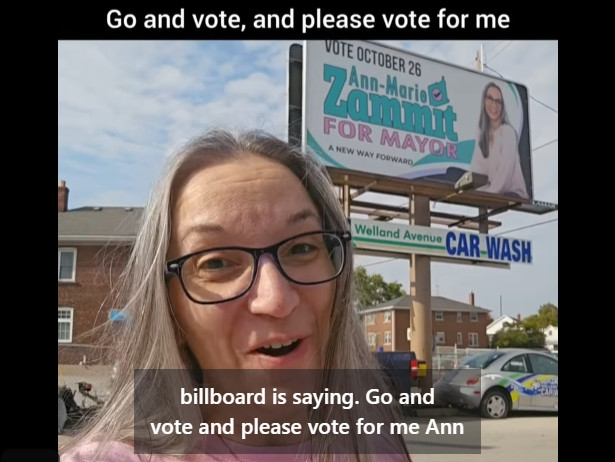
Ann-Marie Zammit came second in the St. Catharines mayoral race, but energized the electorate by calling for changes to the way local leaders run the city’s government. (Ann-Marie Zammit/Facebook)
While the election produced a clear winner, the conversation surrounding the campaign has not ended. Some of the most interesting developments have come after the ballots were counted, particularly in the reaction to comments made by Siscoe about the role social media played in the campaign.
Siscoe described the election as probably “the hardest, the dirtiest and the most smear-filled campaign” he had been involved in. He also said one of his goals over the next four years would be to figure out how to ensure the next campaign would not be like that for the candidates who come forward.
Speaking to supporters at a victory party Siscoe is quoted publicly as stating: “Some of the things that went on, some of the lies that were told, some of the ridiculous things that went on online, that shouldn’t happen in a democracy. People shouldn’t be allowed to make things up.”
The mayor subsequently returned to the subject on social media, writing:
“So, wait.
“Social media ISN’T where elections are decided?
“Well I’ll be damned …”
In another post, he added:
“I'll have more to say in the coming days about social media, and just how awful that part of the campaign was”
His comments prompted negative reactions from some residents, who interpreted his response as that of a sore loser, despite the fact that he had won another term.
One of the most outspoken participants in online discussions during the campaign was St. Catharines resident Lori Ruzic. Ruzic was a very public critic of Siscoe throughout the election, frequently raising questions and challenging the mayor on social media. Given her prominent role in that discussion, The Pointer reached out to ask for her response to the mayor's post-election comments.
Ruzic rejected any suggestion that criticisms, including hers, were motivated by a personal vendetta. Her comments centred on public spending, transparency and accountability. She had initially tried to raise those issues respectfully, she said, before becoming more outspoken when, in her view, questions went unanswered.
She took issue with Siscoe's characterization of the campaign, arguing that criticism of an elected official's public record and decisions should not be confused with dirty campaigning or attacks on private life.
“Speaking for myself, I feel taxpayers deserve answers, elected officials deserve scrutiny, and public office is a position of responsibility, not a throne from which politicians decide which citizens deserve a response and which ones don’t.
“I was asking legitimate questions and I made certain to document my concerns and gave him every opportunity to respond. When that didn't work, I got louder and sarcastic, earning myself the label of the ‘Local Mean Girl’.”
Ruzic posited that although Siscoe won another term he somehow emerged sounding like the victim of a democratic process.
“The man with the political power, public platform and taxpayer-funded office now wants sympathy because ordinary citizens exercised their right to criticize him. I challenged his public record. His public decisions and his responsibility to the people.”
Another resident who was highly visible in social media discussions was Sabrina Hill. Asked for comment, Hill offered a slightly different perspective, arguing that Siscoe's description of the campaign failed to recognize the very different experiences women and other underrepresented groups can face when seeking public office.
She described the mayor's comments as an example of “poor-winner syndrome” and questioned whether male candidates could fully appreciate the hostility women sometimes encounter when entering municipal politics.
As the first openly transgender candidate to run for public office in Niagara, Hill says she experienced such intense and threatening harassment during her 2022 campaign that she had to involve the police.
Siscoe complaining about dirty campaigning, without explaining himself or pointing to any specific examples, might undermine candidates who highlight conduct that crosses the line between intense debate, and dangerous provocation.
She explained that the hostility directed at her was not about her policies, campaign financing or political relationships. She was targeted because she is transgender, with messages suggesting that someone like her had no place in public office or even in public life.
Hill believes there is a fundamental difference between criticism of an elected official's political decisions and attacks directed at someone's identity, which could lead to dangerous outcomes. She argues that women often face an additional barrier when entering politics: before they can present their qualifications, policies or vision, they are forced to establish that they belong there in the first place.
Regarding the criticism directed at Siscoe during the campaign, Hill said much of what she observed concerned his political allegiance to a deeply conservative and increasingly populist provincial government, his priorities as mayor in relation to his relationship with Premier Doug Ford and his connections to developers and other powerful financial interests.
She considers that “all of these are legitimate subjects of public scrutiny for anyone holding elected office, and fundamentally different from attacks on someone's personal identity, appearance, family or right to participate in public life.”
Hill believes elected officials must recognize that public criticism, even when uncomfortable, is part of the responsibility that comes with office. She concluded with a pointed observation about the conditions under which some candidates have to campaign: “Democracy doesn't come with a guarantee that you'll only hear flattering things about yourself. Criticism, even uncomfortable criticism, is part of the job. There is a difference between legitimate scrutiny of elected officials and personal harassment, and politicians should be able to recognize that distinction. If Mat (Siscoe) genuinely wants to make the next municipal election better for candidates, I'd suggest he start by understanding that the playing field was never level to begin with.”
Mayor Siscoe did not respond to The Pointer’s request for comment on his post-election criticism of the campaign, including his allegations of misinformation and inappropriate conduct on social media.
Zammit has repeatedly thanked the almost 9,800 voters who supported her candidacy, giving her a platform going forward.
She encouraged voters to turn election support into day-to-day political engagement to hold the city’s local government accountable; the type of scrutiny Siscoe has suggested, before and after the election campaign, he’s not comfortable with.
Email: [email protected]
At a time when vital public information is needed by everyone, The Pointer has taken down our paywall on all stories to ensure every resident of Brampton, Mississauga and Niagara has access to the facts. For those who are able, we encourage you to consider a subscription. This will help us report on important public interest issues the community needs to know about now more than ever. You can register for a 30-day free trial HERE. Thereafter, The Pointer will charge $10 a month and you can cancel any time right on the website. Thank you
Submit a correction about this story

