

Incumbents Mat Siscoe in St. Catharines and Jim Diodati in Niagara Falls using public resources to campaign—violation of rules
As the October 26 municipal election campaigns heat up, questions are emerging about whether some incumbent politicians are playing by the rules that govern campaign activity, and whether municipal governments are up to the task of enforcing those rules consistently.
In St. Catharines, the issues range from the use of a mayoral social-media presence by Mat Siscoe, photographs and videos produced by municipal staff, to campaign billboards that appeared before the City's permitted signage date. In neighbouring Niagara Falls, mayoral incumbent Jim Diodati is using official advertising featuring himself, placed on restaurant placemats, to promote his re-election campaign through a City Hall platform whose QR code now directs viewers to his campaign website.
The Municipal Elections Act (MEA) requires municipalities to establish rules governing the use of corporate resources during an election, prohibiting candidates from co-opting any public resource for their own political purposes, but it does not explain in detail why those rules are necessary. The Act is largely silent on the broader principles behind the requirement.
It is understood, however, that the purpose is to maintain a clear separation between municipal business paid for by taxpayers for the benefit of the community as a whole, and political business, including election campaigning, that benefits an individual personally.
There is also the matter of fairness—ensuring one candidate can not use advantages that opponents do not have, to create an uneven playing field.
Municipal resources are publicly funded and intended to serve the community. Without rules governing their use, an incumbent could potentially have access to publicly owned resources, platforms or services, including City Hall staff, that other candidates do not have.
In St. Catharines, the boundaries intended to protect the fairness and integrity of the electoral process appear to have become blurred.
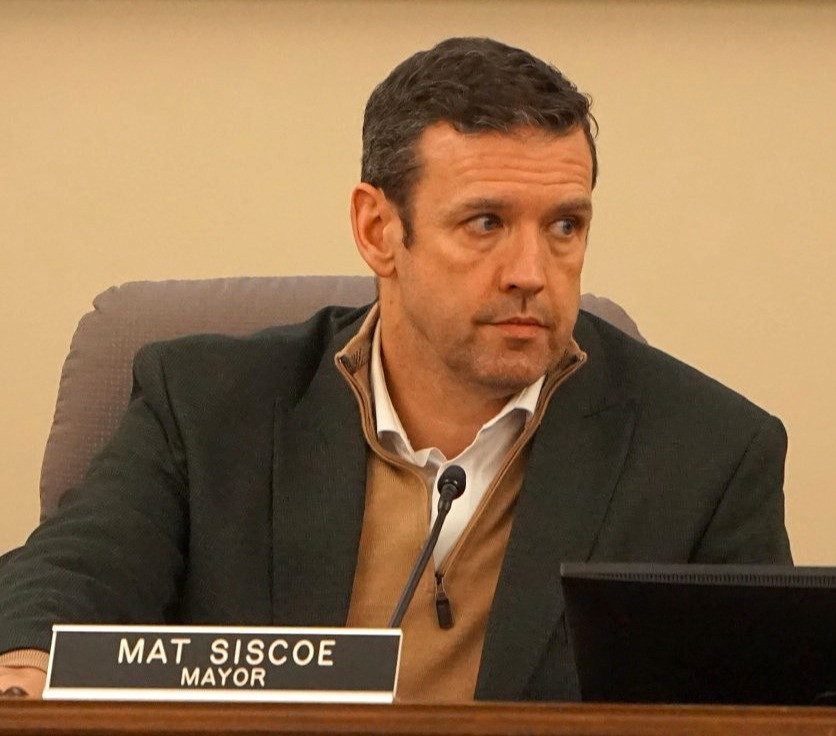
St. Catharines Mayor Mat Siscoe appears to be using City Hall resources to campaign, which is prohibited. (Joel Wittnebel/The Pointer)
Incumbent Mat Siscoe, who is seeking re-election as mayor, uses his Facebook and Instagram accounts to campaign, alongside official City Hall photographs and municipal information that does not belong to him.
Siscoe’s Facebook page previously functioned as a mayoral communications platform, containing a substantial archive of photographs and videos documenting his activities as mayor, before it was recently rebranded as “Mat Siscoe for Mayor”. The page contains hundreds of images and videos of Siscoe carrying out his official duties, including material produced by City staff, paid for by taxpayers, and now serving to help his election campaign. The use of these taxpayer-funded materials on a campaign page raises questions about whether corporate resource policies are being violated. Beyond the videos and photographs, the use of City Hall staff time and other municipal resources to produce them, raise questions about the fairness of Siscoe’s campaign. His opponents do not enjoy the luxury of taxpayer-funded staff working for them to get elected.
Similarly, his campaign Instagram account features a profile picture of him wearing the official chain of office as well as pictures of him conducting official duties produced with municipal resources.
The City’s policy regarding the use of corporate resources for an election campaign appears explicit enough. It states that candidates cannot incorporate into campaign material videos, photographs or other electronic material which the City has proprietary rights over. It also prohibits members of Council from using City IT resources, including the City’s website and social media accounts, for campaign activities. Campaign social media accounts must be managed using personal devices rather than City resources, and candidates are prohibited from using City logos, corporate branding, the coat of arms, slogans or other corporate identifiers on campaign material.
The Pointer reached out to Siscoe with questions about the use of municipal material on his social-media accounts and the work City Hall staff did to create that material. He did not respond.
City staff, however, did respond, providing explanation on how the City’s Use of Corporate Resources for Election Purposes Policy applies to social media content during the election period. Staff said the policy is intended to ensure municipal resources are not used for campaign purposes, but does not require an elected official to remove historical content from an existing social media account when they become a candidate.
The City further confirmed the policy requires municipally-funded communications to remain separate from campaign activity. City Clerk Kristen Sullivan explained in her response that in order to reinforce that separation, a new St. Catharines Mayor social media account has been established for official mayoral communications. The account belongs to the Office of the Mayor and will remain in place for future mayors, while personal and campaign accounts are not maintained using City resources.
Regarding the profile picture of him wearing his official chain of office, on September 17 City staff responded, explaining that “the City discussed the referenced photograph with the candidate (Siscoe), and the candidate has indicated he will update his profile picture.” As of October 13 that picture had not been updated.
The City also acknowledged that photographs and videos appearing in the mayor’s online communications are produced by staff from the mayor’s office or other City departments, while pointing out that Siscoe also takes some material himself or receives assistance from people outside City Hall at events.
This is not the first time Siscoe has used public resources in an election campaign.
As reported by The Pointer, in 2025 documents obtained through a freedom of information request showed City resources were used in connection with Siscoe's attendance at a Doug Ford campaign event ahead of last year’s provincial election. The documents included communications involving Siscoe's City-issued phone and email, his Chief of Staff and other municipal staff. The Pointer reported that staff helped coordinate his attendance and rearrange municipal meetings so he could attend the political event in support of Ford’s candidacy. Siscoe, while at the event, represented himself as the mayor of St. Catharines while endorsing Ford, which raised questions about the City’s policy on the use of municipal resources for political purposes.
A subsequent Integrity Commissioner report found that “some City resources” were used to organize Siscoe's appearance; but the commissioner felt his violations did not rise to a level worthy of punishment.
Regarding incumbent councillor Matt Harris of St. Catharines, the issue is not about the use of municipal resources for his campaign, but his apparent contravention of the City’s bylaw regarding election signs.
Two billboards promoting Harris’s re-election campaign were photographed by The Pointer on September 13. Section 4.1(a) of the election sign bylaw states: “No Person shall place or permit an Election Sign to be placed more than thirty (30) days before Voting Day”.
September 26 was the first day signs were allowed and the City informed candidates of the date. Harris’s billboards were erected at least two weeks prior to the allowable window.
In response to questions from The Pointer Clerk Sullivan acknowledged the City has received complaints regarding election signs associated with two billboards, as well as signs displayed during the annual Labour Day Parade and the complaints have been referred to the City’s By-law Enforcement department for investigation and appropriate follow-up.
Under Section 9 of the By-law, “If a Municipal Law Enforcement Officer or City Clerk is satisfied that a contravention of the By-law has occurred, they may issue an Order to Perform Work requiring work to be done to correct the contravention”. If the order is not complied with, the City may carry out the required work at the owner’s expense.
While Harris did not respond to questions from The Pointer, he issued a statement to other media acknowledging that one of his billboards has been removed because it violated the rule requiring campaign billboards to be erected within the candidate’s ward. The second billboard, however, remains in place.
Responding to questions from The Pointer, the bylaw department stated, “the remaining billboard remains an active investigation. It has been assigned to a by-law officer and is in queue to be investigated.” If the investigation determines Harris has violated the rules, the City has the power to impose a penalty; section 10.1 of the bylaw states: “Every Person who contravenes any provision of this By-law is guilty of an offence and on conviction is liable to a fine as provided for in the Provincial Offences Act”.
In June 2025, council debated how long election signs should be permitted to remain on display. Following a brief discussion, council voted on a motion that would have extended the permitted display period from 30 to 45 days. Harris was one of many who voted against the amendment, choosing to retain the existing 30-day limit, which critics argued gives incumbents an even larger advantage as opponents seeking recognition have limited exposure time to get their names in front of voters. Harris’s position contradicts his use of signs prior to the 30-day period he voted for himself to limit the exposure of candidates, which he appears to have ignored for his own campaign signage.
In Niagara Falls, a different set of circumstances raises another question about the boundary between official municipal business and election campaign activity.
The Queen’s Coach is a popular family-run restaurant that offers a distinctly local experience in Niagara Falls’ heavily franchise-driven dining scene. The placemats at every table are populated with advertisements and promotions from local businesses as well as provincial and federal elected officials. The City of Niagara Falls also has an official advertisement on the placemats welcoming visitors to the city.

The current placemat at popular Niagara Falls restaurant The Queen’s Coach, which features a municipal advertisement with a QR code that was re-directing to Jim Diodati’s campaign website, until The Pointer notified City Hall. (Ed Smith/The Pointer)
The City’s advertisement includes a photograph of incumbent mayor Jim Diodati and invites people to explore and enjoy the city. It also contains a QR code.
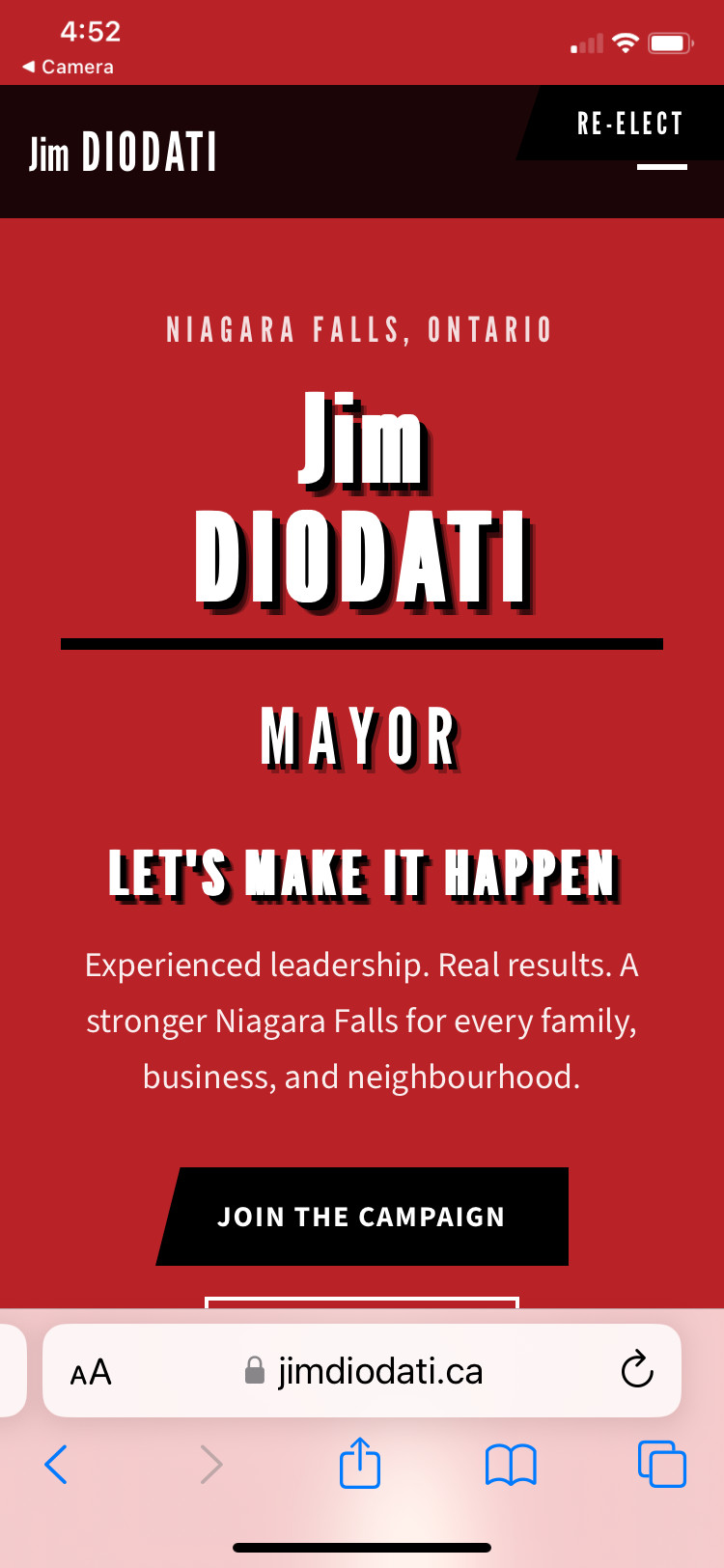
Scanning that QR code usually leads you to City of Niagara Falls website pages, but now, during the election campaign period, it leads you to Diodati's campaign materials. An initial scan of the code takes you to a page that gives you a series of options to choose from. The page features an image of the mayor at the top and the second option down the list invites people to: “Let’s Make It Happen, Re-elect Jim Diodati”.

Selecting that second option redirects you to a page that invites you to join his campaign and “Let’s make it happen” with the url for his campaign website listed in the url field.
Niagara Falls’ Code of Conduct says councillors may use City property only for activities related to their Council role and may not obtain a personal financial gain or advantage from City property. Its political-activity provision is even more explicit: “members may not use City resources for political activity, including promoting or opposing a person’s candidacy for elected office.”
The rationale for those restrictions is reflected in a 2018 staff report recommending that Council adopt rules governing corporate resources during elections. Staff identified three principles: “The election should be fair and non-biased”; “The integrity of the process should be maintained”; and “Candidates should be treated fairly and consistently within a municipality.”
The report said clarifying those expectations would reduce the possibility of candidates or the Corporation inadvertently violating the Municipal Elections Act and would provide “fair and open treatment of all candidates.”
Niagara Falls’ policy applies those principles in practical terms. It prohibits the use of municipal funds, facilities, equipment, services, staff and other corporate resources for campaign purposes. It directs that municipal communications must remain free of campaign content, City IT resources and social media accounts cannot be used for campaigning, and candidates cannot use City-owned photographs or other proprietary material in campaign materials.
The City’s rules establish a clear separation between municipal business and campaign activity, not only to prevent prohibited municipal contributions, but to protect the integrity of the election and ensure candidates are treated fairly and consistently.
Mayor Diodati did not respond to questions from The Pointer.
City clerk, Bill Matson, gave the following response:
“Thank you for bringing this to my attention. I have reminded the candidate of the City’s Use of Corporate Resources for Election Purposes Policy.”
Follow up questions went unanswered.
Diodati also faced criticism last year when he appeared at the same campaign event for Doug Ford, representing himself as the mayor of Niagara Falls when he provided his endorsement of the incumbent premier, at the time.

Mat Siscoe, far right, and Jim Diodati, second from left, with Doug Ford when he was campaigning for re-election ahead of last year’s provincial vote. (Doug Ford/X)
As of October 13 the QR code pathway was changed and a scan no longer points you to campaign material for Diodati, however, it does feature a picture of him.
The rules in St. Catharines and Niagara Falls establish a barrier between the legitimate use of municipal property and their prohibited use for campaign purposes, a separation that also serves the public expectation that elections be conducted fairly and that public money not provide an electoral advantage to any candidate.
The Pointer has asked both municipalities if any action is being taken to enforce their rules, and will follow-up with any new information regarding possible discipline for Siscoe and Diodati.
Email: [email protected]
At a time when vital public information is needed by everyone, The Pointer has taken down our paywall on all stories to ensure every resident of Brampton, Mississauga and Niagara has access to the facts. For those who are able, we encourage you to consider a subscription. This will help us report on important public interest issues the community needs to know about now more than ever. You can register for a 30-day free trial HERE. Thereafter, The Pointer will charge $10 a month and you can cancel any time right on the website. Thank you
Submit a correction about this story

