
A chaotic year in Niagara since the passing of regional chair Jim Bradley
Following the October 26 municipal election Niagara Regional Council will be scaled back from 32 members to 12, plus the Regional chair; there will no longer be directly elected Regional councillors, with council reduced to just the mayors of Niagara’s lower area municipalities; and the Regional chair will be an unelected individual appointed by the provincial government.
The radical changes have been decried as undemocratic.
This past weekend marked the one-year passing of former Niagara chair Jim Bradley, who brought a steady hand to the role, after a series of scandals that had for years divided regional council and frustrated residents, culminating in the Ontario Ombudsman’s “Inside Job” investigation report, which laid bare the disturbing culture inside the upper-tier of municipal government prior to Bradley’s arrival.
The Pointer looks back to the key moments over the past year, many of which presaged a number of the eventual decisions that happened to make the last twelve months head-spinning.
On September 26, 2025, Niagara Regional chair Jim Bradley passed away.
In the release announcing the news it is noted that Bradley, who had previously represented St. Catharines as an MPP for 41 years before he was elected to regional government in 2018 and was then quickly voted in by his colleagues to serve as chair, “led reforms that noticeably improved accountability and transparency at the Region following the Provincial Ombudsman’s report.”
After Bradley was re-elected to regional government in 2022, the Doug Ford PC government, under the guise of the proposed Better Municipal Governance Act, announced it would be re-appointing the regional chairs of Niagara, Peel and York, so the previous process of elected regional members voting to decide who would be chair was scrapped.
During the 2022 inaugural Niagara Regional council meeting, Mayor of Fort Erie, Wayne Redekop stressed that his comments are no reflection on Bradley, but he objected to the “rubber-stamping” of the chair’s appointment, as per the Provincial edict: “This suggests the (provincial) government doesn't have confidence that the (Niagara) elected representatives can make decisions in the best interest of the residents and by implication it suggests that the government doesn't have confidence in the individuals that elected us to make the decisions that are in their best interests.”
Then, on October 17, 2025, following Bradley’s sudden death, Minister of Municipal Affairs & Housing Rob Flack advised the Region that he would be making an order to “appoint a new Chair of Niagara Region to serve for the duration of the current term of council”.
On December 18, regional councillor Bob Gale (Niagara Falls) was named chair for the remainder of the council term.
A month later, two letters penned by Gale were released. They sent shockwaves across the regional government and Niagara’s lower-tier municipalities.
One was directed to Minister Flack. Gale declared that municipal reform was needed in Niagara to combat tax increases that had been passed by Regional council over the previous three years, which together amounted to a nearly 25 percent hike to the Regional tax. He alleged that “several patterns had emerged” during the recent budget process that “taken together, raise serious concerns regarding waste, abuse and a culture of casualness with taxpayer dollars”. He did not elaborate on his claims.
The second letter—erroneously dated February 5—was addressed to Niagara’s 12 lower-tier mayors. It was even more emphatic in its conclusions that some form of municipal amalgamation is necessary. “I am deeply contemplating a 4-city or 1-city model”, Gale informed the local mayors. He called for a reduction in the current number of Niagara politicians from 126 and claimed municipal amalgamation will “maximize efficiencies and benefits to the communities we serve.”
Gale imposed a March 3 deadline for comments from Niagara’s mayors. He made no outreach to the nineteen directly elected Regional representatives. He did not ask for their feedback on his unilateral amalgamation proposals.
The reaction to Gale’s correspondences was swift. Most of the mayors of Niagara’s smaller municipalities released statements in the subsequent days opposed to any forced amalgamation.
All three of Niagara’s big city mayors, who endorsed Premier Doug Ford in the 2025 Provincial election—Frank Campion in Welland, Jim Diodati in Niagara Falls and Mat Siscoe in St. Catharines—had previously expressed support for a four-municipality amalgamation at the Standing Committee hearing in January 2024. After the release of Gale’s letters, Campion released a statement calling for the removal of the Regional level of government and his preference for the four-city model.
Ford had also made public his desire to see some form of amalgamation in Niagara, before Gale was appointed by his government and suddenly made his stunning move in alignment with Ford, who claimed he would not interfere.
On February 23, after pushback from Fort Erie Mayor Wayne Redekop, Gale claimed he was not given any marching orders or mandate letter by Premier Ford or Minister Flack and that the letters were "totally" his idea.
Redekop eventually forced Gale to concede that financial claims he made on the benefits of amalgamation were not supported by any data.
A day later, Niagara-on-the-Lake Lord Mayor Gary Zalepa challenged Gale’s trope of too many politicians in Niagara: “When you use the hyperbole that 126 elected representatives are too much for Niagara, and I would say, if they were full-time equivalents, then you would have a point, but you are probably dealing with 30 to 35 full-time equivalents, which would be comparable with Peel or Toronto,” Zalepa said.
In a statement released after the meeting, Zalepa described Gale’s assertions as lacking “supporting facts and evidence” and warned against any future action without a financial analysis.
Then on February 25, Ford was in Niagara Falls for the raising of the final structural beam on the new South Niagara Hospital. Not surprisingly, the subsequent press briefing was dominated by questions regarding amalgamation in Niagara. When asked if he had tasked Gale to make the amalgamation proposals, Ford dodged the question, stating that any decision on governance would come from Niagara but then added, “We've met with mayors and everyone in the region has been talking about this since I've been elected seven-and-a-half-years ago.”
As far back as 2019, while being interviewed at an event in Burlington, Ford described the number of politicians in Niagara as “ridiculous”. At the press briefing, Mayor Diodati echoed Ford’s talking points. “The current system is not working. I think we all agree that we have too many politicians in Niagara. We have too many cooks in the kitchen and it's too expensive to do business in Niagara.” Diodati also echoed a comment Gale had made in Fort Erie that there was no need for public consultation on amalgamation.
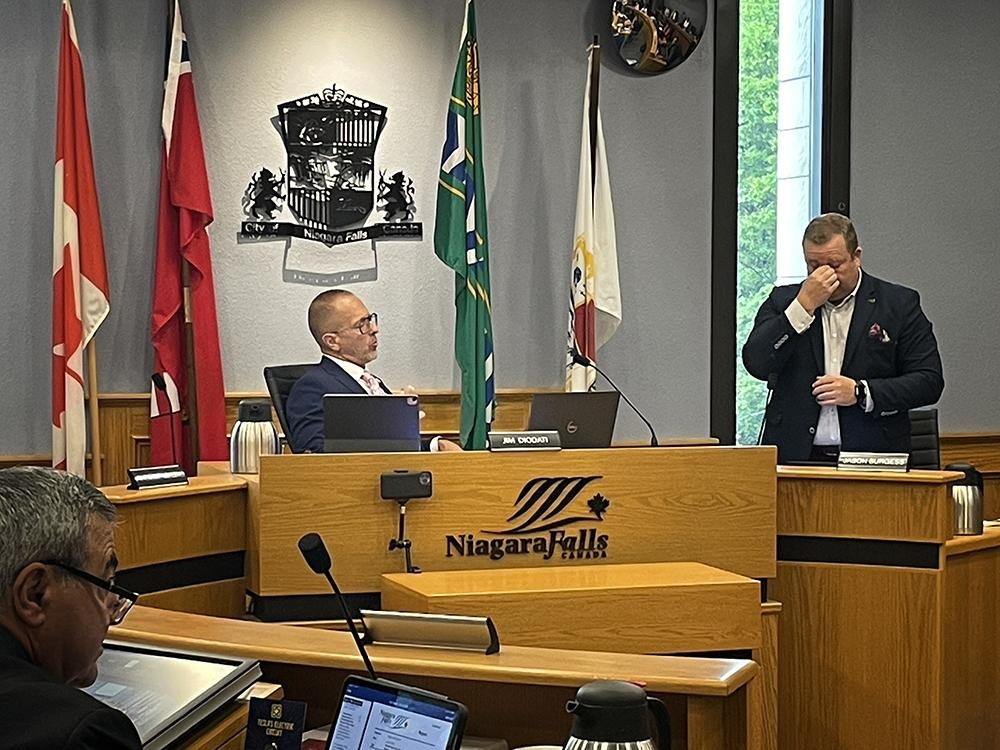
Niagara Falls Mayor Jim Diodati, centre, has mouthed Doug Ford’s desire to reduce the size of municipal government in Niagara and has supported handing over centralized power to a Regional chair hand-picked by Ford’s government. (The Pointer file photo)
Niagara regional council responded, voting to restrict Gale’s actions regarding amalgamation and immediately stop using regional resources for his own consultations to push his agenda.
Then, on March 11, a bombshell dropped.
A media release from the Niagara Region Anti-Racism Association (NRARA) and Justice 4 Black Lives Niagara (J4BL) revealed that Gale had purchased an authenticated, signed copy of Mein Kampf by Adolf Hitler. “Niagara Region Chair Bob Gale needs to explain himself publicly and apologize for owning one of the most notorious pieces of antisemitic hate,” the NRARA demanded.
Later the same day, Gale submitted his resignation. His tenure, after being hand-picked by Ford’s government, lasted 84 days.
Before the end of March, the councils of Niagara-on-the-Lake and Thorold approved motions to reduce their council sizes from eight members and mayor to six members of council and mayor, joining Port Colborne Council, which made a similar move.
It was suggested at lower-tier council meetings that it would be wise to make cuts before Ford imposes reductions on them, just like he did to Toronto council in 2018.
Before council members and residents across Niagara following the drama could catch their breath, on March 26 Minister Flack sent correspondence to the Region indicating he would be appointing a new chair to serve the remainder of the current term of council.
The appointment never took place with Niagara Region council appointing acting chairs monthly, as per its Procedural By-law.
Then, on April 2, Minister Flack introduced the Better Regional Governance Act, 2026, a piece of legislation that continues the PC government’s recent practice of handpicking regional chairs and inserting itself into municipal decision-making.
Provisions in the legislation, not surprisingly, echo the contents of Bob Gale’s March 4 letter.
Niagara Region Council is drastically cut in size from 32 members to just Niagara’s mayors and a Chair, a move to come into effect after October’s 2026 municipal election.
The legislation also provides eight of Ontario’s Regional or County Chairs, including Niagara’s, with “strong chair powers”, akin to the strong mayor powers the PCs handed to almost half of Ontario’s heads of council since 2022.
The Provincial government justified the additional powers for the democratically unelected chairs as necessary to create “more efficient, streamlined local decision-making, enabling them to deliver faster results for residents and support efforts to advance shared provincial-municipal priorities.” Critics argue that the appointed chairs will be puppets, doing the bidding of the PC government.
When asked how his government will “avoid another Hitler debacle”, Minister Flack did not specifically address the circumstances surrounding Gale and his resignation but maintained that future chairs will be vetted by the Provincial Integrity Commissioner. “We are going to carefully look at resumes to see who has the skill sets.”
The Province’s news release on the announcement of the dramatic centralization of power in the hands of chairs hand-picked by Ford and his lieutenants contained positive comments from Mayors Diodati and Campion, as well as Lincoln Mayor Sandra Easton. While St. Catharines Mayor Mat Siscoe was not included in the news release, he was lauded at the press conference as a head of council who has used his strong mayor powers to prioritize housing development. His use of those powers has come under fierce criticism from his own residents.
The Mayors of Grimsby, Port Colborne, West Lincoln, Pelham, Thorold, Wainfleet, and the Lord Mayor of Niagara-on-the-Lake sent out a joint news release “welcoming” the legislation. There was no criticism of the unelected chair. The release merely called on the PC government to “work with all municipalities to get the details right”.
Absent from the joint release of the mayors was Fort Erie’s Wayne Redekop. He sent out his own communication, which took aim at the legislation that allows unelected chairs “dependent on the Premier for their positions” to have veto powers over duly elected council members.
Redekop argued the move would be akin to the Prime Minister appointing provincial and territorial leaders. “This should concern all Ontarians,” he warned.
Email: [email protected]
At a time when vital public information is needed by everyone, The Pointer has taken down our paywall on all stories to ensure every resident of Brampton, Mississauga and Niagara has access to the facts. For those who are able, we encourage you to consider a subscription. This will help us report on important public interest issues the community needs to know about now more than ever. You can register for a 30-day free trial HERE. Thereafter, The Pointer will charge $10 a month and you can cancel any time right on the website. Thank you
Submit a correction about this story

