
25% turnout—Peel’s non-voters and the organizations trying to engage them ahead of October’s municipal election
In 2022, just 24.56 percent of eligible Brampton voters and 21.84 percent of those in Mississauga who were allowed to vote cast a ballot in their municipal election. Roughly three in four eligible residents in two of Canada’s largest cities stayed home.
Brampton has set a target of 30 percent turnout for October’s vote. Mississauga, notably, has not. Whether either city gets closer to that mark may depend less on campaign logistics than on something harder to fix—a growing sense among many residents that politicians simply are not reaching them, and even when they do, there’s little honest engagement on the issues directly impacting residents.
“Maybe just the newer generation and lack of trust in the politicians,” says Brampton resident Shanice Swaby. “For me, I have voted before, but…I mainly vote sometimes based on what my family is voting for. Again, I think it’s just due to the lack of trust for politicians.”
John Beebe, director of Democratic Engagement Exchange at the Toronto Metropolitan University (TMU) has spent years studying why Peel’s numbers look the way they do. He often pushes back on the word that most people use to describe it—apathy.
“I think there’s a lot of barriers to participation in municipal elections,” he said. “Our experience working with communities in the Peel Region—Brampton, Mississauga and Caledon, is that people are really passionate about their communities. They care deeply, but they just don’t see that municipal elections are a way to impact the issues that they care about.”
That reframing is shared almost word-for-word by United Way Greater Toronto, one of the organizations behind Voice the Vote, an initiative to improve participation. Lori Galway, the organization’s director of public policy and public affairs, was asked about Peel’s poor voter turnout and apathy.
“It’s definitely not apathy,” she said. “People care very, very deeply about the issues that affect them and their communities—everything from housing, affordability, to transportation, safety, community well-being. What we’re finding is that sometimes people don’t always connect some of those issues to the role of municipal government.”
Galway said that disconnect is not unique to Peel, but it’s amplified by the region’s rapid growth, its diversity, and the economic pressure many households are under.
“In Peel, those challenges can be really amplified by rapid growth. Significant cultural, linguistic diversity, large newcomer populations, and lots of families face many economic pressures. So when people are focused on housing costs and commutes and multiple jobs or caregiving, participation can really feel further removed from people’s priorities.”
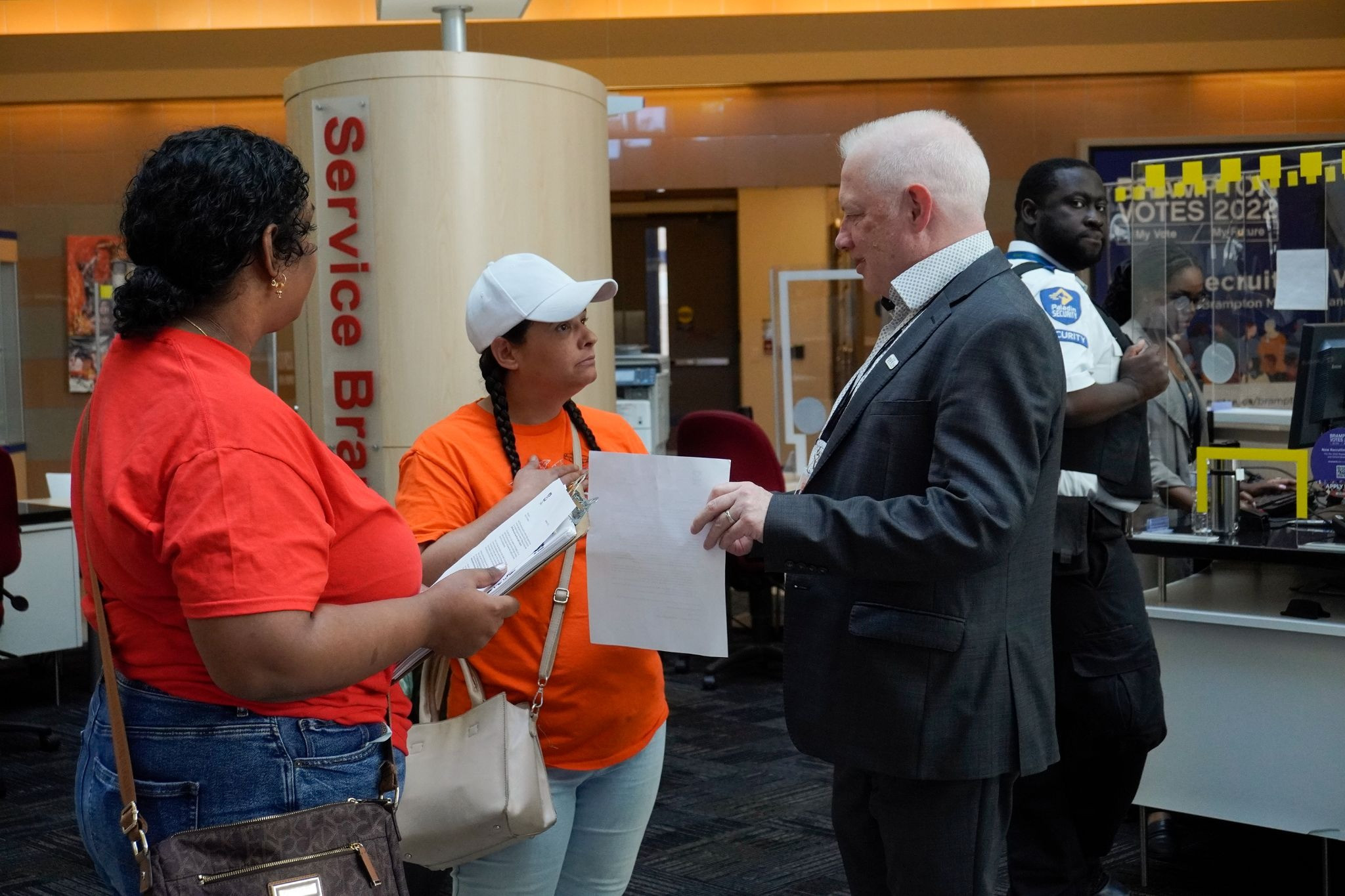
Staff get information at Brampton City Hall ahead of the 2022 municipal election, when less than a quarter of eligible voters turned out.
(Alexis Wright/The Pointer)
Beebe pointed to a related, more practical gap, related to the way information is shared…or not, as a compounding factor. Residents often don’t know who is running, where candidates stand, or how the issues they care about connect to city hall at all. That gap, he says, helps explain why turnout is consistently higher in federal elections than municipal ones, even though city hall touches residents’ daily lives more directly.
“At the federal election, you have political parties, you have a lot of media attention, you have much better information,” Beebe said. “At the municipal level, you’re talking about issues that are like infrastructure, local transit issues, and it’s not clear—well, what’s that candidate’s position?”
Marium Nur Vahed, co-creator and project lead of Voice the Vote, believes a deeper issue is that many residents have never felt invited into local politics in the first place. Voice the Vote, she explains, targets those communities that have not been invited, to “make municipal government feel present in the everyday lives of residents.”
When told about residents who told The Pointer they feel disconnected from candidates, including incumbents who do little to explain their track record and what they plan to do for taxpayers if elected, Vahed said the onus falls partly on the candidates, but engagement should not stop there.
“To build a healthy local democracy, it really requires a whole society approach. Part of that is absolutely candidates being able to leverage the teams that they have and doing some deep outreach and engagement with residents…”.
Beebe said patterns that candidates, particularly incumbents, fall into are self-reinforcing. Campaigns tend to focus their limited resources on people with a voting history, which leaves first-time and infrequent voters outside the engagement loop.
“Candidates in local elections will focus on the people who have voted in the past. And so that creates a sort of negative cycle where people who haven’t participated aren’t reached out to. And that’s a problem.”
Regarding recent low turnout, Beebe was blunt about the impact on local democracy and the legitimacy of the governing process.
“When you see in a city like Mississauga, which is a major city in Canada, you have voter turnout approaching 20 per cent, that’s not democracy. You’re having your elected leaders chosen by just a fifth of the population. It starts to lose legitimacy as a democratic institution, and that’s very problematic.”
Incumbent politicians have historically been criticized for failing to promote voter engagement, knowing that, for example, a powerful mayor with name recognition and the ability to influence votes by handing out money to loyal groups or constantly showing up to community events, does enough to keep a captive audience in their camp. Doing little to promote voter turnout can ensure their own base will cast an outsized portion of the ballots, limiting the ability of competitors to find a foothold among the vast numbers who stay home.
Patrick Brown has built a career on manipulating voters, and bragged about it in a book he authored in 2018, detailing many of the tactics he has deployed. Exploiting ethnic communities is one of his main strategies, making promises to them based on identity politics, and supporting causes linked to their historic concerns, which have nothing to do with the key day-to-day issues in Brampton, where he is once again running for mayor.
His tactics, including blatantly misleading voters about what he has done, for example claiming a tunnelled LRT into the city’s downtown has been funded, when it has not received one cent of capital funding, have a number of consequences, critics on social media, opponents and even fellow conservative politicians in Ontario’s PC Party and Canada’s federal Conservative Party, such as MP Jamil Jivani, who has publicly accused Brown of alienating voters and sowing division, have routinely pointed out.
Brown uses taxpayer-funded staff to get him on media platforms unaware that much of what he says is either false or very misleading. He has claimed Brampton has the most electrified transit system in Canada; it is one of the poorest, and the handful of electric buses he has often pointed to are part of a federally-funded pilot program initiated before he was elected and began to make severe budget cuts to the city’s municipal transit system. He has misled the media about the reasons post-secondary education partnerships with Ryerson (now TMU), Guelph-Humber and his own Brampton University project failed, due to his lack of leadership. He has repeatedly claimed an “Innovation District” has been created downtown; it has not, after he cancelled the widescale downtown revitalization project immediately following his election in 2018. And as a member of the Police Board, he has refused to allow any external audit of the force to find out why, despite Brown forcing through massive spending increases that doubled the Peel Police budget in half-a-decade, causing unsustainable strain on Peel Region’s property tax base, crime solvency rates and rates of certain types of crime such as the targeting of South Asian residents have gone in the wrong direction.
When voters are lied to, many who often have influence with large blocs of the electorate line up to support the candidate, hoping to gain advantages themselves, while many seek out alternatives, looking for actual leadership. But many choose to disconnect completely, fatigued by the constant manipulation so common in politics.
(Elections Ontario)
Voice the Vote’s field operation hired 15 staff in total, including two campaign leads, one each for Peel and York Region and 13 field officers to engage with communities and neighbourhoods that have shown low levels of voter turnout.
“We’ll be focusing on neighbourhoods that have had lower levels of voter turnout in the past,” Galway said. “We also know, through United Way’s funding of community service agencies, where those neighbourhoods are that are really multi-barriered.”
Vahed said that language access is central to the campaign’s approach in a region with large newcomer populations, a theme that echoes concerns The Pointer has heard directly from Brampton residents about navigating an English-dominant political process.
“We are creating resources that outline things like the roles of municipal government, the ways people can vote,” Vahed said. “And we’re doing so in ten languages that we see are the most spoken across the GTA, including French…part of this work has been hiring a field team that is also able to speak many languages.”
While Voice the Vote is built around neighbourhood-level partnerships, the City of Mississauga is taking a more centralized approach, and has explicitly ruled out working with Voice the Vote or any similar third-party campaign, according to a statement provided to The Pointer.
“The City has not set a numeric voter turnout target for the 2026 Municipal Election,” the statement said. “Instead, the City’s focus is on delivering clear, accurate, timely, accessible and trusted election information…The City is not working with any third-party civic campaigns.”
The City of Brampton did not respond to questions.
City of Mississauga staff have said multilingual election information across multimedia channels has been initiated, equipping community partners with ready-made election content, while pop-up information booths in community spaces across Mississauga are being hosted. A separate digital toolkit for community groups, faith organizations, cultural organizations and volunteers to share independently has also been developed.
The statement to The Pointer pointed to a report the City brought to its Governance Committee earlier this year, the Options for 2026 Voter Turnout Study, as the basis for Mississauga’s approach. The report draws on Canadian academic research showing that renters, younger residents and newer immigrants vote at lower rates than older homeowners, a body of research that specifically singles out Mississauga, given its large population of non-Canadian born residents, and a city where such patterns are most visible.
Council committee discussion around the report has also floated potential measures for elected members to consider, including a Vote From Home pilot program, additional advance-voting locations, extended polling hours, and commissioning a dedicated voter-turnout survey.
“The vast majority of new Canadians will tell you that they think voting is an important part of being Canadian,” Beebe said. “So it’s not convincing people that voting is important, it’s convincing people that they have the capacity and skills and the resources they need to make a well-informed decision.”
Galway said that turnout alone is not enough to measure whether the Voice the Vote campaign has succeeded. “We feel that democracy doesn’t start with the vote. It starts with connection to community—that shared experience, and engaging and that interest and capacity to influence the decisions that affect our lives, and affect our families.”
Email: [email protected]
At a time when vital public information is needed by everyone, The Pointer has taken down our paywall on all stories to ensure every resident of Brampton, Mississauga and Niagara has access to the facts. For those who are able, we encourage you to consider a subscription. This will help us report on important public interest issues the community needs to know about now more than ever. You can register for a 30-day free trial HERE. Thereafter, The Pointer will charge $10 a month and you can cancel any time right on the website. Thank you
Submit a correction about this story

