

Brock University cancels scholarship honouring namesake, falls short on honouring his Indigenous allies
In December Brock University ended the long-running full scholarship for students from the Guernsey islands, where General Brock was born, to study in St. Catharines. Students from the Bailiwick of Guernsey off the Normandy coast of France have for many years looked forward to the Brock scholarships, which were an exceptionally generous way Brock University honoured the contribution of the Guernesiais General Isaac Brock in the War of 1812. It has been a recognition too of Guernsey’s independence that Brock’s origins were acknowledged in this scholarship rather than it being given to UK students for his role in the colonial British forces.
It is my understanding that the recognition toward Indigenous peoples secured by General Brock during the historic conflict has not yet been honoured. Brock relied on Indigenous support, including a federation of peoples formed under the Shawnee chief Tecumseh, to defeat U.S. forces. It is not hard to imagine a colonial military leader of this era, himself born on the fringes of the British Empire yet bound up in its colonial historiography, understanding the only remedy to land injustice being the reacquisition of land and honours through colonial service. It is through this understanding that his sincerity becomes clear in his repeated pleas that the Indigenous soldiers be considered “allies” and why he spoke so strongly of Tecumseh’s military qualities, saying that “a more sagacious or more gallant warrior does not exist.” Ultimately, both men gave their lives for their cause, the Guernseyman dying at the Battle of Queenston Heights (where he fought alongside the Mohawk), and Tecumseh a year later. But ultimately, Tecumseh felt betrayed by colonial forces post-Brock, and this is a sentiment many Indigenous people have had cause to feel in the two centuries since. After the war they suffered a loss of influence and a continued loss of land as well as routine violations of treaties.
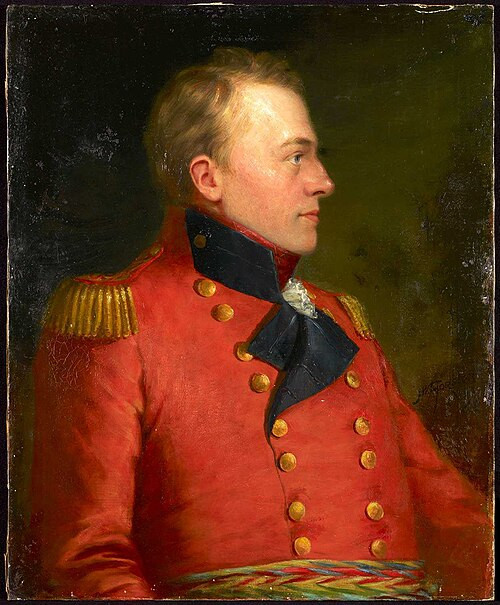
Portrait of General Isaac Brock by John Savery Carey, 1897.
(WikimediaCommons)
Therefore, should funding once again become available to restore this recognition of the legacy of General Brock, Indigenous scholarships should be instead given in Brock’s name. The University has rightly acknowledged that it is on the territory of the Haudenosaunee and Anishinaabe. The struggle for justice of Indigenous peoples is ongoing, as shown by the land defenders at 1492 Land Back Lane. Brock University should honour Brock’s legacy by being a stronger advocate for Indigenous rights and decolonization. They can more firmly honour the Two Row and Dish with One Spoon Wampun Covenants which covers the land they are on by consulting with their Indigenous Treaty partners on any major decision they make, and advance plans to return land. To this end, it is discouraging that Brock University has recently lost its Indigenous Vice Provost for Indigenous Engagement.
Guernsey itself is a small island, part of a chain, whose people value its unique history and its relative autonomy from major European colonial nations. However, it is with deep regret that Guernsey has had a specific influence on Canadian colonial history. There is not only a high likelihood that John Cabot’s expedition to Newfoundland was encouraged by reports by Guernesiais or Jerriais fishermen, but that this early relationship led to Guernsey and Jersey settler business interests that contributed to the wealth of the Channel Islands and etched themselves in the history and placenames of Canada. We share in the responsibility for the spread of colonialism in North America (Turtle Island) and I implore the States of Guernsey to recognize this in future consultations on Guernsey-Canada relations.
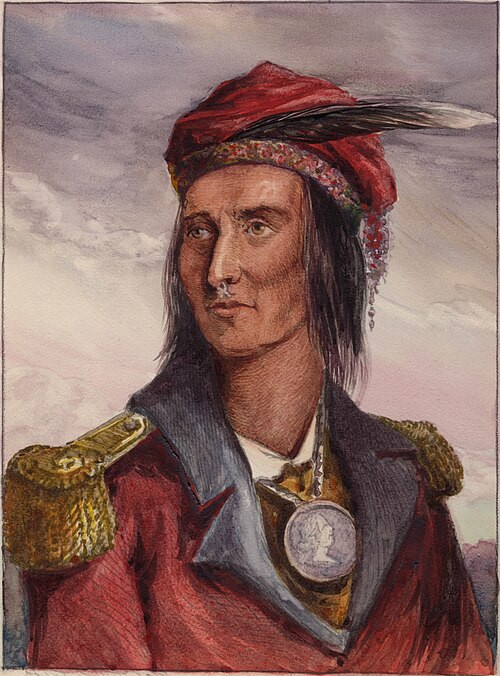
Painting of Tecumseh based on an 1808 sketch and republished by Henry Holt and Company.
(WikimediaCommons)
Finally, it is with confidence that I can speak for many islanders when I also share my dismay at hearing of far-right white supremacists using the statue of General Brock as a rallying point. Brock’s correspondence, as well as the published works of his descendents beginning in the 19th century, convey a respectful solemnity and aspiration for a resolution to colonial crimes. Nor will the legacy of the abhorrent attitudes of these campaigners find an obvious footing in Brock’s homeland, where it is a matter of much greater pride that Victor Hugo considered the island a “rock of hospitality”, rather than any idea that its history could be represented in a statue of a Guernseyman comically appropriated as a symbol of racial superiority. It is crucial that we instead build on the humanist attitudes of Brock and Hugo with considerable anti-colonial nation-building today.
Adele Cain is from St. Peter Port in Guernsey, where General Brock was born. She has a Masters in International Migration and Ethnic Relations from Malmo University.
Submit a correction about this story

