

Tenants push back after St. Catharines City staff put key protections on the chopping block due to lack of funding for bylaw officers
Somewhere in the city a tenant wakes up and discovers there is no hot water for the heating system.
After submitting repeated maintenance requests with no response, they purchase space heaters. When it’s not enough to keep out the cold of a harsh Canadian winter, the oven is used out of desperation to keep the apartment from freezing.
Another tenant alleges the landlord repeatedly shuts off the hydro without notice, even while they are recovering from surgery.
Another reports living for 16 days without running water and says tenants are told to use the public washrooms at Montebello Park.
These are not hypothetical scenarios made up from some distant corner. They are complaints made by St. Catharines tenants directly to the City under the Vital Services Bylaw. They were obtained through a freedom of information request by St. Catharines resident Saleh Waziruddin.

City of St. Catharines council members have failed to properly fund key bylaw officers to ensure critical municipal standards, which they approved, are enforced.
(City of St. Catharines)
According to the City’s website, the bylaw exists to give the municipality the authority to “force landlords to provide tenants with an uninterrupted supply of vital services,” including gas, heat, fuel, electricity and hot and cold water. When a landlord refuses to provide these necessities, the City can arrange for the service to be restored at the landlord’s expense, and may also issue fines.
The seriousness of the complaints received by the City underscores the critical importance of the protections enshrined in the bylaw, which was passed by elected officials who represent the most important issues residents expect action on.
At the July 13 Council meeting, those protections were put on the chopping block.
At the meeting, elected officials were presented a report by staff outlining expanded measures for increasing security in vacant buildings through a proposed Vacant Building Security Bylaw. While the staff report recommended that Council approve the hiring of two additional staff members and the purchase of a vehicle for a two-year pilot project, with an estimated cost of approximately $800,000, it also presented Council with two other distinct options for enforcing the new bylaw.
Option #1 relied on existing resources within the fire department, based on the rationale that firefighters already monitor vacant buildings through routine patrols. This option would require no additional funding and no new staff.
Option #2 involved reallocating existing personnel and resources to enforce the vacant building bylaw by discontinuing enforcement of other municipal bylaws. Among the standards identified that could go without enforcement was the Vital Services Bylaw.
Staff’s decision to put forward an option that would halt enforcement of this crucial bylaw did not go unnoticed by tenant advocates.
Waziruddin, a St. Catharines resident and president of the Park Towers Tenants Association, brought his concerns directly to Council.
In his remarks, he emphasized that the bylaw was created as a critical safeguard for tenants. He pointed to the circumstances that led to its adoption in 2022, when a tenant was left without heat and the existing enforcement mechanisms took three months to resolve the issue. With the bylaw in place situations involving the loss of essential services can be addressed within 24 hours.
“It’s outrageous and callous that staff put the Vital Services Bylaw on the chopping block as one of the alternatives to pay for enforcing the Vacant Building By-law,” Waziruddin told The Pointer. “They specifically included it in the list of bylaws to stop enforcing. They could have chosen other bylaws instead.”
His criticism goes beyond the recommendation itself.
"The City's own data shows calls from tenants have been steadily increasing every year," he noted, adding that this growth exceeded expectations previously expressed by the bylaw manager.
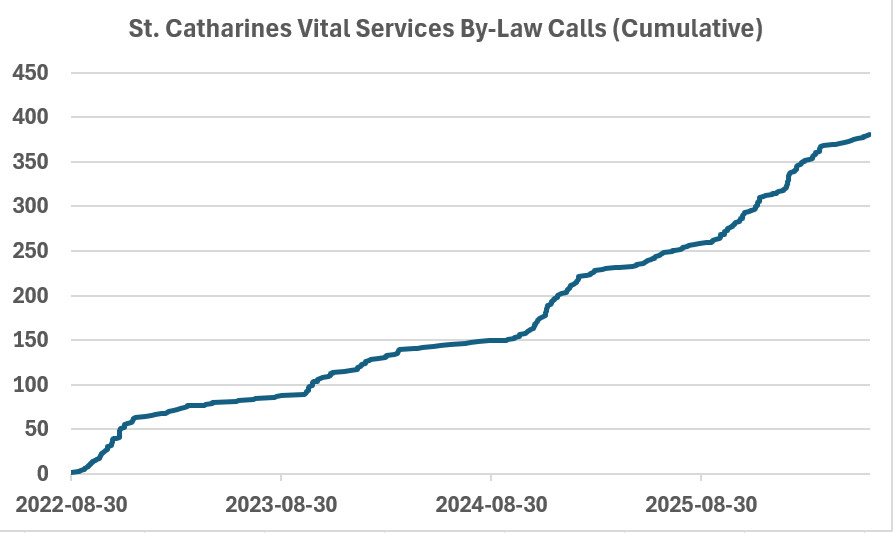
Data obtained from the City of St. Catharines shows 381 total complaints received under the vital services bylaw since its inception in 2022.
Asked why the Vital Services Bylaw was included as a potential option for suspended enforcement, City officials stressed that staff never recommended the option and only included it to provide Council with an alternative should it choose not to support the recommended hiring of two additional bylaw officers.
The inclusion of the option in the report is a recommendation, leaving it up to elected officials if they want to choose it or pick another recommendation.
The decision by staff to make the idea one of their recommended options has left some residents wondering about a disconnect between the realities more of them face, and the bureaucrats inside City Hall who are supposed to act as public servants.
According to the City, the bylaws identified as potential candidates for suspended enforcement were selected based on metrics, including the number of complaints and investigations they generate and the time required to resolve those calls for service.
Staff noted that, even if enforcement of the Vital Services Bylaw was suspended, protections would not disappear entirely. The City's Property Standards Bylaw contains provisions related to vital services, although officials acknowledged it "would be less effective than the Vital Services By-law itself."
Staff also pointed to protections available under Ontario's Residential Tenancies Act through the province's Rental Housing Enforcement Unit.
The timing makes the report even more surprising. As housing affordability continues to deteriorate and climate change brings more and more weather extremes, reliable access to essential services is becoming increasingly important for vulnerable tenants.
For Waziruddin the report has to be seen as a reflection of the values and priorities of the city.
“They could have chosen other bylaws to consider for reduced enforcement, and while the Deputy CAO stated that staff is not recommending this alternative, the question remains: why was it presented as an option in the first place? It would be an absolute disaster for so many of us. This bylaw protects tenants who are left without essential services like heat in the winter, hot water, and electricity,” he said. "Why would staff even open the door to leave these residents unprotected?”
Council neither discussed nor considered the option of discontinuing enforcement of the Vital Services Bylaw. Instead, much of the debate centred on whether firefighters should take the lead in enforcing the proposed Vacant Building Security Bylaw. Ultimately, Council rejected that approach and approved the recommended two-year pilot project, along with the funding required to hire two new bylaw enforcement staff.
City officials said they were pleased Council approved the recommended two-year pilot project, noting the decision allows the municipality to maintain enforcement of the Vital Services Bylaw while expanding vacant building enforcement.
According to the City, bylaw staff have responded to 67 Vital Services complaints so far in 2026, achieving what officials describe as a 99 percent compliance and resolution rate.
Speaking on behalf of his tenants association, Waziruddin did not hold back, despite the final outcome.
“The lives of tenants in St. Catharines are not pawns in a political power struggle between staff and Council. Our basic right to live in safe, habitable housing should be taken seriously, not casually put forward as a sacrificial option simply to make another proposal seem more attractive by comparison,” he said. “It’s 2026, a basic standard of living means having heat in the winter, hot water, and electricity. It’s difficult to understand how anyone could suggest weakening protections for those essential services, knowing it could leave people to suffer and put their health and safety at risk.”
Email: [email protected]
At a time when vital public information is needed by everyone, The Pointer has taken down our paywall on all stories to ensure every resident of Brampton, Mississauga and Niagara has access to the facts. For those who are able, we encourage you to consider a subscription. This will help us report on important public interest issues the community needs to know about now more than ever. You can register for a 30-day free trial HERE. Thereafter, The Pointer will charge $10 a month and you can cancel any time right on the website. Thank you
Submit a correction about this story

