
Caledon awards $4.6M transit contract to Argo; Brampton Transit cutting service after Patrick Brown signed a secret deal with the same company
A second Peel municipality has awarded a multimillion-dollar contract to the same Ontario-based on-demand transit provider with a limited operating history, just days before The Pointer entered an adjudication process with Ontario’s Information and Privacy Commissioner to obtain the City of Brampton's agreement with the company.
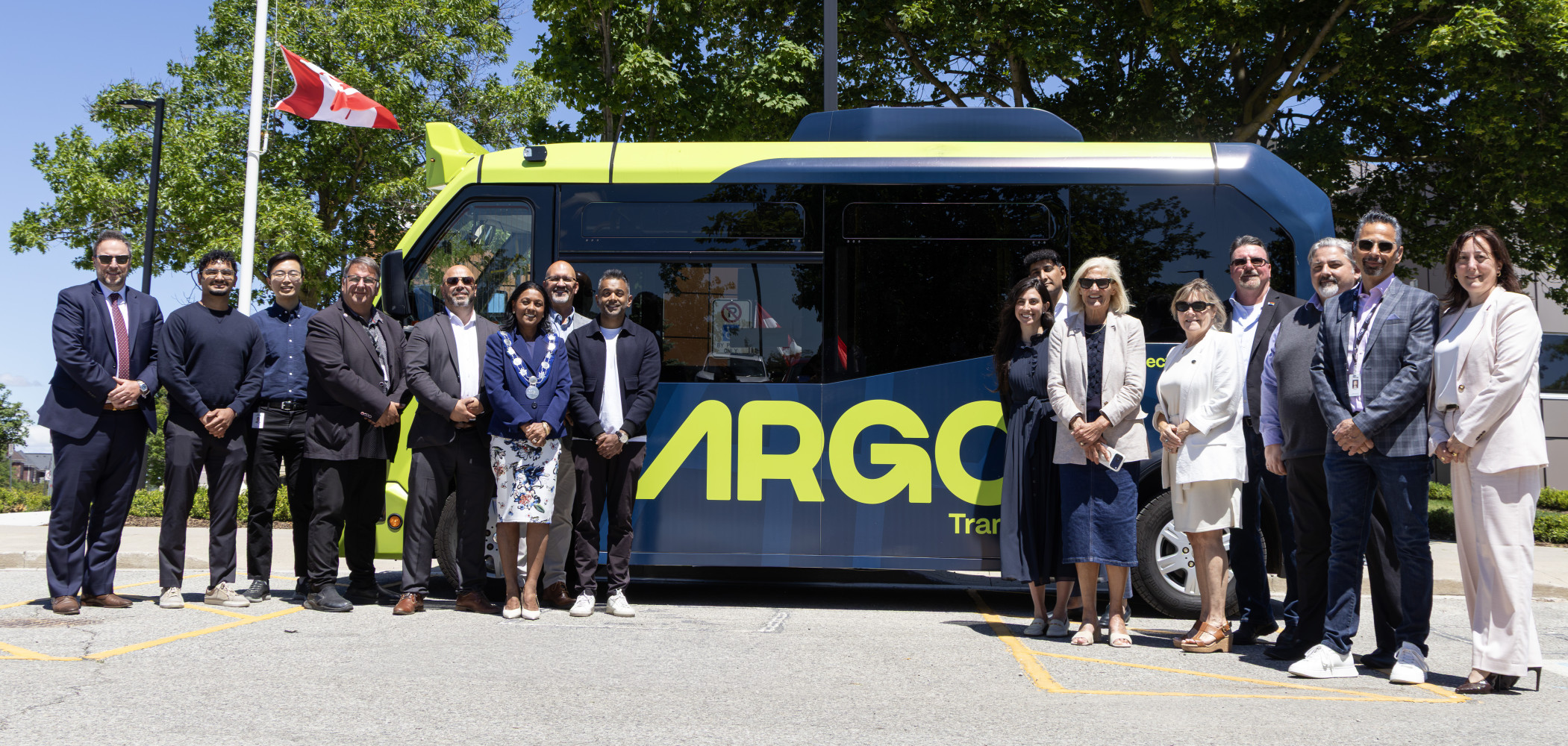
On June 25, Argo Transit announced a 15-month micro-transit pilot with the Town of Caledon, expected to launch this September, nearly three months after council approved a $4.61 million agreement beginning October 1 this year and running until December 31, 2027 with the option to extend the pilot until the end of 2028.
The use of Argo by Ontario municipalities for on-demand service, and claims of supporting existing public transit systems, have raised eyebrows.
On April 13, Burlington City Council voted to move forward with a study examining the possibility of an Argo pilot with a two year on-demand transit program among the options being considered to improve transit access, encourage ridership and reduce congestion.
It has already sparked widespread concerns among some residents who fear a private operator could siphon transit funding away from lower-demand and underserved communities like Alton, Tyandaga, Millcroft, Mountainside and Aldershot and instead introduce a private service in areas already supported by Burlington Transit.
“Do we need more services competing in these already well utilised areas or should we target the service and potential savings of On Demand Transit where it is most appropriate?,” Burlington resident and BFAST (Burlington for Accessible Sustainable Transit) volunteer Jim Young said.
He questioned whether a model that has shown success in smaller communities like Bradford West Gwillimbury, which signed a deal with Argo last year and only has an annual ridership of 60,000, would translate to Burlington’s larger transit system, which achieved a record-breaking ridership of approximately 3.64 million rides in 2024.
Calling the Brampton pilot Argo’s “claim to fame”, he raised concerns about the secretly approved $10.9 million contract to create a “fully electric Smart Routing transit system” that would compete with Brampton Transit’s core services including some of its most successful, popular and highest-revenue routes connecting downtown to GO hubs.
“Is the purpose of Argo's Brampton adventure to improve Brampton Transit Services or to make inroads into Mayor Patrick Brown's well recorded and oft-stated aim of privatizing Transit in Brampton?” Young critiqued.
“Paying a private corporation to provide services that Burlington Transit is perfectly qualified to deliver sounds like a really bad and expensive idea for Burlington but a very good and profitable venture for Argo.”
On social media, a recent decision by Brampton’s leadership under Brown has sparked a backlash after a number of Brampton Transit Service changes were recently announced, which will take effect August 4.
“This is ridiculous, as someone who semi-regularly uses route 55, yes it isn't a packed bus, but it provides an important service, and theres so many including many seniors who rely on it to get around,” Reddit user Stead-Freddy posted.
He pointed out that, “Routes 33, 36, 55, and 56 are being cut completely by Brampton Transit, with adjustments also on routes 501, 502, 505, 561, 5/5A, 13, and 18, which may include reduced frequencies.”
He wrote that “an able-bodied person like myself is able to walk the extra 10 minutes to a different bus route, but not everybody can.
“This goes completely against the City of Brampton's goal of bringing transit within 400m of every home, and at a time when we need to be looking to alternatives to driving to help reduce congestion, the City is making that a harder choice.
“Please, Please write to your local Councillors and the Mayor to express your disappointment, and demand a reversal.”
Others have posted on social media that the Argo vehicles in Brampton are empty, while many have complained that Brampton Transit service needs to be expanded as the city’s population continues to swell, not reduced.
The Pointer has been unable to get any information about Argo ridership and City staff have ignored numerous requests for other details about the contracted service. This has been the pattern since Brown became mayor in 2018 and immediately faced criticism for shutting down transparency inside City Hall, including from councillors during his first term who repeatedly and publicly stated Brown had eroded democracy in Brampton.
While Argo’s expansion into Caledon may appear to be a logical fit for a municipality without its own transit operator, bringing on-demand service to areas like Caledon East for the first time, as part of its growing presence across Ontario, raises questions, including why Brampton residents still do not have access to the full contract with Argo that they are paying for?
When Mayor Brown approved the nearly $11 million agreement, the head of the City’s transit union accused Brown of bargaining in bad faith as a potential transit strike loomed in April 2025. The mayor was accused of undermining Brampton Transit while handing over an $11 million contract to a private service provider with links to the Ontario PC Party, which Brown used to lead.
Not only were taxpayers completely shut out of the process around the Argo deal, there was not one public report, no accounting for how the City planned to spend millions of taxpayer dollars or any detailed explanation of how the contract came about, despite the obvious pitfalls of partnering with a transit start-up that had been operational for less than a year when the contract was inked.
When the City refused to answer questions about the deal shortly after it was signed, The Pointer filed a freedom of information request to learn how a company with no history secured almost $11 million from Brampton taxpayers without their knowledge.
The result of that request? Nearly 1,500 pages of documents — 86 percent of them were fully redacted and a further six percent were redacted so heavily, making them effectively incomprehensible.
The Municipal Freedom of Information and Privacy Act includes exemptions which allow a municipality to withhold certain information if it falls under one of four categories, including legal advice, personal information about identifiable individuals, labour negotiations or certain third-party information that might negatively impact the partner.
The City of Brampton has repeatedly stretched the use of these exemptions to keep information from the public.
Officials withheld the final contract with Argo claiming it was exempt from disclosure as “it contains information relating to negotiations and financial, technical and commercial information that was supplied to the City in confidence”, citing Section 10 and 11 of the MFIPPA.
The Information and Privacy Commissioner of Ontario (IPC) clearly states that contracts between public institutions and third parties generally do not automatically qualify for protection under these exemptions; and when using Section 11 “the exemptions apply to ongoing negotiations, or to negotiations that will occur or are anticipated or intended to occur in the future.”
With the contract already signed and negotiations concluded between the City of Brampton and Argo, the exemption no longer applies.
In July, after The Pointer narrowed its request to seek only the contract, the matter was referred to an adjudicator for review, further extending the fight to receive information that would explain the decision to taxpayers.
The Pointer reached out to the Town of Caledon requesting a copy of the contract signed with Argo but did not receive a response ahead of publication.
Three communities will be served under the pilot.
“As of right now, it's Bolton, Caledon East and Southfields/Mayfield West. Our goal is to be able to then deliver this service townwide,” Wards 3 and 4 Councillor Mario Russo said at an Accessibility Advisory Committee Meeting on July 20.
“It's one of the only possible options that we see that allows that because the infrastructure that would be required to service the town without this type of partner, I think, would be beyond our means financially.”
Staff has been instructed by council to provide two updates on Argo’s performance during the pilot — the first one at the halfway mark and the second after 12 months along with a recommendation on whether the three replaced Brampton Transit routes should remain paused. Otherwise, the service provided by Brampton Transit could resume until some time in 2027 when the arrangement would be reviewed again.
The Caledon pilot will be funded partly with $1.1 million from the Provincial Gas Tax Reserve and $3.51 million from the Town’s Capital Asset Replacement Fund; a staff report acknowledged Argo will take on “all fare revenue risk for the full duration of the pilot”.
The fully electric, wheelchair-accessible minibuses can carry up to 18 passengers, accept PRESTO payments while integrating Ontario's One Fare program and connect riders with regional transit systems by providing them the option to book trips in advance or request rides in real time through a mobile app or by phone — all week long (5:30 a.m. to 8 p.m. on weekdays and 7 a.m. to 7 p.m. on weekends).
“Caledon continues to explore innovative solutions to improve how residents move throughout our community,” Mayor Annette Groves said in a statement.
“This pilot reflects our commitment to delivering accessible, efficient and sustainable transit options while embracing new technologies that have the potential to improve service for our residents.”
The chosen routes are expected to serve communities in Bolton, Mayfield West/Southfields and Caledon East, offering connections to GO Transit, Brampton Transit and York Region Transit, with the Town targeting a median wait time of 20 minutes.
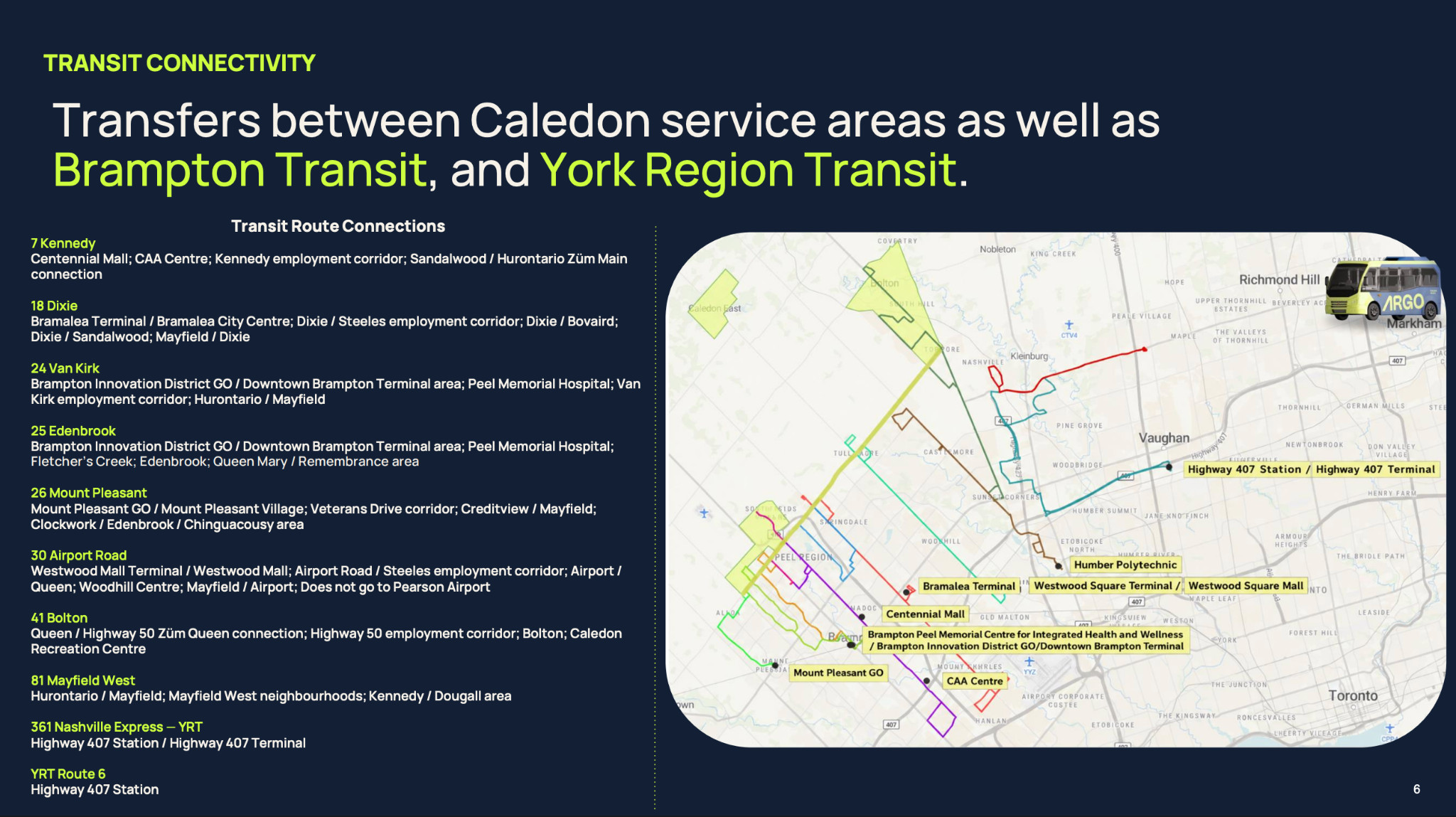
In a presentation on July 20, Argo’s CEO Praveen Arichandran detailed the areas that will be serviced in the company’s pilot in Caledon.
(Argo/Town of Caledon)
The move makes Caledon the second municipality in Peel Region to partner with Argo, whose municipal track record only includes Bradford West Gwillimbury and the City of Brampton, deals that have started in the last year.
“The Argo launch is a great example of how innovation is helping us build a more connected Ontario to get people where they need to go, faster and more conveniently,” Ontario’s Minister of Transportation, Prabmeet Sarkaria, said at the Argo launch in Bradford West Gwillimbury in April 2025.
Four months later, Argo announced it had appointed a former Doug Ford staffer as its Head of Business Operations.
Jenna Bendayan, who worked as a head of priority initiatives in the Office of the Premier of Ontario, was brought on board after she played “a central role in delivering large-scale initiatives including infrastructure expansion, regulatory reform, and transit modernization”.
Bendayan also served as Chief of Staff to Ontario’s President of the Treasury Board, overseeing files tied to fiscal planning, public procurement and the province’s post-pandemic recovery spending after holding the position of director of stakeholder relations at Ontario’s Ministry of Red Tape Reduction.
Argo CEO Praveen Arichandran said “the Caledon launch expands Argo’s Smart Routing infrastructure and service to a third municipality” allowing multiple passengers travelling in the same direction to share trips at the cost of a standard transit fare.
The average municipal cost is estimated to be $16.15 per trip, roughly in line with the $16.35 average cost of the Brampton Transit services being replaced.
Caledon staff noted Argo Transit reached out to the Town in December the same year to “engage in exploratory discussions” on how the services could be beneficial to the community.
As part of its due diligence, officials in Bradford West Gwillimbury were consulted and reported that ridership doubled within six months while all trip requests had been accommodated.
“However, pilot adjustments were required in the early stages and throughout the process with involvement and input from BWG staff to achieve this stable service delivery,” staff noted.
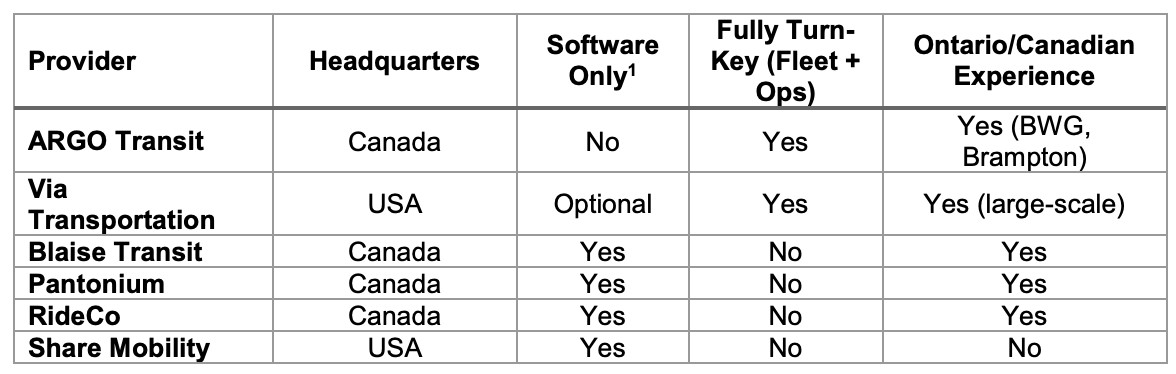
Town of Caledon staff recommended Argo after conducting a market scan of on-demand transit providers such as Via Transportation, RideCo, Blaise Transit, Pantonium and Share Mobility.
(Town of Caledon)
Before choosing Argo, staff carried out a market scan of on-demand transit providers. While many competitors offered software platforms requiring municipalities to source their own vehicles and drivers, Argo's fully integrated model bundled vehicles, drivers, dispatch, booking software and operations under one contract, thereby, reducing the administrative burden on the Town.
While Brampton and Caledon have hopped on board with Argo, another Ontario municipality is weighing whether to bring the company into its transit network.
Email: [email protected]
At a time when vital public information is needed by everyone, The Pointer has taken down our paywall on all stories to ensure every resident of Brampton, Mississauga and Niagara has access to the facts. For those who are able, we encourage you to consider a subscription. This will help us report on important public interest issues the community needs to know about now more than ever. You can register for a 30-day free trial HERE. Thereafter, The Pointer will charge $10 a month and you can cancel any time right on the website. Thank you
Submit a correction about this story

