
‘Where’s animal welfare services?’: Marineland whistleblower claims injured deer, elk being sent to slaughterhouses
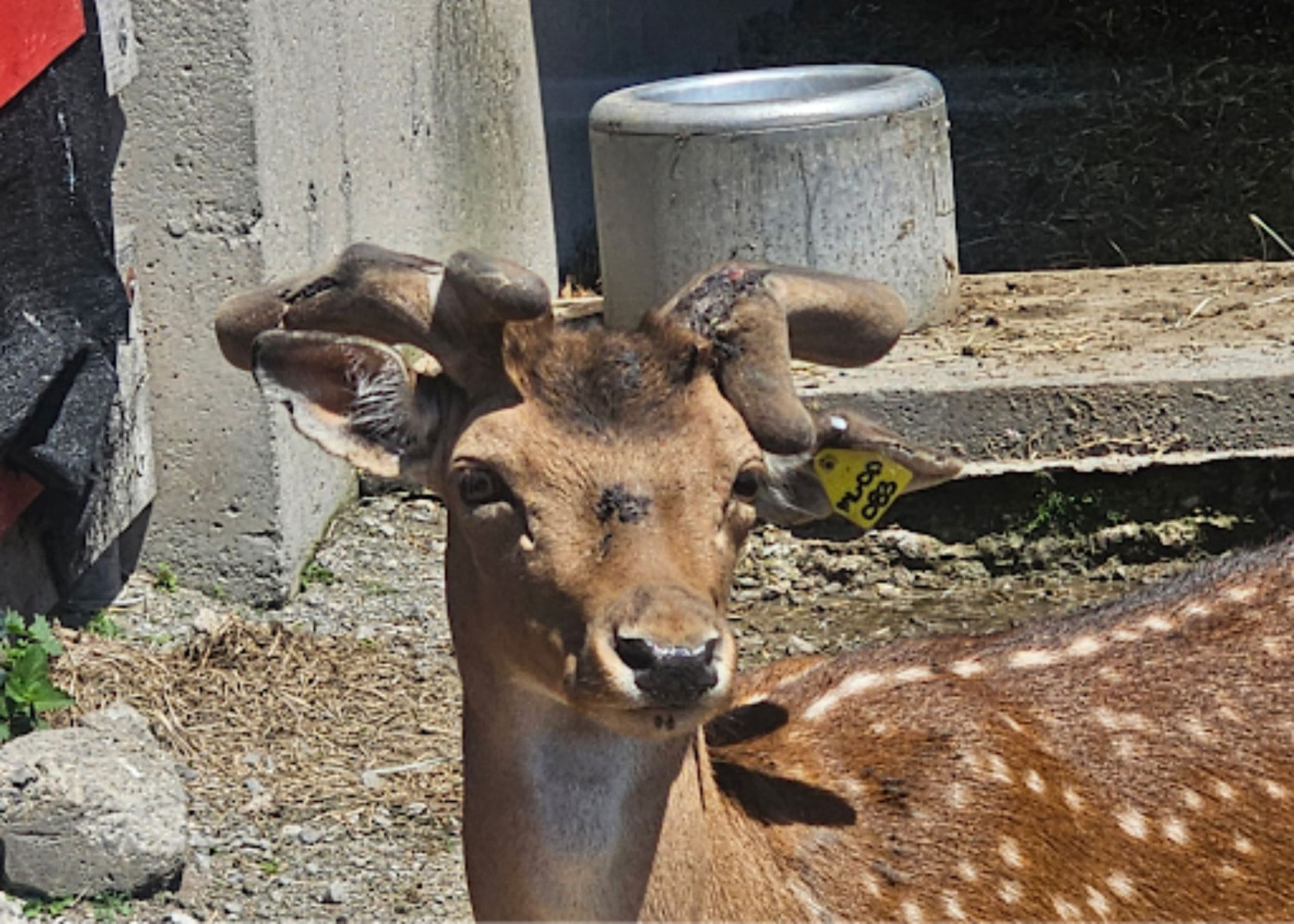
A large, dark wound protrudes from the side of the deer's head, stretching from the base of its antler toward its ear. The animal’s big, dark eyes reflect a weary helplessness.
That’s the hauntingly “heartbreaking” image that stared back at animal rights lawyer Kaitlyn Mitchell from her computer screen after a Marineland employee reached out to Animal Justice's whistleblower tip line.
“It's absolutely hard to look at,” Mitchell shared with The Pointer.
“We're talking about sentient, social animals who have been used for their entire lives to entertain members of the public and children. And now this is their fate, and it's absolutely unacceptable.”
For years, much of Animal Justice's advocacy surrounding Marineland has focused on the park's cetaceans, its whales and dolphins, and the dire conditions in which they are confined. But Mitchell, the Director of Legal Advocacy at Animal Justice, has always had “lingering questions” about what's happening to the other animals living on the property.
In early June, she got some possible answers to those questions when an employee working at Marineland’s Niagara Falls site shared troubling information, alleging that hundreds of captive deer and elk were being trucked off the property, with many in bad shape.
According to a press release from Animal Justice, reports suggest the park “may be sending some of them to slaughterhouses”. The Pointer has been unable to verify this claim.
Marineland has reportedly ordered that all cervids be removed by July 24 and more than 100 animals have already been transported off-site.
The whistleblower described concerning conditions at the former amusement park including inadequate veterinary care, deer suffering lacerations from fencing and injuries sustained during frequent fights in overcrowded and stressful enclosures.
“I wish I could say I was surprised,” Mitchell told The Pointer. “I was not surprised to learn that the deer appear to be in bad shape, I was not surprised to learn that the company doesn't seem to have a wind down plan for the deer…just like the cetaceans.”
This is not the first time deer and elk have been found in terrible conditions at the park.
In 2017, after two years of investigation, the Ontario Society for the Prevention of Cruelty to Animals (OSPCA) laid six charges under the Ontario SPCA Act, for the alleged neglect and mistreatment of elk, red deer and fallow deer. The case was dropped by prosecutors citing no reasonable chance of conviction.
Since opening to the public in 1961 under the slogan “Everyone loves Marineland”, the amusement park has courted controversy after controversy, while exposing the failure of the animal welfare system across multiple levels of government, and the human failure to recognize that animals are not meant for captivity.
In 1963, one of the amusement park’s first attractions, a sea lion named Jeff, slipped under a fence. Jeff was found three days later on a beach in Niagara-on-the-Lake basking in the warm sunshine. When Slovenian-Canadian businessman and Marineland founder John Holer tried to recapture the sea lion, it bit his bicep, but Holer forced the creature back to the park.
Jeff was never able to escape again and the fate of the animals inside the walls of Marineland got worse.
Keiko, a beloved orca captured near Djúpivogur, Iceland in 1979 at the age of two, approximately, was transferred to Marineland in 1982 where he first started performing for the public. He developed skin lesions indicative of poor health and was bullied by an older orca.
Soon after, Keiko starred in Free Willy, a movie that placed him at the centre of an ambitious rehabilitation effort in the 1990s that led to his release in Iceland and a journey to the waters off Norway. However, after 18 months, Keiko died in 2003 from a pneumonia-like illness, ending a life scarred by captivity, to drive the profits of Marineland.
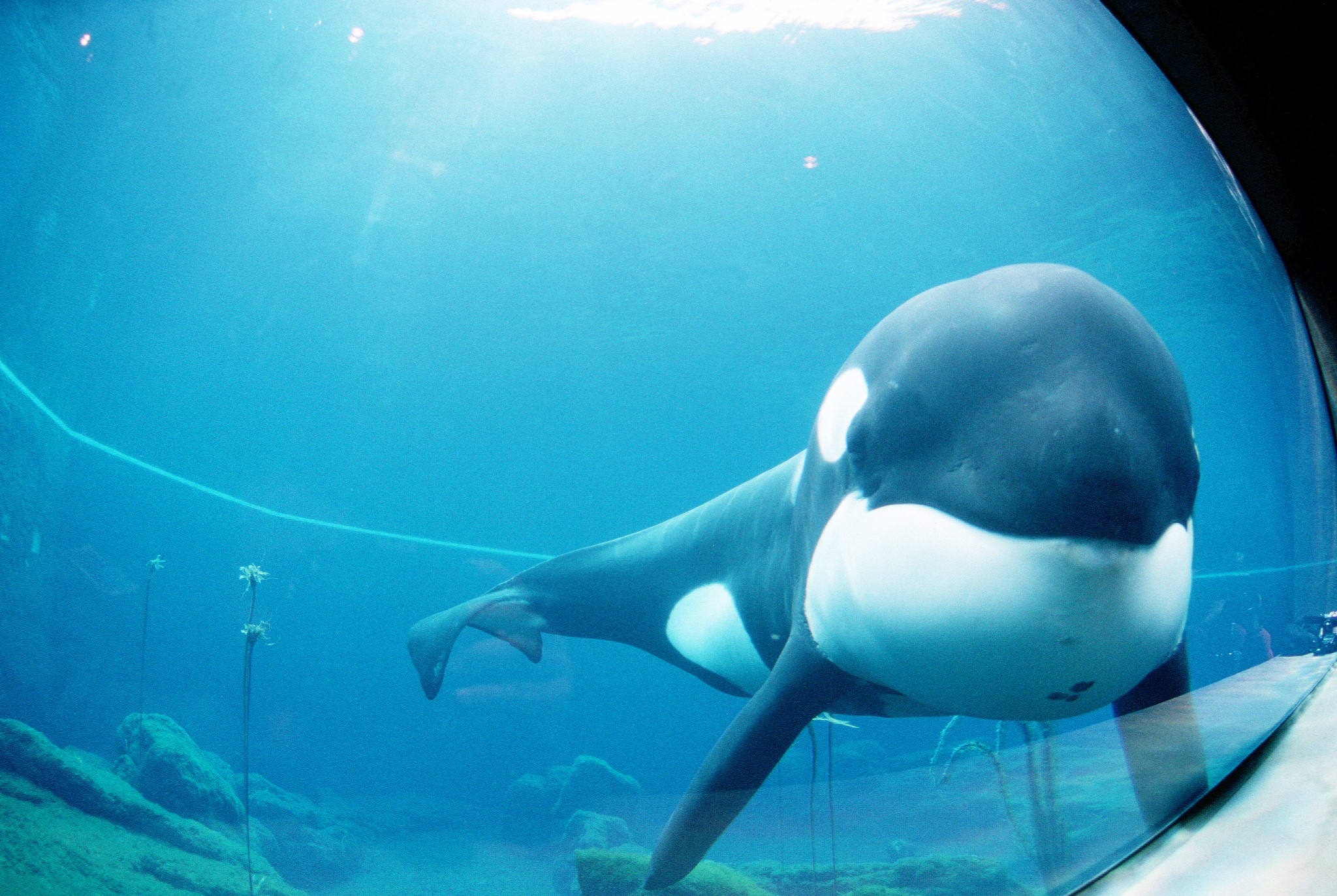
Keiko, the orca made famous by Free Willy and later the subject of a global effort to return him to the wild, died in 2003 at the age of 27 from pneumonia in a bay in Norway after years spent moving between captivity, rehabilitation and partial release attempts.
It would take Ottawa 16 years to recognize the need for stricter laws against using animals for entertainment, after Keiko’s death.
In June 2019, the federal government passed the Free Willy Bill, officially named the Ending the Captivity of Whales and Dolphins Act or Bill S-203, which made it illegal to breed, capture or hold whales, dolphins and porpoises for entertainment. Marineland’s lawyer Andrew Burns tried to block the federal government from passing the ban and was later charged by the RCMP for violating the Lobbying Act. Burns faced no penalty and was let off on a “peace bond” not to lobby for a year on any issue “with a narrow exception for lobbying related to the well-being of marine mammals in arranging for their transfer out of Marineland”, according to a 202.
A month earlier, Marineland had announced the deaths of two deer who were killed in an opening day stampede and a walrus, Apollo, who died from a heart attack.
Mitchell had joined Animal Justice as a lawyer the same month as the historic law was being enshrined, signalling the beginning of the end for Marineland’s business model.
“It was a really exciting moment for all Canadians,” she said.
But Marineland owners seemed unfazed by the legal requirements.
In December 2021, Niagara Regional Police charged the amusement park’s owners under the Criminal Code for using captive dolphins and whales for entertainment without government authorization after activists secured video evidence of the facility’s marine mammals performing tricks with prompts from trainers. The park’s officials claimed the routines were “educational” presentations rather than performances.
A year later, the criminal charge was dropped because a Crown prosecutor decided proceeding to trial was not in the “public interest” despite there being a reasonable prospect of conviction.
Two years later, Canada’s last captive orca, Kiska, widely known as the “loneliest orca in the world”, died at the Marineland facility after four decades of captivity and 12 years of social isolation where she lived completely alone in a barren concrete tank after 2011.
During that time, Kiska had lost all five of her calves, who had died prematurely. Videos released by Animal Justice show her repeatedly slamming her body against the walls of her enclosure, a sign of clear psychological torment. The provincial Animal Welfare Services (PAWS) never laid charges against Marineland related to Kiska.
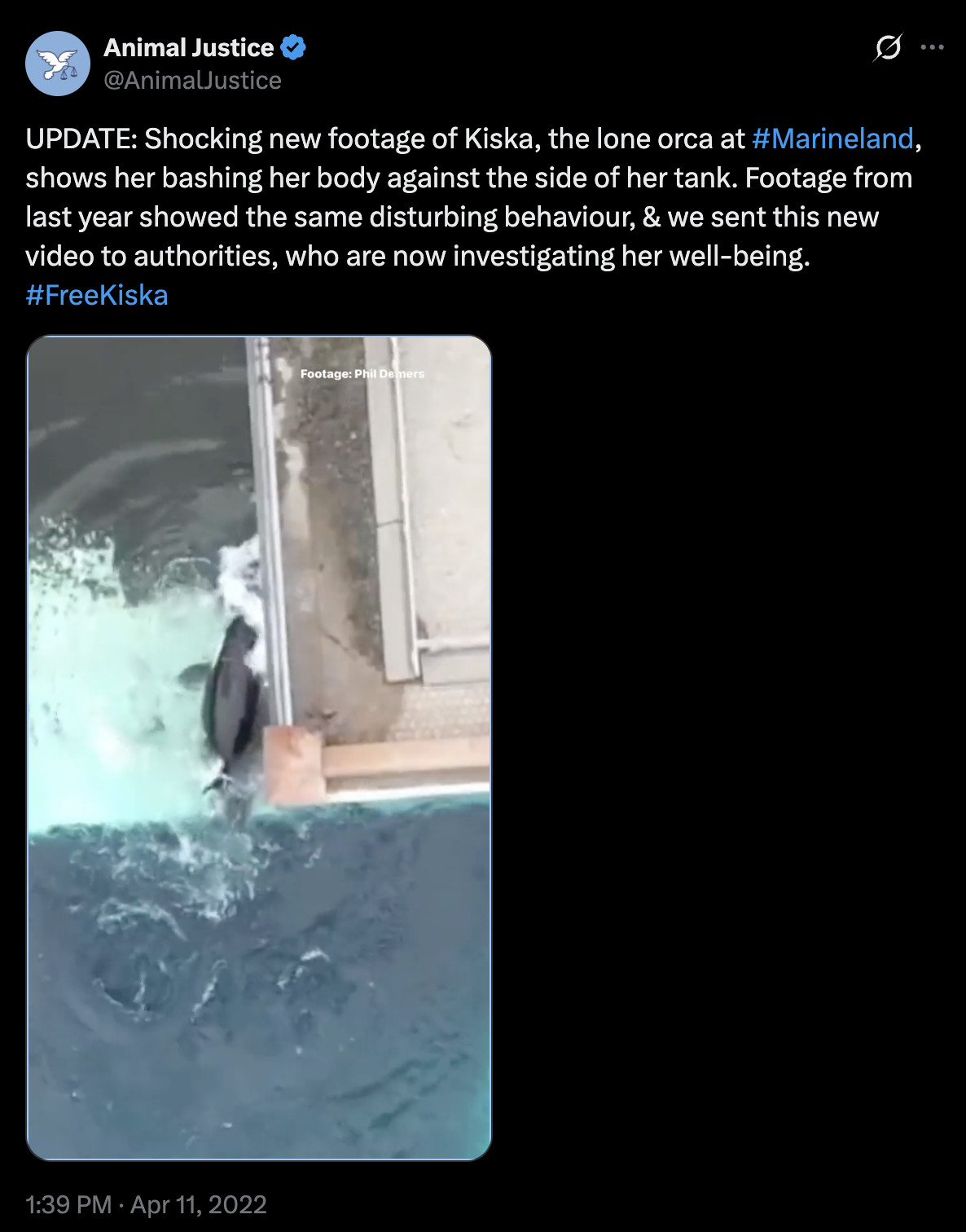
In her final years, Kiska floated listlessly and repeatedly slammed her body against the walls of her tank signalling psychological distress.
(Animal Justice/X)
By early 2024, the park’s management had been found guilty on three counts under the Provincial Animal Welfare Services (PAWS) Act. The charges, first laid in 2021, stemmed from the treatment of three young black bears who had been kept in cramped enclosures without climbing structures or permanent water features.
Ontario’s Animal Welfare Services deemed the animals to be in distress and issued orders requiring immediate improvements to their living conditions. When those changes were not made, the Crown intervened and seized the bears, relocating them to sanctuaries. Marineland had initially pleaded not guilty, arguing that their subsequent relocation meant it had complied with the 2021 orders but the court rejected that position.
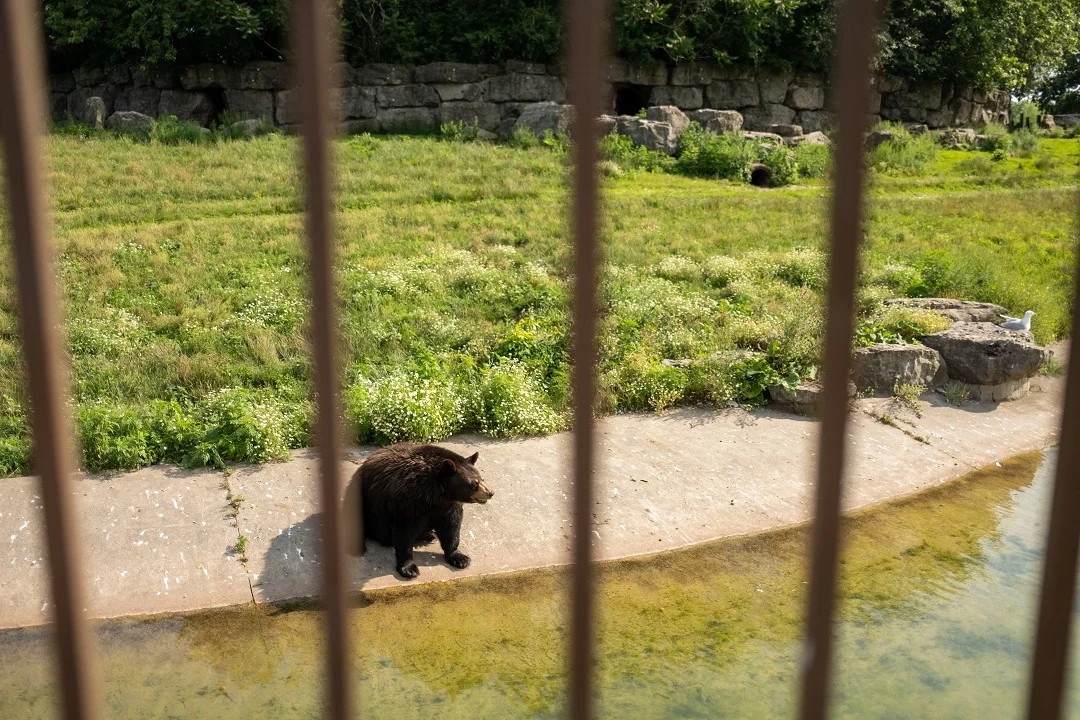
A captive bear at Marineland in Niagara Falls.
(Sasha Rink/World Animal Protection)
In 2024, Marineland announced it had finally decided to close its doors to the public following the death of Marie Holer on September 6. But the parks’ future and that of its remaining animals has become the subject of intense political and legal disputes.
After months of negotiations between Ottawa and officials with the Niagara Falls marine park, the Department of Fisheries and Oceans Canada endorsed a plan in late May to relocate Marineland’s remaining 30 beluga whales to Oceanogràfic València, at its locations in Spain and U.S..
The decision came after the federal government blocked the export of the whales to China, prompting park authorities to threaten that they would resort to euthanasia unless emergency funding was provided by October. The deadline passed and multiple reports indicated the whales remained alive.
While permits still needed to be finalized, experts like Mitchell worry given the documented history of belugas dying after transport, the risks to their welfare remain.
The future of Marineland’s more than 500 cervids (deer and elk) confined on-site since 2024 also remains worrisome.
“The whistleblower indicated to us that these deer are not receiving adequate veterinary care, there's botched euthanasias, animals with wounds who are not receiving proper care,” Mitchell said.
“Where is Animal Welfare Services?”
Between 2019 and 2024, a total of 17 belugas, one orca, one dolphin, two seals and two sea lions died while at Marineland.
“We have not been able to get any answers from Animal Welfare Services about orders in place or what they are doing to not only monitor water quality but provide the care these animals need and relieve their distress,” Mitchell added.
A 2023 amendment to the Provincial Animal Welfare Services Act provided authority to intervene to protect the animals if necessary and then recover those costs from operators.
“An animal welfare inspector who is lawfully in any place and who finds an animal in distress may, in addition to any other action the inspector is authorized to take under this Act, take any reasonable steps to relieve the animal’s distress, which may include providing the animal with necessaries to relieve its distress,” the PAWS Act dictates.
Mitchell emphasized that Marineland, despite financial pressures, holds significant assets and the Province can “recover costs later when the property is sold if they take steps now to improve the well-being of the animals”.
Section 35 of the Act allows the Province to bill animal owners for expenses incurred when inspectors relieve an animal's distress, remove animals from a facility, or provide ongoing care after they have been taken into custody.
“On paper our animal welfare statute is actually a really good law. It provides all of the tools available to the inspectors,” she noted.
“So it is incredibly frustrating to see these animals continue to suffer at the hands of a company that's winding down, and it seems like right now the primary concern is just getting rid of these animals, and someone needs to be there to make sure that their interests are still being protected.”
Animal Justice has since urged Animal Welfare Services and the Canadian Food Inspection Agency to launch a formal investigation into the matter.
However, gaining access to the results of the investigation might be another hurdle.
Over the years, Animal Justice has filed multiple freedom of information (FOI) requests to find out how PAWS responded to its complaints as well as the circumstances surrounding animal deaths at the park. The organization was repeatedly told it could not access the records, often on the grounds of “ongoing investigations”.
“There's not a lot more to investigate [about Kiska], but we have still not been able to obtain those records,” Mitchell said.
The Pointer has also filed freedom of information requests with the Province for necropsy reports related to Kiska’s death. In a violation of a provincial law, no response was received within the legislated timelines.
In the case where an investigation was done, Animal Justice has been met with high fees to retrieve the documents.
To gain access to the investigation results surrounding the fate of three bears at the park, Mitchell was initially met with a fee estimate of $40,680.
“We appealed that decision and the Information and Privacy Commissioner (IPC) ordered the Solicitor General to issue a final decision without collecting a fee deposit,” she said.
The Solicitor General issued that decision denying disclosure under section 65(5.2) of Ontario's Freedom of Information and Protection of Privacy Act which states the Act does not apply to a record regarding a prosecution if all proceedings have not been completed.
“We appealed again as we were aware that the proceedings had indeed completed. The Solicitor General agreed that the proceedings were completed and issued another decision, this time with a fee estimate of $1,290,” Mitchell added.
“Given the amount of time that has passed and the still very significant fee estimate, we decided not to pursue the request further.”
Premier Doug Ford acknowledged in September last year that the conditions at Marineland are “just terrible”.
On June 10, New Democratic Party’s Member of Provincial Parliament for Niagara Falls, Wayne Gates, wrote a letter to Ontario’s Minister of the Solicitor General, Michael Kerzner, to make “major PAWS investigations” public to remove “speculations”.
“It should never take a whistleblower to ensure public accountability,” Gates wrote.
“How is it possible that the investigations at Marineland are still happening without any public reporting from PAWS about when they inspected them, their current conditions, whether they are safe to be transported, and what is to become of them?”
In an interview with The Pointer, Gates confirmed he had spoken to the Solicitor General on June 12, who claimed inspections were being conducted regularly.
“The public should know exactly what's going on there, and by not releasing the inspection records, it creates doubt that the provincial government doesn't want to do their job,” he said, adding that releasing inspection reports will allow Ontarians to not have to “rely on whistleblowers or allegations”.
When asked if he would pursue the issue at Queen's Park when MPPs return from an extended five-month summer break on October 27, Gates said he hopes the situation is resolved before then.
“I think they got to find a result to it relatively quickly,” he said. “This is a perfect example [of] why you can't shut down the legislature when you have important issues like this.”
Ontario is the only province in Canada without a centralized, provincial licensing or permitting system for keeping exotic wildlife.
In December 2024, Bill 236, the Captive Wildlife Protection Act, was introduced at Queen’s Park to establish the first province-wide licensing and inspection system for zoos and facilities housing captive wild animals while banning exploitative practices such as animal performances, photo opportunities and direct public encounters involving wildlife—five years after similar federal legislation. The proposed legislation expired when the provincial election was called last year.
On May 29 last year, MPPs Lucille Collard and Karen McCrimmon reintroduced it as Bill 35, Captive Wildlife Protection Act. One year and a month later, the legislation has not been debated after being ordered for a second reading.
World Animal Protection estimated there are about 30 unlicensed roadside zoos in Ontario, “many of which keep animals in substandard conditions”. A 2025 poll found 88 percent of Ontarians support provincial licensing and oversight of zoos.
“Ontario is the roadside zoo capital of Canada, and that absolutely needs to change. You need a permit in order to build a deck in your own backyard but you do not need a provincial permit to set up a petting zoo?...It's completely unacceptable. It leaves animals to suffer,” Mitchell said.
“I wish I could say Marineland was the only problematic roadside zoo in Ontario. Sadly, it's not.
“Even after Marineland closes, there will still be roadside zoos confining animals in deplorable conditions, and it all could have been prevented by the province stepping up, improving the laws and preventing situations like this from cropping up in the first place.”
The Pointer reached out to Marineland and the Office of the Solicitor General for comment but did not receive a response.
Email: [email protected]
At a time when vital public information is needed by everyone, The Pointer has taken down our paywall on all stories to ensure every resident of Brampton, Mississauga and Niagara has access to the facts. For those who are able, we encourage you to consider a subscription. This will help us report on important public interest issues the community needs to know about now more than ever. You can register for a 30-day free trial HERE. Thereafter, The Pointer will charge $10 a month and you can cancel any time right on the website. Thank you
Submit a correction about this story


#/media/File:KeikoOrcaFreeWillyDec98.jpg)