
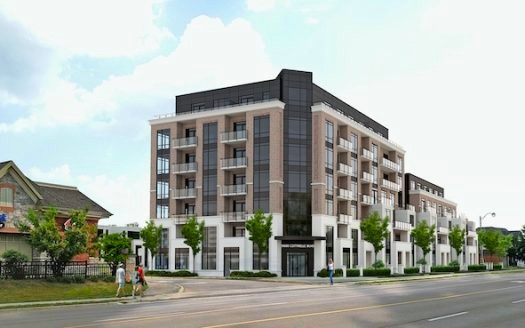
Ford’s housing plan lands with a thud in Brampton’s suburban neighbourhoods where city’s 2040 Vision for smart growth is fizzling
“Enclosed is the petition objection letter submitted on behalf of residents and community members who oppose the proposed development at this site in its current submitted state, including the 10-storey mixed-use apartment building and stacked townhouse blocks identified in the public notice.”
That was the opening of a letter by Brampton resident Rushiraj Shah, “on behalf of concerned members of the Westfield Community Brampton West” who live near 8799 Heritage Road, where a developer has proposed building the 10-storey tower.
The correspondence was part of the city’s planning meeting Monday, May 11, where Doug Ford’s Bill 23 and its ambitious policies to get 1.5 million new homes built across the province by 2031, were laid bare by the people who will ultimately have to live, literally, with the impacts.
The wording encapsulated the mood of the evening, as dozens of local residents voiced their opposition to what was repeatedly described as “intensification” that is wholly incongruent with the lifestyle that was sold to homeowners when they bought their property.
“This submission,” Shah wrote, “reflects significant and organized community opposition to the proposed development. Residents are deeply concerned about the scale and intensity of the project, the increase in traffic and congestion on surrounding streets, the pressure on local infrastructure, and the potential impact on the nearby park and surrounding neighbourhood character. The community is also alarmed by the dramatic shift in land use intensity, as a site understood within a detached residential context is now being proposed for a much more intensive multi-storey development.”
The City of Brampton started to see more development applications for dense, multi-storey housing since the PC government announced in late 2022 its targets for municipalities under its plan to get 1.5 million new homes constructed by 2031. Brampton was told to approve permits for 113,000 new units to meet the ambitious goal.
Now, what planners and municipal officials across Ontario warned about is playing out inside Brampton City Hall, where residents in the booming suburban community are voicing opposition to much of the housing some developers are hoping to build, as local planning officials struggle to balance smart growth with the lifestyles of those who do not support such rapid urban intensification.
“I am a resident of the Westfield community,” Helen Josiah said in a communication Monday, “writing to formally object to the proposed 10-storey mixed-use apartment building at 8799 Heritage Road. I want to be clear: I am not opposed to the proposed 48-unit stacked townhouse component. My objection is specifically and firmly directed at the 10-storey, 162-unit apartment tower. It must be refused.”
Many of her reasons were shared by dozens of her neighbours:
- “Ontario's More Homes Built Faster Act (Bill 23) must not be used to override sound planning principles or impose a tower on a community whose infrastructure cannot support it. The City has the authority and obligation to refuse this application, and must use it.”
- "In 2019, this property was listed on Brampton's Municipal Register as a heritage resource, with a low-rise concept of 17 detached homes under discussion. By 2022, that heritage designation was removed. By 2026, a 10-storey tower is proposed. This community was never properly consulted on this trajectory. The applicant also failed to hold the pre-submission Community Information Meeting they committed to, and failed to post a Public Notice sign on Fordham Road as required.”
- “Local schools, parks, law enforcement, healthcare, and community services are already stretched beyond capacity. No independent assessment has been provided to demonstrate that a 162-unit tower can be absorbed.”
- “There are no apartment buildings in the Westfield subdivision. A previous application for a similar development in this area was already refused — and that proposal was for only four storeys. A 10-storey tower is indefensible on the same grounds.”
Critics of Nimbyism have argued that such concerns are little more than closed-minded expressions by those residents who do not understand the ongoing housing and economic crisis facing Canadians who need more affordable homes in compact “complete communities” where access to public transit and immediate services is much more conducive to younger residents and many newcomers.
In 2018, council under the leadership of former mayor Linda Jeffrey, endorsed the 2040 Vision Master Plan for Brampton, which was supposed to guide the city’s growth over the next four decades.
“This Vision is about a smart way of doing things – an attitude – that will facilitate change that is popular, resilient, and innovative,” the new plan heralded.
Complete communities, featuring immediate access to transit, amenities and services within a 15-minute walk, would sprout up across the city, even in areas where sprawling, car-dependent suburban-style living had long been the lifestyle of choice.
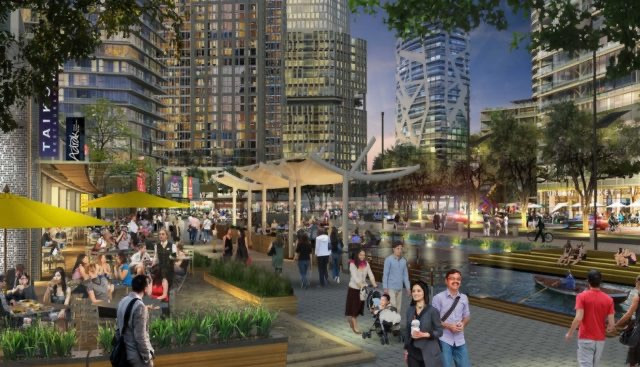
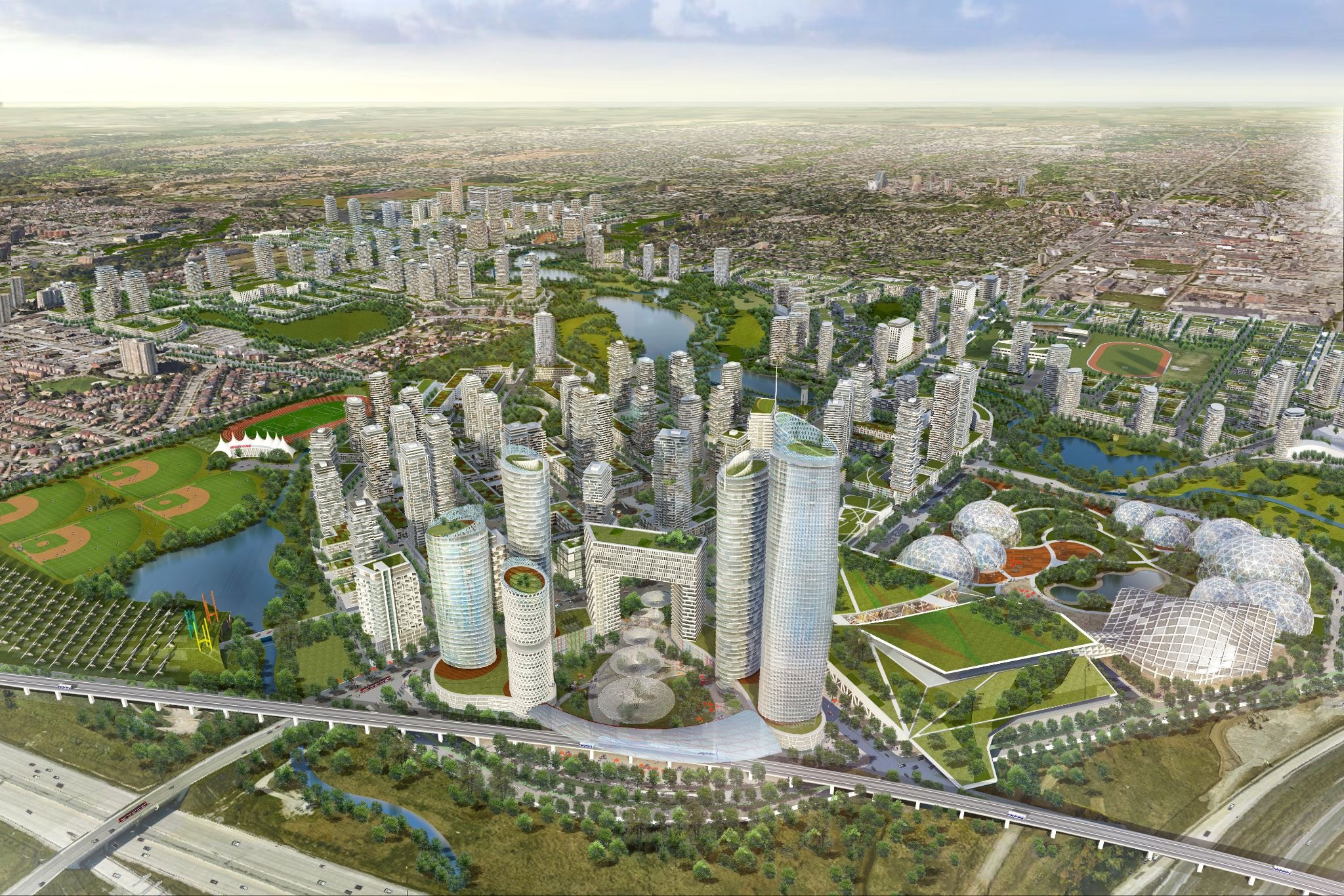
Renderings from the Brampton 2040 Vision document, approved in 2018 and meant to guide smart growth in the city over four decades.
(City of Brampton)
The plan called for urban hubs across the city, and much more dense housing integrated even into areas where large single-family detached homes have defined local subdivision planning for decades.
It appears there is little support for the 2040 Vision in neighbourhoods where dense development is being met with overwhelming community opposition. Residents are questioning the PC government’s housing plan, despite applications under the sweeping policy that would also align with the Master Plan approved by Brampton Council in 2018.
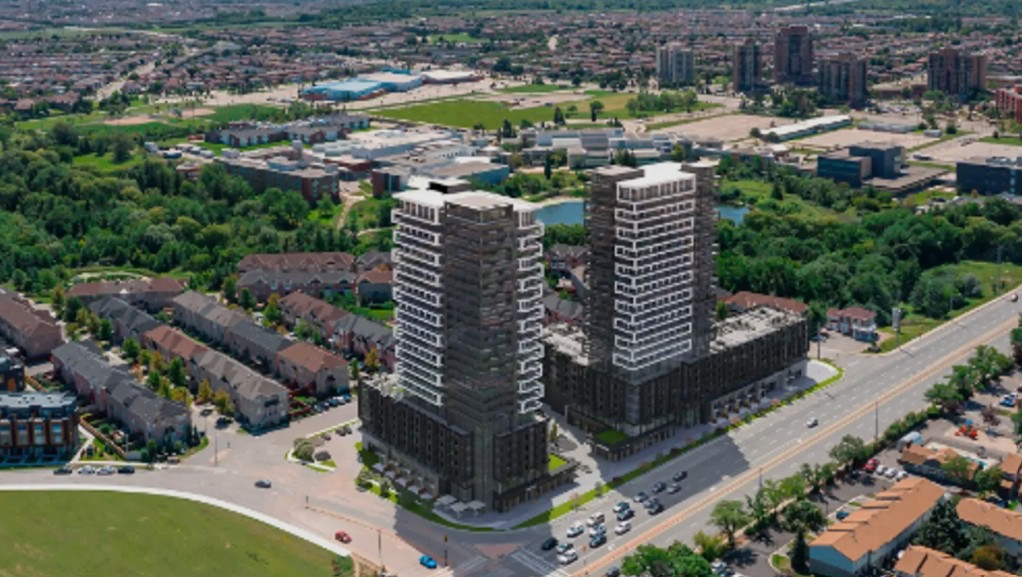
Plans for a two-tower condo project in Brampton in line with the city’s 2040 Vision Master Plan for smart urban-style growth.
(National Homes)
On Monday, residents called out the Ford government’s Bill 23.
“It has created in-practice a significant pressure on municipalities to approve high-density development at a pace that outstrips the capacity of local infrastructure, services, and communities to absorb it,” Gurpreet Sehmbi told planning committee members, who also sit on City Council.
“We are opposed to the exploitation of a legislative instrument designed to build homes faster being used to justify the imposition of a 10-story tower on a low-rise neighbourhood that is entirely unprepared. The City of Brampton must not sacrifice the well-being of existing residents on the altar of density targets driven by provincial legislation.”
The development proposal for 8799 Heritage Road was submitted by Glen Schnarr Associates on behalf of the builder.
The property is located in a low-density residential area in Brampton’s west end, where large tracts of greenspace and lush lands around the West Credit River have remained untouched by suburban encroachment. This is rapidly changing, but while residents have bought up large suburban-style houses that have popped up in the area over the past two decades, plans for more urban development are being met with fierce opposition. The surrounding natural heritage systems in the agricultural zone, designated as “low/medium density residential" and “Valleyland” in the Brampton West Secondary Plan, could be threatened under zoning amendments that allow more dense development.
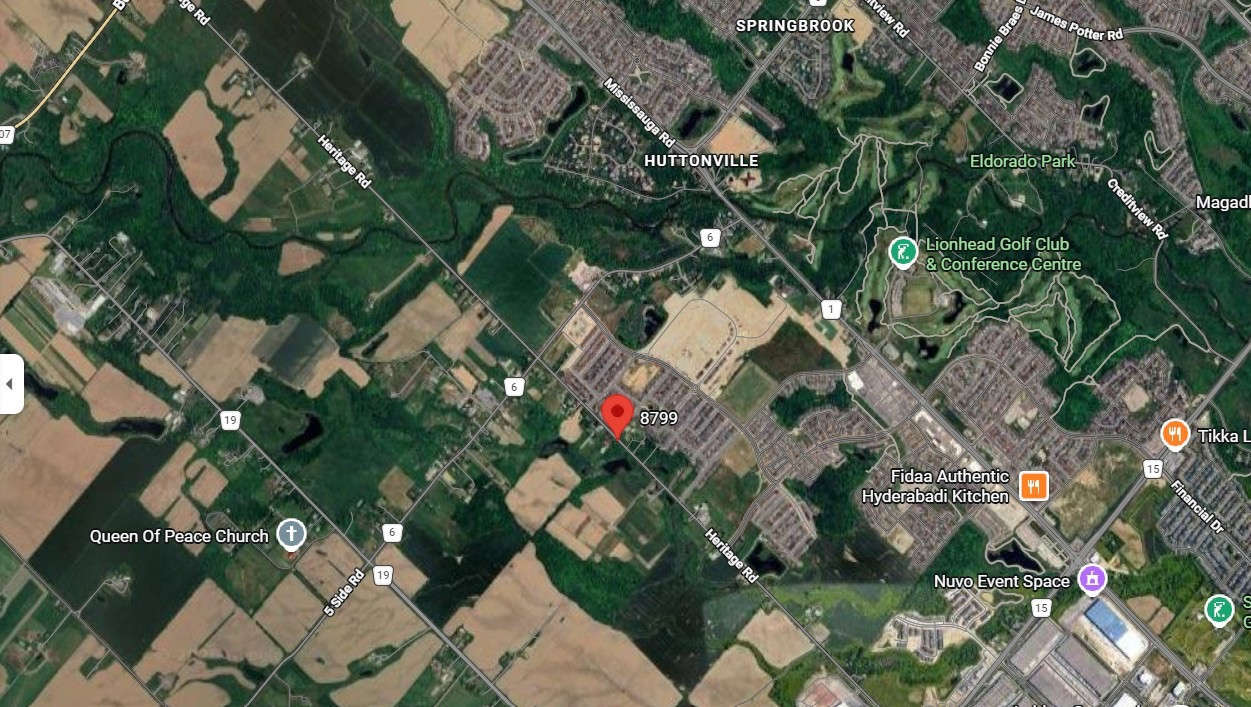
The location of the proposed 10-storey tower in west Brampton, where the red pin is.
(Google Maps)
Sehmbi expressed frustration during the meeting over the change in the development plan, which was shifted from what the community expected earlier.
“To pivot from 17 detached homes to a 10-storey tower is not an incremental evolution; it is a wholesale abandonment of the vision that was presented to the people who live here now.”
According to the presentation submitted by residents, the site was listed on Brampton's Municipal Register as a “Heritage Resource” in 2019, and the low-rise development concept was proposed. In 2022, the City lifted the heritage designation, concluding the property no longer met heritage criteria.
“How does a listed heritage property become a 10-storey tower in just seven years—without community warning or consultation?” residents asked in a presentation submitted to the City.
Elected officials also heard from residents opposed to a similar application on Countryside Drive, for a 12-storey residential building in the city’s north end, directly opposite a large subdivision with single-family houses.
"The current road infrastructure is already operating at or near maximum capacity; the addition of a large number of residential units will inevitably increase the traffic flow in volume beyond what the existing infrastructure can safely and efficiently accommodate," Bruno Spina, another Brampton resident, told the planning committee during the meeting.
"There has been no clear and adequate plan presented to address this feasible strain on the environment."
The residents filed a petition with 700 signatures on it, citing several other flaws, according to them, in the plan, including hydrogeological risks to the existing properties, privacy concerns and infrastructure strain as the low-density neighbourhood was not planned to support 128 new households and retail businesses that would require water, sewage capacity and electric grid power not currently serviced by existing infrastructure.
"Many of the existing homes will be directly overlooked, resulting in a loss of privacy in the backyard and living spaces," Spina said.
"My house is located directly in front of the proposed development. My children's bedrooms are directly in front of my master bedroom, adjacent to the roadway, which would be visible at night. I strongly urge the appropriate authorities to reconsider or reject the proposal for this development."
Both projects are now in the staff review phase, as municipal and regional officials across Ontario continue to question how Bill 23 can be implemented without community approval and with no idea of who will pay for tens of billions of dollars in required infrastructure to support 1.5 million new homes.
“Developers and applicants are leveraging the legislative environment created by Bill 23 to push through proposals of a scale and intensity that would not otherwise be supportable under sound planning principles," residents who oppose the Heritage Road application wrote in their joint letter.
When passed, the legislation was heavily criticized by council members, residents, local advocates and environmental groups who warned that without local revisions housing would be mismatched with community desires, and infrastructure costs downloaded from developers to taxpayers under Bill 23 would lead to skyrocketing property tax bills, while the legislation failed to create more affordable housing.
“Peel Region Council received an update last Thursday on efforts to support the province's ambitious housing targets - with enabling infrastructure. Bill 23 significantly accelerates the demands for water, wastewater, and roads infrastructure, at rates almost five times that of historical growth,” Region of Peel senior staff warned in a 2023 press release.
They highlighted that at least “$20.4 billion dollars” would be needed “to fund the infrastructure to achieve the provincial housing target, and the potential impacts to the existing community.”
When the controversial legislation was being pushed through the provincial legislature by Ford’s PC government in 2022, Ontario Nature was one of many organizations across the province that warned of Bill 23’s provisions which freeze out local residents from planning decisions: “Bill 23 would remove requirements for public meetings on certain planning matters. It would also remove people’s right to appeal planning decisions (e.g., Official Plans, zoning by-laws, minor variances). Community members and groups would be kept in the dark and no longer be able to participate in or challenge development decisions affecting their neighbourhoods or local farmland and natural areas.”
Four years later Brampton residents, including many who voted for Ford, are now opposed to the urban-style planning his legislation has opened the door to, which doesn’t align with the suburban lifestyle they desire.
Email: [email protected]
At a time when vital public information is needed by everyone, The Pointer has taken down our paywall on all stories to ensure every resident of Brampton, Mississauga and Niagara has access to the facts. For those who are able, we encourage you to consider a subscription. This will help us report on important public interest issues the community needs to know about now more than ever. You can register for a 30-day free trial HERE. Thereafter, The Pointer will charge $10 a month and you can cancel any time right on the website. Thank you
Submit a correction about this story

