
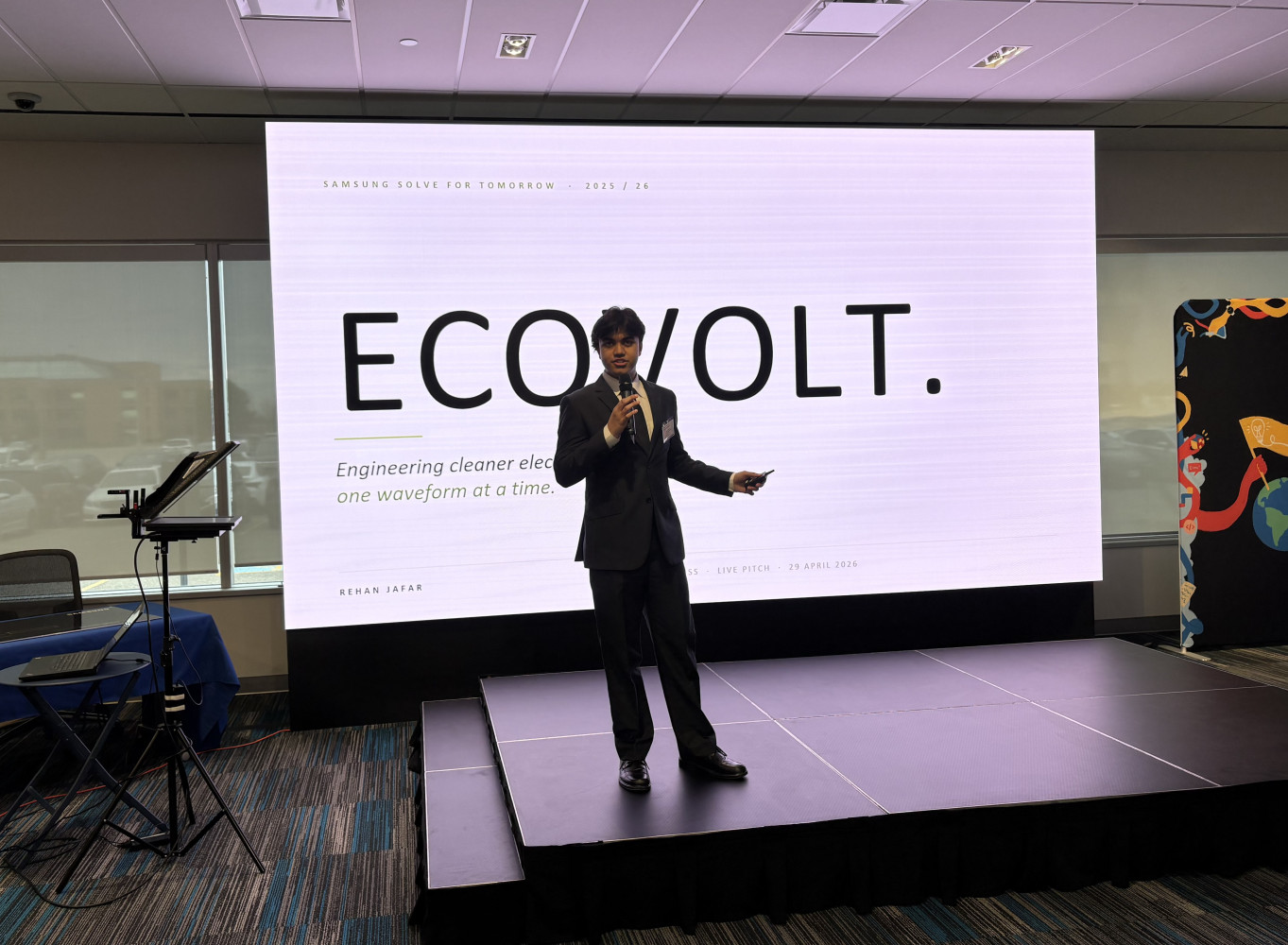
Brampton teen’s curiosity leads to greener electronics breakthrough, targets harm of everyday devices
Brampton teen Rehan Jafar grew up the way most kids in the modern world do — surrounded by glowing screens and devices, and asking questions about everything. While many outgrow their childhood curiosity, he did not. That’s what set him on a path to tackle a growing global crisis.
“I've always wondered: how are things made?” Rehan told The Pointer with a humble but confident smile.
At 3 a.m., he would find his older brother and start on him: “what are stars made of? How is this table created?”
By the time he was 17, the questions began taking a more practical, philosophical shape: what does it take to build the technology we can’t live without, where does it end up and what is it costing our planet, our future?
“What I see in the world around me is a lot of waste.”
Every year, millions of electronic devices are discarded as they break or become obsolete, turning into e-waste that can pose dangerous risks to human health and the environment. In 2022, the world generated an estimated 62 million tonnes of e-waste, according to the World Health Organization (WHO) — only 22.3 percent of which was formally collected and recycled.
In Canada, e-waste has more than tripped over the past two decades: reaching nearly one million tonnes in 2020, the equivalent of filling the CN Tower 110 times. A group of University of Waterloo researchers found per-person e-waste had jumped from 8.3 kilograms in 2000 to 25.3 kgs in 2020.
When this waste is heated or improperly processed, it releases toxic substances such as lead, cadmium and beryllium into the air, which can also seep into groundwater. In landfills, hazardous materials like mercury and lead can contaminate soil. The WHO has linked exposure to e-waste to respiratory problems, reduced lung function and adverse birth outcomes.
He wanted to do something about it…
Afterall, Leonardo da Vinci rightly said: “Knowing is not enough; we must apply. Being willing is not enough; we must do.”
Last year, when his school year had just begun, Rehan was one of the students at Central Peel Secondary School who were pursuing an independent study as part of their Advanced Placement (AP) Capstone, a program by the College Board. He had “narrowed down” his research to material science and biocenters; ultimately, focusing on a highly conductive, transparent and flexible polymer known as PEDOT used to make phones, OLED screens and wearable biosensors.
“Making it requires an electrochemical processes. It takes a lot of energy, but not because it has to, rather because no one has found a reliable way to predict optimal conditions,” he explained.
“And for the last year or so, I've been working on a tool that changes how we synthesize conductive polymers before they even touch a lab.”
He has named that tool — EcoVolt, a multi-physics simulation platform designed to predicts optimal manufacturing conditions before any material is physically synthesized, reducing the need for energy-intensive trial-and-error experiments.
“The most sustainable experiment is the one you never have to run,” Rehan remarked.
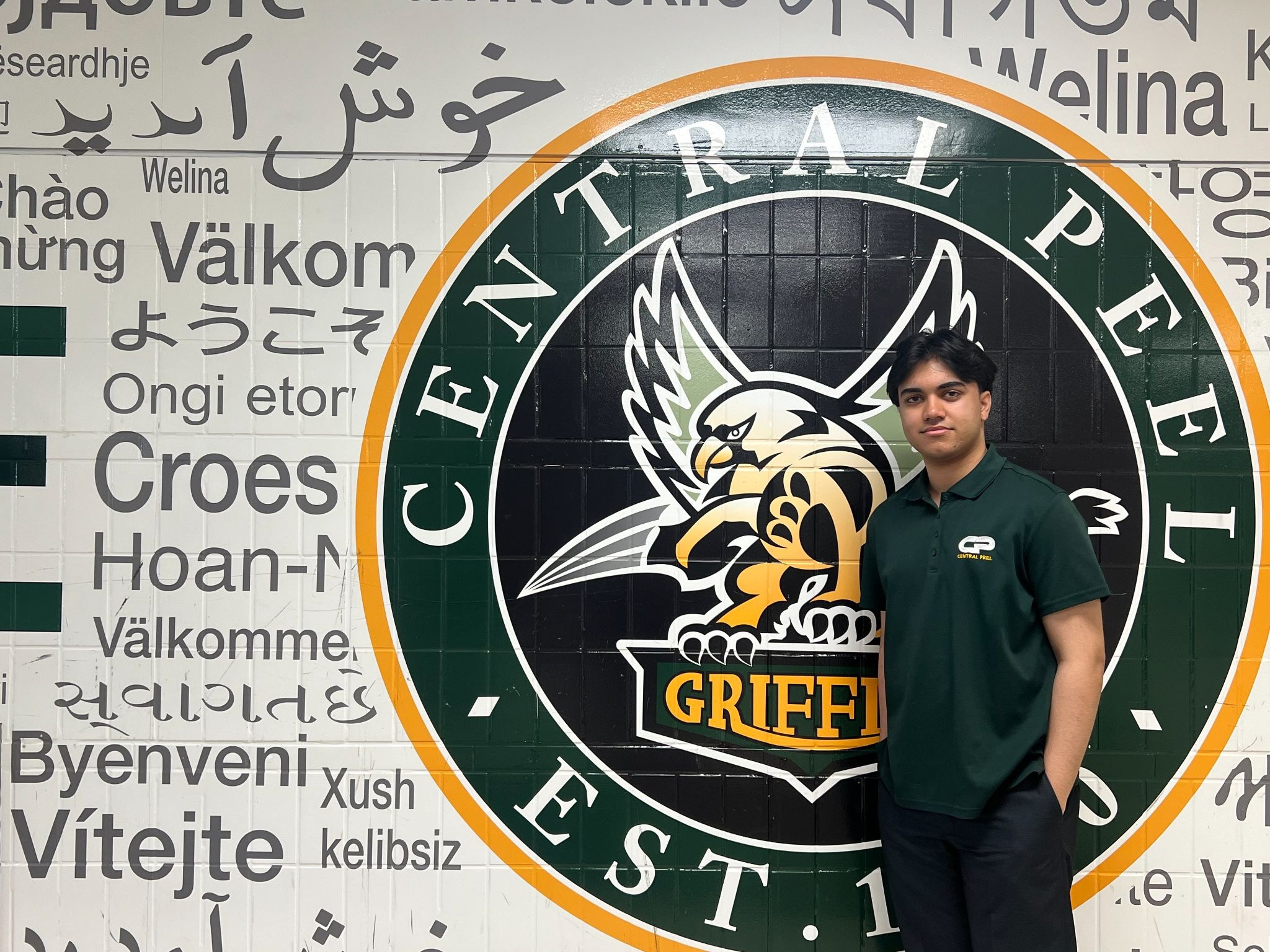
Rehan Jafar said his parents feel both proud and surprised by his research journey, describing it as him “growing his own pair of wings” while acknowledging that academic research is “also completely new world to them”.
(Anushka Yadav/The Pointer)
After reviewing countless peer-reviewed research, he identified four key factors that govern how PEDOT grows: electron field distribution, electrokinetics, ion transport and film growth. The challenge was while each of these processes had been studied individually, they had never been fully integrated into a single two-compartment model.
“That was the gap and that’s what EcoVolt is closing,” he said.
The trajectory of his research shifted further in December, when his English teacher Heather Woloshin, who is also the National AP Advisory Committee for STEM, said the school was approached to particular in Samsung’s Solve for Tomorrow, a national STEM contest aimed at empowering young innovators to bring meaningful change by designing solutions for problems they see in their communities. Rehan’s project fit the theme because it was all about sustainability and reducing the environmental impact of electronic manufacturing.
On April 29, he won the third place in the competition as well as the Fan Favourite award, determined by public vote for being the most resonating project with the Canadian community, securing a total of $15,000 Samsung technology voucher for his school.
But the journey was anything but straightforward.
Rehan’s initial plan was to use MATLAB, a standard tool for scientific computing, but he ran into licensing barriers he was unable to resolve on his own. He rebuilt the system using Python and an integrated development environment, shifting to an open-source approach that offered more flexibility and transparency—just like PEDOT.
When he first ran the simulation, the outcome was discouraging because no matter what values he changed, whether it was frequency, diffusion coefficients or system parameters, the results remained the same.
“The film grew identical every time,” he noted.
What appeared to be a finished model was in reality four disconnected equations running side by side “not talking to each other” rather than interacting as a system.
But he remained hopeful and persistent and a recent victory along the way helped keep spirits up.
Rehan and a team of 11 students from his school recently won the grand prize at the international NSS Gerard K. O’Neill Space Element contest, a competition spanning more than 30 countries and over 23,000 participants annually, earning recognition for the technical depth, feasibility and overall quality of their project, which has since led to invitations to present their work at community events and at the International Space Development Conference in Washington, where they will speak alongside scientists and an astronaut.
“We are the only team from Canada that has historically ever won [the] grand prize in this competition. We are also the only school in Canada that has historically ever competed in this competition,” Rehan shared.
It also led to a eureka moment for his EcoVolt project! He restructured the model around a feedback loop, which changed everything: in this revised system, the electric field influences ion transport, ion transport affects reaction rates, reaction rates shape film growth and film growth in turn alters the system’s geometry; thus, feeding back into the electric field. Each step continuously informs the next, creating a dynamic, interdependent simulation.
It taught him one of the biggest lessons in problem-solving, which “was not technical”.
“It was about learning to ask, what is the simulation telling me, rather than did the simulation actually run? And those two questions are very, very different,” Rehan said.
“Science isn't about the results that you expect it to get. It's about the results that you got and what you do with them.”
He had some help along the way.
His teacher, Justin Schikschneit, detected “it's not just one simulation that Rehan is running, but 54 and each one of them has to be coded and met to his parameters to test his research question”.
Running across 18 parameter combinations including frequency, electrolyte properties and cell geometry, the system generated detailed “morphological maps” that predicted how PEDOT films will form under a range of conditions. The maps can then distinguish between uniform films suited for electronic connectors and high-surface-area dendritic structures used in biosensors, complicated patterns that would otherwise require extensive laboratory testing to produce.
“You also reduce chemical waste before it's even generating,” Rehan said.
“Ecovolt doesn't just help produce PEDOT. It shifts optimization upstream to the computer, so it costs nothing, but some electricity and time.”
Although, he recognized the model has its limitations as it is currently “two dimensional and the kinetics are simplified”.
But those are the next steps.
“When you think of multi-physic simulations such as EcoVolt, expanding that to every single field, everywhere, would ultimately help the world, reduce that production cost and reduce that electronic waste, ultimately reducing environmental factors that then perhaps harm mother nature,” Rehan said.
As he prepares to graduate soon and become the first person in his family to pursue a career in computer engineering and sciences, there is one thing he won’t stop: asking questions.
The most important ones being: “What can I improve? How can I better help the world? How can I make a stronger impact in the community?”
Email: [email protected]
At a time when vital public information is needed by everyone, The Pointer has taken down our paywall on all stories to ensure every resident of Brampton, Mississauga and Niagara has access to the facts. For those who are able, we encourage you to consider a subscription. This will help us report on important public interest issues the community needs to know about now more than ever. You can register for a 30-day free trial HERE. Thereafter, The Pointer will charge $10 a month and you can cancel any time right on the website. Thank you
Submit a correction about this story

