
Can Mark Carney’s ‘capitalist’ Nature Strategy protect a natural world in steep decline?
“Nature is at the heart of Canada. It is at the heart of our identity…When we fail to protect nature, we are not making a sound economic choice. We are making a choice that works against us.”
Prime Minister Mark Carney’s words, as he announced one of the country’s most “ambitious” environmental plans on a crisp morning in Wakefield, Quebec, were uttered five months after unveiling a federal budget that failed to connect the climate crisis with the economy.
Since 2000, Canada has lost an average of 2.3 million hectares of forest to forest fires each year.
Wildlife populations suffered an average decline of ten percent between 1970 and 2022, according to the Living Planet Report Canada 2025 — more than half of 910 vertebrate species are in decline, with bird, fish, mammal and amphibian populations all trending in the wrong direction.
In February, a Canadian Parks and Wilderness Society (CPAWS) report found Canada’s terrestrial and ocean protected and conserved areas generated approximately $10.9 billion in GDP in 2023-24, holding carbon valued at $51.1 trillion.
On March 31, Carney announced $3.8 billion in funding over the next five years as part of the federal government’s nature strategy, dubbed A Force of Nature: Canada’s Strategy to Protect Nature, positioning conservation as a foundation for growth rather than a barrier to meet Canada’s international commitment to protect 30 percent of its lands and waters by 2030 — a pledge made alongside 195 countries at the 2022 United Nations Biodiversity Conference in Montreal during COP15.
“Climate change, pollution, and industrialisation are causing global habitat loss, an increase in invasive species, and more destructive wildfires and floods. Tackling this issue is both a moral duty and an economic imperative,” a statement from the Prime Minister’s Office noted.
Since 2024, the federal government has released an annual Nature Strategy outlining how it will meet commitments under the Kunming-Montreal Global Biodiversity Framework. It includes goals such as natural climate solutions, Indigenous-led conservation and ecosystem restoration, recognizing that healthy ecosystems support the economy, protect food and water systems and reduce the costs of climate-related disasters.
This year’s plan is built around three pillars: protecting nature, building Canada well and valuing and mobilizing capital for nature.
The long-anticipated policy, loosely defined during Carney’s election campaign, has since drawn cautious support from environmental leaders, particularly for its focus on mobilizing private investment, aligning conservation with economic priorities and renewed commitments to Indigenous-led stewardship. But many remain skeptical about whether Ottawa is adapting conservation to fit around industrial needs.
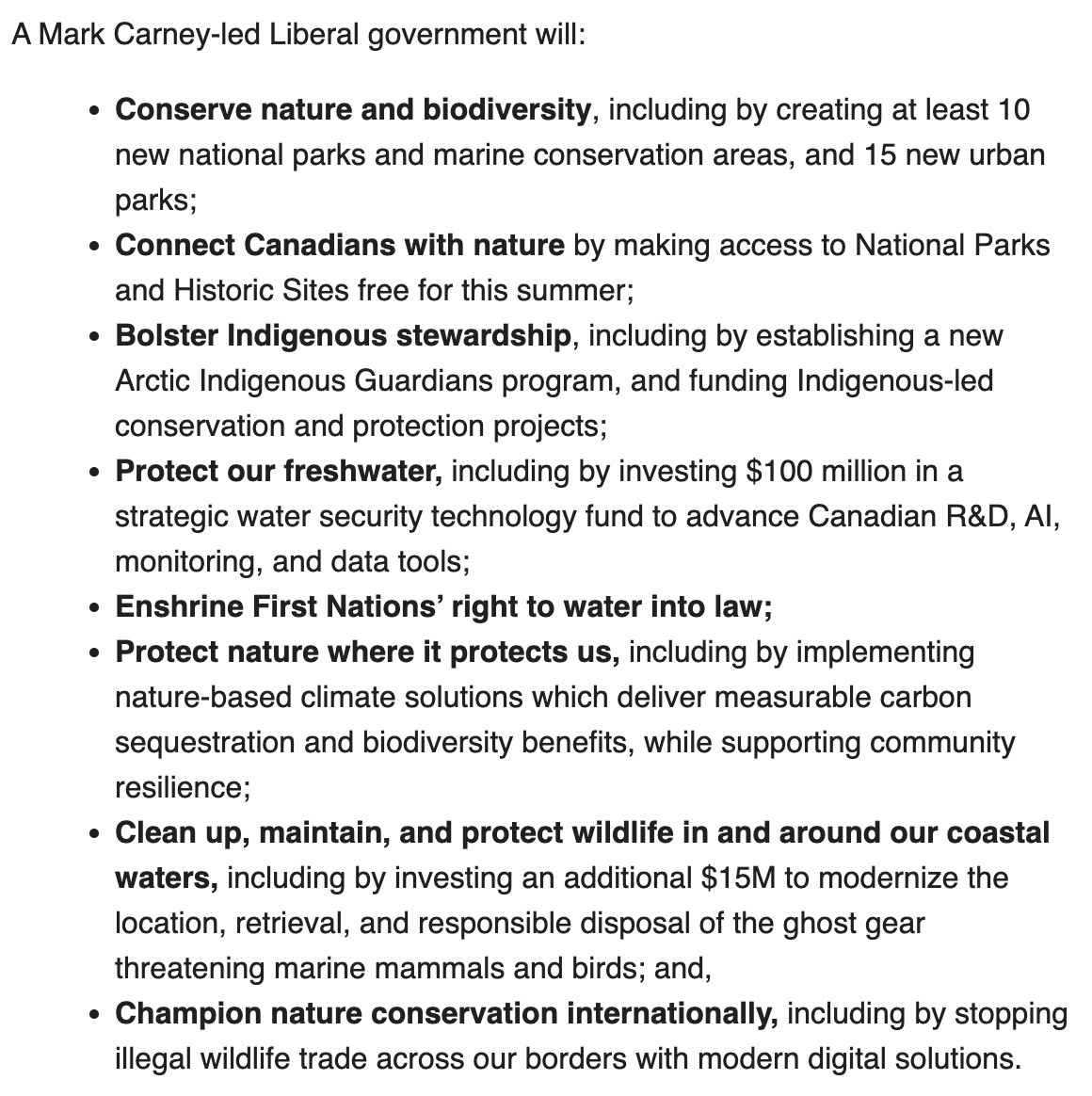
“Nature is part of our very identity as Canadians,” Liberal leader Mark Carney said in a press release during his election campaign. “In this time of crisis, we need bold new approaches to protect Canada’s natural heritage and defend it for future generations.”
(Liberal Party of Canada)
“It appears to be a very positive step forward for land and freshwater conservation in Canada. It has a huge amount of potential, but it's critical that it’s implemented well,” Canadian Parks and Wilderness Society (CPAWS) National Director, Conservation, Chris Rider, said.
Still, renewed investments of more than $230 million in the Indigenous Guardians Program, which has been “a huge success” in the past, supporting close to 250 Indigenous-led initiatives and creating nearly 1,500 jobs since 2018, stood out as among the strongest elements of the plan.
The Carney government has pledged to protect 1.6 million square kilometres of land and up to 700,000 square kilometres of oceans over the next four years by creating 10 new national parks, 14 marine protected areas and 15 urban parks, while increasing terrestrial conservation from 14 percent to 30 percent by 2030.
The Seal River Watershed National Park Reserve in northern Manitoba, one of the largest intact watersheds in the world, as well as the proposed Wiinipaakw Indigenous Protected Area in eastern James Bay, will be advancing.
The strategy also includes major species recovery investments including $90 million to support wood bison populations along the Alberta-Northwest Territories border through the Wood Buffalo National Park World Heritage Site Action Plan, $410 million to restore Pacific salmon populations and $80 million to rebuild Atlantic salmon habitat.
Fisheries and Oceans Canada is set to receive funding for its Ghost Gear Fund, which has supported 144 projects for a total of $58.4 million between 2020 and 2025, to continue removing harmful fishing equipment from Canada’s oceans, building on the 2,500 tonnes of abandoned fishing gear already cleared.
While Rider welcomed the latest round of funding, he pointed out that it arrived too late to prevent disruption from previous cuts and job losses.
The 2025 federal budget slashed 2026-27 funding for Environment and Climate Change Canada by $1.4 billion (down 45 percent compared to 2025-26) and for Fisheries and Oceans Canada by $4.3 billion (down 69 percent compared to 2025-26).
When he travelled to Saskatoon a few weeks back for the Braiding Knowledges Gathering, he heard from conservation practitioners across the country who had already lost jobs or were set to lose them as earlier funding expired on March 31, leaving projects stalled and livelihoods uncertain.
While the federal government wants to restore salmon populations through hundreds of millions in new funding, earlier this year, Fisheries and Oceans Canada confirmed it was shutting down two biodiversity facilities in Atlantic Canada, ending a live gene bank program critical to the survival of endangered Inner Bay of Fundy salmon, listed under the Species at Risk Act.
Although the new money may restore some positions, Rider fears the delay has already caused real harm that could have been avoided with earlier certainty.
He acknowledges that a moderate reduction in new conservation funding compared to previous levels was not surprising given the shifting political landscape but the challenge moving forward will be identifying where those cuts will ultimately be felt.
“Polar bears and the rest of the 5,000 species at risk in Canada need intact ecosystems. They need, and are still waiting, for real action beyond a 15-page nature strategy from this government,” Wilderness Committee Conservation and Policy Campaigner Lucero Gonzalez said.
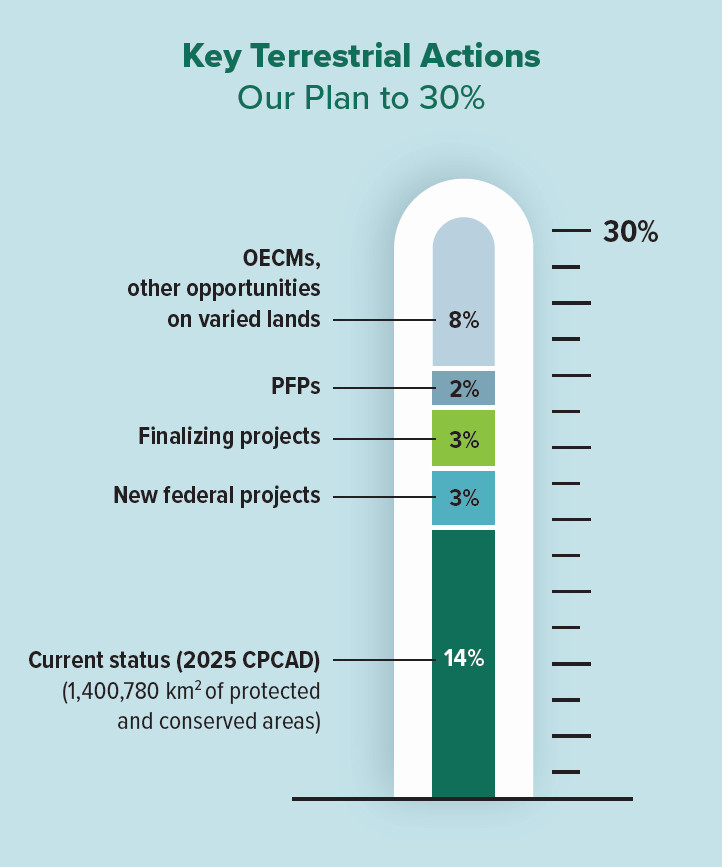
There are unanswered questions about meeting the 30 percent protection target due to an overreliance on Other Effective Conservation Measures (OECMs), areas not formally designated for conservation such as some military lands that still support biodiversity. While useful, Canadian Parks and Wilderness Society National Director, Conservation, Chris Rider, cautioned they must be carefully defined and monitored or they “falsely boost conservation progress and hide real issues”.
(Government of Canada)
What’s different this time around is a major shift in how conservation in Canada will be financed.
“For so many years, decision makers have looked at protected and conserved areas as an economic burden,” Rider said.
The federal government formally embraced “mitigation hierarchy,” a framework that prioritizes avoiding ecological damage before attempting to minimize or offset it.
“Up until now, Canada has lacked this framework and as a result, the destruction of nature is too often considered an unfortunate trade-off for development,” Rider said.
“If fully implemented, this will be a big step forward.”
The goal is to attract private investment by assigning economic value to ecosystems and natural assets through the launch of an Expert Taskforce on Natural Capital Accounting and Nature Financing, which will examine how to better measure the value of nature, integrate it into decision-making and recommend new policies, incentives, and financing tools to encourage businesses and investors to support conservation.
For Nature Investment Hub Chief Executive Officer, Priya Bala-Miller, private investors will be critical if Canada hopes to close the estimated $20 billion annual biodiversity financing gap before 2030 (as stated on Target 19 of the Global Biodiversity Framework) and Carney’s move comes as a “very important sign of reassurance” for the future.
“There is substantial interest in under-financed areas including Indigenous Protected and Conserved Areas and the blue economy, while also expecting to continue or increase investment in more traditional themes like forestry and agriculture,” Bala-Miller told The Pointer.
The taskforce will need to ensure the right financial instruments, at the right scale of capital, are deployed in the right ecosystems, with the right partners, and strong measurement, reporting and verification systems to ensure high-integrity, inclusive outcomes that meet the Declaration on the Rights of Indigenous Peoples Act commitments.
But Deborah McGregor, Canada Research Chair in Indigenous Environmental Justice at Osgoode Hall Law School, finds Ottawa’s approach “very capitalist”.
McGregor worries that putting a dollar value on nature opens the door to treating ecosystems as trade-offs in development decisions and its “only purpose is to serve humans and somehow figure out how much nature costs”.
An added layer of complication lies in who will be shaping these valuation systems — she expects the task force to be “dominated” by economists, policy professionals and industrial representatives with “one or two Indigenous people on it”.
While such expertise may be necessary for technical implementation, she questions whether it can adequately reflect ecological relationships or Indigenous knowledge systems.
The latest strategy’s wider implementation leans heavily on environmental data systems, mapping tools and artificial intelligence to identify key biodiversity areas, streamline approvals and improve decision-making. It also expands the use of regional assessments under the Impact Assessment Act (IAA) to evaluate environmental effects at a broader scale before individual project reviews, with claims of improving efficiency while strengthening protections for species at risk.
But what gets lost in that translation is the big question.
“When you’re accelerating permitting, that basically means go ahead with the damage. You might identify this is turtle habitat or this is where some species migrate across the road, but then you just get a permit to ignore that,” McGregor told The Pointer.
“You can also count how many hectares are protected, how many trees were planted using metrics, but did that actually improve anything? Did it protect species?”
Despite the federal government’s claim that tools like the IAA will lead to better outcomes, past decisions suggest Ottawa may still be reluctant to intervene. Under the leadership of Justin Trudeau, the Highway 413 project was not designated for a federal impact assessment in December 2024, following an earlier decision in April to drop a prior designation. Instead of proceeding with a full review, Ottawa chose to form a joint working group with Ontario to oversee environmental impacts—an arrangement that remains in place and, as previously reported by The Pointer, has been marked by internal divisions.
Critics argue that the new focus on “mobilizing capital” and developing financing tools for conservation treats ecosystems as investment opportunities rather than essential life-support systems.
“We don’t protect nature because it’s a business case, or because of employment. Market capital is a horrible way to look at nature, our only life support system,” Wilderness and Water Campaigner Eric Reder added.
“Hoping for ideas from a task force in the future as one of the three pillars of your strategy, frankly, looks like a rushed job, perhaps to quell the anger over Carney’s devastating cuts and backsliding on the environment and climate change.”
McGregor fears that shifting conservation funding toward philanthropy and industry allows the federal government to step back from its own responsibility: “What I see is an effort to offload more to industry and philanthropists. That worries me because that’s moving away from public responsibility and toward a market-driven approach.”
The contradiction becomes clearer when accounting for the same government pursuing aggressive industrial expansion — “a lot of which is not nature-friendly” — including support for critical mineral extraction in the Ring of Fire and fast-tracked development approvals for liquid natural gas pipeline(s), both of which have been referred to the Major Projects Office.
“There was always going to be a conflict between major projects and the environment. This strategy doesn’t resolve that conflict…it tries to manage it under a capitalist lens,” she said.
But this is where Canada can look towards its G7 neighbours.
Bala-Miller said strong checks and balances will be essential and the federal government should look to models such as the U.K.’s Biodiversity Net Gain, which requires development to leave ecosystems in a measurably better state, and Australia’s Nature Repair Act, which establishes a regulated biodiversity credit market to attract private investment.
In her view, these approaches “help incentivize more funding for nature, in addition to maintaining a robust permitting and environmental and social impact assessment regime while pressing forward with major projects.”
“Systemic challenges around land rights and jurisdiction means that there are no easy answers on the right configuration of guardrails and solutions,” Bala-Miller noted.
“What does work, though, is ensuring the federal government, provinces and territories, Indigenous communities and relevant stakeholders deliberate on the path forward together. Local communities are an important consideration in advancing nature finance in Canada.”
Some critics still contend that the data-driven approach simply risks widening the gap between decision-makers and lived ecological reality.
“You can be sitting in front of a laptop crunching numbers and never have seen a caribou habitat or a watershed you’re evaluating…and that disconnect matters,” she said.
“How do you account for [the] relationships people have with land and animals over thousands of years? Or the idea that these systems have value in and of themselves?”
But Indigenous perspectives do not separate nature from relationship. Land, animals and ecosystems are not resources to be priced but relatives bound in systems of reciprocity, responsibility and care that extend far beyond economics.
McGregor remembers attending a conference pre-pandemic on nature capital, where researchers and business leaders debated how to assign value to different ecosystems and species. One session involved discussions over how much a caribou population might be “worth” depending on whether it was abundant or endangered in a given region.
She recalls the discomfort of those discussions and the absence of Indigenous relational understandings of the same species: “It wasn’t part of the conversation at all. There was no sense of the animal as a relative, or of reciprocal relationship. It was all about valuation.”
The experience left a lasting impression, one that resurfaces as she analyzed the new federal strategy years later. The concern is not only about methodology but about worldview: who gets to define value, and how those definitions shape decisions about land, water and life itself.
“We don’t think about it as just services to people. It isn’t about people being the most important thing on the planet. It’s a very different worldview,” McGregor said.
And in that difference lies the question the strategy cannot quite answer: whether nature is something to be accounted for or something we are accountable to.
Email: [email protected]
At a time when vital public information is needed by everyone, The Pointer has taken down our paywall on all stories to ensure every resident of Brampton, Mississauga and Niagara has access to the facts. For those who are able, we encourage you to consider a subscription. This will help us report on important public interest issues the community needs to know about now more than ever. You can register for a 30-day free trial HERE. Thereafter, The Pointer will charge $10 a month and you can cancel any time right on the website. Thank you
Submit a correction about this story

