
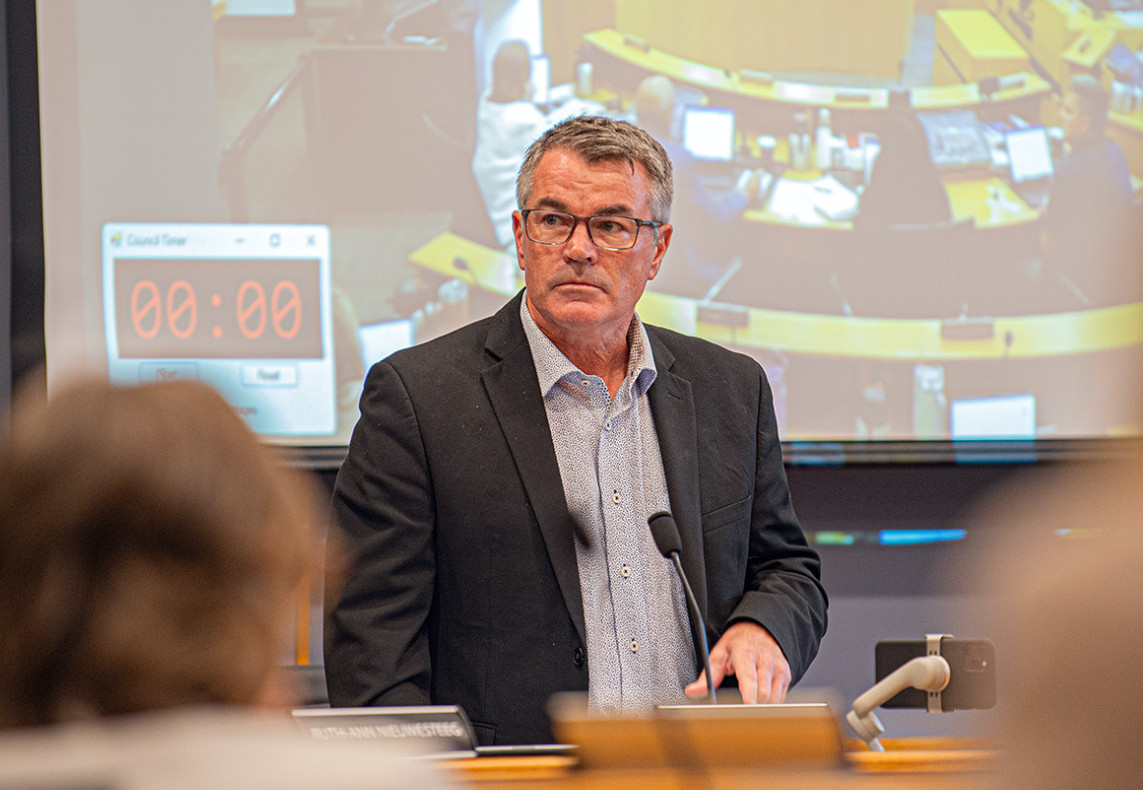
Niagara Falls Councillor Mike Strange not guilty in domestic assault trial
Niagara Falls councillor Mike Strange has been found not guilty of assaulting his former intimate partner, after a two-day trial that hinged on sharply conflicting accounts of a volatile night, competing interpretations of injuries and the reliability of memory when impaired by alcohol and grappling with trauma.
As reported by The Pointer, Strange was arrested in the early morning hours of May 3, 2025, after Niagara Police responded to a 3 a.m. call at a residence in Niagara Falls. Officers found a woman injured at the scene; she was treated on site. Strange was later apprehended a short distance from the home and charged with assault.
The trial began on April 14 and, throughout the two-day proceeding, Strange was accompanied in court by fellow councillors Vince Kerrio and Victor Pietrangelo, as well as City Solicitor Nidhi Punyarthi.
The acquittal came after the complainant spent most of the first day testifying that she was violently assaulted and suffered significant bleeding, hair loss, and facial injuries as a result of an attack by Strange, her common-law partner of more than 10 years. (She requested that the media not report her name.)
Strange has denied the allegations against him and during trial testified that it was his former partner who attacked him, sustaining her injuries when she fell and struck a dresser.
In delivering his decision, Ontario Court Justice Stephen Darroch acknowledged that both accounts were broadly consistent regarding the earlier portions of the evening, but diverged significantly after the couple returned home.
He emphasized the legal standard required for conviction: proof beyond a reasonable doubt, and the need to assess both credibility and reliability.
He stressed that he found the complainant to be credible in terms of honesty, but expressed concerns about the reliability of her recollection. She had readily admitted to significant memory gaps, including during statements made to EMS shortly after the incident.
Justice Darroch stated that he did not reject her account as fabricated or invented, but noted that “in the end I may not convict unless I am satisfied by the accuracy of the evidence.”
In her testimony the court heard how she was “pushed hard off the bed” and remembers hitting the floor forcefully. While she was trying to get up she kept getting knocked back down while her hair was being pulled, she recalled, thinking to herself, “This time he’s going to kill me.”
Strange’s lawyer, Michael DelGobbo, suggested a very different narrative of that night. He denied any assault took place and argued that the injuries—which were photographed by police and shown during the trial—were accidental and occurred during a chaotic struggle in which both parties had been drinking and Strange was defending himself from her aggression.
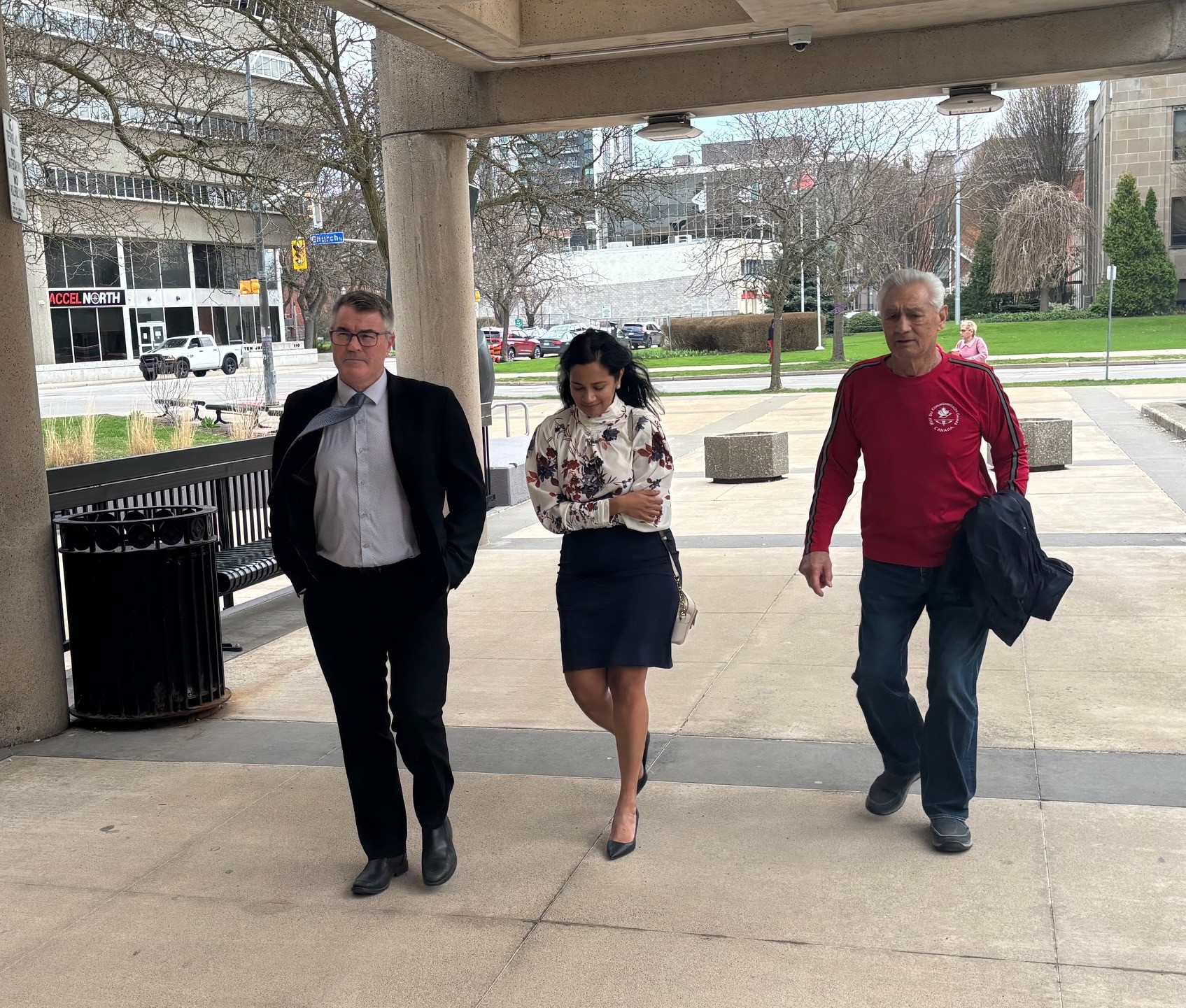
Niagara Falls Councillor Mike Strange (left) enters a St. Catharine's courtroom alongside Nidhi Punyarthi, the city solicitor for Niagara Falls. His trial for domestic assault heard that Strange's infidelity with Punyarthi was the source of an argument that turned violent last year.
(Ed Smith/The Pointer)
The trial centred on events following a Cinco de Mayo-themed gathering held at a Falls View Hose Brigade event, where the couple had spent the evening drinking.
The complainant testified that she arrived at the event around 11 p.m. and found Strange already there, involved in selling drinks from the margarita bar. She said he appeared visibly intoxicated. She also acknowledged drinking several alcoholic beverages herself after arriving.
Strange similarly testified that he had been helping organize the event and serving margaritas. He testified that he began drinking only after his work responsibilities ended around 11 p.m., and that they left the event together in an Uber around 1:30 a.m.
According to both, the early part of the evening was largely unremarkable. The judge later noted this as an important point of convergence: their narratives were broadly consistent up to the moment they returned home.
The central dispute in the case arose after the couple returned home.
Both agreed that once inside the residence, an argument erupted over allegations of infidelity. She alleged that Strange had been involved in an affair with a municipal lawyer.
In correspondence with The Pointer, she confirmed she was referring to Nidhi Punyarthi, the City Solicitor for Niagara Falls, and described the matter as a recurring source of conflict in their relationship. Punyarthi accompanied Strange both days of the trial and was present in the courtroom during the complainant’s testimony.
Both sides during the trial also conceded that there were no injuries to Strange.
The complainant described going up to bed shortly after he did and then being pushed forcefully off the bed, repeatedly knocked down as she attempted to get up, and having her hair pulled.
The defence disputed this version of events.
Strange testified that she “lost it” after they returned home, describing her as “going crazy” chasing him around the bed and “swinging wildly at me.” He said she initiated the physical confrontation by lunging at him while they were in bed, causing them to become entangled in the blankets and fall to the floor.
Strange claimed that when they got up, she continued swinging at him, and was only trying to control her when he ducked a punch, what he described as a “haymaker”, that caused her to fall into a dresser. He speculated that her injuries must have been caused by her collision with the dresser.
Strange maintained that he did not strike her at any point and said any injuries she sustained must have been accidental.
Strange testified that, after she fell into the dresser, he quickly got dressed and left because she “was going berserk.”
According to his testimony, when police first told him that “your wife is bleeding everywhere,” he responded, “Bleeding? She was not bleeding when I left her. If she had been bleeding, I would not have left.” He later added that had she been bleeding, he would have remained at the residence and provided appropriate care.
During his testimony, Strange flatly denied ever striking her. Asked directly by his lawyer, “Did you punch her?” Strange responded without hesitation, “No, not at all.”
A key piece of evidence presented in court was the 911 call made by the complainant.
Transcripts included statements such as: “I’m bleeding like he stabbed me”; “Oh my god, I don’t know where I’m bleeding from.”
She also testified that she called 911 while holding the phone in one hand and attempting to catch the blood dripping from her face with the other, describing herself as terrified and bleeding heavily. Photographs shown in court depicted blood on her face, hands, and clothing, as well as a noticeable injury to her scalp where hair was missing.
It was noted that the scalp pictures were not taken the morning of the incident, but a few days later by her after she noticed her hair falling out in clumps as a result of what she said was Strange pulling it violently during the altercation.
Police officers Skyla Read and Michael Maryniuk testified that they arrived shortly after 3 a.m. and found her crying and covered in blood. Their notes indicated blood was present on her face, hands, chest and clothing.
Maryniuk testified that Strange was located approximately one block from the residence. He was described as intoxicated, exhibiting slurred speech and glossy eyes. Police records also indicate that Strange had placed a 911 call. According to his testimony, after leaving the house and heading toward a neighbour’s home, he noticed police vehicles rushing to his residence and decided to call 911 himself to speak with officers. He said he was instructed to remain where he was on the street until police arrived.
A central issue in the trial was how to interpret the physical evidence.
The Crown argued that the injuries, including facial bleeding and a missing clump of hair, were consistent with her account of a violent assault. Prosecutors emphasized that her distress during the 911 call and immediate condition when police arrived strongly corroborated her version of events.
The defence argued that the injuries were consistent with an accidental fall into furniture during a chaotic struggle.
In cross examining the complainant, DelGobbo suggested that, “You sort of started the dispute because of your hurt feelings over the affair. The only force he used was to push you so he could leave.”
While she readily admitted to being “heartbroken” about the affair, she maintained her position that Strange had attacked her.
Crime scene photographs were also heavily scrutinized. The Crown pointed out that Strange’s claim that both parties fell from the bed while entangled in blankets was inconsistent with images showing the bedding not on the floor, noting the linens were laid relatively flat out on the bed and showed no signs of having been on the floor.
Both parties acknowledged consuming alcohol that night.
Strange testified that, “I had a few, but five beers and a couple shots is not a lot”, adding that he did not begin drinking until after his shift behind the bar ended at 11 p.m. He said the two left the party together in an Uber at approximately 1:30 a.m. Strange maintained that alcohol does not affect his memory and repeatedly claimed to have a clear recollection of the events. According to the testimony from the Niagara Police officers Strange was visibly intoxicated.
The Crown challenged Strange’s testimony, suggesting that his self-assessment of unaffected memory was unrealistic given the volume and timeframe of his alcohol consumption. Prosecutors also pointed to an earlier DUI conviction 26 years ago, introduced during cross-examination, to challenge his credibility on alcohol-related judgment.
The complainant also acknowledged she had at various times in her past struggled with alcohol issues, and that because of her drinking that night her memory of the incident was incomplete. She testified that she believed she suffered a concussion that night and was “definitely traumatized,” explaining that her emotional and physical state contributed to gaps in her recollection.
The judge later noted that she was candid about her memory limitations and that he found her to be on the whole a credible witness, however, in the end he could not ignore the gaps in her memory.
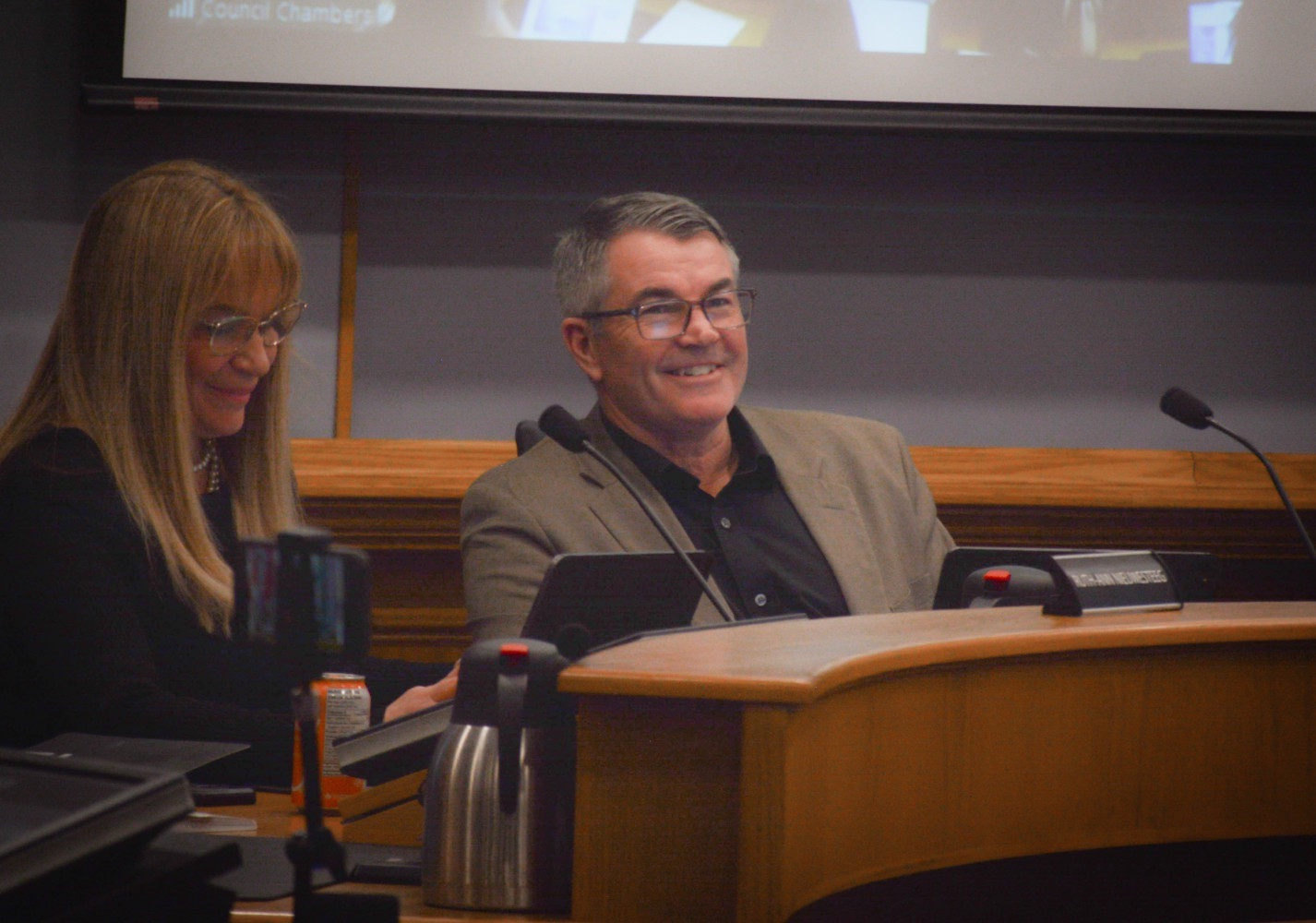
Mike Strange was first elected to Niagara Falls council in 2014.
(Joel Wittnebel/The Pointer files)
Throughout the trial, the defence focused on undermining the reliability of the complainant’s account, pointing to intoxication, emotional distress over the alleged affair, and inconsistencies in her memory.
The affair between Strange and Punyarthi was acknowledged by both parties as the issue that precipitated the argument between them that night. She admitted that, while her memory was not clear, it was “likely her” who raised the matter.
Strange testified that the couple had argued about his infidelity “like 50 times in the past year,” and it was later suggested that the incident escalated during what was described as the “51st time.” He added that the month of May was a particularly sensitive period, as it marked the anniversary of when she first discovered the infidelity.
The defence maintained that she initiated the physical confrontation out of emotional distress.
The Crown, by contrast, argued that despite memory gaps, she was a credible witness who admitted uncertainty rather than embellishing her testimony. Prosecutors said trauma, shock, and intoxication provided a reasonable explanation for inconsistencies, however, on the significant issues she was reliable and credible.
The Crown also emphasized that physical evidence, including blood, injuries, and hair loss supported her account and could not be explained away by falling into the dresser.
In closing arguments, the defence argued that the Crown had failed to meet the burden of proof required for conviction, contending it made little sense for Strange, as the person alleged to have had the affair, to initiate the argument and the ensuing violence, and suggested the complainant’s emotional state influenced her interpretation of events.
The Crown countered that while both parties had been intoxicated, the totality of the evidence including the 911 call, police observations, and physical injuries, supported a finding of assault. Prosecutors described her as an honest witness whose memory gaps were consistent with trauma rather than fabrication, and she was no less believable.
In the end, the judge reiterated that, while he found her to be credible and he did not think her version of the night was invented; “by her own admission there were significant gaps in her recollection of events.”
He found aspects of her testimony, particularly the severity and nature of the alleged assault, were not fully consistent with the objective medical and physical evidence presented in court.
He noted that circumstantial evidence, including the hair found at the scene, was not sufficient on its own to conclusively establish how the injuries occurred.
The judge described Strange’s account as generally straightforward. While he noted some evasiveness in parts of his testimony, particularly regarding the mechanics of the altercation, he concluded that these concerns did not justify rejecting his evidence entirely.
The judge stated that Strange’s version of events “might reasonably be true,” describing his account as exculpatory and straightforward, though at times somewhat evasive under Crown questioning. This included questions about his ability to regulate the force of his alleged punches and the position of the bedsheets as depicted in the photographic evidence. The judge noted, however, that “this does not rise to the level required to reject his version of the story.”
The judge emphasized that the burden was not on Strange to prove that he did not commit the offence, but on the Crown to establish his guilt beyond a reasonable doubt.
The result was an acquittal for Mike Strange.
The judge’s ruling underscores a fundamental principle of criminal law: even in cases involving visible injury and competing narratives, a conviction cannot be entered unless guilt is proven with certainty that excludes reasonable doubt.
Contacted by The Pointer regarding the possibility of an appeal, Assistant Crown Attorney Nick Hegedus declined to comment.
Email: [email protected]
At a time when vital public information is needed by everyone, The Pointer has taken down our paywall on all stories to ensure every resident of Brampton, Mississauga and Niagara has access to the facts. For those who are able, we encourage you to consider a subscription. This will help us report on important public interest issues the community needs to know about now more than ever. You can register for a 30-day free trial HERE. Thereafter, The Pointer will charge $10 a month and you can cancel any time right on the website. Thank you
Submit a correction about this story

