
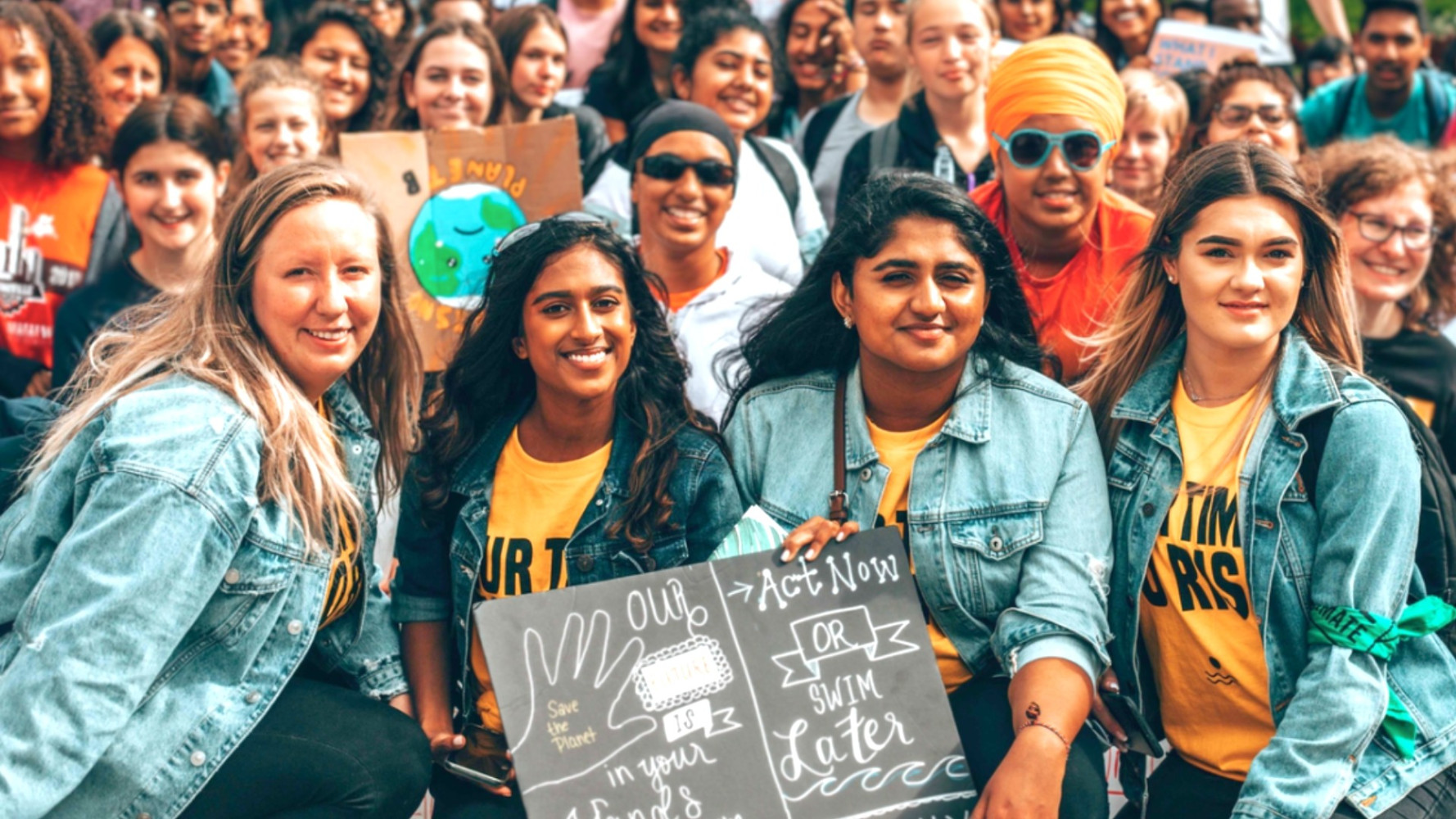
How Peel’s Community Climate Council connects families of all backgrounds to sustainable lifestyles
“Communities of colour are so busy working to put food on the table that they may not even think about climate change or environmental racism,” Community Climate Council Executive Director Miranda Baksh says.
“I want to change that.”
It didn’t take her long to understand that growing up in Peel, one of the most diverse regions in Canada, change would look much different.
Raised in a Guyanese-Canadian household, she watched her parents, who moved here in their teens, work around the clock to build a life. That meant moving and changing schools often, to wherever opportunities could be found.
Like many Canadians, she enjoyed many of the traditions her family adopted, with their own unique cultural additions, spending summers at the cottage, surrounded by family, cooking fish dipped in curry over an open fire and eating together outdoors by the water — a mosaic of enriching experiences gathered together in a sort of global soul that has become the core of this country’s identity, for so many.
“That became a sacred space, a grounding place for me,” Miranda tells The Pointer, reminiscing about her own time on the lake while growing up. “I feel very connected to nature there.”
When they would return home she became her “mom’s helper in the garden”.
Her parents valued cooking with food they grew themselves. It was what they knew. Many of the vegetables and herbs used in their kitchen came straight from their backyard.
“I grew up thinking that was normal. But I realized later it was actually a privilege to live so connected to nature.”
One afternoon, when she was just four years old, she was gardening in the backyard with her mother when she noticed something wriggling through the soil, a tiny worm she had never seen before.
Fascinated, she scooped it up carefully with a bit of dirt and rushed over to show her mother.
“Look how cool this is, mum!” Miranda exclaimed, enthralled.
Her mother, slightly squeamish, noticed the excitement in her daughter’s eyes and encouraged her curiosity.
Looking back, Miranda believes that connection to the natural world wasn’t just an accident; it was passed down through generations.
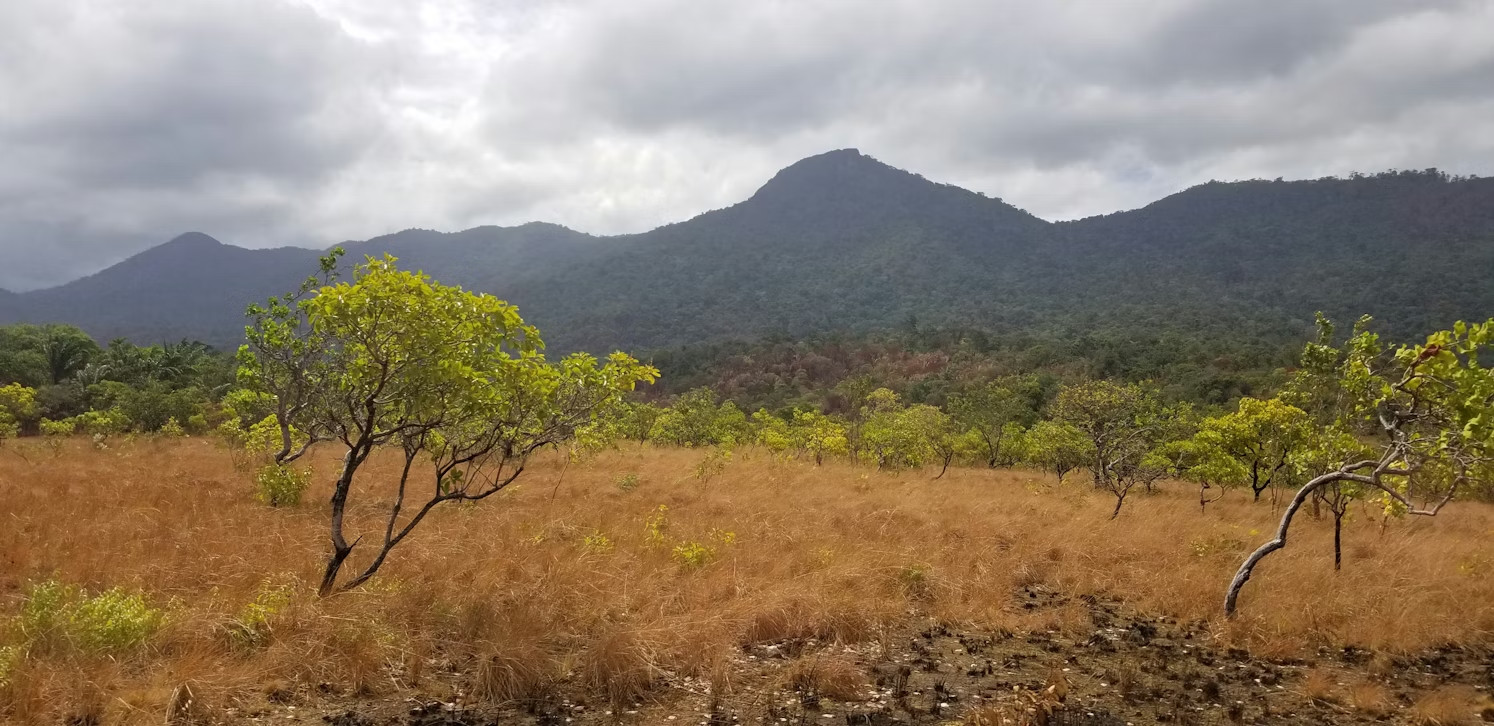
A large part of Guyana’s territory is covered by the Amazon rainforest, the world’s largest and most biodiverse tropical rainforest, shaping not only the country’s landscape but also its cultural relationship with the environment. Sustainability is deeply rooted in Guyanese life, particularly through its strong Indigenous heritage, where stewardship of the land has long been a guiding principle. With nine Indigenous nations, protecting forests, rivers and wildlife has traditionally been a way of life, reflected in community-led ecotourism, small-scale agriculture and a culture of self-sufficiency. That ethos is carried at the national level through Guyana’s Low Carbon Development Strategy, which aims to protect the vast majority of its forests as it pursues economic growth. With roughly 85 percent of the country still forested, the country acts as a significant carbon sink while navigating the pressures of rapid development, particularly the recent hunt for oil beyond the obvious destinations.
(Joshua Gobin/Unsplash)
Her grandfather had a mango tree just outside his window in Guyana, a country on South America’s North Atlantic coast defined by its vast, dense rainforest — creating perfect conditions for sweet, tropical fruits.
“He could reach out and pick a mango from his bedroom window. But there was this concept that you don’t take all the mangoes,” she remembers fondly.
Some fruit was left behind for birds. If a mango fell to the ground, it stayed there for insects and other animals.
“I think in a lot of post-colonial worlds and Western societies, we lose that connection, but for them it was just how you lived,” Miranda contemplates.
“They probably don't even realize the impact that that way of living has had on me. But when I think back, all of those things must have shaped something.”
She knew she wanted to pay homage to that intricately woven understanding of the ecosystem by leaving “the world a better place than when” she entered it.
Miranda has been doing just that with like-minded people focusing on political advocacy, community engagement and climate literacy through Community Climate Council (CCC).
On March 1, CCC, a youth-founded, not-for-profit organization advocating for local climate action through enhancing climate literacy and political advocacy in Peel, celebrated its fifth anniversary.
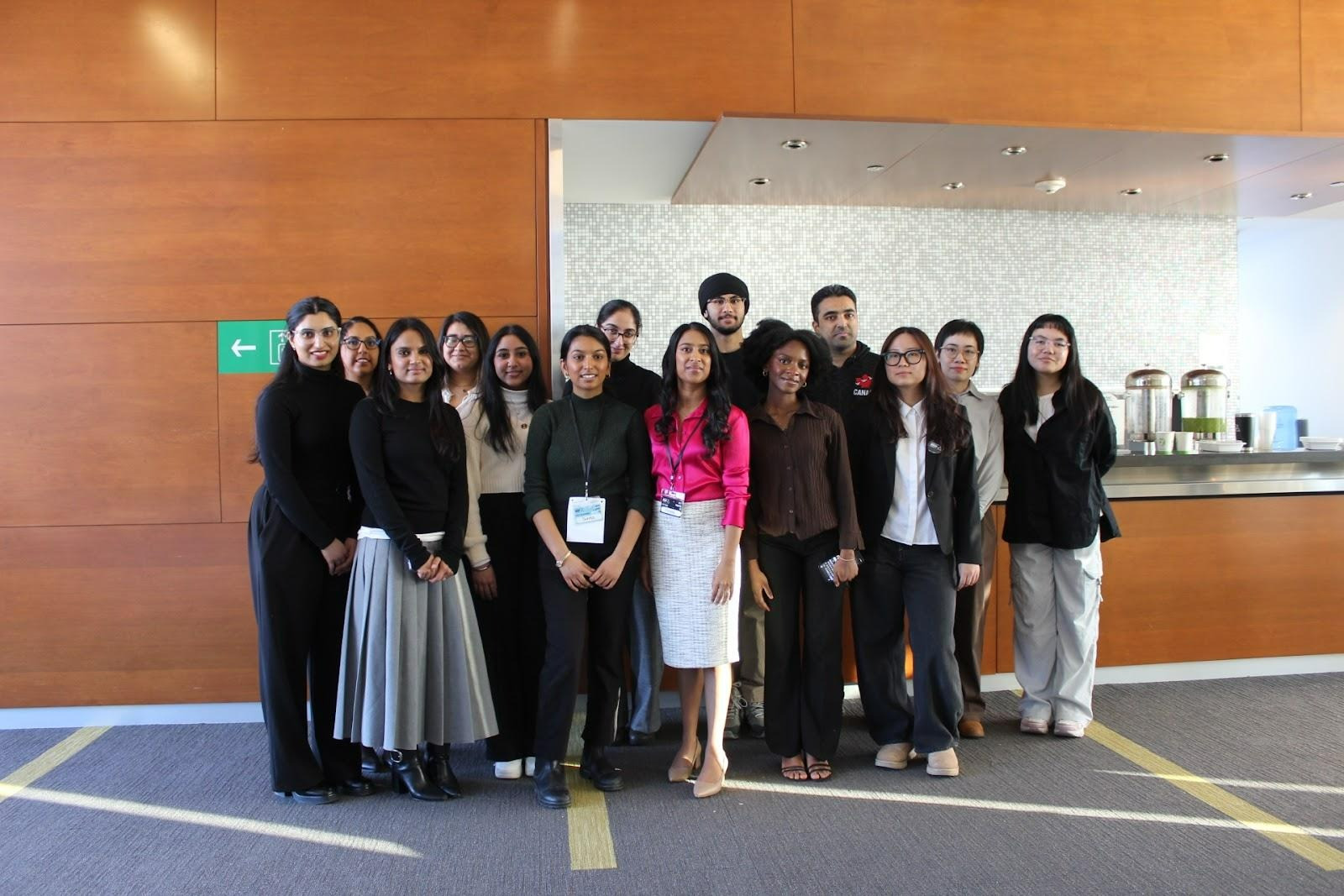
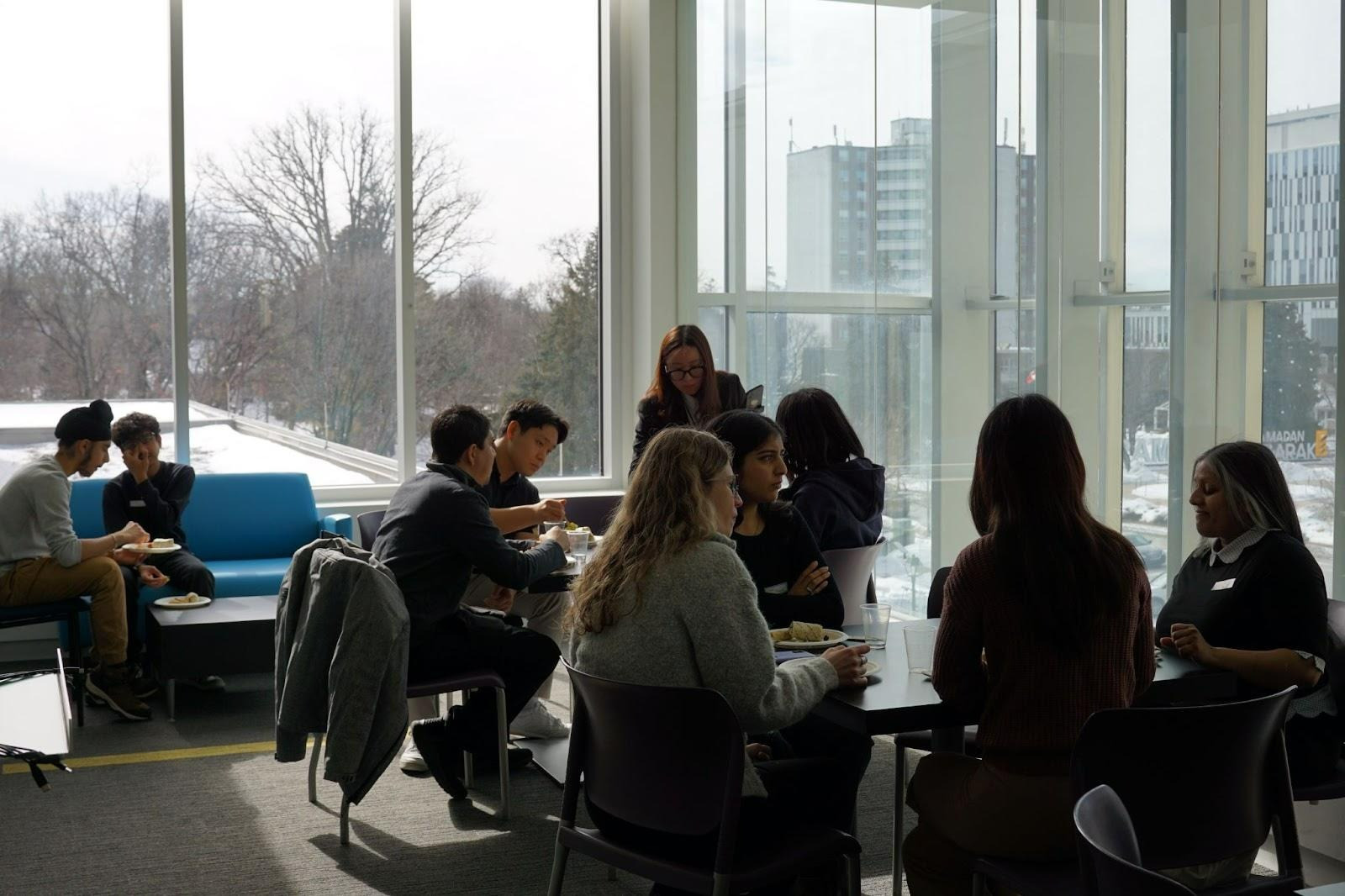
On Sunday, March 1, Peel-based, volunteer-led non-profit Community Climate Council marked its fifth anniversary with climate activist Karishma Porwal as keynote speaker. Many young people took the opportunity to have conversations about the environment.
(Community Climate Council)
“But our story actually begins eight years ago,” she says.
In 2018, when Greta Thunberg, a grade nine student, decided not to attend school until the Swedish general election on September 9 advocating for climate measures, Miranda saw how one individual step could spark a global movement.
She realized that while climate strikes were happening worldwide, students in Brampton and Peel Region often couldn’t make it to Toronto, the distance, parental permissions and other barriers made it inaccessible.
Joining hands with five young women from diverse backgrounds who she met through the Youth Challenge International (a program that sought climate action catalysts across Ontario), they decided to host Peel Region’s first local climate strike.
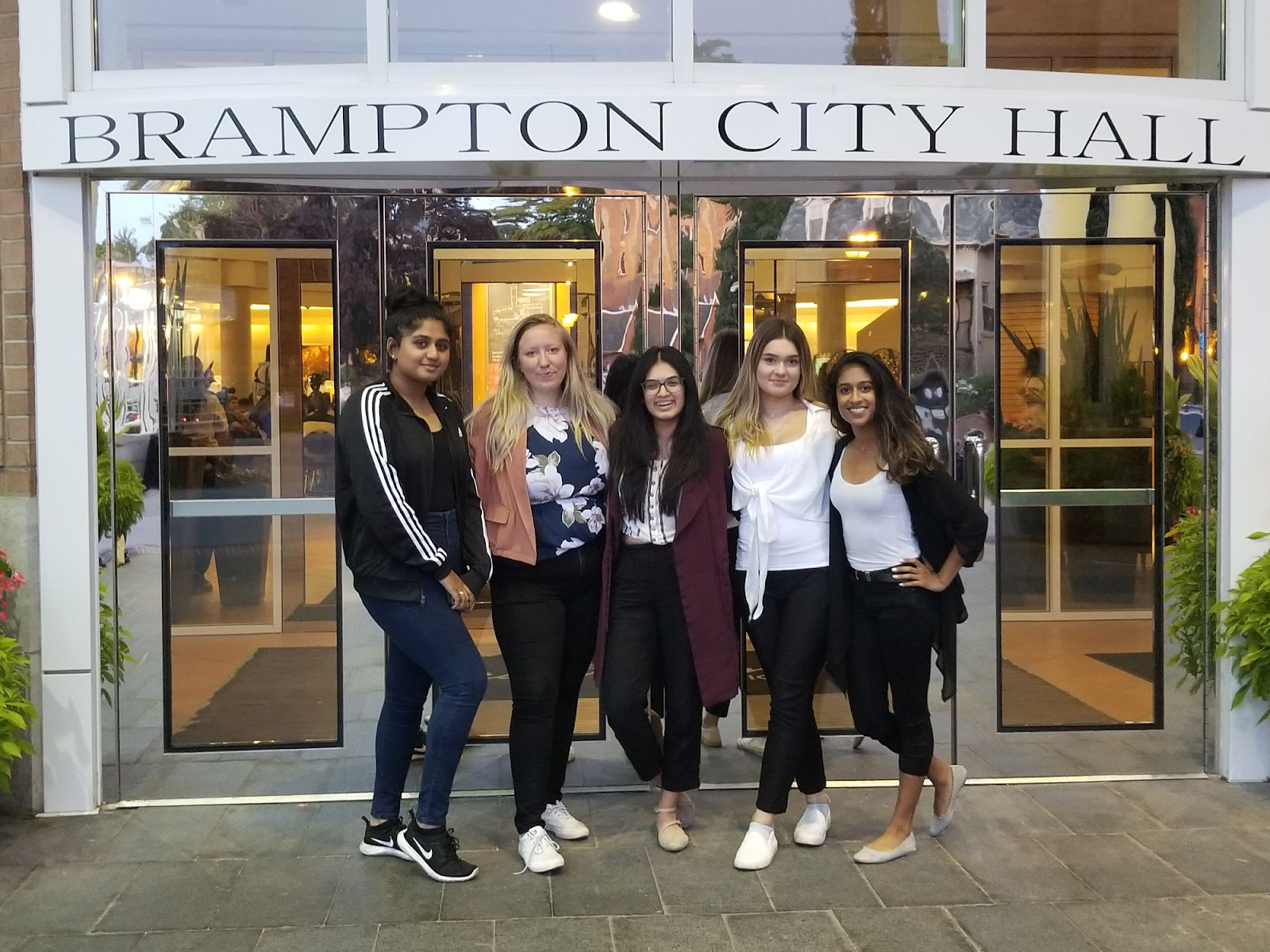
The five founders of Community Climate Council: Mithila Jeganathan, Samantha Casey, Divya Arora, Aneta Brynkus and Miranda Baksh.
(Community Climate Council)
Expecting fewer than 10 attendees, they gathered outside Brampton City Hall. But as people began trickling in, the crowd quickly grew to over 250, including individuals of all ages and representatives from all four political parties, coinciding with the election period.
“It was incredible…for a moment, politics didn’t matter,” Miranda said. “Climate should be human-centred. It really is a social justice issue. The planet will survive whether we’re here or not; we have to decide what kind of world we want to live in.”
The rally brought personal stories to the forefront. An introvert, Miranda found herself talking to equally climate-conscious people from all backgrounds — a recognition that would motivate her to start Climate Cafés, a safe space for people to discuss their emotional, psychological and personal responses to the climate crisis.
By the end, everyone walked across the street to Gage Park for a spontaneous litter cleanup, gloves and bags in hand.
“It was activism full of love, empathy and care. Every protest I’ve attended since has followed that same spirit, and we even left the park cleaner than we found it,” she added.
It was the kind of day that reminded Miranda of what community unity can do and the need for a formal space in Peel for climate conversations that lead to civic engagement: on January 25, 2020, CCC came into existence.
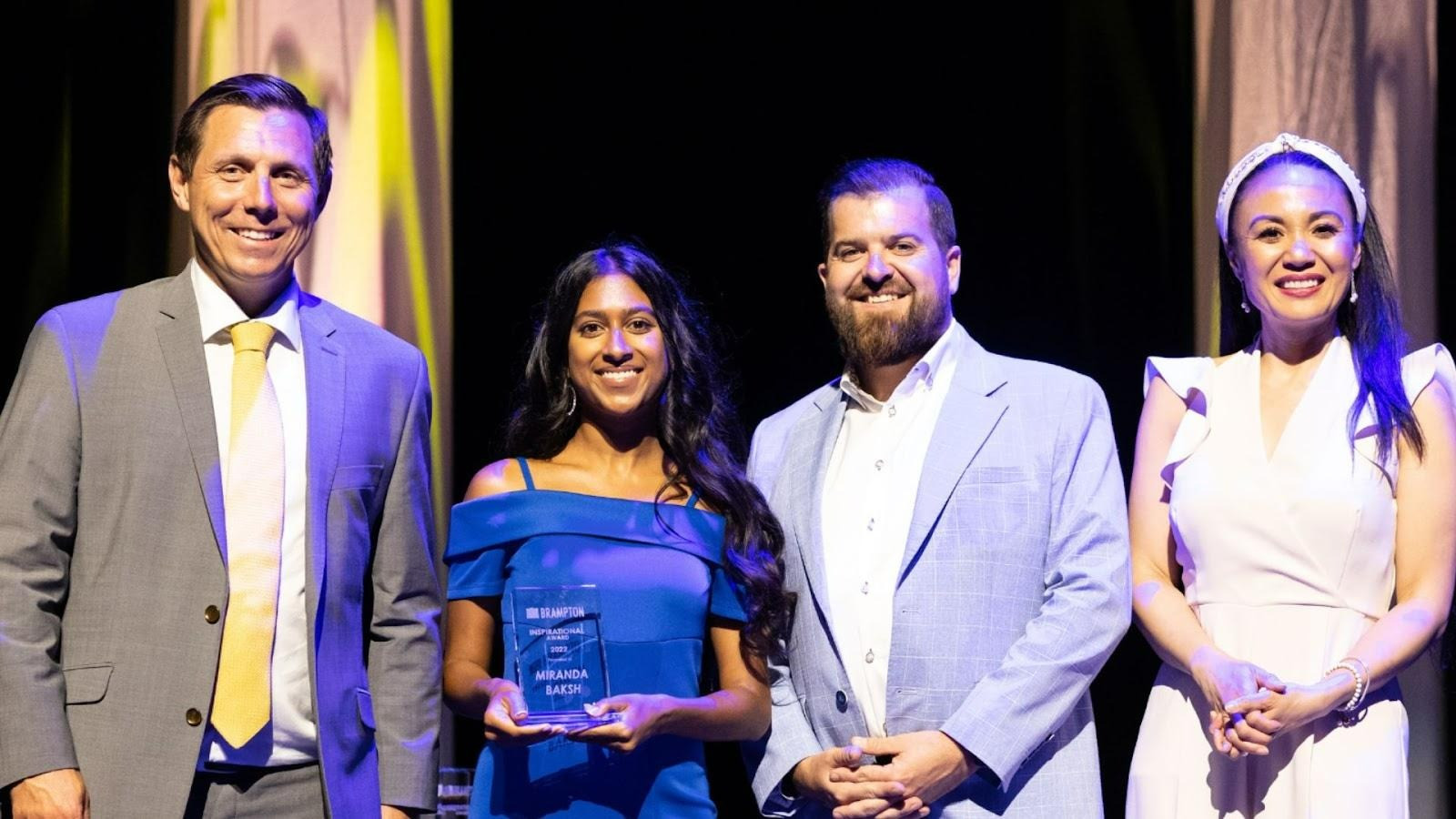
Miranda Baksh receiving the Brampton Mayor Citizen Award in 2022.
(Community Climate Council)
“Talking about climate change with friends or family is important, but the conversation often ends there,” she noted.
“We wanted to make sure we weren't only doing activism — because, yes, that's important — but we also want to be taken into account as real policymakers and change makers in our future. We have councillors and MPs constantly talking about the future we're living in, so we should be co-designing that future.”
Since its establishment, CCC members have delegated in support of Peel’s first Climate Change Master Plan, organized rallies, educational webinars, zines, workshops, a podcast with environmental experts along with Climate Library, a book club and virtual Climate Cafés during the pandemic, spreading awareness on a range of issues from local to provincial such as Highway 413 and its ecological impacts.
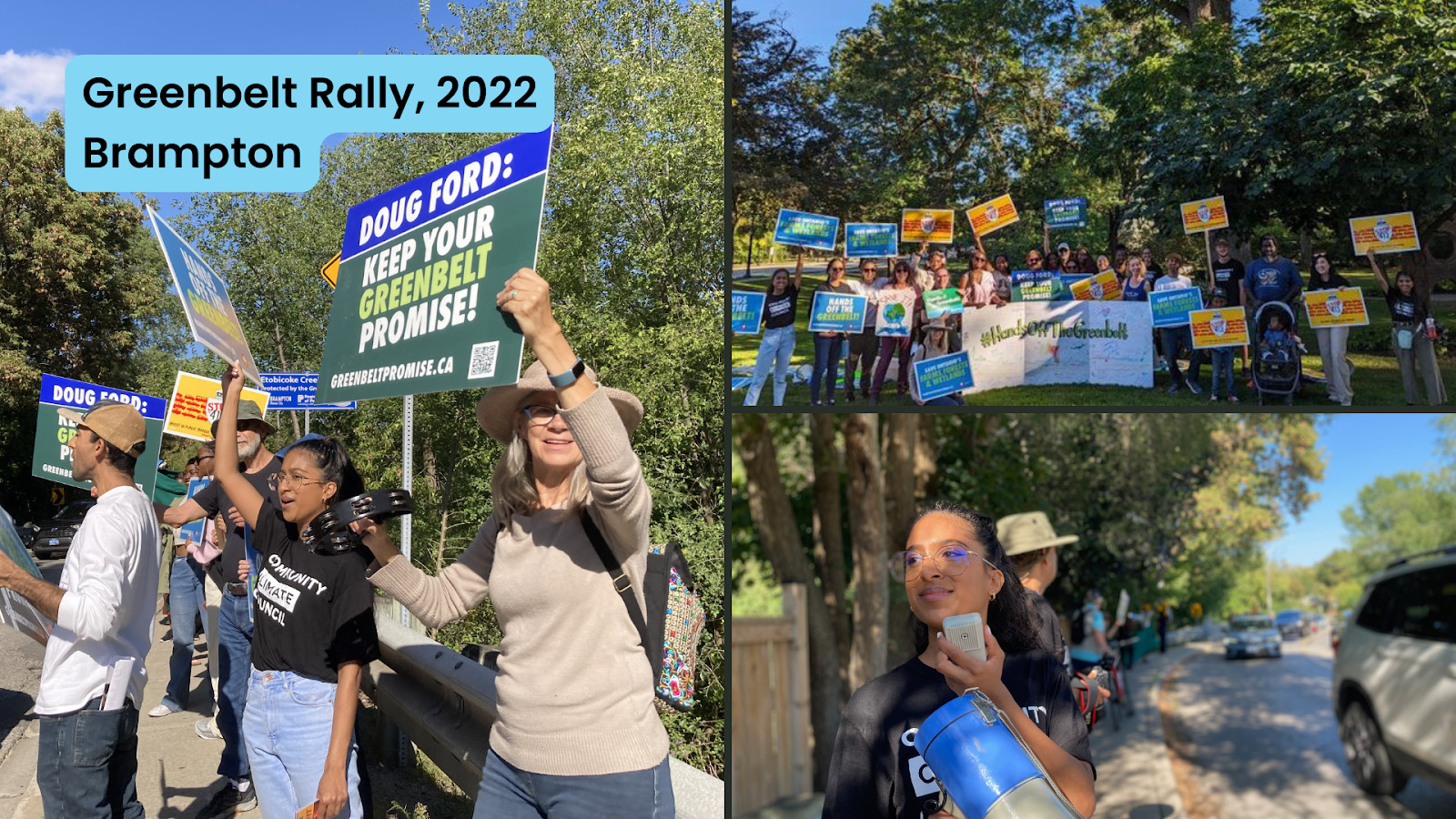
In 2022, when numerous “Hands off the Greenbelt” rallies occurred across Ontario, specifically targeting Bill 23 and the provincial government’s proposal to remove 7,400 acres of protected land for development, Miranda Baksh organized one in Brampton.
(Community Climate Council)
Since its official launch five years ago, 193 volunteers have helped CCC grow and “100 percent of them now work in sustainability and climate sectors”.
Currently, about 40 volunteers including Miranda coordinate virtually, carving out evenings and weekends despite busy schedules because of the urgency the climate crisis demands.
At their anniversary event this year at the Peel Art Gallery, Museum and Archives in Brampton, CCC unveiled a new initiative, the Peel Climate Champions Program, “a transformative, youth-led initiative that empowers BIPOC and equity-deserving youth in Peel Region to take bold, informed action in the face of climate change”.
In a sold out room with attendees travelling from Hamilton, Guelph, Scarborough and Etobicoke to show their support, Miranda shares that the group was able to raise $1,000 for the program. “It told us that people cared, they were interested in what we do…and they were willing to invest in our ideas.”
Through the program, she hopes to give young people passionate about climate change the tools and confidence to get actively engaged, something that she had to decipher on her own.
“Up until high school, I was still figuring things out. [I was] super shy. I didn’t even raise my hand in class. But in the 2018 rally, I had a message to share…my drive to let everyone know about the forest fires, biodiversity loss and the direction the world was heading, outweighed my nervousness and shyness.”
She believes education is the cornerstone of climate activism: “Even chatting about climate change at the dinner table, sharing stories with kids, is powerful. Especially now, with misinformation, fascism and climate denial rising and children becoming victims to AI, truth and real scientific knowledge are so important.”
“Our decisions today have ripple effects on the world we leave for the next generation and we can talk about what they can do to change that future whether it’s through sustainable diets or renewable energy.”
Email: [email protected]
At a time when vital public information is needed by everyone, The Pointer has taken down our paywall on all stories to ensure every resident of Brampton, Mississauga and Niagara has access to the facts. For those who are able, we encourage you to consider a subscription. This will help us report on important public interest issues the community needs to know about now more than ever. You can register for a 30-day free trial HERE. Thereafter, The Pointer will charge $10 a month and you can cancel any time right on the website. Thank you
Submit a correction about this story

