
Transit over traffic
Mike Marcolongo is the Associate Director of Environmental Defence and co-author of a new report.
No one disputes that traffic gridlock in the Greater Toronto and Hamilton Area (GTHA) is costing our economy and our quality of life. An oft-mentioned statistic is that congestion is a $45 billion per year hit to our economy.
In our new report, entitled “Transit over Traffic: Hard Truths for Addressing Gridlock in the GTHA”, we demonstrate that the Ontario government’s response to gridlock is actually making the congestion crisis worse.
The report tracks how over the last eight years—by mismanaging public transit investments, by proposing damaging, expensive and ineffective mega-highways, by eliminating market-based congestion solutions, and by reducing transit operating funding—the Ontario government is making your GTHA commute worse, not better.
But what about the traffic solutions being implemented today?
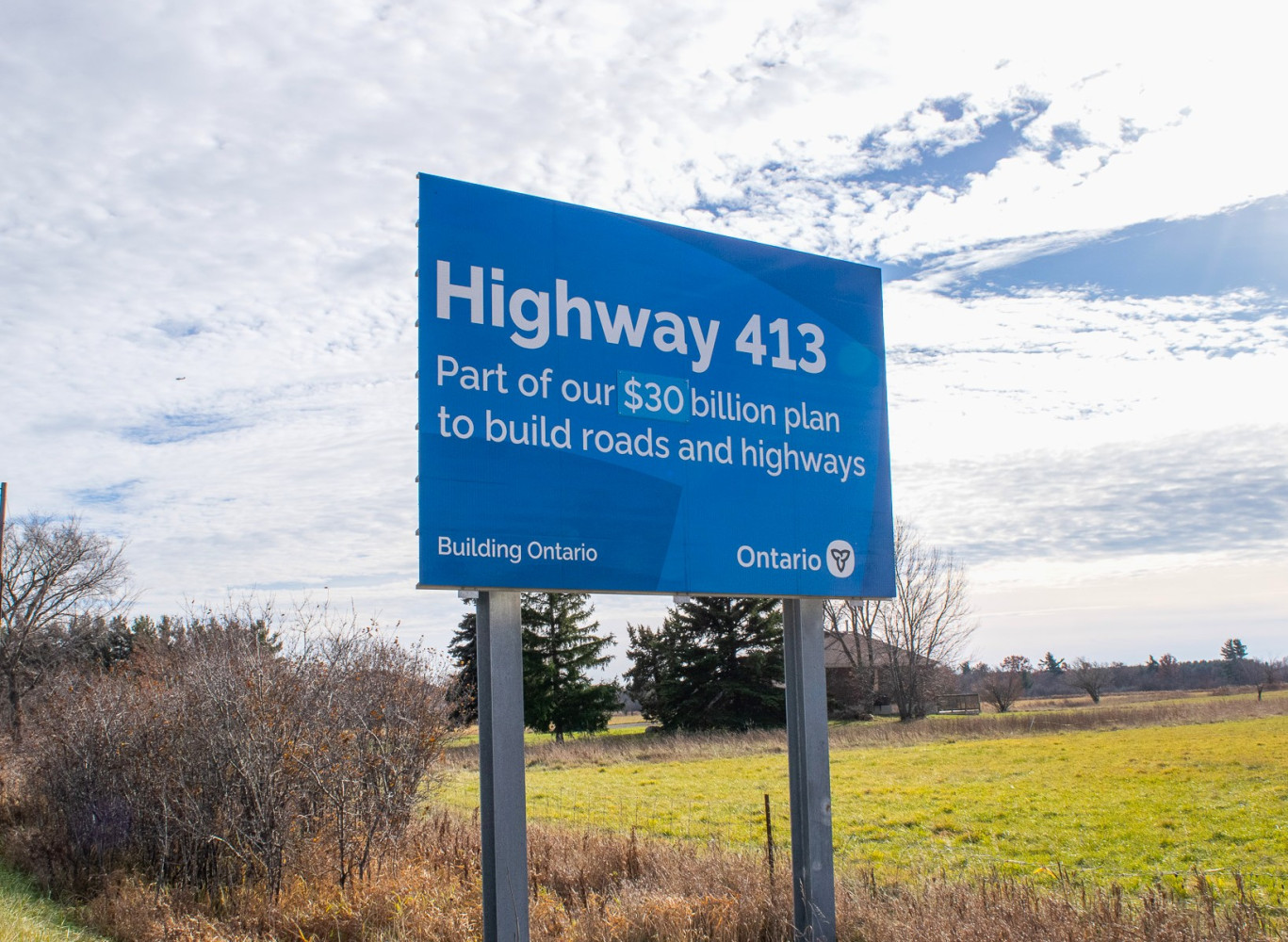
Despite all the ads by the Government of Ontario claiming that congestion is being addressed through infrastructure improvements—the Ministry of Transportation’s own modelling shows projections of commuter speeds at 20-40 km/hr on all 400-series highways by 2041.

Protesters in Caledon, where the massive new transportation corridor will pave over farmland, called for the cancellation of the 413 Highway project.
(Alexis Wright/The Pointer)
Despite the Ministry of Transportation’s own internal modelling, the Ontario government is pushing ahead with very expensive and very disruptive mega highways. Between Highway 413, the Bradford Bypass and the Highway 401 tunnel, the Ontario government will be committing approximately $80 billion for projects that will exacerbate GTHA congestion for decades to come.
Our research demonstrates that if the Ontario Government instead spends the $80 billion to increase the frequency of transit and the reach of new transit infrastructure in the GTHA, we could have real solutions to congestion. These investments would allow 30 percent of people’s trips to occur via transit in the GTHA, and thereby ease pressure on roads and highways.
In the report, we also point to Ontario’s lack of progress in the Western GTA with regard to investments in higher order transit investments (for example ad hoc GO train expansions) and municipal rapid transit. These missing investments are being diverted to the Government of Ontario’s push for the $14 billion 413 mega-highway.
The report offers a sobering reminder that GTHA congestion solutions are at hand if market-based congestion measures are used, if transit is properly funded and if those investments are properly managed. Evidence also shows that Rapid Bus Transit, dedicated bus lanes and prioritized transit signalling are all cost effective solutions that could be implemented next week, next month and next year.
By optimizing roads to move the largest amount of people, not the most amount of cars—congestion could actually be addressed across the region in the coming months and years—not decades down the road.
Submit a correction about this story

