

How a TD Rewards booking for a Cuban vacation left a Canadian family in the cold when the bank bent to U.S. sanctions policy
When Laura Edell entered “Havana” into Toronto Dominion Bank’s (TD) Expedia-powered travel booking portal, the response was not a warning, a policy notice or legal explanation.
Instead, the screen displayed a single message: “Sorry, it seems we have taken a wrong turn.”
There were no search results. No indication that travel to Cuba was restricted and no way for the family to use the travel reward points to book a trip to the island. It was simply not an option through the bank’s booking system.
The message appeared as Edell, her partner and their two children were trying to finalize plans for a Christmas vacation to Cuba. The family had chosen the destination for its affordability, family-friendly resorts and the availability of direct flights from Ontario.
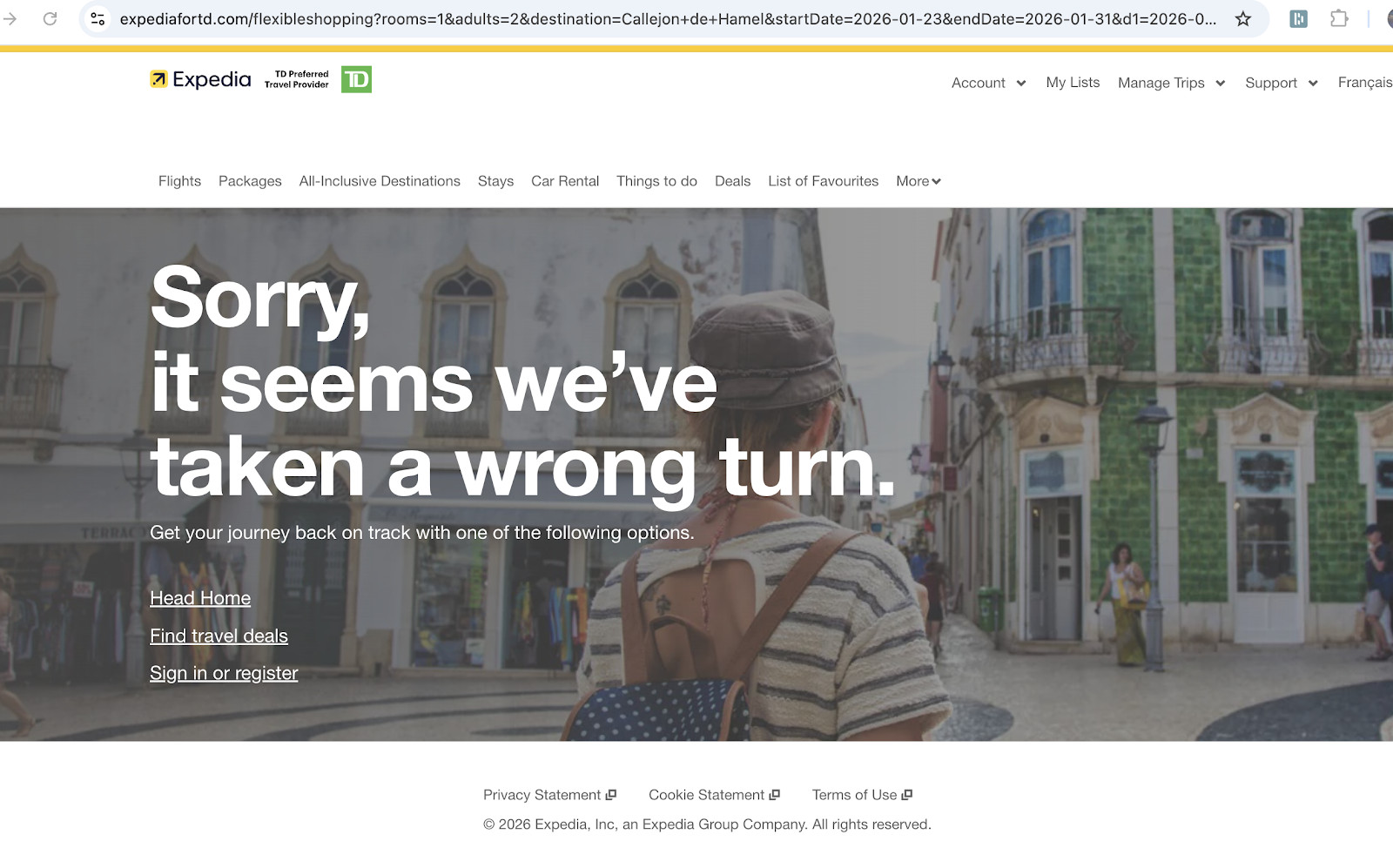
A screengrab of the Expedia message received by the Edell family when attempting to book a holiday to Cuba using TD Rewards.
(Supplied)
According to Edell, the trip was meant to be paid for using travel rewards accumulated through a TD First Class Travel Visa Infinite Card. To redeem those points for airfare and accommodations, the family logged into the Expedia for TD booking platform, then hit a dead end.
“At first, (we) thought it was a glitch,” Edell said. “There was nothing saying Cuba wasn’t allowed.” That’s when they saw the message about taking a wrong turn.
It was only after conducting their own research that the family discovered the absence of options for Cuba in the search results was not a technical error, but the consequence of a policy decision. Expedia does not allow TD cardholders to redeem travel reward points for trips to Cuba.
By the time the reason became clear, Edell said, it was too late to research an alternative destination for the Christmas holidays. The family cancelled their travel plans and spent Christmas in Niagara at the home of Laura’s parents instead.
Her parents were glad for the unexpected family holiday time, but when her father (Dennis Edell) learned of the circumstances that forced his daughter and her family to stay home he became concerned. Dennis, a longtime TD customer, said he was stunned by what he was hearing.
After investigating further, Dennis said he discovered that Expedia Group has blocked bookings to Cuba, citing legal risks arising from U.S. sanctions, including liability under the Helms-Burton Act.
“I couldn’t believe this could be true,” he said, in comments made to The Pointer. “TD is my bank. It’s a trusted Canadian institution, American laws have no power over our interactions with our banks.”
The Helms-Burton Act is an American law that tightened and expanded the U.S. economic embargo against Cuba and, crucially, extended it beyond the country’s borders. The Act locked an embargo into American law and applied that U.S. law to foreign companies, even when their activities are legal under their own national laws. Canada does not recognize the Helms-Burton extraterritorial applications and has gone so far as to pass Canadian legislation intended to block Canadian companies from complying with the American law and the country’s sweeping embargo against Cuba.
Canada's Foreign Extraterritorial Measures Act (FEMA) is legislation designed to protect Canadian sovereignty and business interests by blocking the reach of foreign laws into Canadian affairs. It allows the Canadian Attorney General to prohibit compliance with foreign measures like the Helms-Burton Act. It is essentially Canada's way of protecting our businesses and residents from consequences that other countries try to create, preventing other countries' laws from overriding Canadian law in international trade and commerce.
“Expedia won’t accept new bookings for Cuba, even for non-U.S. travelers, because of U.S. law,” Dennis continued. “And TD is allowing that policy to be applied to Canadian customers.”
TD customer service representatives confirmed to Dennis that the Expedia for TD platform does not permit Cuba bookings, and suggested his daughter redeem her points for cash and book travel independently. They rejected that option, noting that cash redemption significantly devalues travel reward points compared to booking directly through the Expedia platform. In effect a customer would be losing money if they followed that suggestion.
When he escalated the complaint to TD’s senior customer service office, Dennis said the bank offered to reimburse his daughter for a Cuba trip she never took, an offer they declined.
“That told me TD recognized the harm,” he said. “But this isn’t a customer service issue. It’s a policy issue.”
The Pointer reached out to TD for comment but no response was received.
In an interview with The Pointer, Dany Tur de la Concepción, Deputy Head of Mission at the Cuban Embassy in Ottawa, framed the family’s experience as part of a broader pattern caused by the extraterritorial reach of U.S. economic sanctions.
He described the U.S. embargo as “the longest-running and most comprehensive system of unilateral sanctions imposed on any country”, noting that it has been in place for more than 60 years. According to Tur de la Concepción, the embargo places pressure on foreign banks, airlines and companies operating outside the United States, including in Canada.
“That pressure leads financial institutions to adopt overly restrictive policies when transactions involve Cuba, even where such restrictions may not be permitted under Canadian law,” he said.
He added that Cuba’s designation by the U.S. as a state sponsor of terrorism intensifies the effect, making banks particularly cautious about any Cuba-related transactions. Tur de la Concepción characterized these measures as part of a broader U.S. strategy of “maximum pressure” aimed at restricting tourism and financial flows to weaken Cuba’s economy.
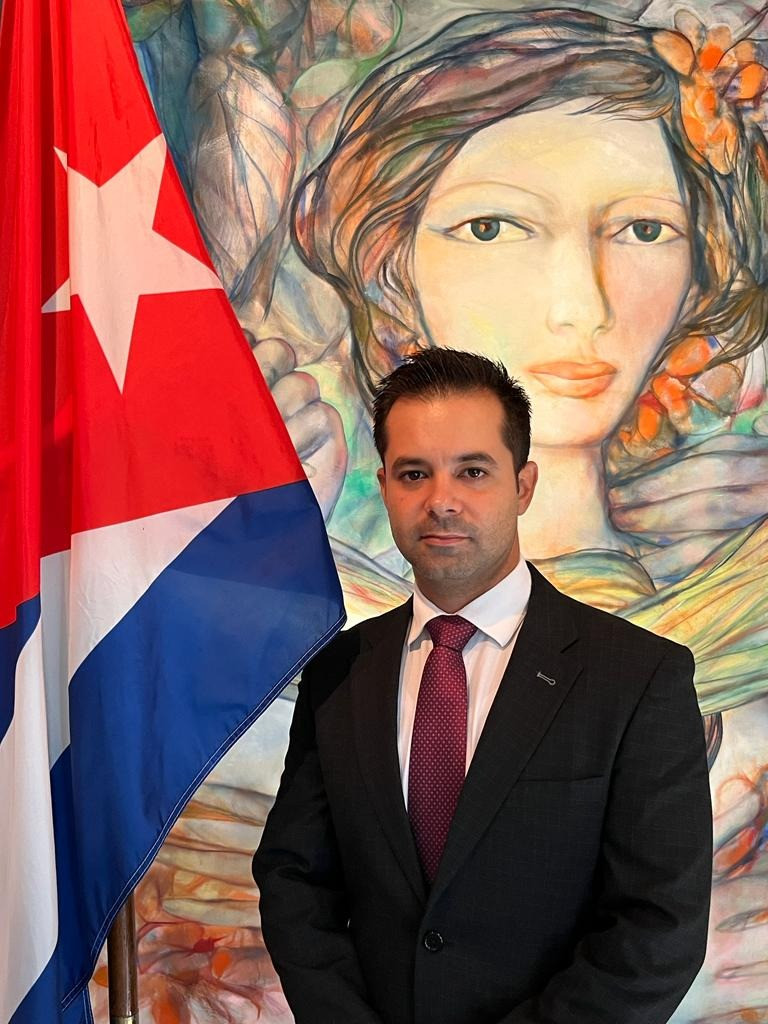
Dany Tur de la Concepción, Deputy Head of Mission at the Cuban Embassy in Ottawa.
(Embassy of Cuba in Canada)
The diplomat said Cuba documents such cases globally and submits annual reports to the United Nations General Assembly, where a large majority of member states routinely vote to condemn the embargo. He said Cuba has identified multiple cases in Canada involving banks, airlines and corporations, though many incidents likely go undetected because businesses choose to avoid Cuba-related activity altogether.
While refraining from giving direction to Canadian authorities, Tur de la Concepción said cases like these are exactly what the Foreign Extraterritorial Measures Act (FEMA) was meant to prevent.
“Disputes involving Canadian banks and Cuba-related transactions fall within Canada’s legal and regulatory framework,” he explained, “not U.S. law.”
He described the embargo as a violation of international law and human rights, arguing that its effects extend to citizens of other countries, including Canadians. In his strongest remarks, he characterized the blockade as “a form of genocide against the Cuban people,” while expressing hope that friendly nations would choose not to reinforce its effects.
The case has also drawn criticism from Canadian civil society organizations that monitor Canada–Cuba relations and the global reach of U.S. sanctions.
Julio Fonseca, co-chair of the Canadian Network on Cuba and President of the Association of Cubans in Toronto, Juan Gualberto Gómez, said the TD case is a clear example of U.S. policy being enforced beyond American borders.
“It is clear that this Canadian bank is complying with the U.S. sanctions against Cuba, which is another proof of the extraterritorial implementation of the U.S. blockade imposed on the island for more than 60 years now,” Fonseca said.
It is unacceptable for a Canadian financial institution to be governed by foreign political decisions, he added.
“It is inconceivable that a bank from Canada, a sovereign nation, should be bound to policy regulations by another state,” Fonseca said. “It certainly violates Canada’s sovereignty.”
Fonseca said Edell is justified in demanding accountability beyond internal bank reviews.
“The complainant is right to demand a real explanation at the highest level.”
In a written response to Edell, TD Bank’s Senior Customer Complaints Office (SCCO) confirmed that it would not change its policy restricting the redemption of TD travel rewards for Cuba-related travel.
TD acknowledged Edell’s frustration and apologized for the inconvenience, but stated that its review found no errors or service failures within the bank’s direct control. The bank said the SCCO does not have the authority to intervene in business or compliance decisions involving rewards programs or third-party partners.
TD confirmed to Dennis that Expedia for TD does not list or permit bookings to Cuba, noting that Expedia is a U.S.-based provider that operates in compliance with U.S. sanctions administered by the Office of Foreign Assets Control (OFAC).
“There is no operational capability available to manually override or enable Cuba listings on the Expedia for TD platform,” the bank wrote.
TD acknowledged that alternative redemption methods, such as redeeming points for cash or using the “Book Anyway/Pay Off Purchases” option, offer a lower effective redemption value than booking through Expedia for TD.
The bank offered Edell a one-time, discretionary accommodation, agreeing to consider applying the Expedia redemption rate to a Cuba booking made outside the platform, provided the family submitted third-party documentation. TD emphasized that the offer did not represent a policy change. Edell refused any sort of one time accommodation, seeking policy change, not compensation.
Unsatisfied with any of the responses provided by TD, the complaint has now been escalated to the Ombudsman for Banking Services and Investments (OBSI) by the Edells, requesting a formal investigation.
In the complaint, Dennis argues that TD, as a Canadian chartered bank, is effectively restricting Canadians’ lawful travel to Cuba by applying U.S. policy intended solely for American citizens. The ombudsman is asked to find that TD is in breach of FEMA, which was enacted to counter the extraterritorial application of foreign laws, particularly U.S. sanctions on Cuba.
He also highlights the broader impact on Cuba, noting that Canadians represent the country’s largest group of foreign visitors and a critical source of foreign exchange. Restricting Canadian travel, he argues, penalizes the Cuban people during a period of economic hardship and aligns a Canadian bank with U.S. policy routinely condemned by the United Nations.
Among other remedies, Edell is asking OBSI to require TD to allow Cuba travel redemptions at equal value, communicate the restriction transparently to cardholders, compensate affected customers and issue a public apology.
For Edell, the issue goes beyond one cancelled vacation.
“What looked like a simple booking glitch turned out to be U.S. foreign policy deciding what Canadians can do with their own bank rewards,” he said.
What began with a vague message..“Sorry, it seems we have taken a wrong turn”, has now evolved into a case touching on consumer rights, Canadian sovereignty and punitive actions against Cubans through the reach of American sanctions into everyday financial services in Canada.
Whether regulators agree remains to be seen. But for now the road to Cuba using TD reward points, remains closed.
Email: [email protected]
At a time when vital public information is needed by everyone, The Pointer has taken down our paywall on all stories to ensure every resident of Brampton, Mississauga and Niagara has access to the facts. For those who are able, we encourage you to consider a subscription. This will help us report on important public interest issues the community needs to know about now more than ever. You can register for a 30-day free trial HERE. Thereafter, The Pointer will charge $10 a month and you can cancel any time right on the website. Thank you
Submit a correction about this story

