

In a rare face-to-face, Niagara’s human trafficking investigators educate community, extend support to survivors
More than three quarters of Canadians can not identify human trafficking, even if it was happening right before their eyes.
Nearly the same number believe this heinous crime to be a significant issue in this country.
Gathered by the Canadian Centre to End Human Trafficking in a 2021 survey, the statistics reveal a disturbing gap between the knowledge of what human trafficking looks like, and the understanding of the deep harm it causes across Canada.
On a snowy night at the end of November, the Niagara Police were doing their part to close this information gap.
The Niagara Police Human Trafficking Unit hosted a community information session on November 25 to speak directly with residents about human trafficking—which is on the rise in Niagara. It’s a rare move for officers whose work is cloaked in secrecy to facilitate the undercover sting operations they carry out. While briefly stepping into the spotlight, the four-member team, three of whom were present, declined to be photographed.

Niagara Police headquarters.
(Lobo Security Consulting)
Accustomed to smaller, direct consultation with businesses and other community groups at their request, the officers were not too sure how the community would react to an open invitation.
The response was overwhelming.
The RSVPs flooded in and the event quickly filled to capacity.
In the audience were parents, including those whose children had either been trafficked, or encountered possible traffickers online, advocacy organizations, as well as a number of young teens.
In Canada, the average age a young woman enters the sex trade is 13. Statistics Canada published data on December 8 showing that nearly two-thirds of the 3,954 human trafficking victims found between 2014 and 2024 were under the age of 25.
This is why the NRPS officials geared the presentation toward teens and parents. Lessons included the behaviour to watch out for from strangers online or a loved one who may be being active trafficked; the apps commonly used to target young people (Snapchat and Instagram are two of the most common); and the tactics used by traffickers to coerce young, vulnerable teens. The “Romeo method”—by far the most common ruse used by traffickers, mostly based on its success—involves the trafficker pretending to be romantically interested, showering the young woman with compliments and gifts. This “love bombing” is especially effective on vulnerable teens with low self-esteem, and makes it easy for traffickers to eventually transition them into exploitation. Desperate for affection and love, victims will do almost anything to get their “boyfriend’s” affections back.
There were surprised gasps; murmurings of disbelief; chairs creaked with uneasy shifting as data highlighting the prevalence of this crime in the Niagara Region appeared on screen. The number of victims and survivors identified by investigators has surged 700 percent in a single year.
After the reactions came questions, a lot of them.
How can we hold technology companies responsible for their role in facilitating this crime?
It’s a critical question, but a tough place for police to be in, officers said. It is more a job for provincial and federal politicians.
Where is this happening?
Online, in schools, in shopping malls—anywhere there are young people.
Can anyone really become a victim of this crime?
Yes they can, especially if they have existing vulnerabilities, like a troubled home-life, previous abuse, or they are part of the child welfare system. According to the National Foster Youth Institute, 60 percent of U.S. human trafficking victims were involved in the foster care system at one time.
How do we do more?
It’s a question Detective Sergeant Tara Ryan and her team of three detective constables are faced with every single day.
Established in 1971, Niagara police is the oldest regional police department in Ontario, and with a jurisdiction covering more than 1,800 square kilometres, its officers are responsible for one of the largest geographic regions in the province.
For a unit of four officers, investigating a crime that is notoriously difficult to detect and uncover, and increasingly in an online world that offers various levels of anonymity, it’s a monumental undertaking.
“It’s definitely a task, but one very much worth taking,” Ryan said after the November 26 information session.
She was thrilled with the turnout, but slightly disappointed they could not accommodate more residents. She says those who missed out will still benefit from the heavy turnout as it has triggered plans for more sessions in the coming months.
When asked about the reactions from parents in attendance, Ryan herself was not shocked. She says the smaller sessions with targeted community groups often elicit similar reactions. She admits with the rapid pace of change with modern technology, even she gets surprised as a parent trying to navigate the newest apps.
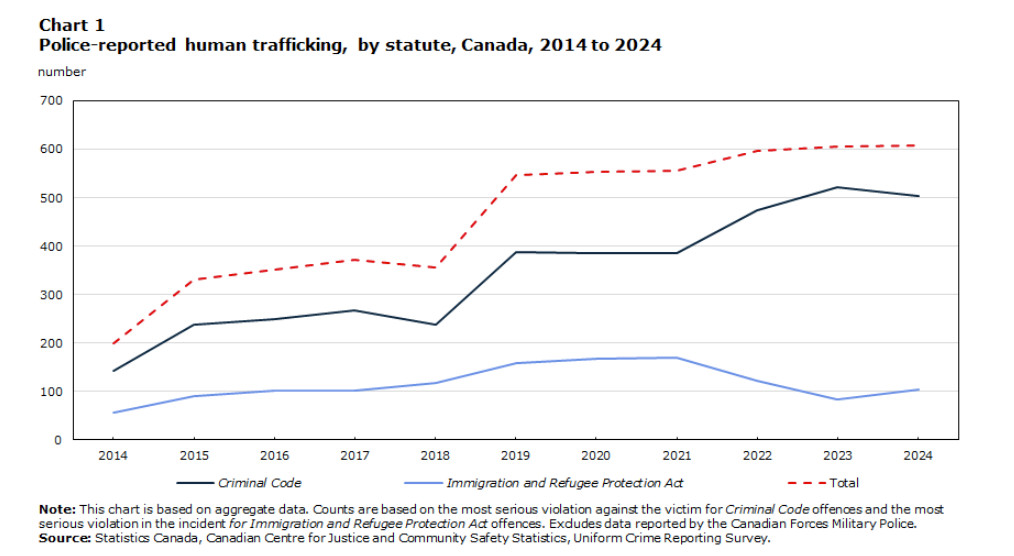
The most recent data on human trafficking from Statistics Canada shows how the crime has been on a general, upward trend since 2014.
(Statistics Canada)
Educating the public, especially about such an uncomfortable, dark topic as human sex trafficking is a slow process. The hope is the information may permeate outside the glass walls of police headquarters, potentially finding the ears of someone who desperately needs to hear it— like a victim or survivor—and let them know there is a team willing to help them escape.
That’s “the win”, Ryan says.
“Of course holding offenders accountable is important, and that is our job, but the other half of our job is protecting people and making sure they’re okay and they’re safe and in this case, they can exit whatever situation they’re in,” she explains. “They’re safety, them moving on with their life as best they can, is more important than a court process for us.
“It’s a critical message to disseminate. Numerous studies have shown that along with a lack of education about what human trafficking is—many survivors are unaware they are trafficking victims—mistrust of police is one of the top reasons victims and survivors do not report what happened to them. A 2020 survey of service providers completed by Family Services of Peel—an agency providing research and survivor aid in one of Ontario’s hubs of human trafficking—found nearly 95 percent of respondents said victims didn’t come forward for help because of a “lack of trust in the system”.
For Ryan and her unit, the survivor-first approach appears to be working.
Her unit helped identify 48 victims of human trafficking in 2024, a 700 percent increase from the year before. Their work led to the arrest of 29 alleged traffickers (a 190 percent increase) and 107 charges against (a 75.4 percent increase). Data from Statistics Canada for 2024 show trafficking in persons offences (the Criminal Code term for human trafficking) occur at a rate of 1.99 per 100,000 people in Ontario. In Niagara, these offences occur at a risk of 3.71 per 100,000.
The cause of this increase is complex. Increased awareness can lead to more reporting, and the compassionate approach taken by Ryan’s unit could be opening doors to survivors who may not have been willing to come forward previously. A week before the November 25 information session, police arrested 56-year-old Stephen Caron of St. Catharines in connection to human trafficking crimes dating that took place between 2008 and 2018. The charges have not been tested in court.
While this is not a true picture of human trafficking in Niagara, it is still a useful metric for Niagara Police leaders to know that more resources need to be directed toward Ryan and her team.
The 2026 Niagara Region budget, if approved, could add three new members to the unit: a Staff Sergeant, and two Detective Constables. Since its creation in 2019, only two new members have been added. Of the other large police services in Ontario, Niagara had the highest number of human trafficking investigations—and one of the smallest investigative complements.
Inspector Chris Lemaich oversees the Niagara Human Trafficking Unit and is hopeful the additional staff will trigger “transformational change”, similar to what occurred this year with Niagara’s Domestic Violence Unit.
After declaring an intimate partner violence epidemic in September of 2023, Niagara Police made a significant ask through its 2024 budget to expand the unit. This year, a staff sergeant and three detective sergeants were added, joining the 21 detective constables in that unit.
“Having those additional resources has made, I would suggest, an immediate positive impact,” Lemaich says. He believes the same will be true with Ryan’s unit.
“There is a need; it would allow Detective Sergeant Ryan and her group to do even more spectacular work.”
Email: [email protected]
At a time when vital public information is needed by everyone, The Pointer has taken down our paywall on all stories to ensure every resident of Brampton, Mississauga and Niagara has access to the facts. For those who are able, we encourage you to consider a subscription. This will help us report on important public interest issues the community needs to know about now more than ever. You can register for a 30-day free trial HERE. Thereafter, The Pointer will charge $10 a month and you can cancel any time right on the website. Thank you
Submit a correction about this story

