
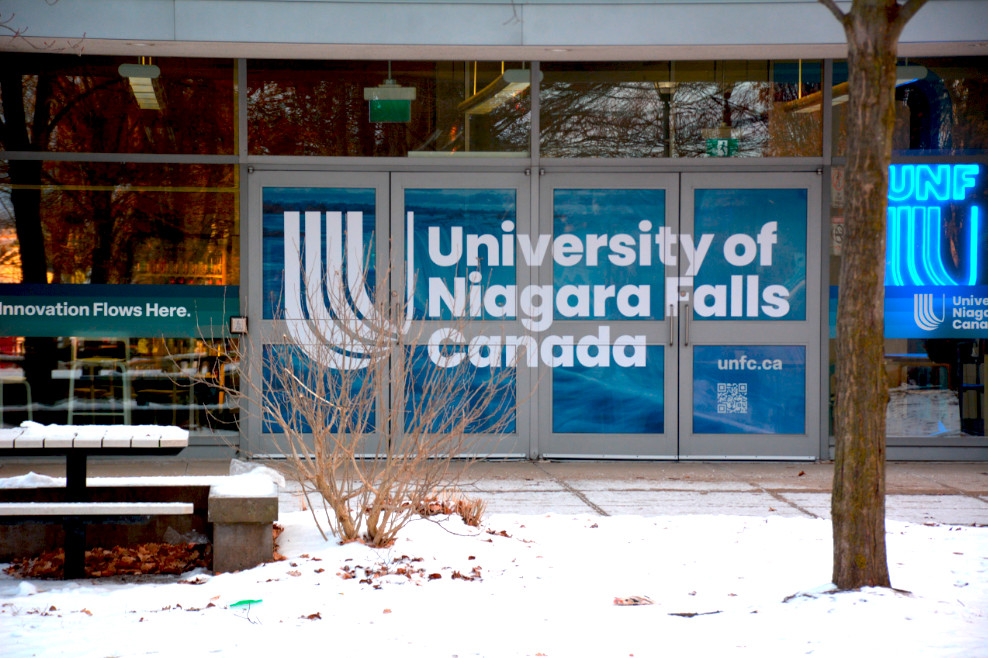
Mayor Jim Diodati claimed UNF students would revitalize downtown. What happened?
The University of Niagara Falls was heralded as the saviour of the city’s downtown: a post-secondary institution that would draw thousands of students, boost the housing market and infuse badly needed investment to lift struggling businesses suffering amid the surrounding decay.
The school began offering classes in April of last year and officially had its grand opening in September 2024.
Businesses are still waiting for the promised benefits.
“I have had roughly 10 students since the university opened and that was because I ran a 30 percent off promotion to students and staff,” Rob Barranca of Back Alley Barber Shop told The Pointer. His business sits less than a block from UNF. He says the thousands of students Mayor Jim Diodati and the university anticipated, with great fanfare, have yet to materialize.
Diodati and UNF President David Gray claim that as of October, there were approximately 3,000 students registered at the school—90 percent of them from outside the country—and the vast majority are on campus, studying in person.
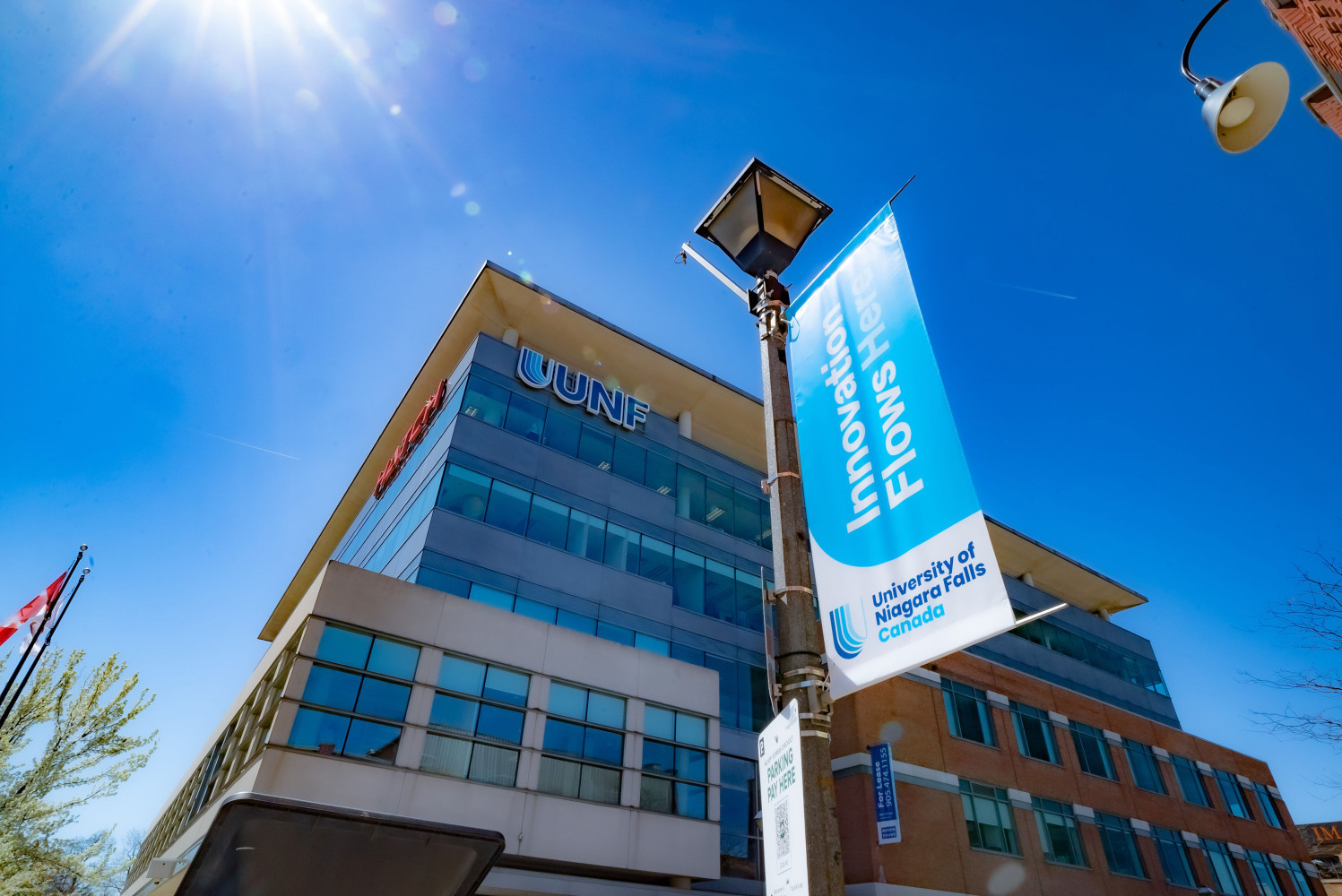
The University of Niagara Falls building in the city’s downtown.
(Google Maps)
“That would be great if there were 3,000 students downtown and it would be very noticeable, but right now there is not,” Barranca said. “The students that came in said they have very little money for things like haircuts. Most of them told me they were living in St. Catharines because they could not afford the cost to rent in Niagara Falls and had to take the bus every day from city to city, and that was costing them a lot.”
Another business owner close to UNF, who asked not to be identified, told The Pointer much the same.
“In my observations over the time it has been open, our business has seen no benefit from the university at all. If there were 3,000 students there it would be impossible for any business on Queen Street not see that many people coming and going. I would be surprised if there are even 500 students.”
The university, unlike standard practice across Ontario, refuses to provide enrollment data or information about in-person learning, despite repeated requests from The Pointer. It’s unclear if significant numbers of students have opted for virtual learning, and therefore are not as visible in the downtown area.
In an interview with The Pointer in April 2024, David Gray, then VP of UNF, said the school's first cohort had 60 students registered for the fall, but did not define whether or not those students were online or physically onsite.
On April 25, 2025, one year after the first classes were offered, Cindy McLeod, CEO of GUS Canada—the university’s parent company—claimed UNF had more than 2,000 students, and the “vast majority are in person.” This would have been a 3,200 percent increase from the 60 students that were reportedly registered for the previous fall semester.
In an article published on September 7 in the Niagara Falls Review, Gray, now UNF President, said that, “come October, enrollment will likely hit 3,000 students.
“The vast majority of our students are face-to-face on campus,” he said. The article reported that only 10 percent of those students were domestic and 90 percent were international.
In an article published on September 12, Diodati claimed the university was “exploding”, with thousands of students studying at the school.
“They’re going to be at 3,300 students this fall. They’re having huge success,” the mayor claimed in the article.
University officials claim it grew from 60 students, to 2,000 in a single year; then by as many as 1,300 more between April and October 2025.
There is no publicly available data for the university’s student enrollment and the Universities Canada page which lists the fall 2025 enrollment of all universities in the country, does not have any information on the University of Niagara Falls.
The numbers claimed by UNF officials and Mayor Diodati would have been difficult to achieve, due to the limited number of international study permits allotted to universities such as UNF by the federal government following restrictions put in place last year and further cuts this year. Algoma University, by comparison, saw its enrollment cut in half over the same period, from “just over 8,000 students” according to its September 2024 report to the board to about 4,000 students in the fall of 2025. Almost all of the drastic decline was due to the severe drop in international enrollment.
Neither Gray nor Diodati responded to The Pointer’s requests for comment.
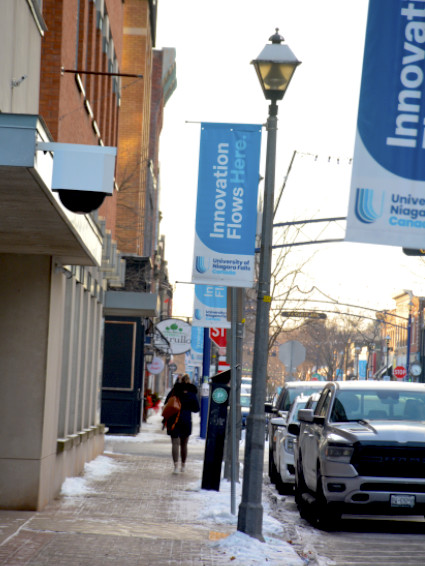
Business owners on Queen Street in downtown Niagara Falls say they are still waiting for the promised influx of students attending University of Niagara Falls.
(Joel Wittnebel/The Pointer)
On March 27, 2024, in an effort to restrict the number of international students coming to Canada, the federal government instituted a cap on the number of study permits it would issue to prospective international learners. Each province was given a set number of study permits. In order to be granted one of these now limited permits, prospective students were required to obtain what is called a Provincial Attestation Letter (PAL). This PAL confirms for the federal government that the student has been granted one of the permits within the province or territory they choose to study.
Earlier this year, the federal government reduced its international student cap a further 10 percent, from the 40 percent reduction in 2024.
Then, Prime Minister Mark Carney announced as part of his 2026 budget that new international study permits would be even more severely reduced from the 2025 target of 305,900 to 155,000 in 2026 and 150,000 in each of 2027 and 2028. This compares to almost 700,000 issued in 2023.
Diodati and UNF officials have yet to explain how they claim to have increased student enrollment by more than 30 times under Ottawa’s new policies, or how their claims of more dramatic increases could materialize with the federal government’s extreme cuts to international student enrollment till at least 2028. They have not released any data to back up their claims.
The new PAL system allows the province to control and track the number of international students being accepted into any Canadian college or university—public or private.
When these new restrictions were put in place, Premier Doug Ford allocated 96 percent of the PAL’s in Ontario to public universities and only 4 percent to private universities, language schools and institutions. UNF falls into this latter category.
According to data from Immigration, Refugees and Citizenship (IRCC) in 2025 Ontario was allotted 116,740 study permits. Of those, according to direction from the provincial government, 96 percent of them (112,070) went to public universities and colleges. A mere four percent (4,669) were to be shared among all private universities, language schools and other institutions across the province. There are 33 private universities and institutions in Ontario qualified to receive study permits. If these 4,669 permits were divided equally, it would mean UNF was allocated 141 permits in 2025—or 141 additional international students allowed to study in person. That is without factoring in language schools, which would potentially further reduce the 141 permits.
An Ontario government spokesperson said a breakdown of the permits provided to specific institutions is not publicized “in order to protect our institutions’ competitiveness.”
Based on these numbers, it’s unclear how Diodati and Gray could be claiming the vast majority of students at UNF, particularly the additional 1,300 apparently added this year, are studying downtown.
In 2026, the federal government is reducing the study permit numbers further, with Ontario only being allotted 70,074 for the coming year.
The Pointer reached out to UNF for clarification of its numbers and how many PALS it received in 2025.
UNF did not respond.
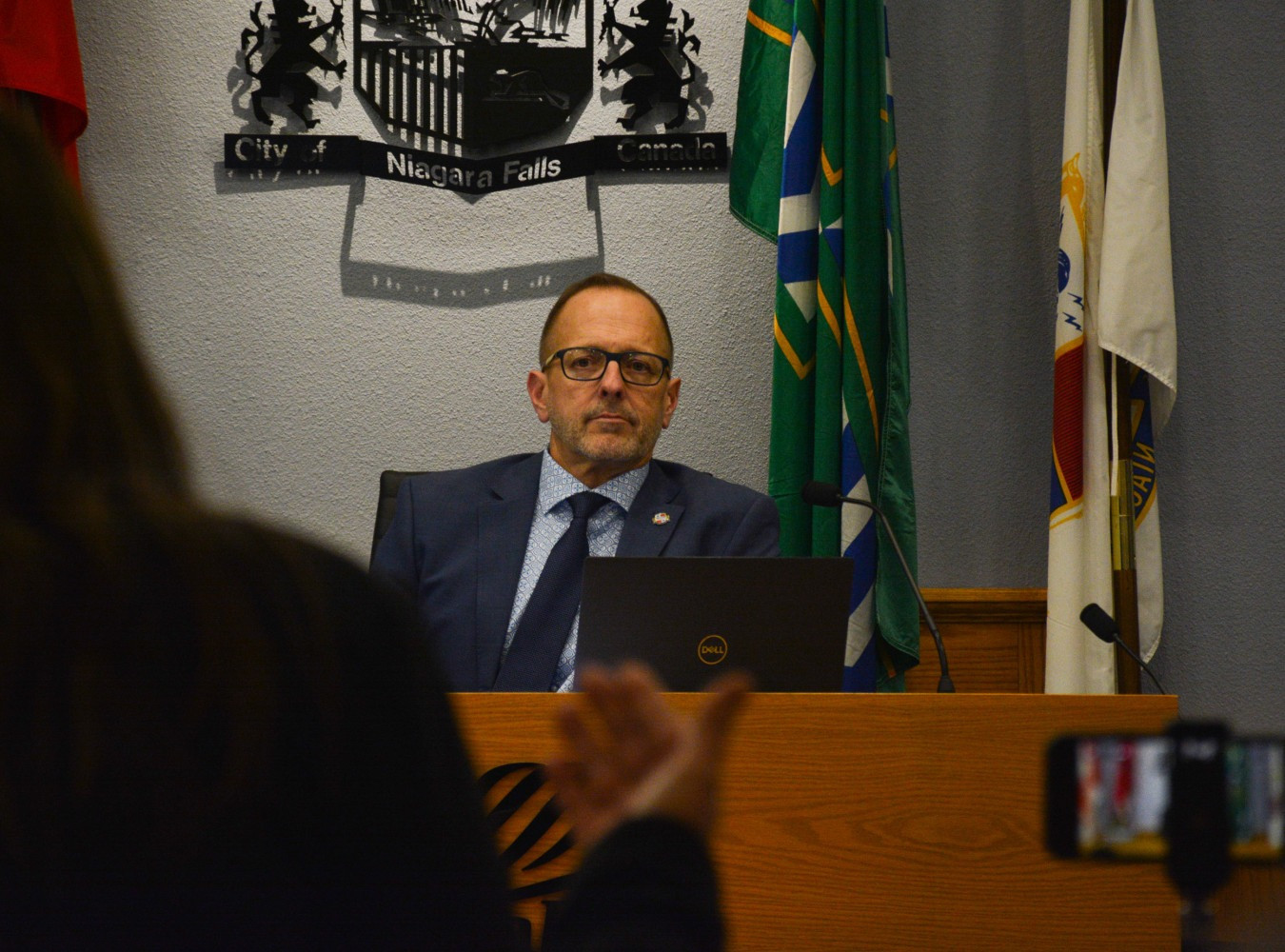
Niagara Falls Mayor Jim Diodati has claimed there are approximately 3,300 students enrolled at the University of Niagara Falls, the majority of them studying in person downtown. With the new restrictions on international study permits put in place by the federal government, it’s unclear how the university could have enrolled that number of international students.
(Joel Wittnebel/The Pointer files)
Diodati has gone to the media to defend UNF against what he has characterized as misleading information.
In the September article, he is quoted as saying it is far from the “diploma mill” many are describing it as on social media and is instead educating the young professionals needed to fill the jobs of the future in Niagara Falls.
“It’s not a diploma mill. These are not basket weaving courses. These are graduate programs, high-end programs that are creating the kind of graduates we want in Canada. They are attracting the kind of people that we want to take the jobs we need filled,” he claimed in the article.
Diodati had a close connection to UNF even before it opened in Niagara Falls.
He said it “took years of travelling” to find Global University Systems (the university owner) and convince it to open their business in Niagara Falls. He said, “UNF is not here to compete with public institutions, but to complement them and fill a niche that’s not being filled and will attract some of the brightest minds around the world.”
International students are cash cows for universities and colleges in Ontario which charge them as much as four times the tuition and fees domestic students pay.
Private post-secondary schools have long been accused of exploiting international students by both the provincial and federal government. At UNF an international student will pay $39,375 for a Master of Arts in Digital Media and Global Communications but a domestic student will only pay $17,505. Turning international students into a business model is one of the reasons the federal government has dramatically reduced caps.
Last year, Marc Miller, the former immigration minister said “the goal is in part to target private institutions that are the diploma equivalent of puppy mills.” Miller pointed directly at Ontario where he claimed private universities were giving out “fake” degrees.
University Canada West, the other university owned by GUS located in Vancouver, benefited from lax rules around the number of international students allowed into Canada. With about 14,000 enrolled, it had the second highest number of international students in Canada, behind Conestoga College, and the only one in the top 10 not in Ontario. That was before Ottawa stepped in.
Editor's note: Carolynn Ioannoni is a former City of Niagara Falls councillor.
Email: [email protected]
At a time when vital public information is needed by everyone, The Pointer has taken down our paywall on all stories to ensure every resident of Brampton, Mississauga and Niagara has access to the facts. For those who are able, we encourage you to consider a subscription. This will help us report on important public interest issues the community needs to know about now more than ever. You can register for a 30-day free trial HERE. Thereafter, The Pointer will charge $10 a month and you can cancel any time right on the website. Thank you
Submit a correction about this story

