
Lack of public consultation around illegal plan to pave parts of beloved Niagara park latest example of chaotic municipal governance
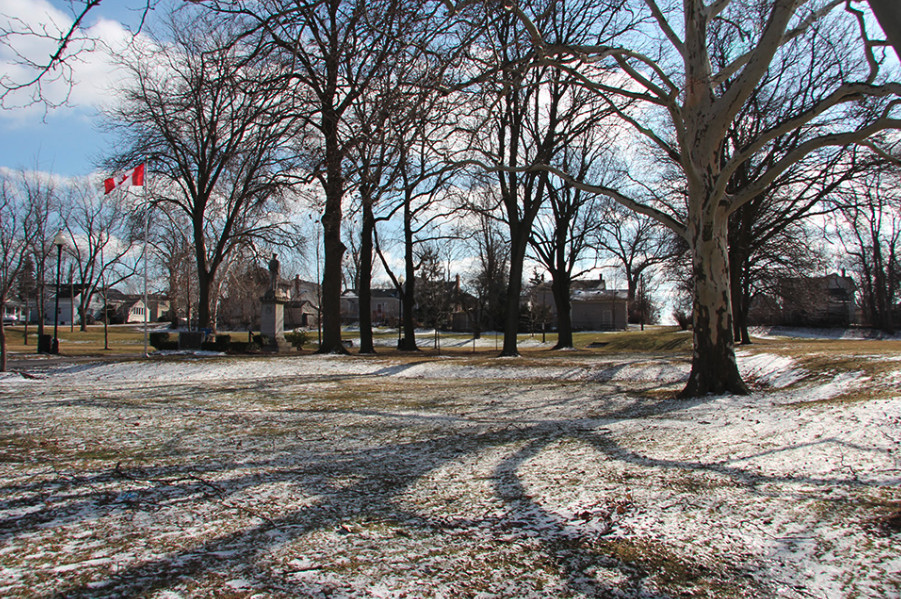
Thorold’s Memorial Park is typically a site of solemn reflection. A central piece of community parkland populated with mature trees designed to provide a space to honour those who served and made the ultimate sacrifice.
“This park is an outstanding example of Thorold’s natural heritage…a wonderful area of peace, solemnity and reflection in our City,” a page dedicated to the park on Heritage Thorold’s website details.
In recent weeks it has instead become a source of controversy. A proposal to pave portions of the park to create a parking lot outraged residents who weren’t consulted on the idea before it appeared on the November 18 council agenda. The staff report detailed how a contractor had been selected to build the lot, following council approval, for approximately $194,000. The City budgeted $250,000 for the project.
“The process was conducted in accordance with the City’s Procurement Policy. As this contract falls within the project scope and within the allocated budget, and all procurement policies have been followed, the project will move forward to the next phase,” the report explains.
That was before a strong reaction from angry residents forced council to backtrack and schedule a public consultation.
Residents were enraged further when pre-construction notices were mailed to surrounding property owners, signalling the parking lot proposal was basically a done deal, and the City’s public consultation was nothing but window dressing.
Then a curveball. The City’s Heritage Committee Chair revealed a portion of the park eyed for the parking lot is a designated heritage site—giving it the protective armour of provincial legislation under the Ontario Heritage Act. Typically proposals to change or alter designated heritage properties require extensive study, including a heritage impact assessment before the matter is even brought to council for final approval. A permit under the Act is also required. None of that was done for this proposal.
The revelation has forced the Town to rethink its plans, and has many residents questioning how things got this far.
How did City staff put forward such a plan without knowing about the heritage designation? Why was this bylaw not discovered earlier in the process?
What does this mean for the bidding and procurement process given the pre-construction survey notices residents received?
To potentially answer those questions, we must go back to the beginning. The parking lot proposal stems from one particular problem.
Thorold Centre 50+ is a seniors centre located beside the park on Carleton Street. It also has deep community roots. The building operated as a public school until its closure in 1981, after which it was repurposed as City Hall. When demand grew for a dedicated seniors facility, the City moved its administrative offices elsewhere and designated the main floor for the seniors centre. The top floors were left unused at the time.
In recent years, the upper floors have been converted into office space for City staff as municipal departments outgrew the newer City Hall building. This change significantly increased daily parking pressure at the site and saw City employees competing with users of the Thorold Centre 50+ for parking. The situation is further complicated by the age and limited mobility of many of the Centre’s users. For those relying on walkers, canes, or other assistive devices, parking two or three blocks away when the lot is full is simply not practical.
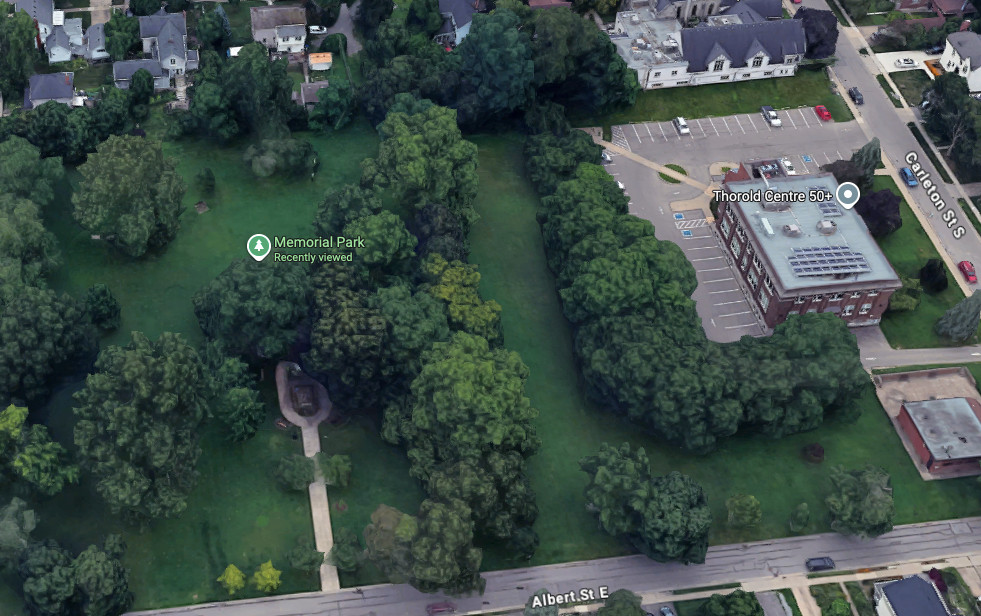

The Thorold Centre 50+ sits directly adjacent to Memorial Park (top). Original plans to expand the Centre’s parking lot have been mired in controversy for weeks. The original proposal (bottom image) would have seen a number of mature trees along Albert Street removed to create room for 40 new parking spaces.
(Google Maps/City of Thorold)
To address the issue, the City moved to expand the lot. The original proposal appeared on the November 18 council agenda and would have involved the removal of mature trees and other greenspace to facilitate the addition of 40 parking spaces.
Controversy erupted.
When the parking lot proposal first appeared it prompted a rapid community response from residents who say they were blindsided by the plan and the speed at which it appeared poised for approval.
Within hours of the City’s plan appearing on the council agenda, observant residents raised the alarm.
Longtime residents Gloria Leahey and Tami Friedman formed a grassroots advocacy group, Friends of Memorial Park, to mobilize public awareness and demand transparency. The pair immediately focused on spreading the word and ensuring residents were in attendance for the November 18 council meeting.
Thanks in large part to their efforts, the meeting saw the council chambers filled to standing room only, with many expressing shock and frustration that such a significant decision had been prepared without consultation with residents. Their presence that night, and the clear public discontent that was brewing, prompted Council to delay ratification of the plan and schedule a public information session for November 24.
With a six-day reprieve, Leahey and Friedman doubled down on their efforts to ensure this next meeting was as well attended as the council meeting.
Doubts about the effectiveness of the last minute public consultation were intensified when, on November 21, many residents who live near the park found notices in their mailboxes explaining that pre-construction property surveys were scheduled for Memorial Park. The notices encouraged homeowners to arrange inspections in case upcoming work caused damage to their properties. It left many with the impression that the project was moving ahead despite council’s call for further review and that the public consultation was being done not in good faith, but as a gesture of appeasement.
Residents who came out to the public consultation were presented with two versions of the proposed parking expansion at Memorial Park. The first was the original plan shown to Council the previous week, which would have encroached significantly into the greenspace to create 40 new parking spaces. The revised option preserved all mature trees and encroached far less on the park’s green space, though it would provide only 25 additional spaces. The latter plan appears to have been developed after the significant public pushback at the council meeting less than a week earlier.
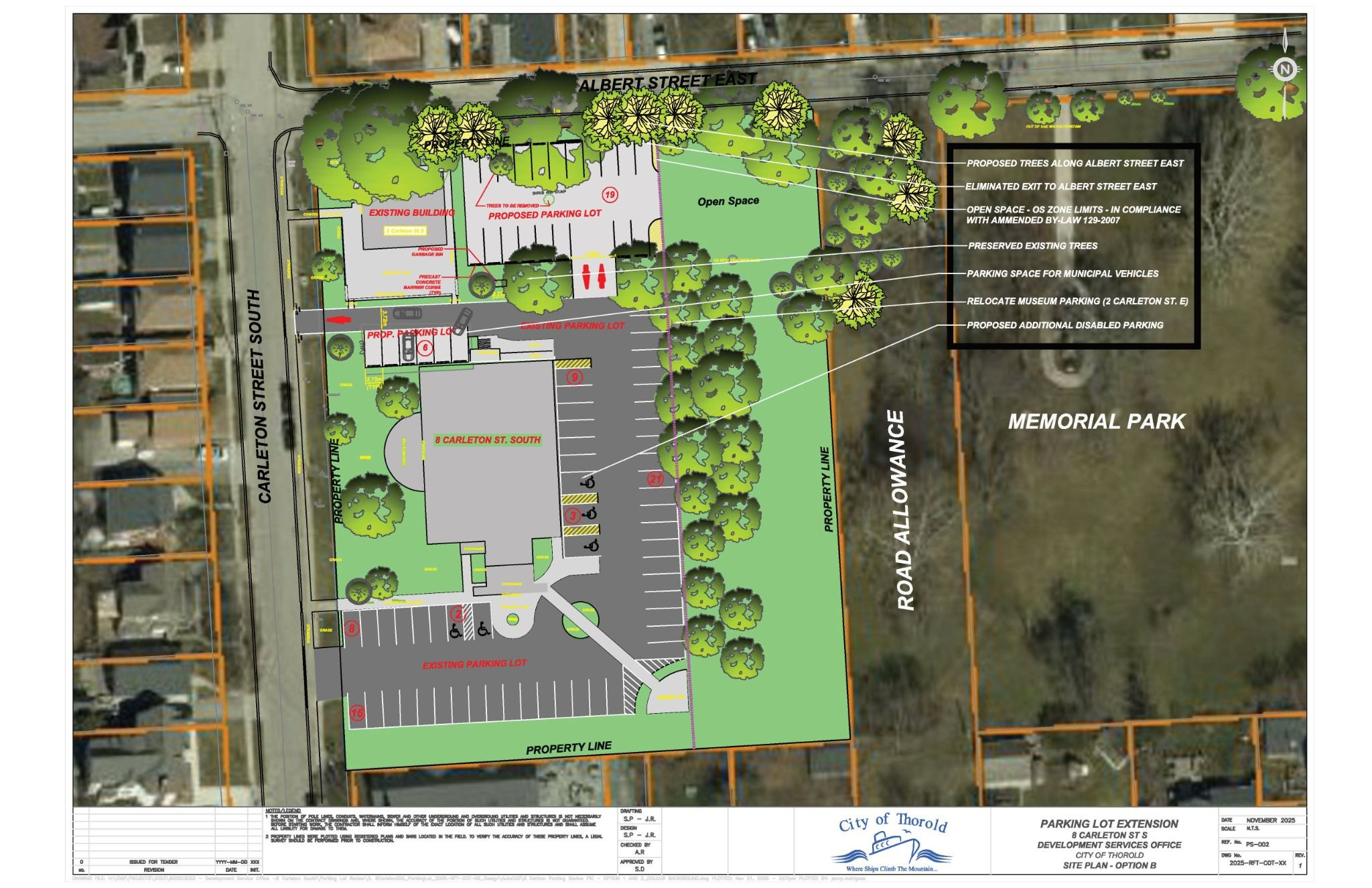
The scaled down version of the new parking lot removes a number of spaces along Albert Street that cut into parts of Memorial Park designated as a heritage site.
(City of Thorold)
For many residents, even the scaled down plan did little to address deeper concerns about transparency, the level of research and study conducted to date and the questionable process that led them to this point.
“The decision-making process related to this parking lot has been disappointing and the public meeting process has been haphazard, demonstrating that those in political power care more about advancing their own agendas than developing municipal policies with local residents in mind,” Ken Thomson said. He lives near the park and attended the public information session after becoming aware of the City’s plans. “While the City of Thorold’s City bylaws suggest that public forum committees are a setting that ‘fosters positive relationships’ between elected officials and community members, it is clear that the meetings and public forums were nothing more than theatrics.”
“Folks are underappreciating that Memorial Park is not only a peaceful respite in the middle of the city, but is a real memorial to the young men of Thorold who made the ultimate sacrifice for our country and its values over the past century,” Thomson added.
Just one day after the City’s public information session a major development surfaced.
At a meeting of the City’s Heritage Advisory Committee on November 25, the Committee Chair Anna O’Hare announced that the plans for the parking lot had been scaled back “considerably” after an amendment to the original heritage bylaw designating Memorial Park had been discovered.
O’Hare explained how City staff first provided a proposal for the parking lot to the committee last spring. The committee approved that proposal at the time, under the assumption that the proposed area planned for the parking lot was not covered under the heritage designation for the park. Then an amendment to the original bylaw, which O’Hare, and potentially City staff, was not aware of, surfaced.
“Last Thursday I was given an amendment to that bylaw which I was not aware of. The bylaw was passed in 2007. I did not move here until 2019, most of the City were probably not at City Hall at that time, none of us were aware of that bylaw amendment,” she explained. “Now we are, and that land directly east of the existing parking lot, extending in a straight line down to Albert Street, is part of Memorial Park.”
According to O’Hare, this means the 40-space option is “off the table”, and City staff have agreed.
For a community already concerned about transparency, the revelation has reinforced the sense that the project was rushed and inadequately researched.
Geoff Holman, Thorold’s Director of Public Works, explained that the design—already completed and tendered—was based on the boundaries described in the original Heritage Designation By-Law. Holman said staff were unaware that the bylaw had later been amended to extend the protected area onto a portion of the 8 Carleton Street property where the parking lot would be located.
He further explained that the City only became aware of the bylaw amendment when it was identified by the Heritage Advisory Committee Chair. Once notified, and after receiving public feedback both online and at the council meeting, staff developed the second, smaller version of the parking lot to avoid the protected lands.
According to Holman, any changes to the parking lot proposal can be accommodated with the chosen contractor.
“The contractor has been advised that the City expressly reserves all contractual rights and remedies available… including the right to adjust scope through a Change Order,” he told The Pointer in an email.
Both versions were presented at the November 24 public information session to show that the original proposal had been scaled back in light of the newly uncovered heritage constraints.
"It's a relief to know the first plan is off the table, but honestly the more we learn about this project, the murkier and more confusing it becomes,” Friedman says. “It seems as if this kind of ignorance has been driving the process since it started, and we still don't even know how or when it started… While the news is welcome that the larger proposal is off the table, I would say we are even more concerned and committed to making sure decisions are based on accurate data, appropriate evidence, and community involvement.”
Friedman remains frustrated by what she sees as a lack of due diligence behind the proposal.
“City staff hastily designed a new proposal with fewer parking spaces and less destruction of trees, but the community is still left with a whole slew of questions and concerns that haven't been addressed. Where is the environmental impact statement? Where is the heritage report? Where is the evidence to show all these extra spaces are needed in the first place? Why wasn't there any public consultation?”
Leahey and Friedman stress that their organization understands and is sympathetic to the needs of the seniors who use the facility and they “would love to hear from seniors directly so we can find ways to achieve common ground.”
They question why the parking requirements of City staff can not be accommodated elsewhere and leave all current spaces available for seniors.
City officials have consistently pointed out that all the land in question is municipally owned and subsequently it is not legally required to consult or notify residents.
The matter returns to City Council on December 9 for what could be the final decision. Representatives with The Friends of Memorial Park say they will be there and are encouraging all residents to join them. The group will host a public meeting at the Thorold Public Library on Saturday December 6, at 11 a.m. to update residents and prepare for the next council meeting.
Email: [email protected]
At a time when vital public information is needed by everyone, The Pointer has taken down our paywall on all stories to ensure every resident of Brampton, Mississauga and Niagara has access to the facts. For those who are able, we encourage you to consider a subscription. This will help us report on important public interest issues the community needs to know about now more than ever. You can register for a 30-day free trial HERE. Thereafter, The Pointer will charge $10 a month and you can cancel any time right on the website. Thank you
Submit a correction about this story

